
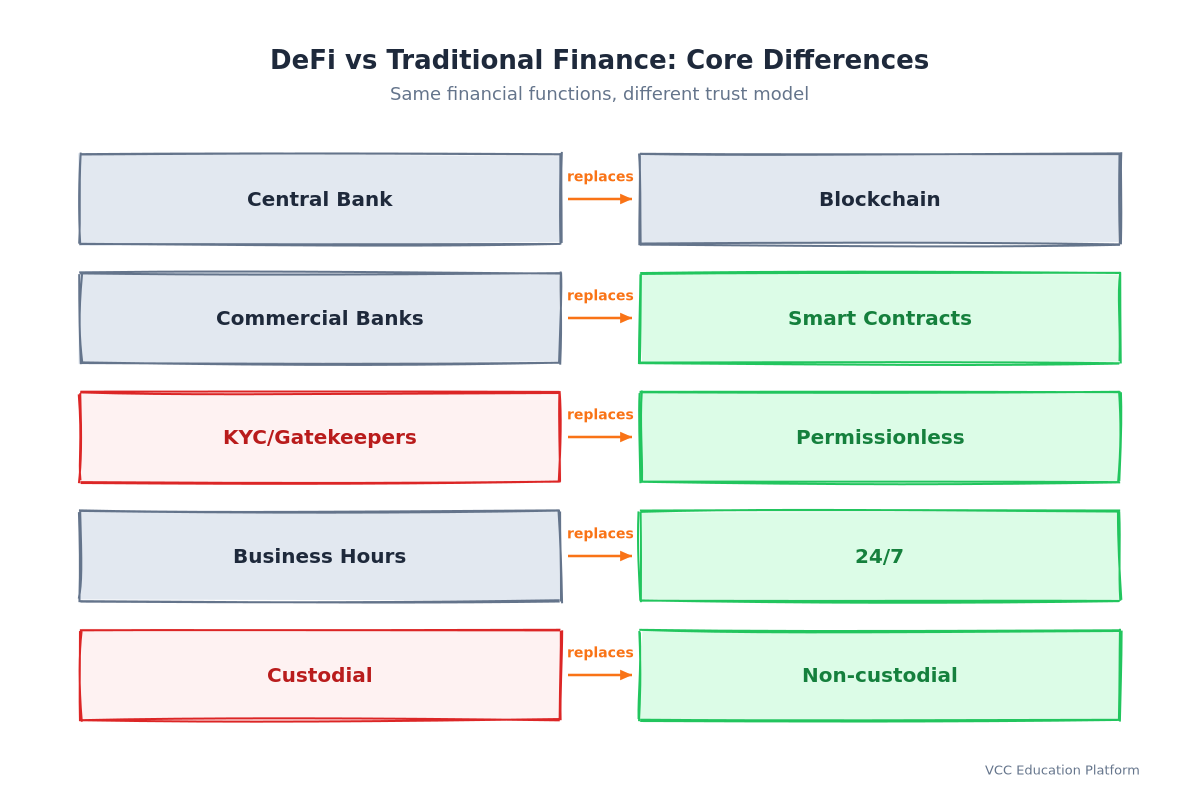
DeFi fundamentals start with a simple idea: what if financial services — lending, borrowing, trading, earning interest — worked without banks, brokers, or gatekeepers? Instead of trusting institutions, you trust code running on a blockchain. That is decentralized finance (DeFi) in one sentence.
If you are new to this space, the terminology can feel overwhelming: AMM, TVL, impermanent loss, yield farming, money legos. This guide breaks down what is DeFi using plain language, Vietnam-relevant examples, and mental models you can actually use. By the end, you will understand the core building blocks, the real risks, and a practical checklist to start safely.
What Is DeFi? A Simple Definition
DeFi (decentralized finance) is a set of financial applications built on public blockchains — primarily Ethereum, but also BSC, Polygon, Arbitrum, Solana, Base, and others. Unlike traditional finance (TradFi), DeFi has no central operator. No company approves your loan. No exchange holds your funds. No compliance team freezes your account.
Instead, smart contracts — self-executing code deployed on-chain — handle the logic. You interact directly with these contracts from your own wallet. The blockchain records every transaction publicly. Anyone can verify the code (if it's open source) and the state of the system at any time.
The DeFi Spectrum: Not All "DeFi" Is Equal
Most introductions present DeFi as binary: either it's decentralized or it's not. Reality is a spectrum of decentralization. Understanding where a protocol sits on this spectrum is more useful than a yes/no label.
| Level | Characteristics | Examples | Risk Profile |
|---|---|---|---|
| Fully on-chain, immutable | Core contracts cannot be changed; no admin keys | Uniswap v2 core, Aave v2 (Ethereum) | Smart contract risk only |
| Governance-parameterized | Contracts immutable but params (fees, risk factors) adjustable by token holders | Uniswap v3 fee tiers, Aave v3 risk params | + Governance risk |
| Upgradeable proxy + multisig | Contract logic can be upgraded by a multisig (3-10 signers) | GMX, Pendle, most 2022+ protocols | + Upgrade/key management risk |
| Centralized backend + on-chain settlement | Order matching off-chain, settlement on-chain | dYdX v3 (pre-v4), some orderbook DEXs | + Operator risk |
| CeFi with DeFi wrapper | Centralized entity offers "DeFi yields" via custodial product | Centralized lending platforms, some yield aggregators | Custodial + counterparty risk |
Key insight for beginners: When someone says "this is DeFi," ask: Which level? A protocol at Level 3 carries fundamentally different risks than Level 1.
DeFi Fundamentals: Core Building Blocks
Every DeFi application, no matter how complex, is built from a handful of primitives — basic building blocks that snap together like LEGO bricks. This composability is why DeFi moves fast: developers don't rebuild lending from scratch; they plug into Aave or Compound.
1. Automated Market Makers (AMMs) — Trading Without Order Books
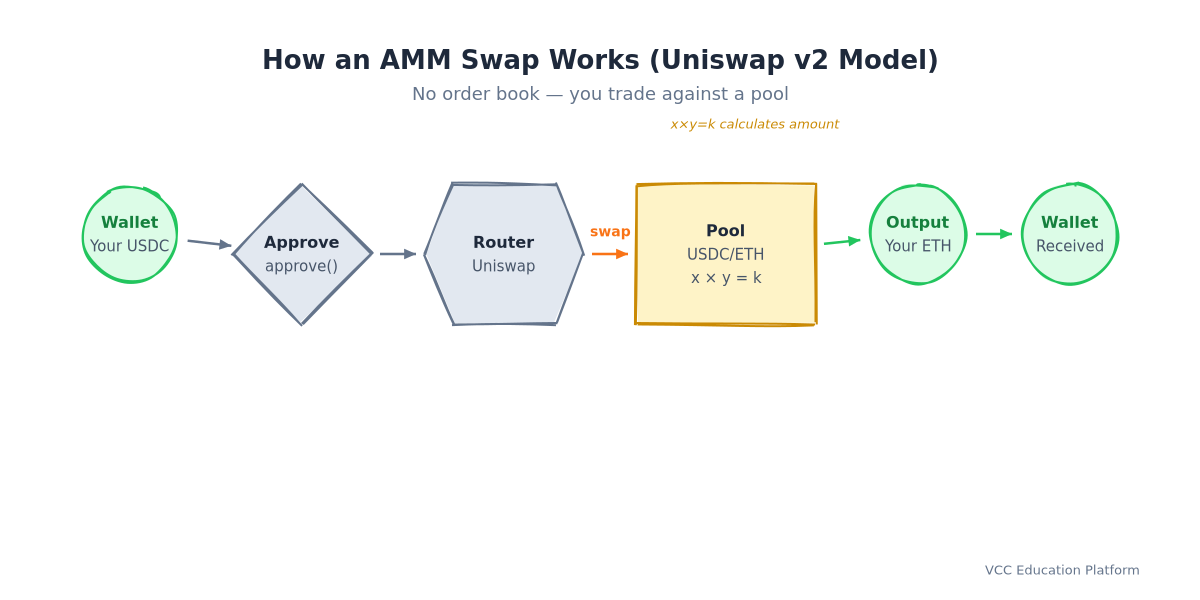
Traditional exchanges match buyers and sellers via an order book. DeFi's breakthrough: liquidity pools where anyone can deposit two tokens (e.g., ETH and USDC) and become a market maker.
The most famous formula: x × y = k (Uniswap v2).
x= reserve of Token Ay= reserve of Token Bk= constant product
When you swap ETH for USDC, you add ETH to the pool, remove USDC. The product x × y must stay constant, so the price adjusts automatically. Larger trades relative to pool size = worse price (slippage).
Vietnam context: On BSC or Polygon, a $100 USDC/USDT swap costs ~$0.01 in gas and <0.1% slippage on deep pools. On Ethereum mainnet, same swap might cost $5-20 gas. Start on L2/sidechains.
2. Lending & Borrowing — Overcollateralized by Design
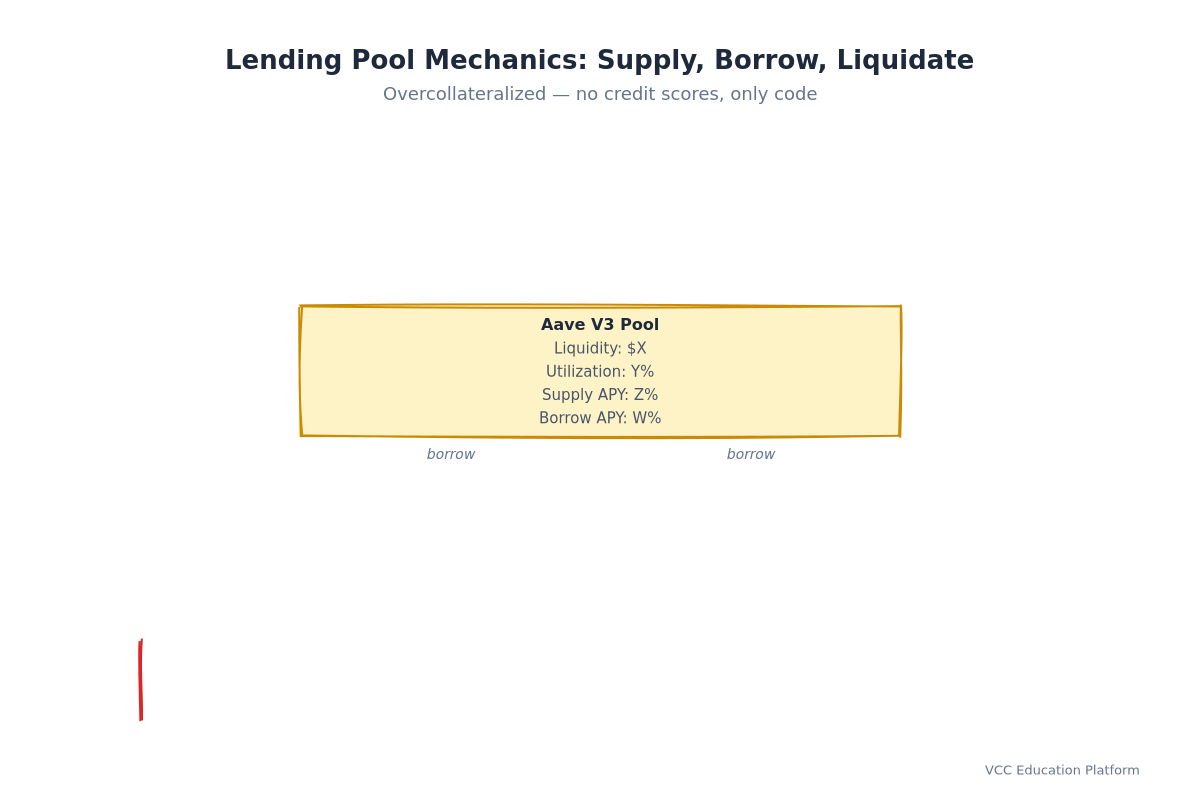
In TradFi, banks lend based on credit scores. In DeFi, there are no credit scores — only collateral. You deposit Asset A (e.g., ETH), borrow Asset B (e.g., USDC) up to a loan-to-value (LTV) ratio (typically 50-80%).
If collateral value drops near the liquidation threshold, the protocol automatically sells part of your collateral to repay the loan. No phone calls, no grace period, no negotiation. Code executes.
Interest rate models (e.g., Aave, Compound):
- Utilization rate = borrowed / total supplied
- Low utilization → low rates (encourage borrowing)
- High utilization → rates spike sharply at "kink point" (usually 80-90%) to protect liquidity
Vietnam use case: Deposit $10,000 USDT on Aave (Arbitrum), borrow $5,000 USDC at ~3-5% APY, use USDC for living expenses or farming elsewhere. Your USDT keeps earning ~5-8% supply APY. Net cost ~0-2% — far cheaper than credit cards.
3. Stablecoins — The Bridge Between Crypto and Fiat
Stablecoins are tokens pegged 1:1 to a fiat currency (usually USD). They are the unit of account for DeFi. Without them, every trade would be volatile-asset vs volatile-asset.
| Type | Mechanism | Examples | Risk |
|---|---|---|---|
| Fiat-backed | $1 in bank reserve per token | USDT (Tether), USDC (Circle) | Counterparty (issuer), regulatory |
| Crypto-backed (overcollateralized) | Lock $150 ETH → mint $100 DAI | DAI (Maker/Sky), LUSD (Liquity) | Smart contract, oracle, liquidation cascade |
| Algorithmic | Supply adjusts via mint/burn incentives | UST (failed), FRAX (partially algo) | Death spiral risk — mostly deprecated |
For Vietnamese users: USDT and USDC dominate. USDC is more transparent (monthly attestations); USDT has higher volume. Both trade at ~23,500-24,000 VND on local P2P markets. Stablecoin yield (5-15% APY) is the most practical DeFi entry point for VN savers — beats bank savings (0.5-1%) and preserves USD purchasing power vs VND depreciation (~3-5%/year).
4. Yield Strategies — Where Returns Come From
"Yield farming" sounds magical. It's not. Every yield source in DeFi falls into one of these categories:
| Yield Source | Who Pays | Sustainable? | Example |
|---|---|---|---|
| Trading fees | Traders paying swap fees | Yes, as long as volume exists | Uniswap LP fees (0.3%) |
| Borrow interest | Borrowers paying interest | Yes, market-driven | Aave supply APY |
| Protocol incentives | Protocol emitting governance tokens | Temporary (emissions end) | COMP, ARB, OP rewards |
| Leveraged basis | Funding rate arbitrage | Market-dependent | Pendle PT/YT, Ethena sUSDe |
| Inflationary token emissions | New token supply | No — dilutes holders | Many "farm" tokens |
Rule of thumb: If you cannot explain who pays the yield, you are the yield. High APY (>50%) on a new token usually = you are exit liquidity for early insiders.
The Composability Budget: A Mental Model for Beginners
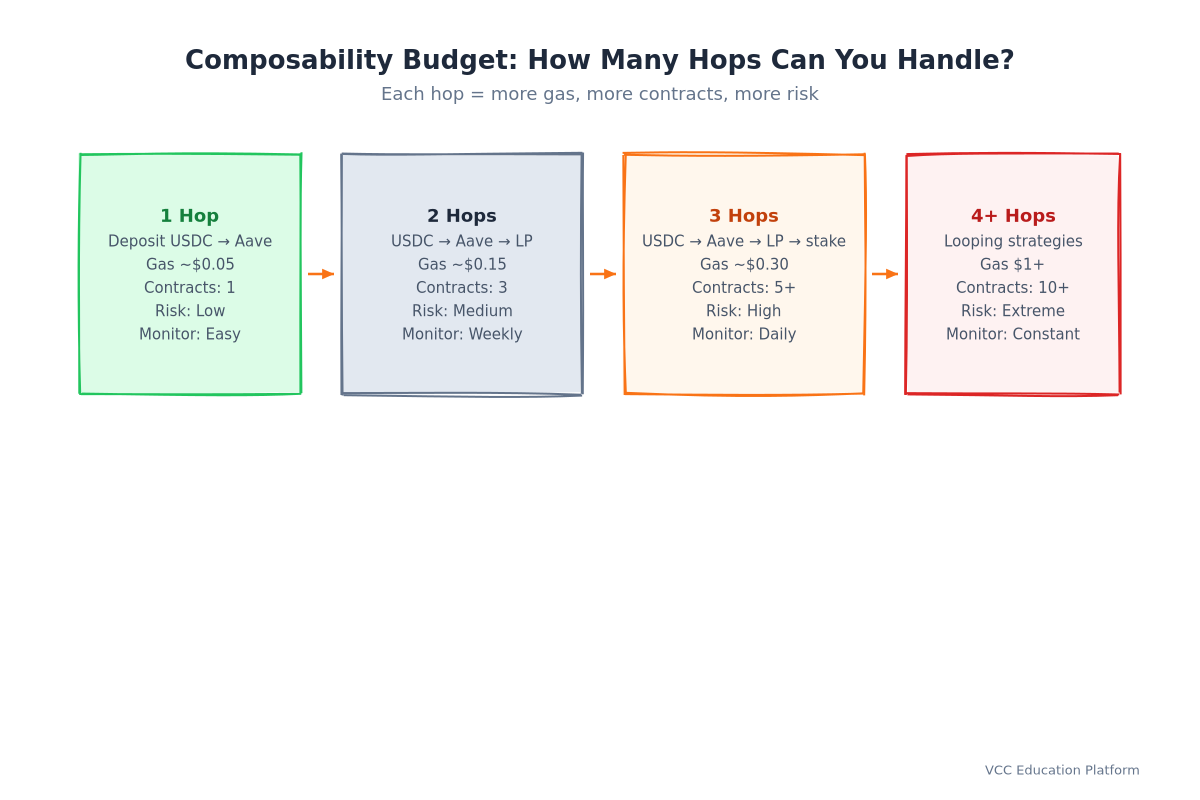
DeFi's superpower is composability — protocols plug into each other like money legos. Aave deposits become collateral on Maker; Uniswap LP tokens get staked on a yield aggregator; Pendle tokenizes future yield.
But each "hop" adds:
- Gas cost (even on L2, multi-step txns cost more)
- Smart contract risk (each new contract = new attack surface)
- MEV exposure (sandwich attacks on multi-hop swaps)
- UX friction (more approvals, more things to monitor)
Composability Budget for Beginners: Maximum 2-3 hops.
- Hop 1: Deposit USDC → Aave (supply)
- Hop 2: Borrow USDT → deposit into Uniswap USDC/USDT pool
- Stop. That's 2 hops. Trackable, auditable, manageable.
Going beyond 3 hops (e.g., leveraged looping strategies) is for advanced users who model liquidation paths in spreadsheets.
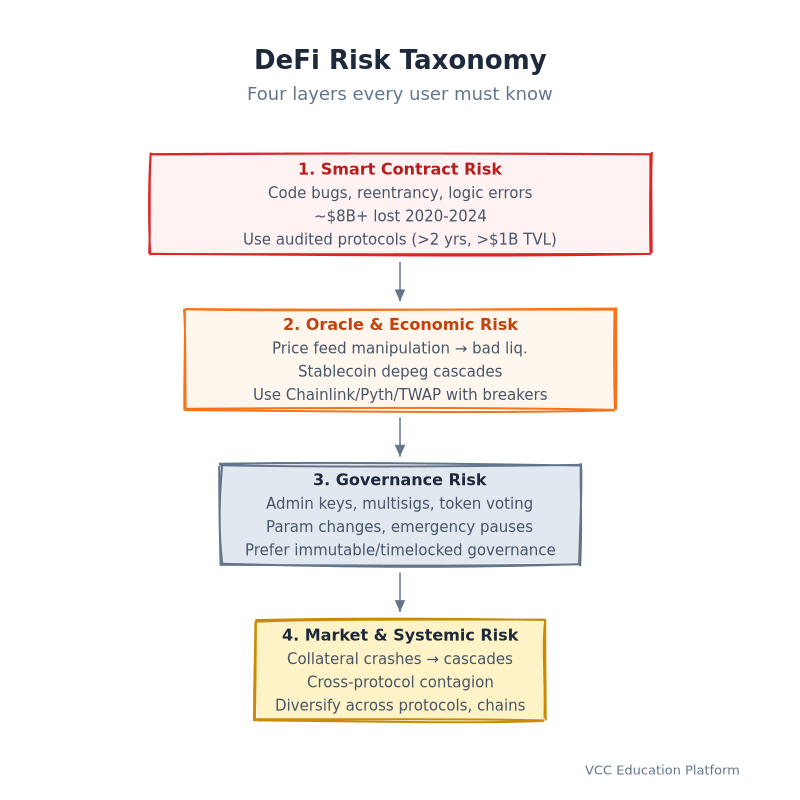
Risk Taxonomy: The Four Layers Every User Must Know
DeFi risk is not one thing. Map it to four layers:
Layer 1: Smart Contract Risk (Code Bugs & Exploits)
- Reentrancy, logic errors, oracle manipulation
- ~$8B+ lost 2020-2024 (DeFi Llama exploit database)
- Mitigation: Use battle-tested protocols (>2 years, >$1B TVL, multiple audits); avoid unaudited "food farms"
Layer 2: Oracle & Economic Risk (Bad Data → Bad Outcomes)
- Price feeds determine liquidations, minting, settlements
- Manipulated oracle = wrong price = unfair liquidations or bad minting
- Mitigation: Protocols using Chainlink, Pyth, or TWAP oracles with circuit breakers
Layer 3: Governance & Centralization Risk (Human Decisions)
- Admin keys, multisigs, token voting can change protocol rules
- "Emergency pause" can freeze funds; parameter changes can dilute you
- Mitigation: Check admin key structure; prefer immutable or timelocked governance
Layer 4: Market & Systemic Risk (Crypto Volatility & Contagion)
- Collateral drops → cascading liquidations → protocol insolvency
- Stablecoin depeg → entire lending market affected
- Mitigation: Diversify across protocols, chains, asset types; keep emergency reserve
Vietnam-specific risk: Regulatory uncertainty. SBV says crypto is not legal tender, not a payment method. DeFi usage is not explicitly banned but operates in a grey zone. No legal recourse if a protocol fails. Only use funds you can afford to lose.
Practical Checklist: Your First DeFi Steps (Vietnam-Friendly)
Step 0: Prerequisites
- [ ] Understand: Private key = ownership. Lose it = lose funds forever.
- [ ] Use a hardware wallet (Ledger, Trezor) for >$1,000. Software wallet (Rabby, MetaMask, Coin98) for smaller amounts.
- [ ] Bookmark official sites:
app.aave.com,app.uniswap.org,defillama.com. Never click Google ads. - [ ] Learn to read block explorers: Etherscan, BscScan, Polygonscan, Arbiscan.
Step 1: Get Stablecoins On-Chain (Lowest Friction Entry)
- [ ] Buy USDT/USDC on a VN-friendly CEX (Binance, Bybit, OKX, MEXC, BingX)
- [ ] Withdraw to your wallet on Arbitrum, Base, Polygon, or BSC (NOT Ethereum mainnet — gas too high)
- [ ] Verify: Received tokens match contract address (check on CoinGecko)
Step 2: Supply to a Lending Market (Passive Yield)
- [ ] Go to
app.aave.com→ select Arbitrum/Base/Polygon network - [ ] Connect wallet → Approve USDC → Supply
- [ ] Track: Supply APY, utilization rate, health factor (keep >1.5)
- [ ] Expected: 4-10% APY on USDC/USDT, mostly from borrow interest + minor incentives
Step 3: Provide Liquidity to a Stablecoin Pool (Low IL)
- [ ] Go to
app.uniswap.org→ Pools → New Position - [ ] Select USDC/USDT (or USDC/DAI) on Arbitrum/Base
- [ ] Price range: Full range (0 to ∞) for simplicity
- [ ] Expected: 5-20% APY from 0.01-0.05% fee tier + volume-dependent
- [ ] Impermanent loss near zero for stablecoin-stablecoin pairs
Step 4: Monitor & Manage
- [ ] Check positions weekly: health factor, pool composition, fee accrual
- [ ] Rebalance if utilization spikes >90% (liquidity crunch risk)
- [ ] Harvest incentives monthly (claim reward tokens, swap to stablecoins)
- [ ] Tax note: VN has no clear crypto tax guidance yet. Keep records of every txn.
FAQ: DeFi Introduction — Common Questions
Q: Is DeFi legal in Vietnam?
A: The State Bank of Vietnam (SBV) has stated cryptocurrency is not legal tender and not a permitted payment method (Circular 01/2021, Decree 06/2023). However, holding and trading crypto peer-to-peer is not explicitly criminalized for individuals. DeFi usage falls in a regulatory grey zone. No consumer protections exist. Proceed with caution and only risk capital you can lose.
Q: How much money do I need to start?
A: On Arbitrum/Base/Polygon/BSC: $50-100 is enough for meaningful positions (gas < $0.10). On Ethereum mainnet: $500+ due to gas costs ($5-50 per transaction). Start on L2/sidechains.
Q: Can I lose all my money?
A: Yes. Smart contract exploits, oracle failures, governance attacks, stablecoin depegs, and user error (phishing, wrong address, infinite approve) can all result in total loss. Never invest rent money, emergency savings, or borrowed funds.
Q: What's the difference between APY and APR?
A: APR = simple annual rate (no compounding). APY = annual rate with compounding. In DeFi, rewards often compound automatically (e.g., Aave supply APY includes compounding). A 10% APR compounded daily = ~10.5% APY. Always compare apples to apples.
Q: Do I need to know coding?
A: No. Modern frontends (Aave, Uniswap, Pendle, GMX) are as easy as banking apps. The hard part is risk assessment, not button-clicking. Learn to read: TVL trends, audit reports, governance forums, utilization charts.
Q: Which chain should I use?
A: For Vietnam users in 2024:
- Arbitrum / Base: Best balance of TVL, security (Ethereum L2), low gas, major protocol coverage
- Polygon: Huge DeFi ecosystem, very low gas, but separate consensus (not Ethereum L2)
- BSC: Lowest gas, highest VN user familiarity, but more centralized validator set
- Solana: Different ecosystem, very low fees, but separate wallet (Phantom/Backpack)
Start with Arbitrum or Base — closest to Ethereum security, lowest friction.
Q: How do I avoid scams?
A:
- Never share your seed phrase — no legitimate protocol asks for it
- Verify URLs — bookmark official sites; check for typos (uniswap.org vs uniswop.org)
- Revoke approvals — use
revoke.cashmonthly to remove unused token allowances - Ignore DMs — no "support" will message you first on Telegram/Discord
- Test with small amounts — $10 test before $1,000 deposit
Summary: DeFi Fundamentals in 5 Sentences
- DeFi = financial primitives (swap, lend, borrow, earn) as open, permissionless code on blockchains.
- Core building blocks: AMMs for trading, lending pools for borrow/earn, stablecoins as unit of account.
- Composability lets protocols stack — but each hop adds risk (your "composability budget" = 2-3 hops max for beginners).
- Risk lives in four layers: smart contract, oracle/economic, governance/centralization, market/systemic.
- Best VN entry path: Stablecoins on Arbitrum/Base → Aave supply → Uniswap stable pool → monitor weekly.
Next Steps
- Read: "DeFi Risk Management" (deep dive into the four risk layers with case studies)
- Read: "Yield Farming Strategies" (sustainable vs predatory yield sources)
- Read: "DEX Platforms Overview" (Uniswap v3 concentrated liquidity, Curve stableswap, Balancer weighted pools)
- Tool: DeFi Llama (TVL, yields, protocol health) — your daily dashboard
- Tool: Revocation tools (revoke.cash, approved.zone) — monthly hygiene
Disclaimer: This article is educational, not financial advice. DeFi carries risk of total loss. Verify all information independently. The author holds positions in various DeFi protocols mentioned. No affiliate links or referral codes included.