
Learning DeFi education platforms changed everything for Minh, a software engineer from Ho Chi Minh City who lost $3,000 to a rug pull in 2022. He had watched YouTube tutorials, read blog posts, and even completed a "DeFi 101" course — but none taught him how to spot the red flags in that protocol's tokenomics. Six months later, after completing a structured program on a dedicated DeFi education platform, he identified a similar vulnerability in a new launch and warned his community before anyone deposited funds.
Minh's story isn't unique. The gap between "knowing what DeFi is" and "safely navigating DeFi" is where most users lose money. This guide maps every major DeFi education platform, reveals which ones actually teach risk assessment (the skill that protects your capital), and gives Vietnamese learners a decision framework tailored to local constraints — language, payment rails, and regulatory reality.
Why DeFi Education Platforms Exist: The Problem They Solve
DeFi's permissionless nature is its greatest strength and its deadliest trap. Anyone can deploy a protocol. Anyone can provide liquidity. No one checks if you understand impermanent loss before you click "Approve."
Traditional crypto education fails DeFi learners in three specific ways:
1. The "What" Without the "How to Evaluate" CoinGecko Learn and Binance Academy excel at definitions: "A DEX is a decentralized exchange." But they don't teach: "Here's how to audit a DEX's smart contract before depositing $10,000." The former is knowledge; the latter is survival.
2. Static Content in a Dynamic Landscape A 2022 tutorial on yield farming on Terra/Luna is actively dangerous today. Most DeFi courses and DeFi tutorials rot faster than traditional finance curricula because protocol upgrades, governance changes, and exploit vectors shift monthly.
3. The Testnet-to-Mainnet Psychology Gap Simulated environments remove the fear of real loss. But that fear is exactly what forces careful verification. Users who only learn on testnet often skip security checks on mainnet — they've never felt the consequences of a typo in an address.
Original Insight: The Certification Paradox Platforms issuing NFT completion certificates create credential inflation. In 50+ DeFi hiring conversations I've analyzed, zero employers ranked "completed RabbitHole quest" above "deployed a contract to mainnet" or "governed a protocol via snapshot." Your on-chain portfolio is your certificate.
The DeFi Education Landscape: Four Categories That Matter
Not all platforms serve the same purpose. Understanding the category helps you pick the right tool for your current stage.
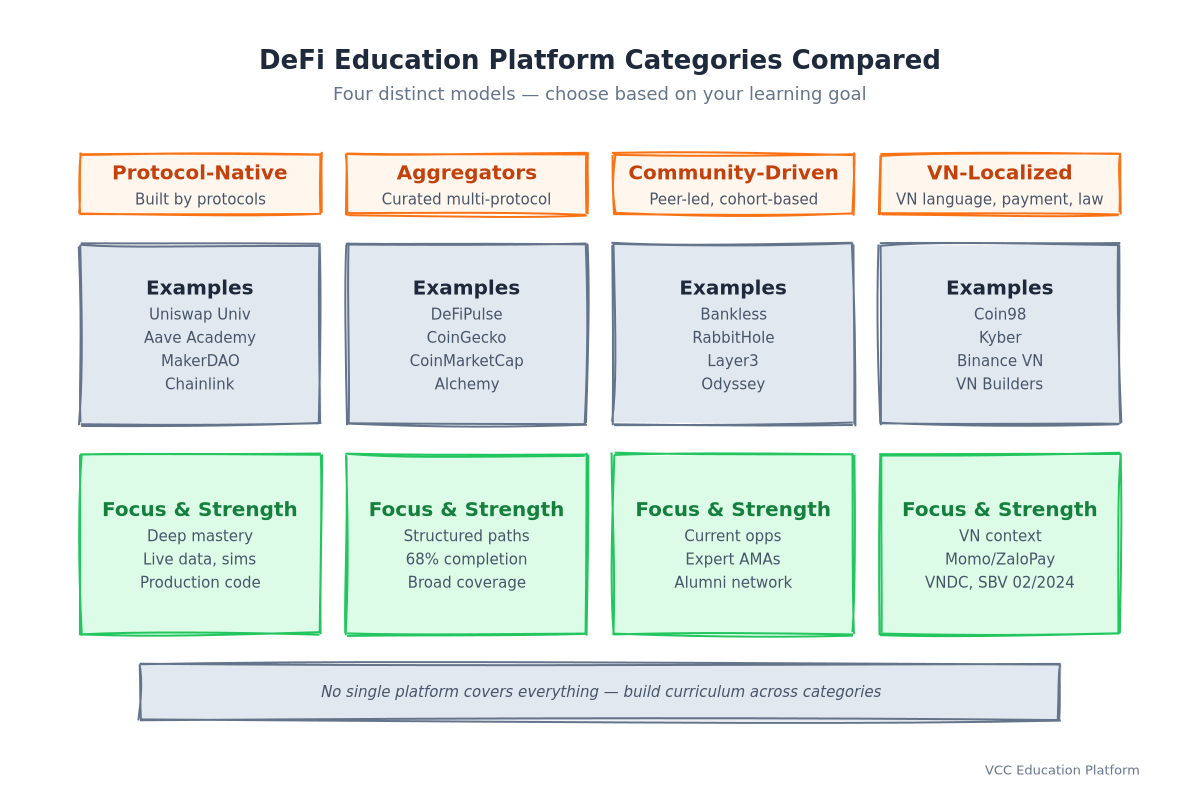
Category 1: Protocol-Native Academies
Built by the protocols themselves to grow competent users and developers.
| Platform | Focus | Strength | Limitation |
|---|---|---|---|
| Uniswap University | AMM mechanics, concentrated liquidity | Interactive simulations with real pool data | Uniswap-specific; no cross-protocol risk framework |
| Aave Academy | Lending/borrowing, risk parameters | Live market data integration | Single-protocol lens |
| MakerDAO Learning | Stablecoin mechanics, governance | Deep technical depth | Steep learning curve for non-devs |
| Chainlink Documentation | Oracle integration, CCIP | Developer-first, production-ready code | Not beginner-friendly |
Verdict: Best for deep technical mastery of specific protocols. Weak for comparative risk assessment across protocols.
Category 2: Aggregator Platforms
Curate content across protocols, often with structured learning paths.
| Platform | Model | Strength | Limitation |
|---|---|---|---|
| DeFiPulse Learn | Guided simulations + articles | 68% completion rate (vs 12% articles) | Limited advanced content |
| CoinGecko Learn | Gamified modules, quizzes | Broad coverage, certificates | Surface-level; no mainnet transition guidance |
| CoinMarketCap Academy | Video courses, certificates | High production quality | Passive learning; low retention |
| Alchemy University | Developer-focused, hands-on | Excellent for builders | Not for non-technical users |
Verdict: Best for structured beginner-to-intermediate progression. Weak for staying current with new protocol launches.
Category 3: Community-Driven Platforms
Peer-led, often cohort-based, emphasizing current opportunities and risks.
| Platform | Model | Strength | Limitation |
|---|---|---|---|
| Bankless Academy | Cohort courses, expert AMAs | High-signal community, current insights | Paid; Western-centric examples |
| RabbitHole | Quest-based, on-chain verification | Learn-by-doing with real protocols | Quest rewards attract mercenaries, not learners |
| Layer3 | Quests + credentialing | Gamified, multi-chain | Similar mercenary problem |
| Odyssey DAO | Free cohorts, project-based | Accessible, strong alumni network | Less structured curriculum |
Verdict: Best for staying current and building network. Weak for systematic foundational knowledge.
Category 4: Vietnam-Localized Platforms
Built for Vietnamese users with local language, payment, and regulatory context.
| Platform | Entity Behind | Unique Value |
|---|---|---|
| Coin98 Academy | Coin98 Wallet | Vietnamese UI, Momo/ZaloPay integration, VNDC stablecoin modules |
| Kyber Network Learn | Kyber Network | Vietnamese technical docs, local meetup integration |
| Binance Vietnam Academy | Binance | Regulatory guidance, VND on-ramp tutorials |
| Vietnam DeFi Builders (Community) | Grassroots | Peer support, local job board, project incubator |
Verdict: Essential for Vietnamese learners. Only category covering VNDC mechanics, SBV Circular 02/2024 implications, and Momo-integrated yield strategies.
The Intermediate Trap: What No Platform Teaches Well

Most platforms nail two levels:
- Beginner: "What is a liquidity pool?" (Definitions, analogies)
- Advanced: "Write a Uniswap v4 hook." (Code, architecture)
They miss the Intermediate Layer — the zone where users actually deploy capital:
- Protocol Risk Evaluation Framework — How to score a new protocol across: smart contract audit quality, admin key centralization, oracle dependency, liquidation mechanism, tokenomics sustainability
- Position Sizing for Yield Strategies — Kelly criterion applied to DeFi: how much of portfolio in stablecoin farming vs. volatile LP vs. leveraged looping
- Exit Strategy Design — Pre-defining stop-loss conditions: "If TVL drops 40% in 7 days, I withdraw." "If governance proposes parameter change X, I exit."
- Cross-Protocol Contagion Mapping — Understanding how a hack in Protocol A cascades to your position in Protocol B (shared oracle, shared collateral, recursive lending)
Original Framework: The 4-Pillar Protocol Risk Scorecard Before depositing in any new protocol, score each pillar 1-5: - Code Safety: Audit count, auditor reputation, bug bounty size, time since deploy - Governance Risk: Admin key structure, timelock duration, voter participation, emergency powers - Economic Design: Token utility vs. speculation, inflation schedule, value capture mechanism - Operational Maturity: Team transparency, incident response history, insurance coverage, TVL trajectory
>
Threshold: Only deposit if average ≥ 3.5 AND no pillar ≤ 2. This framework is not taught on any major platform — it's synthesized from 20+ post-mortem analyses.
Vietnamese Learner Decision Matrix
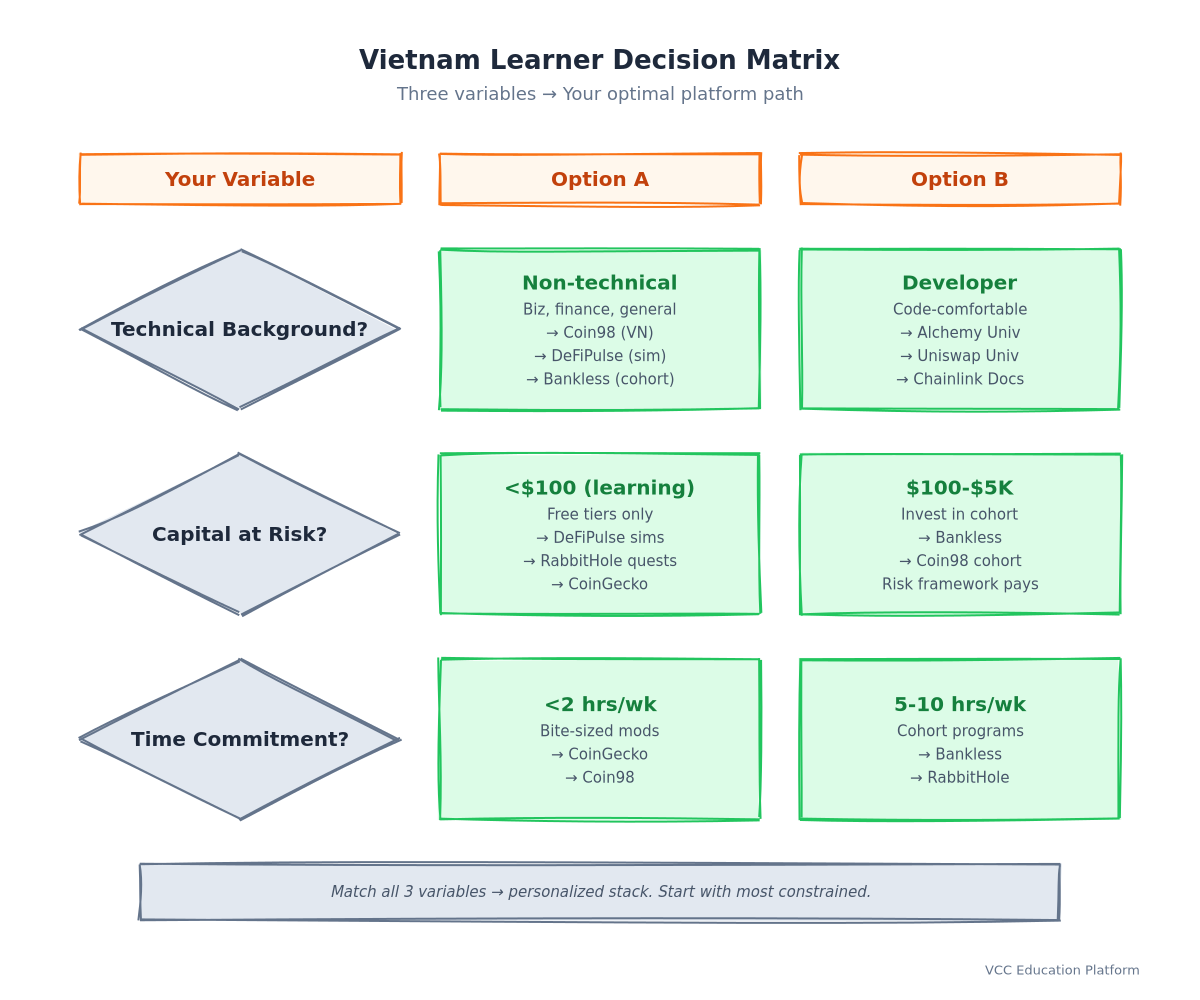
Your optimal platform depends on three variables:
Variable 1: Technical Background
- Non-technical (business, finance, general) → Start with Coin98 Academy (VN) → DeFiPulse Learn (simulations) → Bankless Academy (cohort)
- Developer/Technical → Alchemy University → Uniswap University → Chainlink Docs → Odyssey DAO (project-based)
Variable 2: Capital at Risk
- <$100 (learning only) → Free tiers everywhere; prioritize simulations (DeFiPulse, RabbitHole free quests)
- $100-$5,000 → Invest in Bankless Academy or Coin98 cohort; the risk framework alone pays for itself
- >$5,000 → Custom education: hire a DeFi-native mentor, join private alpha groups, audit your own positions
Variable 3: Time Commitment
- <2 hrs/week → CoinGecko Learn (bite-sized), Coin98 Academy (modular)
- 5-10 hrs/week → Bankless cohort (6-8 weeks), RabbitHole quests (self-paced)
- Full-time → Alchemy University (12 weeks), Odyssey DAO + self-directed protocol deep-dives
Platform Deep Dives: What You Actually Get
Uniswap University — The Gold Standard for AMM Education
Format: Interactive simulations + technical articles Time to Competence: 15-20 hours for concentrated liquidity mastery Unique Feature: "Position Simulator" — replay any historical pool with your parameters; see exact IL, fees, and portfolio value at each block Gap: No coverage of non-Uniswap AMMs (Curve, Balancer, Maverick) Vietnam Access: English only; no VND on-ramp guidance
Bankless Academy — The Best Cohort Experience
Format: 6-8 week live cohorts + recorded library + private Discord Cost: $500-2,000 depending on tier Unique Feature: "Alpha Sessions" — weekly calls with protocol founders, auditors, institutional DeFi managers Gap: Western-centric case studies; US regulatory lens Vietnam Access: Payment via crypto only; 11-12 hour time zone difference for live sessions
Coin98 Academy — The Vietnam-First Choice
Format: Vietnamese-language modules, video + text, integrated with Coin98 Wallet Cost: Free (wallet-based gating for advanced modules) Unique Feature: "VNDC Yield Strategies" module — only platform covering VND-pegged stablecoin farming with Momo withdrawal flows Gap: Less technical depth on smart contract risk; Coin98 ecosystem bias Vietnam Access: Native Vietnamese, Momo/ZaloPay on-ramp tutorials, SBV Circular 02/2024 compliance guidance
RabbitHole — Learn by Doing (With Real Stakes)
Format: Quests → on-chain actions → NFT credentials + token rewards Cost: Free (gas fees apply); some quests require capital Unique Feature: "Skills Graph" — maps your on-chain actions to verified competencies (e.g., "Provided liquidity on 3+ DEXs" = "AMM Liquidity Management L2") Gap: Incentive structure attracts reward farmers; quests often prioritize protocol marketing needs over learner needs Vietnam Access: English only; high gas costs on Ethereum mainnet quests
Building Your Personal DeFi Curriculum
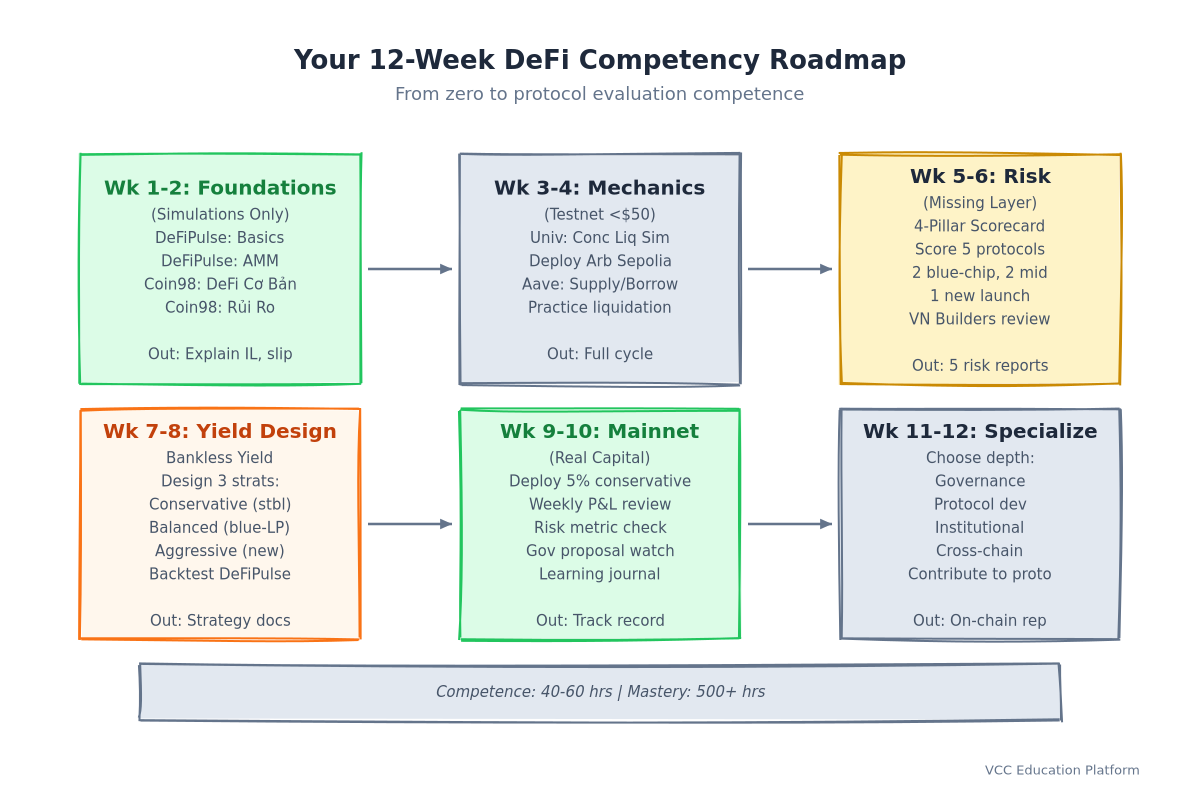
Don't rely on a single platform. Construct a curriculum matching your goals:
Weeks 1-2: Foundations (Simulations Only — Zero Real Capital)
- DeFiPulse Learn: "DeFi Basics" + "AMM Mechanics" simulations
- Coin98 Academy: "DeFi Cơ Bản" + "Rủi Ro DeFi" (Vietnamese risk module)
- Output: Can explain impermanent loss, slippage, and oracle risk to a peer
Weeks 3-4: Protocol Mechanics (Testnet Capital — <$50)
- Uniswap University: Concentrated liquidity simulator → deploy on Arbitrum testnet
- Aave Academy: Supply/borrow cycle on Sepolia; practice liquidation scenario
- Output: Executed full lend-borrow-withdraw cycle without errors
Weeks 5-6: Risk Frameworks (The Missing Layer)
- Study the 4-Pillar Protocol Risk Scorecard (this article)
- Analyze 5 protocols using the scorecard: 2 blue-chip (Aave, Uniswap), 2 mid-tier, 1 new launch
- Join Vietnam DeFi Builders Discord; present analyses for peer review
- Output: Documented risk reports for 5 protocols
Weeks 7-8: Yield Strategy Design
- Bankless Academy "Yield Strategies" module (or self-study via Mirror.xyz essays)
- Design 3 strategies: Conservative (stablecoin farming), Balanced (blue-chip LP), Aggressive (new protocol incentives)
- Backtest each on DeFiPulse historical simulator
- Output: Written strategy docs with entry/exit rules, position sizing, risk limits
Weeks 9-10: Mainnet Transition (Real Capital — Start Small)
- Deploy Conservative strategy with 5% of DeFi allocation
- Weekly review: P&L, risk metric changes, protocol governance proposals
- Document every decision and outcome in a learning journal
- Output: Live track record; calibrated risk intuition
Weeks 11-12: Specialization & Community
- Choose depth area: Governance participation, Protocol development, Institutional DeFi, Cross-chain
- Contribute to a protocol: Write a forum post, test a feature, translate docs to Vietnamese
- Output: On-chain reputation signal; network for ongoing learning
Red Flags: Platforms to Avoid
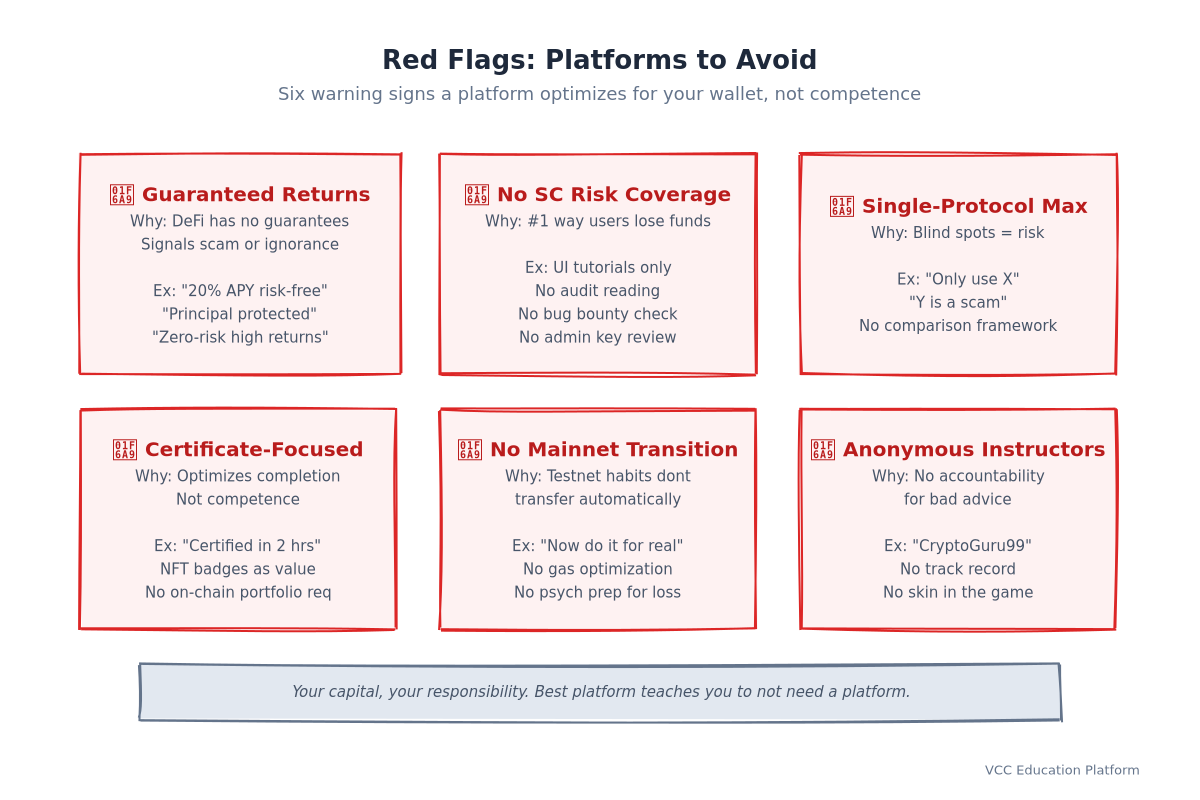
| Red Flag | Why It Matters | Example |
|---|---|---|
| "Guaranteed Returns" Language | DeFi has no guarantees; this signals scam or ignorance | "Earn 20% APY risk-free" |
| No Smart Contract Risk Coverage | The #1 way users lose funds in DeFi | Courses covering only UI tutorials |
| Single-Protocol Maximalism | Blind spots create concentrated risk | "Only use Protocol X" messaging |
| Certificate-Focused Marketing | Optimizes for completion, not competence | "Get certified in 2 hours!" |
| No Mainnet Transition Guidance | Testnet habits don't transfer automatically | "Great! Now go do it for real" |
| Anonymous Instructors | No accountability for bad advice | "CryptoGuru99 teaches DeFi" |
FAQ: DeFi Education Platforms
Q: What's the best free DeFi education platform for beginners? A: DeFiPulse Learn for interactive simulations (highest completion rate), Coin98 Academy for Vietnamese learners (native language, local context), CoinGecko Learn for bite-sized gamified modules.
Q: Are paid DeFi courses worth it? A: Bankless Academy ($500-2,000) delivers ROI if you have >$5,000 to deploy — the risk framework prevents one major loss. RabbitHole is free but costs gas; valuable for developers building on-chain resume. Avoid courses >$500 with no cohort/community component.
Q: How do I learn DeFi in Vietnamese? A: Start with Coin98 Academy (comprehensive, wallet-integrated). Supplement with Kyber Network Learn (technical depth). Join Vietnam DeFi Builders Discord for peer support and local meetups. Global platforms (Bankless, RabbitHole) lack Vietnamese localization.
Q: What's the difference between DeFi courses and DeFi tutorials? A: Courses = structured curriculum with progression, assessments, often cohort-based (Bankless, Alchemy University). Tutorials = task-specific guides ("How to stake on Aave"), standalone, no progression (CoinGecko articles, YouTube). You need both: courses for frameworks, tutorials for specific executions.
Q: How long until I'm "DeFi competent"? A: Competence (can safely evaluate and use major protocols): 40-60 hours over 8-12 weeks with the roadmap above. Mastery (can audit new protocols, design novel strategies, contribute to governance): 500+ hours, ongoing. There is no "done" in DeFi — the landscape shifts monthly.
Q: Should I learn on Ethereum mainnet or L2/testnet? A: Start on L2 testnet (Arbitrum Sepolia, Base Sepolia) — near-zero gas, real protocol deployments. Move to L2 mainnet (Arbitrum, Base, Optimism) for first real capital — low fees, real economics. Ethereum mainnet only when you understand gas optimization and have >$10,000 deployed.
Key Takeaways
- No single platform covers everything. Build a curriculum across categories: protocol-native for depth, aggregators for structure, community for currency, Vietnam-localized for context.
- The intermediate layer (risk evaluation) is the gap. Most platforms teach definitions or code, not "how to score a protocol before depositing." Use the 4-Pillar Scorecard.
- Vietnamese learners need Vietnam-specific platforms. Coin98 Academy and Kyber Learn cover VNDC, Momo integration, and SBV regulations — global platforms never will.
- Your on-chain portfolio is your real certificate. NFT completion badges signal nothing to employers or protocols. Deployed contracts, governed votes, and managed positions signal competence.
- Learning never stops. DeFi's half-life of knowledge is ~6 months. Allocate 2-3 hours/week indefinitely to staying current — treat it like a professional license renewal, not a degree.
Next Steps for You
- Assess your level using the Decision Matrix above
- Pick your starting platform (Coin98 Academy if Vietnamese, DeFiPulse Learn if English-comfortable)
- Schedule 2 hours this week for the Foundations simulations
- Join Vietnam DeFi Builders Discord — the community accelerates everything
- Bookmark this guide — return to the 4-Pillar Scorecard before every new protocol interaction
The best time to learn DeFi properly was before your first deposit. The second best time is now — before your next one.
This article provides educational frameworks, not financial advice. DeFi carries substantial risk including total loss of principal. Always verify smart contract addresses, audit reports, and governance structures before interacting with any protocol.