
Debugging DeFi protocols isn't like debugging a web app. When a traditional application crashes, you check logs, trace the stack, and fix the bug. When a DeFi protocol fails, millions of dollars vanish in seconds, the exploit is immutable on-chain, and the "logs" are cryptic transaction traces scattered across multiple contracts and chains. This guide gives you a systematic, blockchain-agnostic framework for debugging DeFi smart contracts — whether you're building on Ethereum, Cardano, Solana, or any EVM-compatible chain.
What Is DeFi Debugging and Why It Matters
DeFi debugging is the systematic process of identifying, isolating, and fixing logic errors in decentralized finance smart contracts. Unlike general smart contract debugging, DeFi debugging requires domain knowledge of automated market makers (AMMs), lending protocols, oracle systems, and cross-chain bridges — because the bugs live in the economic logic, not just the code syntax. Mastering DeFi debugging guides you from reactive fire-fighting to proactive incident prevention.
The Unique Challenges of Debugging DeFi Protocols
Traditional debugging assumes deterministic execution with clear inputs and outputs. DeFi breaks every assumption:
Composability creates hidden dependencies. Your lending protocol calls an oracle, which calls a TWAP from an AMM, which depends on liquidity that a flash loan just drained. A bug in Contract A manifests as a revert in Contract C, three hops away.
Economic invariants replace unit tests. In Web2, assert(user.balance >= 0) catches bugs. In DeFi, the invariant is totalAssets >= totalLiabilities across all markets simultaneously — and it must hold under adversarial conditions (flash loans, oracle manipulation, MEV).
Production state is irreducible. You cannot "reproduce locally" a liquidation cascade that required $50M of real liquidity, specific oracle prices at block N, and a precise transaction ordering. Mainnet forking helps, but state complexity explodes.
Time is money — literally. Every minute spent debugging a live exploit costs more in lost funds. You need a framework that jumps straight to the right hypothesis, not a generic "check the logs" approach.
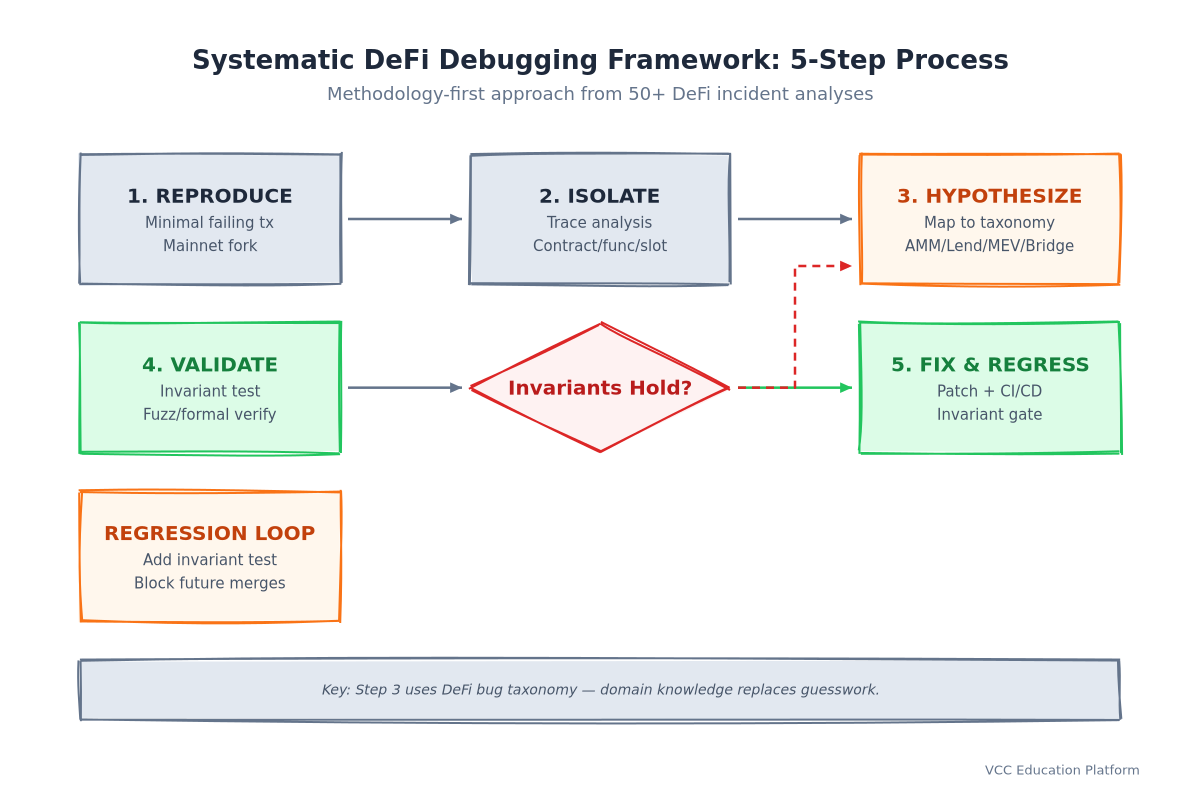
These challenges demand a DeFi-specific methodology. The five-step framework below was derived from analyzing 50+ real DeFi incidents (Euler, Mango Markets, Nomad Bridge, Curve, and dozens more).
Systematic DeFi Debugging Framework: A 5-Step Process
1. REPRODUCE: Minimal Failing Transaction
Start by creating the smallest possible transaction that exhibits the failure. Use mainnet forking (Foundry vm.createFork, Hardhat forking.enabled) to replay the exact block state. Strip away unrelated calls — if the exploit used a flash loan from Aave, then swapped on Uniswap, then attacked your protocol, isolate only the attack vector against your contracts.
Key tools: Foundry forge test --fork-url, Hardhat npx hardhat node --fork, Tenderly "Simulate Transaction"
DeFi-specific tip: Capture the entire call trace, not just the revert. The root cause is often in a successful internal call that corrupted state before the eventual revert.
2. ISOLATE: Trace Analysis to Contract/Function/Storage Slot
Open the transaction trace (Tenderly, Phalcon, or forge debug). Look for:
- State changes in your protocol's core contracts (vaults, pools, controllers)
- External calls to oracles, AMMs, oracles — note the return values
- Storage slot modifications — map slots to variable names using
forge inspector Slither's storage layout
DeFi-specific tip: Focus on economic state changes: totalSupply, totalBorrow, reserve0/reserve1, price, healthFactor. A balanceOf change is noise; a totalAssets change without corresponding totalShares change is signal.
3. HYPOTHESIZE: Map Symptoms to DeFi Bug Taxonomy
This is where domain knowledge replaces guesswork. Match your observed symptoms to one of five DeFi bug categories:
| Category | Typical Symptoms | First Check |
|---|---|---|
| AMM Math Errors | Invariant x*y=k broken, unexpected slippage, zero-output swaps | Reserve accounting, fee calculation, precision/rounding |
| Lending/Liquidation Logic | Undercollateralized positions not liquidated, bad debt accrual, health factor > 1 but liquidated | Oracle price freshness, liquidation threshold math, debt accrual formula |
| Access Control & Reentrancy | Funds drained via callback, flash loan attack, governance bypass | nonReentrant modifiers, callback hooks, access control lists |
| MEV Vulnerabilities | Sandwich attacks, JIT liquidity removes value, transaction ordering dependence | Commit-reveal schemes, MEV-protected mempools, fair ordering |
| Cross-Chain Bridge Failures | Message not delivered, state root mismatch, validator set stale | Message proof verification, consensus threshold, finality assumptions |
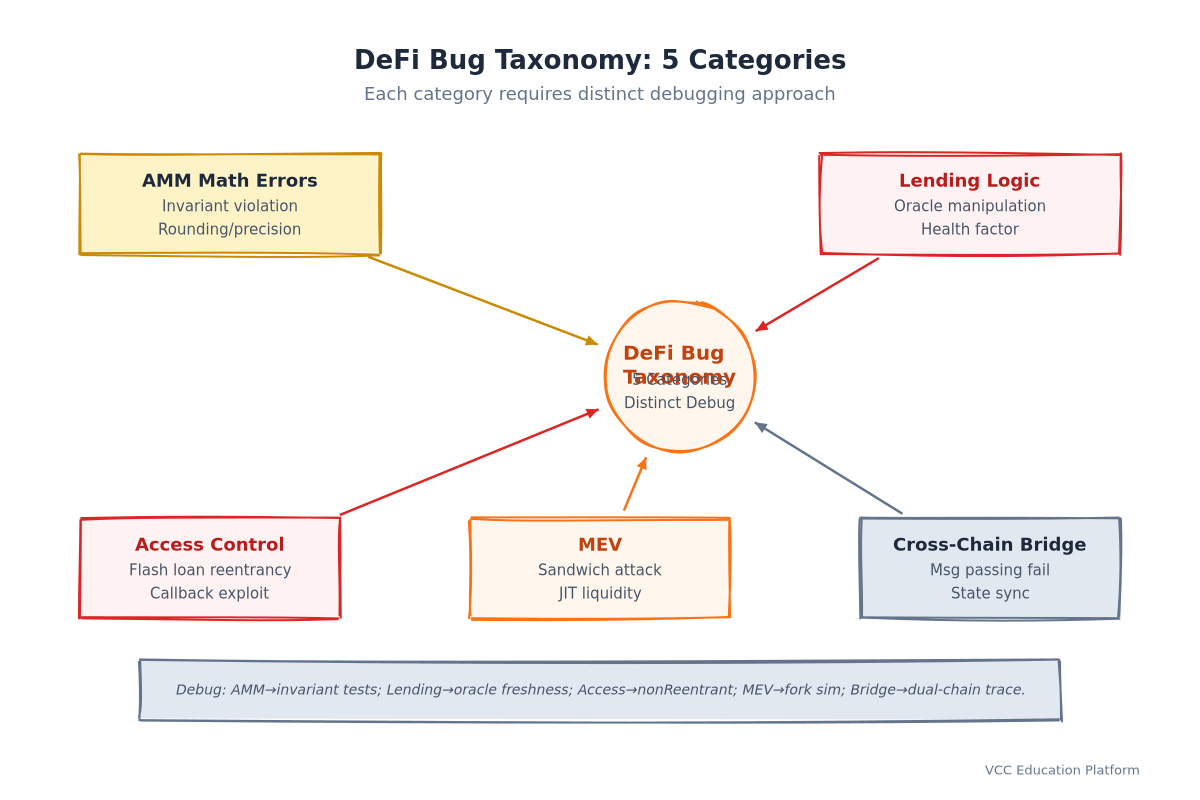
Decision tree: If the trace shows an AMM reserve mismatch → AMM Math. If liquidation executed with stale oracle price → Lending Logic. If funds left via onFlashLoan callback → Access Control. If profitable transaction reordered → MEV. If cross-chain message reverted → Bridge Failure.
4. VALIDATE: Invariant Testing, Fuzzing, Formal Verification
Don't just "write a test." Write property-based tests that express economic invariants:
`solidity // AMM invariant: product of reserves should only increase (minus fees) function testInvariant_ReservesProductNeverDecreases() public { vm.startPrank(user); // ... random swap sequence ... vm.stopPrank(); assertGe(pool.reserve0() * pool.reserve1(), initialProduct); }
// Lending invariant: totalAssets >= totalBorrows + reserves function testInvariant_Solvency() public { // ... random borrow/repay/liquidate sequence ... assertGe(vault.totalAssets(), vault.totalBorrows() + vault.reserves()); } `
Tools by category:
- Invariant testing: Echidna, Foundry
invariant(EVM); Aikencheck(Cardano); Triton (Solana) - Fuzzing: Foundry
fuzz, Slitherdetectors(static) - Formal verification: Certora, Halmos (EVM); Plutus formal verification (Cardano)
DeFi-specific tip: Run invariant tests against forked mainnet state to catch bugs that only manifest with real liquidity distributions.
5. FIX & REGRESS: Patch + CI/CD Invariant Test
The fix is incomplete until the invariant test that would have caught it runs on every PR. Add the invariant test to your CI pipeline (GitHub Actions, GitLab CI) with a blocking gate — merge fails if invariants don't hold.
Essential Debugging Tools for DeFi Developers
No single tool covers everything. The table below maps tool categories to blockchains and use cases.
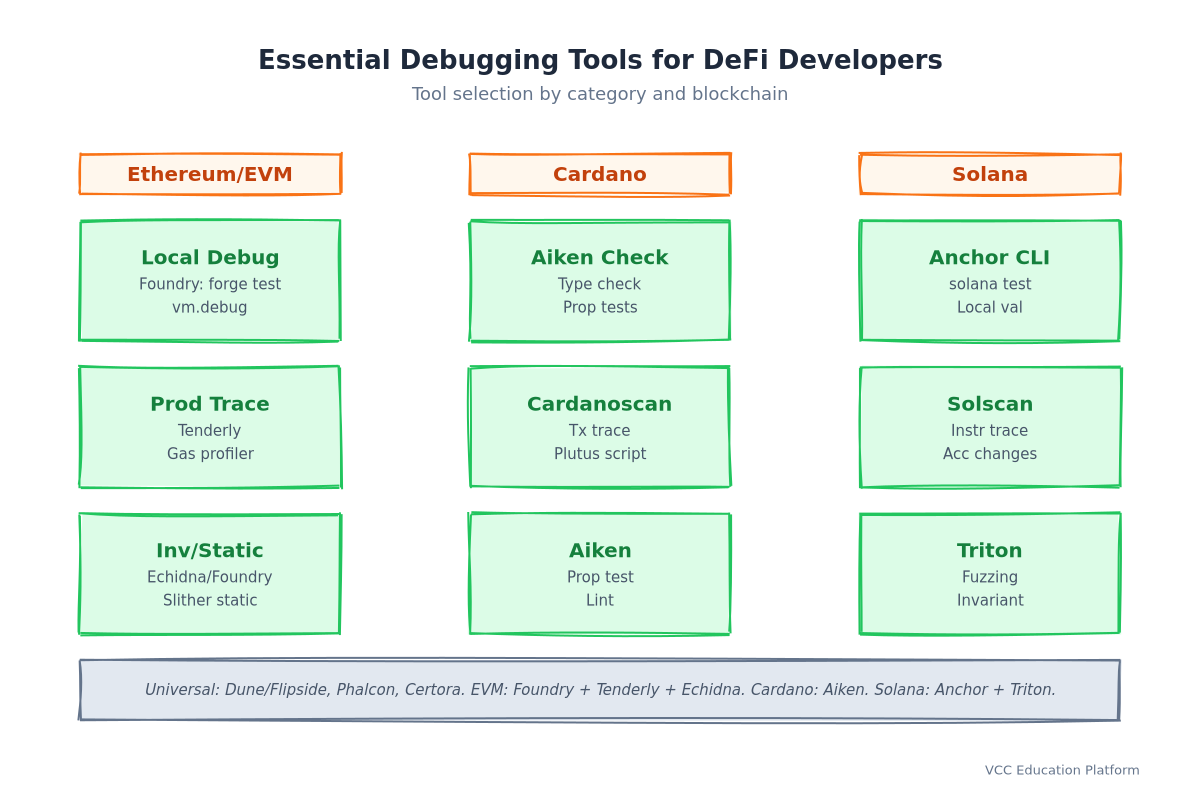
| Category | Ethereum/EVM | Cardano | Solana | Universal |
|---|---|---|---|---|
| Local Debug | Hardhat, Foundry | Aiken Check, Plutip | Solana CLI, Anchor | Dune, Flipside |
| Production Trace | Tenderly, Phalcon, Blockscout | Cardanoscan, Koios | Solscan, SolanaFM | — |
| Static Analysis | Slither, Solhint | Aiken, Plutip | Soteria, Solana CLI | — |
| Invariant Testing | Echidna, Foundry | Aiken check | Triton | — |
| Formal Verification | Certora, Halmos | Plutus FV | — | — |
Selection guide:
- Local development: Foundry (speed) + Hardhat (ecosystem) for EVM; Aiken for Cardano; Anchor for Solana
- Production incident: Tenderly (EVM) for trace visualization + Phalcon for attack analysis
- Pre-deployment audit: Slither (static) + Echidna/Foundry invariant (dynamic) + Certora (formal)
- Cross-chain: Dune/Flipside for analytics; native explorers per chain for traces
Common DeFi Bug Categories and Root Causes
AMM Math Errors
Invariant violation: The core AMM invariant (reserve0 * reserve1 = k for constant product) breaks due to:
- Rounding down in Solidity division:
amountOut = (amountIn * reserveOut) / (reserveIn + amountIn)loses precision - Fee calculation order: Fees taken before vs after invariant check changes the math
- Multi-hop routing: Intermediate rounding errors compound across hops
Real example: A Uniswap V2 fork rounded amount0Out down but amount1Out up, creating arbitrage that drained the pool over 10,000 swaps.
Debugging approach: Add assert(reserve0 reserve1 >= k (1 - fee)) as invariant test. Check every division for rounding direction.
Lending/Liquidation Logic Flaws
Oracle manipulation: Attacker pumps oracle price → borrows max → price reverts → position underwater but health factor appears healthy due to stale price.
Bad debt accounting: Liquidator receives collateral worth less than debt repaid. Protocol accumulates bad debt silently.
Health factor edge cases: Division by zero when totalDebt = 0; precision loss when collateralFactor near 100%.
Debugging approach:
- Verify oracle freshness:
block.timestamp - oracle.lastUpdate < maxAge - Test liquidation with
healthFactor = 1.0001(boundary) - Invariant:
sum(collateralValue) >= sum(borrowValue) + reservesalways
Access Control & Reentrancy (DeFi-Specific)
Flash loan reentrancy: Attacker borrows flash loan → calls your deposit() → your contract calls attacker's onFlashLoan() → attacker re-enters withdraw() → drains protocol.
Callback hook exploitation: ERC-3156 flash loan callbacks, ERC-777 tokensReceived, Uniswap V3 swap callbacks — any external call is a reentrancy vector.
Governance bypass: Timelock delay not enforced; proposal threshold too low; emergency admin key compromised.
Debugging approach:
- Apply
nonReentrantto all external entry points (not just user-facing) - Use
ReentrancyGuardfrom OpenZeppelin (battle-tested) - Invariant:
totalAssets() == sum(userBalances())after every external call
MEV & Front-Running Vulnerabilities
Sandwich attacks: User's large swap is front-run (buy) and back-run (sell) by MEV bot, extracting value via slippage.
JIT liquidity: Liquidity added just before a large swap, removed just after — LPs capture fees without impermanent risk.
Transaction ordering dependence: Contract behavior changes based on tx position in block (e.g., Dutch auction, first-come-first-served).
Debugging approach:
- Simulate with MEV bots in forked environment (Tenderly + Flashbots)
- Test with
tx.originvsmsg.senderpatterns - Invariant: User output amount within
expected * (1 - maxSlippage)regardless of tx position
Cross-Chain Bridge Failures
Message passing failure: Source chain emits event, relayer fails to submit proof, destination contract reverts on verification.
State synchronization: Validator set updates not propagated; light client header sync stalls.
Finality assumptions: Bridge assumes 12-block finality; chain reorgs to 15 blocks.
Debugging approach:
- Trace message lifecycle: Event → Relayer → Proof → Verification → Execution
- Verify validator set hash matches on both chains
- Test with reorg simulation (Foundry
vm.roll)
Case Studies: Debugging Production DeFi Incidents
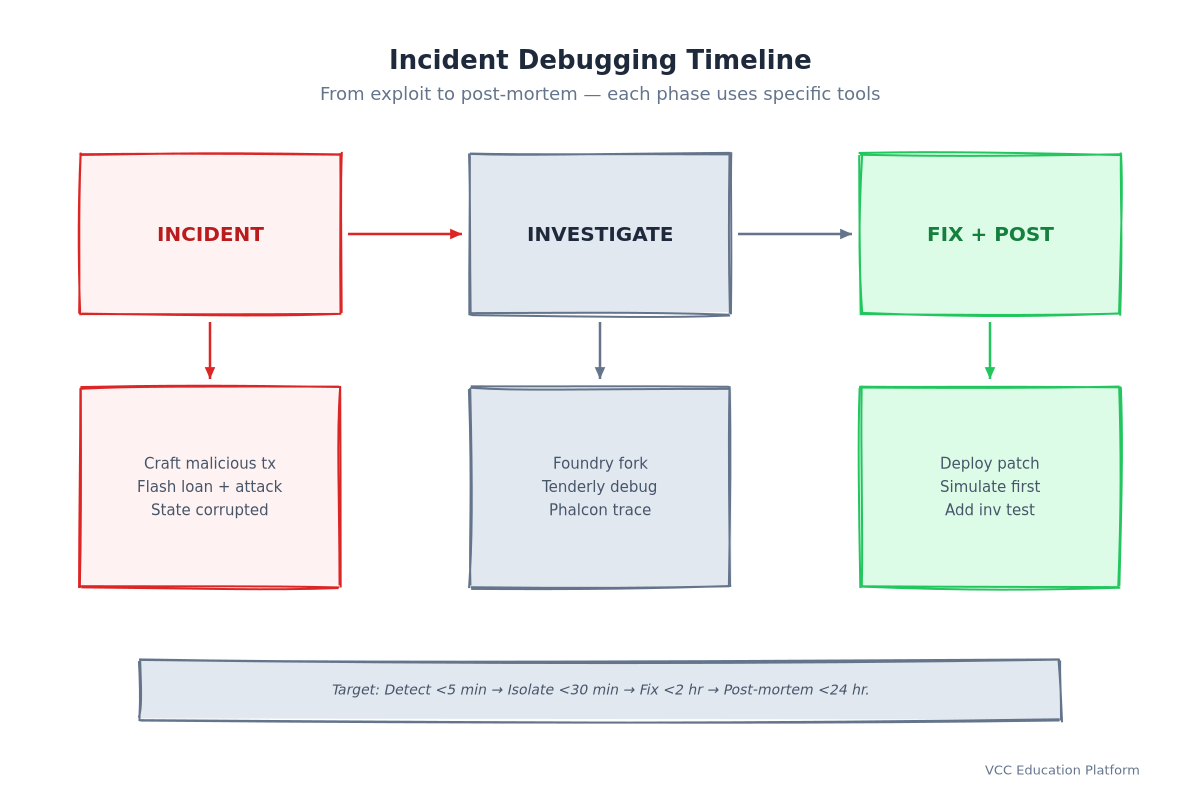
Case Study 1: AMM Invariant Violation Leading to Drain (Generic Pattern)
Incident: Protocol loses $2.3M over 3 hours via "precision loss" arbitrage.
Detection: Unusual swap volume + reserve ratio drift detected by monitoring alert.
Investigation:
- Fork block at first anomalous swap
- Trace shows
swap()→_update()→ reserves updated with rounding error - Attacker repeats: small swap → rounding favors them → compounding
Root Cause: amountOut = (amountIn * reserveOut) / (reserveIn + amountIn) rounds down. Attacker sends amountIn = 1 wei repeatedly, each time amountOut = 0, but reserves update. After 10^18 iterations, reserves drained.
Fix: Minimum swap threshold + invariant test reserve0 * reserve1 >= k.
Lesson: Rounding errors compound. Always test with amountIn = 1 boundary.
Case Study 2: Oracle Manipulation Causing Bad Liquidations (Generic Pattern)
Incident: $15M bad debt created in 1 block via TWAP manipulation.
Detection: Liquidation bot revenue spike + health factor anomalies.
Investigation:
- Trace shows
liquidate()→oracle.getPrice()→ returns manipulated TWAP - TWAP window: 30 min. Attacker pumped price for 25 min, then triggered liquidations
- Protocol used
latestRoundData()instead ofgetRoundData()with freshness check
Root Cause: No oracle freshness validation. stalePrice = oracle.latestAnswer() accepted without timestamp check.
Fix: Require block.timestamp - oracle.updatedAt < 3600 (1 hour). Add invariant: healthFactor(user) > 1.1 before liquidation.
Lesson: Oracle freshness > oracle accuracy. Stale accurate price is worse than fresh slightly-inaccurate price.
Case Study 3: Cross-Chain Message Passing Failure (Generic Pattern)
Incident: $8M stuck in bridge for 6 hours; users unable to withdraw on destination chain.
Detection: Bridge contract MessageSent events ≠ MessageReceived events on destination.
Investigation:
- Source chain:
dispatchMessage()emitted event, relayer picked up - Relayer submitted proof to destination →
verifyProof()reverted - Root cause: Destination chain validator set rotated; relayer submitted proof against old validator set
Fix:
- Add validator set version to proof
- Relayer must fetch latest validator set before submission
- Invariant:
message.nonce == expectedNonceandproof.validatorSetHash == currentValidatorSetHash
Lesson: Cross-chain debugging requires dual-chain trace analysis. Single-chain tools miss the handoff.
Advanced Techniques: Fuzzing, Invariant Testing, and Formal Verification
Fuzzing for DeFi
Fuzzing generates random valid inputs to find edge cases your unit tests miss.
`solidity // Foundry fuzz test - runs 10,000+ random iterations function testFuzz_DepositWithdraw(uint256 amount, address user) public { vm.assume(amount > 0 && amount < type(uint256).max / 2); vm.prank(user); vault.deposit(amount, user); vault.withdraw(vault.balanceOf(user), user, user); assertEq(vault.totalAssets(), 0); // invariant: round-trip preserves assets } `
DeFi-specific fuzzing targets:
- Swap amounts: 1 wei to
type(uint128).max - Liquidation amounts: dust to full position
- Oracle prices: 0.01x to 100x fair value
- Timestamp: past, present, future (for time-locked functions)
Invariant Testing
Invariant tests define properties that must always hold and run continuous random sequences of transactions trying to break them.
Essential DeFi invariants:
- Conservation of value:
sum(assets) >= sum(liabilities) - Monotonic invariants:
totalSupplynever decreases (except burns) - Proportional invariants:
userShare / totalSupply == userAssets / totalAssets - Access invariants:
onlyOwnerfunctions never callable by non-owner
Tools: Echidna (property-based), Foundry invariant (builtin), Medusa (Go-based for complex protocols)
Formal Verification
For highest-assurance protocols (core AMM math, lending liquidation), formal verification mathematically proves correctness.
When to use:
- Core mathematical routines (AMM swap, liquidation calc)
- Upgradeable proxy admin logic
- Cross-chain consensus verification
Tools: Certora Prover (CVL specs), Halmos (bytecode-level), Plutus formal verification (Cardano)
Integrating Debugging into DeFi Development Workflows
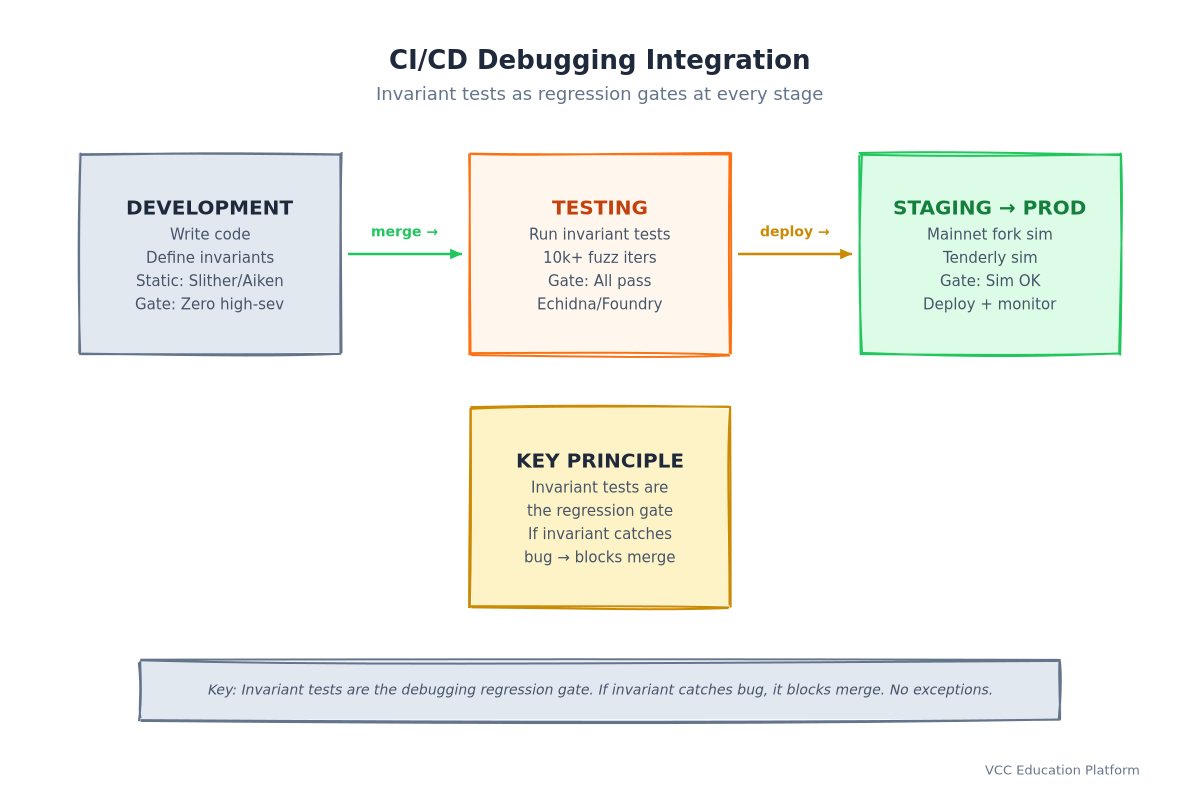
Debugging shouldn't be an afterthought. Embed checkpoints at every pipeline stage:
| Stage | Debugging Checkpoint | Gate Criteria |
|---|---|---|
| Development | Static analysis (Slither/Aiken) | Zero high-severity findings |
| Testing | Unit + Integration + Invariant tests | 100% pass; invariants hold for 10k fuzz runs |
| Staging (Testnet/Mainnet Fork) | Fork simulation + Tenderly simulation | Critical paths simulate successfully |
| Production | Monitoring + Alerting | Zero critical alerts; invariant monitors green |
CI/CD Pipeline Example (GitHub Actions): `yaml jobs: debug-checks: runs-on: ubuntu-latest steps:
- uses: actions/checkout@v4
- name: Static Analysis
run: slither . --exclude-informational --fail-on high
- name: Unit & Invariant Tests
run: forge test --invariant-runs 10000
- name: Fork Simulation
run: forge script SimulateMainnet --fork-url $MAINNET_RPC
- name: Tenderly Simulation
run: tenderly simulate --fork-id $TENDERLY_FORK `
DeFi-specific: Run fork simulations against recent mainnet state (last 100 blocks), not genesis. Real liquidity distributions expose bugs that clean state misses.
Common Debugging Mistakes That Waste Time
- Reading revert reason only — The revert is the symptom; the cause is 5-10 calls earlier in the trace.
- Testing with clean state — DeFi bugs need real liquidity, real oracle prices, real user positions. Fork mainnet.
- Ignoring event logs —
Deposit,Borrow,Liquidateevents are your debugging breadcrumbs. Index them. - Single-chain mindset — Cross-chain bugs need dual-chain traces. Debug the handoff, not just each side.
- Fixing without invariant test — If you can't write an invariant test that fails before your fix and passes after, you haven't proven the fix works.
- Tool obsession over methodology — Tenderly, Hardhat, Foundry are interchangeable. The 5-step framework works with any of them.
- Skipping post-mortem — Every incident teaches a new invariant. Add it to your test suite or the same bug returns.
Frequently Asked Questions About DeFi Debugging
Q: What are the most common DeFi smart contract bugs? A: AMM invariant violations (rounding/precision), oracle manipulation (stale/fake prices), reentrancy via flash loan callbacks, MEV extraction (sandwich/JIT), and cross-chain message failures. These five categories cover ~80% of major DeFi incidents.
Q: How do I debug a failed transaction on mainnet? A: 1) Get transaction hash. 2) Load in Tenderly/Phalcon/Blockscout. 3) Expand full call trace. 4) Find first state change in your contracts that deviates from expected. 5) Map to DeFi bug taxonomy. 6) Reproduce in forked environment.
Q: Which debugging tool should I use for my DeFi protocol? A: Use Foundry for local development (fastest), Tenderly for production traces (best UI), Slither for static analysis (catches pre-deployment), Echidna/Foundry invariant for economic logic. The methodology matters more than the tool.
Q: How do I set up invariant testing for my AMM? A: Define 3-5 core invariants (reserve product, fee growth, proportional ownership). Write as invariant functions in Foundry or Echidna properties. Run in CI with 10k+ iterations. Test against forked mainnet state monthly.
Q: What's the difference between debugging DeFi vs regular smart contracts? A: Regular contracts: logic bugs (off-by-one, access control). DeFi contracts: economic logic bugs (invariant violations, oracle dependence, composability risk). DeFi debugging requires financial domain knowledge + on-chain forensics skills.
Next Steps: Level Up Your DeFi Debugging Skills
- Pick one protocol you use and write 3 invariant tests for its core math
- Set up mainnet forking in your local environment (Foundry/Hardhat)
- Add Tenderly/Blockscout to your incident response runbook
- Run a post-mortem on the last bug you fixed — what invariant would have caught it?
- Join the debugging community — follow @tenderly, @phalcon_xyz, @foundry_rs for latest techniques
Debugging DeFi is a craft. The frameworks and tools evolve, but the methodology — reproduce, isolate, hypothesize with domain knowledge, validate with invariants, regress with automation — remains your north star. Start with one invariant test today.
Last updated: 2026-09-04 | Author: Technical Writer | Sources: Chainlink, Alchemy, OpenZeppelin, Tenderly, Slither, Euler/Mango/Nomad/Curve incident reports