
Building a DeFi community isn't like growing a Web2 user base. There's no email list to nurture, no freemium funnel to optimize, and no customer success team to reduce churn. In DeFi, your users are also your owners, your marketers, your security auditors, and sometimes your fiercest critics — all at the same time.
This guide distills the 4-phase framework used by protocols that turned early contributors into self-sustaining ecosystems: Uniswap, Aave, MakerDAO, Pendle, and Ethena. You'll get phase-specific tactics, incentive designs that align (not attract mercenaries), metrics that predict health, and a Vietnam/SEA playbook for the region where Zalo beats Discord and university clubs drive 10x ROI.
Why DeFi Communities Are Different from Traditional Communities
| Dimension | Traditional Community | DeFi Community |
|---|---|---|
| Relationship | User ↔ Platform | Owner ↔ Protocol |
| Incentive | Features, support, status | Economic alignment (tokens, yield, governance) |
| Governance | Feedback → Product team | On-chain voting → Parameter changes |
| Value Capture | Platform captures value | Community captures value (fees, emissions, treasury) |
| Exit Cost | Low (delete account) | High (sell tokens, exit positions, reputational) |
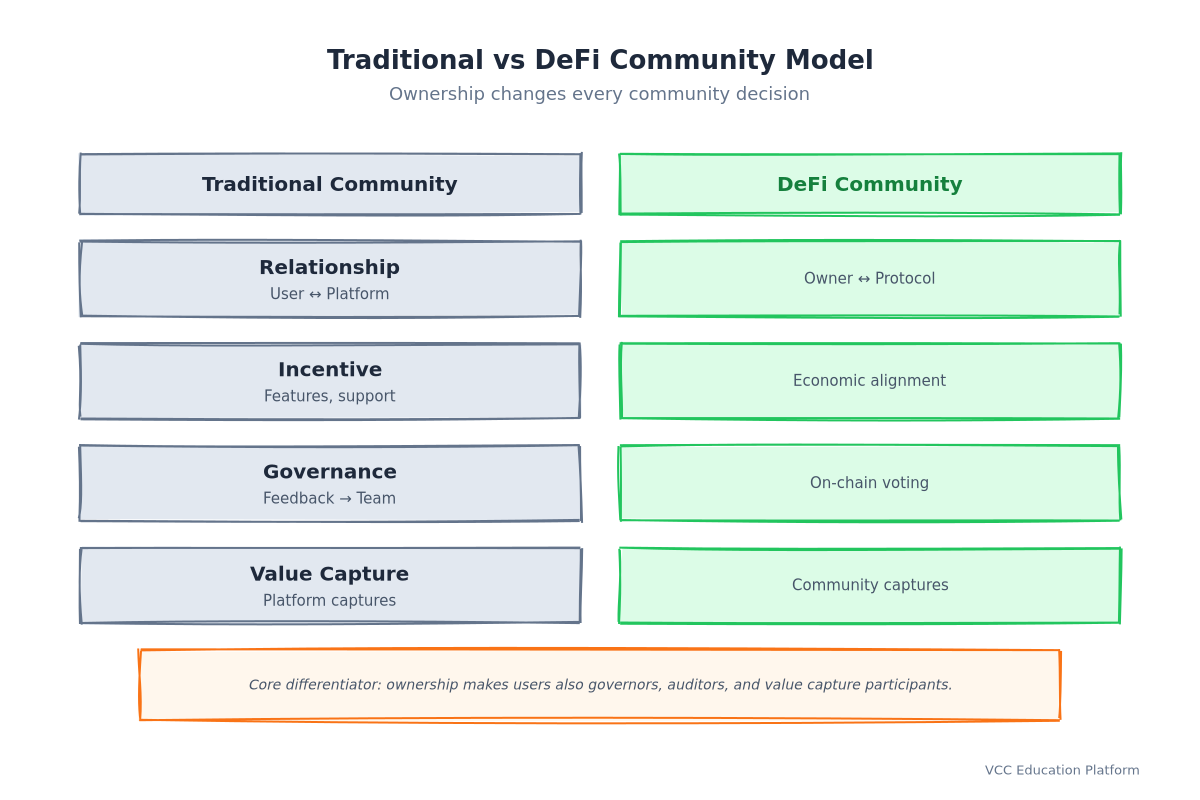
The core differentiator is ownership. When a Uniswap LP provides liquidity, they earn fees and govern the protocol through UNI. When an Aave safety module staker backs the protocol, they earn AAVE emissions and vote on risk parameters. This dual role — user and owner — changes every community decision: acquisition, retention, crisis response, and succession.
Vietnam context: The ownership narrative resonates strongly in VN where "cổ đông" (shareholder) culture from stock investing translates naturally to token governance. But regulatory language matters — avoid "cổ phần" (shares) or "đầu tư" (investment); use "tham gia quản trị" (participate in governance) and "nhận phần thưởng" (earn rewards).
The DeFi Community Lifecycle: Four Phases
Every successful DeFi community moves through four phases. The phases aren't rigid gates — they overlap — but each has distinct goals, activities, and metrics.
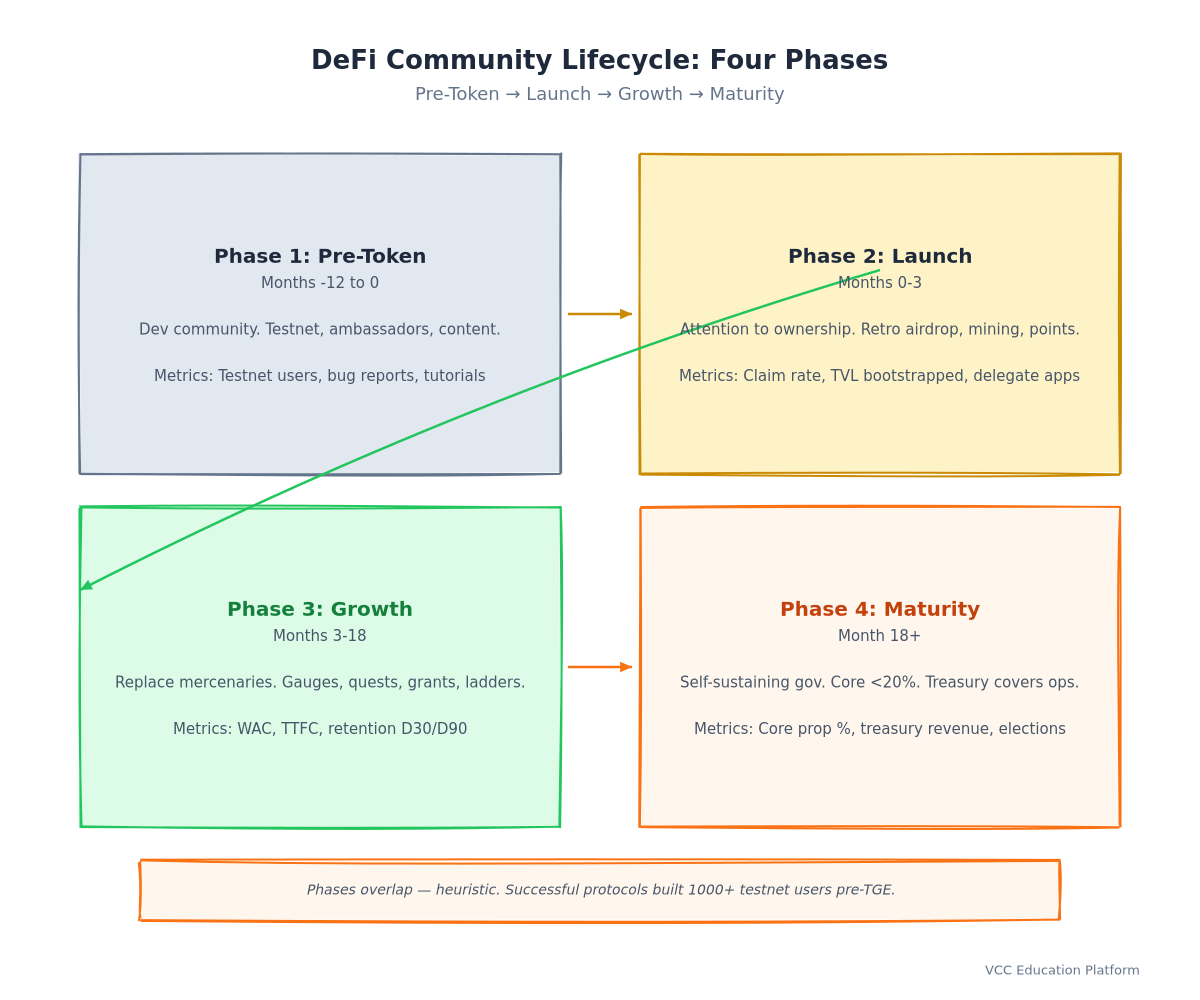
Phase 1: Pre-Token — Ideation to Testnet (Months -12 to 0)
Goal: Build a developer/power-user community before any token exists. Key Activities:
- Technical content flywheel: architecture deep-dives, tutorial series, hackathon challenges
- Ambassador/devrel program: 10-20 technical ambassadors testing devnet, writing docs, answering questions
- Waitlist with proof-of-work: not email capture — require testnet transactions, bug reports, or content creation
- Points/NFT system for testnet participation → mainnet allocation criteria
Metrics: Weekly active testnet users, Bug reports per week, Tutorial completion rate, Ambassador retention Risks: Building audience without product, Over-promising token allocation, Regulatory "expectation of profit" exposure
Case Study — Pendle: Launched vePENDLE after 18 months of testnet V1/V2. Early adopters who provided liquidity on testnet received retroactive allocation. Result: 40% of vePENDLE locked by addresses active pre-TGE.
Phase 2: Launch — TGE to Liquidity (Months 0-3)
Goal: Convert attention into aligned ownership without triggering securities concerns. Key Decisions:
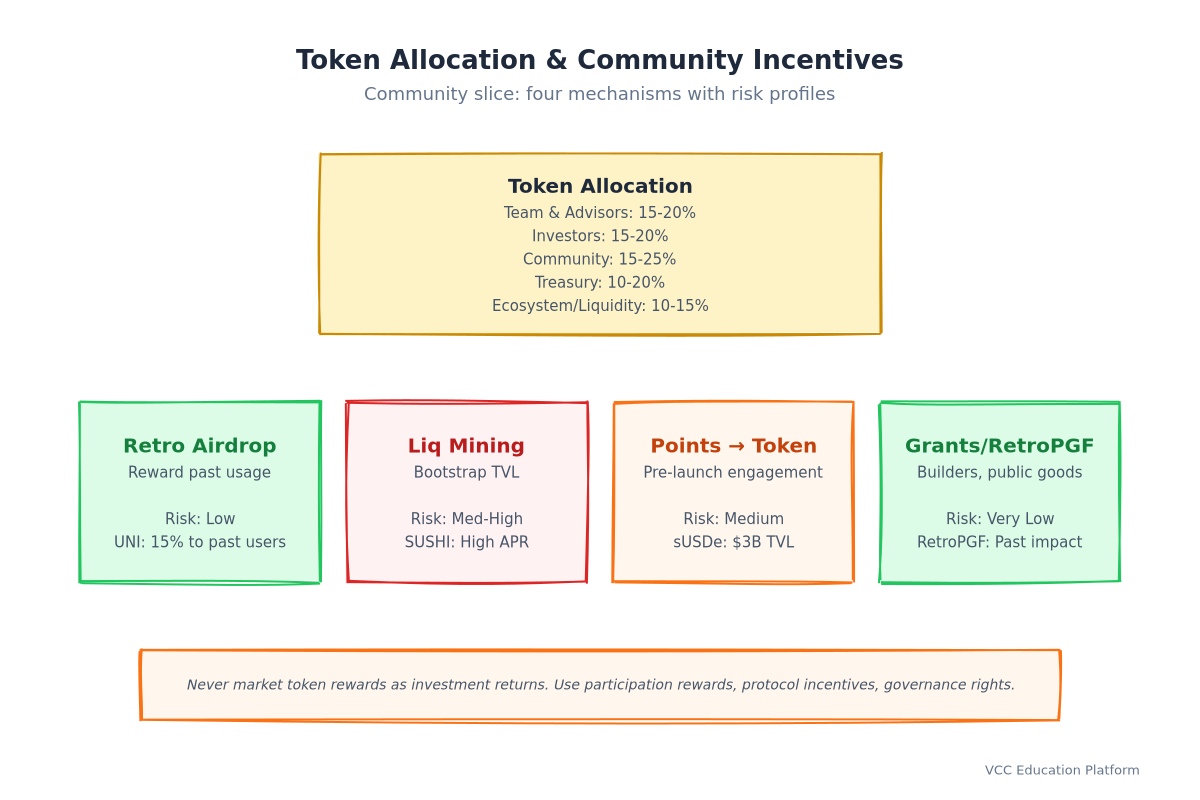
| Mechanism | Best For | Regulatory Risk | Example |
|---|---|---|---|
| Retroactive airdrop | Rewarding past usage | Low (no prospective promise) | Uniswap, Arbitrum, Optimism |
| Liquidity mining | Bootstrapping TVL | Medium (yield = expectation) | SushiSwap (v1), Curve |
| Points → token | Pre-launch engagement | Medium-High (marketing matters) | Ethena sUSDe, LayerZero |
| Grants/retroactive funding | Builders, public goods | Low | Gitcoin, RetroPGF, Protocol grants |
Critical Rule: Never market prospective token rewards as "investment returns." Use "participation rewards," "protocol incentives," "governance rights." The SEC's Howey test asks: Is there an investment of money in a common enterprise with expectation of profit from efforts of others? Design incentives where users contribute work (liquidity, code, governance, content) — not just capital.
Case Study — Ethena: sUSDe campaign awarded points for minting/holding sUSDe and referring users. No token promised. Post-TGE, points converted to ENA allocation. Result: $3B+ TVL pre-token, but regulatory scrutiny on "points = expectation" narrative.
Phase 3: Growth — Incentive Design That Scales (Months 3-18)
Goal: Replace mercenary capital with aligned contributors through structured incentives.
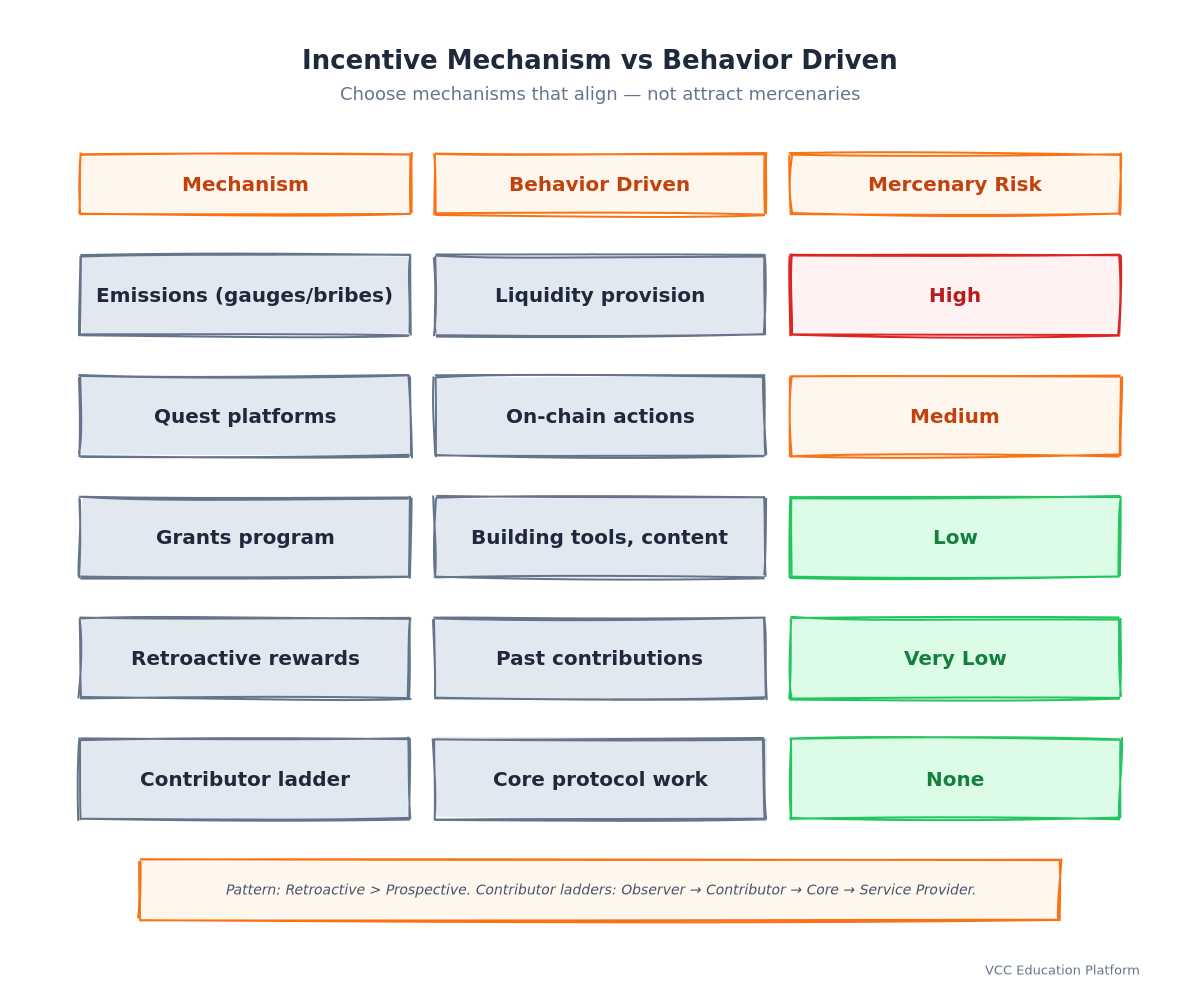
| Incentive Type | Behavior Driven | Duration | Mercenary Risk |
|---|---|---|---|
| Emissions (gauges/bribes) | Liquidity provision | Ongoing | High — follows highest APR |
| Quest platforms (Galxe, Layer3) | On-chain actions (swap, vote, mint) | Campaign-based | Medium — sybil farms |
| Grants program | Building tools, integrations, content | Quarterly/Annual | Low — requires delivery |
| Retroactive rewards (RetroPGF) | Past valuable contributions | Periodic | Very low — no prospective promise |
| Contributor ladder (salary/stipend) | Core protocol work | Ongoing | None — employment-like |
The Gauge/Bribe Model (Curve-style): Protocols with vote-escrow tokens (veTOKEN) let veTOKEN holders direct emissions to specific pools. External protocols "bribe" voters for emissions. This creates a market for emissions — but also a meta-game where voters optimize for bribes, not protocol health.
Better Pattern — Contributor Ladders: Formalize progression: Observer → Contributor → Core Contributor → Core Unit/Service Provider. Each rung has defined scope, compensation (stipend/salary/token vesting), and governance weight. MakerDAO's Core Units, Aave's Service Providers, Uniswap's Delegate Rewards all implement versions.
Vietnam Playbook: Run quarterly hackathons with VN universities (HCMUT, NEU, FTU). Prize: grant + token allocation + mentorship. Coin98's "Buildathon" generated 50+ projects, 5 mainnet deployments. Cost: $20K; ROI: 10x vs paid marketing.
Phase 4: Maturity — Governance & Self-Sustainability (Month 18+)
Goal: Community operates without core team daily involvement. Markers of Maturity:
- Core team <20% of governance proposals
- Treasury managed by elected multisig/service providers
- Contributor ladder self-perpetuating (core contributors onboard new contributors)
- Legal wrapper operational (Cayman Foundation, BVI Company, Wyoming DAO LLC)
- Revenue covers operational costs (protocol fees > emissions)
Roles Map:
- Core Team: Protocol development, security, strategy (salary + token vesting)
- Delegates/Representatives: Vote on behalf of token holders (reputation + delegation rewards)
- Ambassadors: Regional growth, content, events (grant + token allocation)
- Developers: Integrations, tooling, frontends (grants + retroactive rewards)
- Moderators: Discord/Telegram/Zalo health, support (stipend + reputation)
- Users: Liquidity providers, borrowers, traders (yield + governance rights)
RACI for Key Decisions:
| Decision | Responsible | Accountable | Consulted | Informed |
|---|---|---|---|---|
| Parameter changes (fees, caps) | Risk committee | Core team | Delegates, Community | All token holders |
| Treasury spends >$100K | Service provider | Multisig signers | Community forum | All |
| Protocol upgrades | Core developers | Security council | Delegates | All |
| New market/pool listings | Risk committee | Core team | Community | All |
Case Study — MakerDAO: 20+ Core Units (CU) with elected facilitators, $100M+ annual budget. Each CU: mandate, KPIs, budget, facilitator. Facilitators elected annually by MKR holders. Result: Protocol operates without founder involvement since 2022.
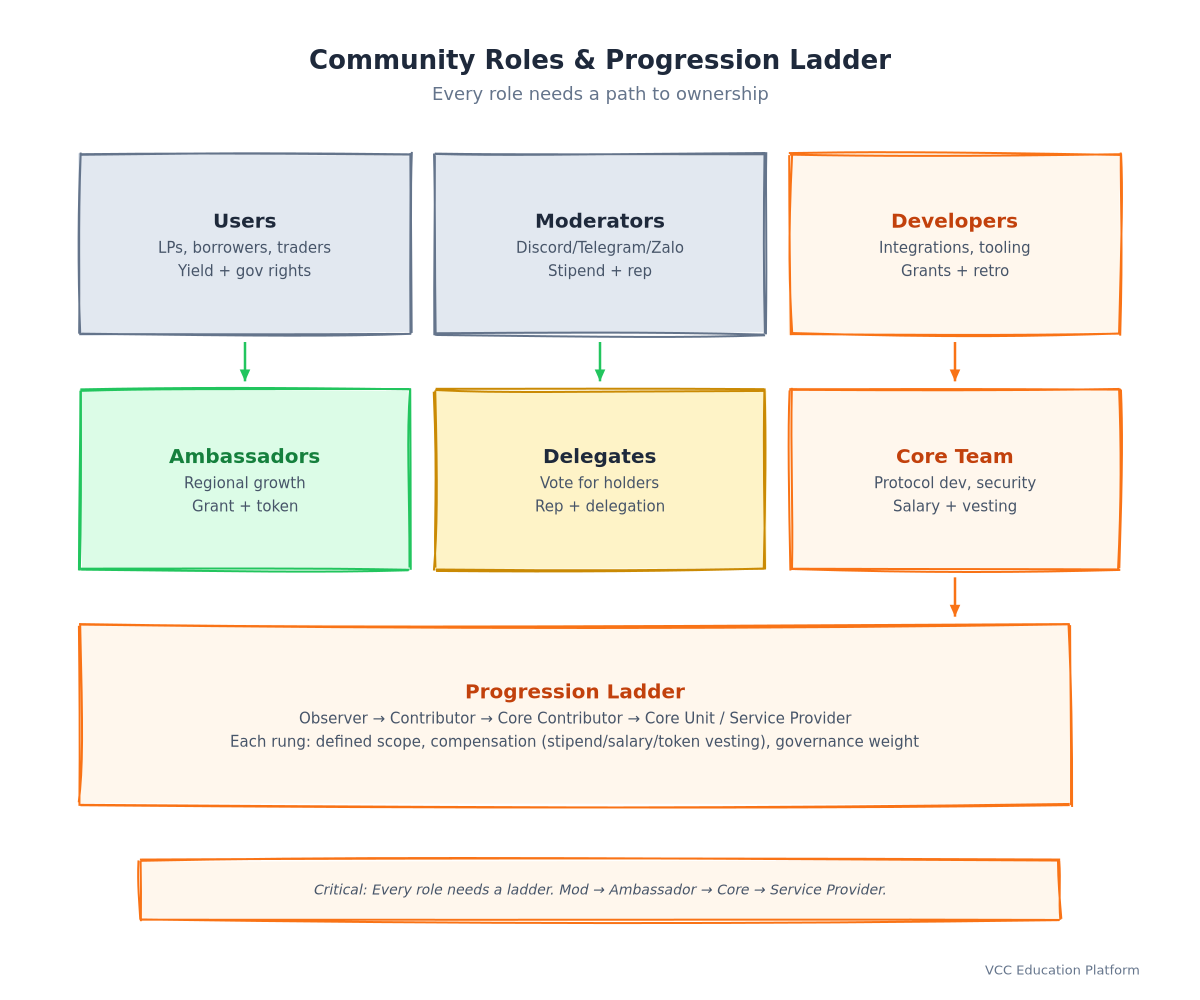
Community Roles & Responsibilities Map
The radial diagram above shows how roles connect to the protocol center. Critical insight: every role needs a progression path. A moderator should see a path to ambassador; an ambassador to core contributor; a contributor to service provider. Without ladders, your best people leave.
Implementation Checklist:
- [ ] Define role descriptions with scope, time commitment, compensation
- [ ] Publish contributor ladder with clear promotion criteria
- [ ] Create onboarding flow for each role (not just "join Discord")
- [ ] Set up delegation dashboard (Snapshot, Tally, or custom)
- [ ] Establish contributor agreement (IP assignment, confidentiality, code of conduct)
Measuring What Matters: Leading Indicators Over Vanity Metrics
Most dashboards show lagging indicators — results of past health. You need leading indicators — predictors of future health.
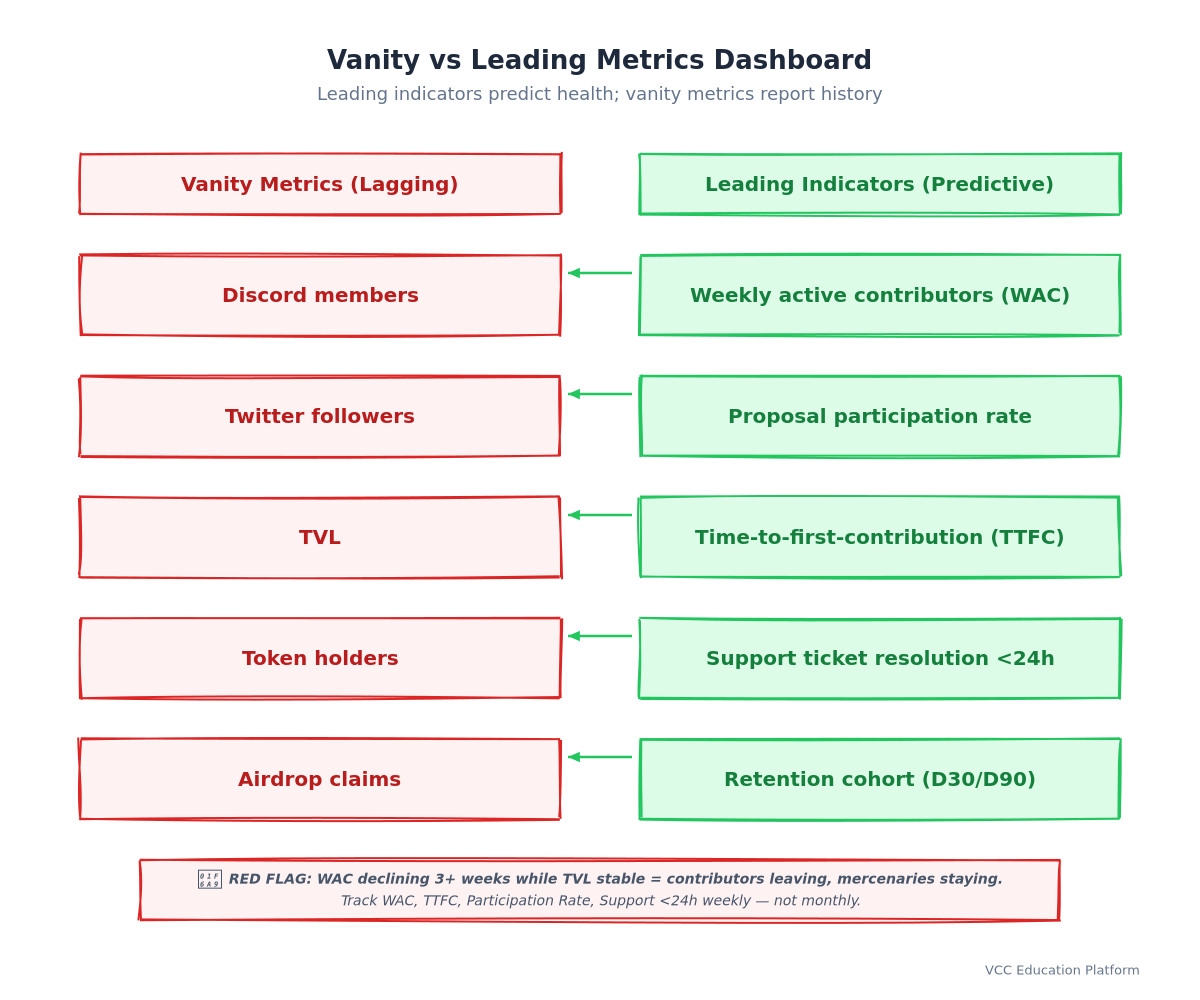
| Vanity Metric (Lagging) | Leading Indicator (Predictive) | Why It Matters |
|---|---|---|
| Discord members | Weekly active contributors (WAC) | WAC correlates with code commits, proposals, support quality |
| Twitter followers | Proposal participation rate | Governance health = protocol resilience |
| TVL | Time-to-first-contribution (TTFC) | Lower TTFC = better onboarding = sustainable growth |
| Token holders | Support ticket resolution <24h | Community health = user retention |
| Airdrop claims | Retention cohort (D30/D90) | Distinguishes mercenaries from aligned users |
Weekly Dashboard Template:
- WAC: Count unique addresses: voting, forum posting, PR merged, support answered
- TTFC: Median days from "first touch" (discord join, docs read) to "first contribution"
- Proposal Participation: % of circulating supply voting on last 5 proposals
- Support Health: Median resolution time, % resolved in <24h, CSAT score
- Retention: D30/D90 of addresses that claimed incentives vs organic users
Red Flag: WAC declining for 3+ weeks while TVL stable = contributors leaving, mercenaries staying. Protocol will decay when incentives shift.
Crisis Communication Playbook for DeFi
Exploits happen. Your community's trust depends on how you communicate in the first 72 hours.
T+0 to T+1 Hour: Acknowledgment
Template:
🚨 Incident Acknowledged — We're aware of unusual activity on [protocol/contract]. Investigating now. Will update every 30 min. Do not interact with [affected contract] until further notice. Official updates only here and @protocol_twitter.
Channels: Twitter/X, Discord #announcements, Telegram announcement channel, Zalo OA (VN), Forum post.
T+1 to T+6 Hours: Technical Assessment
Template:
🔍 Technical Update — Root cause: [reentrancy/price oracle/access control] in [contract]. Affected: [specific vaults/pools/users]. Estimated impact: $[X]M. Funds at risk: [yes/no]. Mitigation: [paused contracts/emergency multisig/whitehat negotiation].
T+6 to T+24 Hours: Action Plan
Template:
🛡️ Action Plan — 1) Contracts paused: [list]. 2) Recovery: [whitehat negotiation / on-chain recovery / user compensation fund]. 3) Compensation: [snapshot vote / automatic / case-by-case]. 4) Audit: [firm engaged, timeline]. 5) Post-mortem: [date commitment].
T+24 to T+72 Hours: Post-Mortem & Compensation
Template:
📋 Post-Mortem Published — [Link]. Root cause, timeline, fixes, prevention. Compensation: [mechanism, eligibility, timeline]. Governance vote: [snapshot link, quorum, deadline].
Case Studies: - Euler Finance (March 2023): Transparent hourly updates, whitehat negotiation recovered 90% funds, compensation vote passed. TVL recovered 60% in 30 days. - Curve Finance (July 2023): Delayed acknowledgment (4h), confusing messaging. Trust damage persisted months after funds recovered. - KyberSwap (Nov 2023): Clear technical posts, but no compensation plan for 2+ weeks. Community fragmentation.
Vietnam & Southeast Asia: Regional Playbook
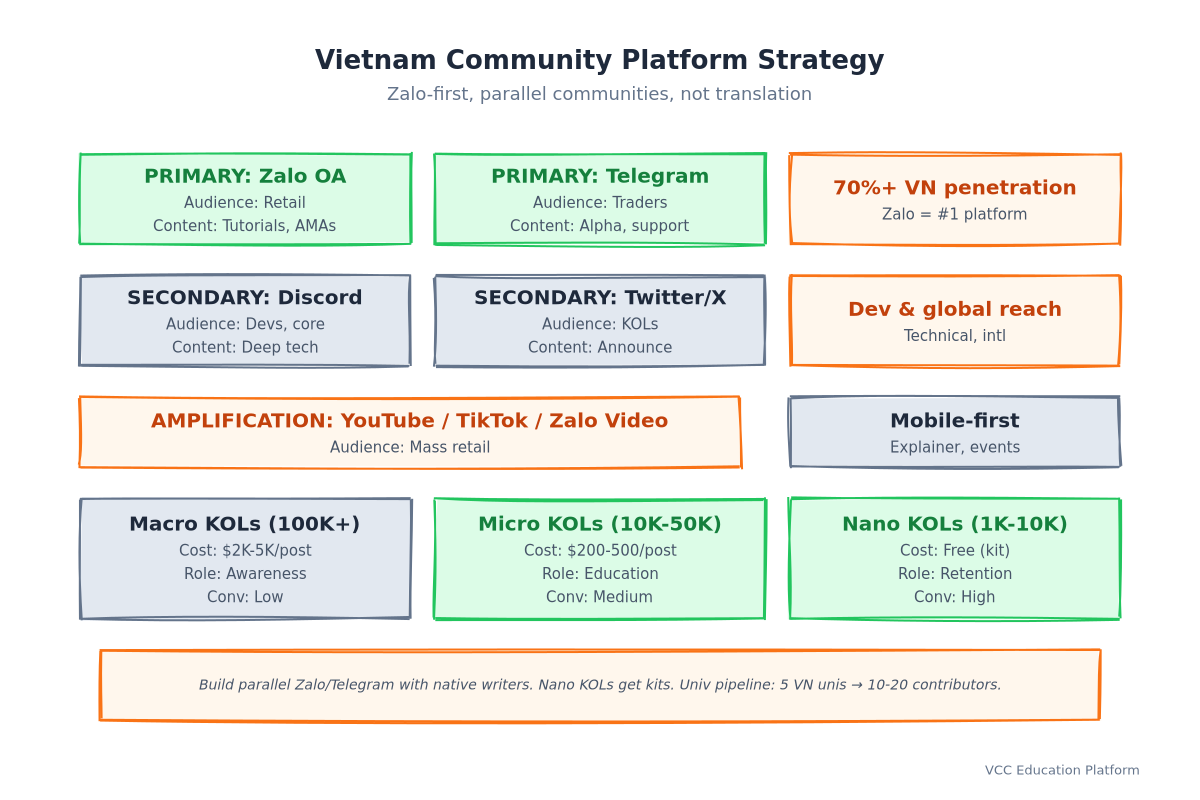
Platform Strategy
| Platform | Audience | Content Type | Priority |
|---|---|---|---|
| Zalo OA + Groups | General crypto-curious, retail | Tutorials, AMA summaries, news | Primary (70%+ penetration) |
| Telegram | Traders, technical users, devs | Alpha, technical discussion, support | Secondary |
| Discord | Developers, core contributors | Deep technical, governance, grants | Tertiary |
| Twitter/X | KOLs, international audience | Announcements, thought leadership | Amplification |
| YouTube/TikTok | Mass retail | Explainers, interviews, event highlights | Brand |
Content Localization (Not Translation)
- Don't translate Discord. Build parallel Zalo/Telegram with native writers.
- VN-first content: "Cách stake token an toàn" > "How to stake safely (translated)."
- Format: Short videos (TikTok/Reels/Zalo Video) > long articles for retail. Long-form for devs (Mirror, Substack, GitBook).
KOL Tier Structure
| Tier | Followers | Cost/Post | Role | Conversion |
|---|---|---|---|---|
| Macro | 100K+ | $2,000-5,000 | Awareness, credibility | Low (broad) |
| Micro | 10K-50K | $200-500 | Education, tutorials | Medium |
| Nano | 1K-10K | Free (equip with kit) | Retention, community voice | High (trust) |
Equip Nano KOLs: Give them content kits — infographics, tweet threads, AMA question banks, referral links. They amplify authentically.
University Pipeline
- Target: HCMUT, NEU, FTU, UEH, HUST blockchain clubs
- Program: Ambassador scholarship (token grant + mentorship + swag)
- Deliverables: Monthly workshop, translated doc, hackathon project
- Cost: ~$500/ambassador/quarter. ROI: 10-20 high-quality contributors per cohort.
Regulatory Guardrails (Vietnam)
- SBV Circular 02/2024: Prohibits "issuing, providing payment services for virtual assets."
- Safe Language: "Tham gia cộng đồng" (join community), "Nhận phần thưởng" (earn rewards), "Đề xuất cải tiến" (propose improvements)
- Unsafe Language: "Đầu tư" (invest), "Lãi suất" (interest rate), "Bảo vệ vốn" (principal protection), "Chứng chỉ" (certificate)
- Legal Opinion: Budget $5-10K for VN law firm review before mainnet launch.
FAQ
When should I start building community for my DeFi protocol?
Day -365. Start the technical content flywheel and ambassador program 12 months before TGE. The best communities (Pendle, Ethena, Hyperliquid) had 1,000+ active testnet users before token.
How much token allocation for community incentives?
15-25% of total supply over 4-8 years. Typical split: 5-10% retroactive/airdrop, 5-10% emissions/liquidity mining, 3-5% grants/ecosystem fund. Avoid >30% — signals mercenary design.
Discord vs Telegram vs Discourse — which for DeFi?
All three, different purposes:
- Discord: Core contributors, governance, grants (structured, searchable)
- Telegram: Traders, real-time alpha, support (fast, mobile-first)
- Discourse/Forum: Proposals, technical debates, permanent record (governance-grade)
- VN addition: Zalo OA/Groups for mass retail onboarding
How to prevent mercenary farmers in incentive programs?
- Proof-of-work: Require on-chain history (tx count, volume, protocol usage)
- Time-lock: Vesting 6-12 months with cliff
- Reputation gates: Gitcoin Passport, on-chain attestations, POAPs
- Retroactive > prospective: Reward past behavior, not promised future behavior
- Sybil defense: Layer3/Galxe sybil scores, custom clustering analysis
What legal structure for a DeFi community treasury?
| Treasury Size | Recommended Structure | Cost/Year | Jurisdiction |
|---|---|---|---|
| <$1M | Multisig (Gnosis Safe) | $0 | Any |
| $1-10M | Cayman Foundation | $15-25K | Cayman Islands |
| $10-100M | BVI Company + Trust | $30-50K | British Virgin Islands |
| >$100M | Wyoming DAO LLC + Foundation | $50K+ | US (Wyoming) + Offshore |
Key: Foundation owns IP/trademarks; Company/DAO LLC holds treasury, enters contracts. Separate legal personality protects token holders from liability.
Summary Checklist: Your 90-Day Community Launch Plan
| Week | Phase | Deliverable |
|---|---|---|
| 1-2 | Pre-Token | Technical blog series (3 posts), Ambassador applications open, Devnet launch |
| 3-4 | Pre-Token | First hackathon challenge, Tutorial series (5 videos), Zalo OA setup (VN) |
| 5-6 | Pre-Token | Testnet incentives live (points/NFTs), Ambassador cohort #1 onboarded |
| 7-8 | Launch | TGE announcement, Allocation criteria published, Claim site live |
| 9-10 | Launch | Liquidity mining gauges live, Delegate program applications open |
| 11-12 | Growth | Grants program v1 launched, Quest campaign #1 (Galxe/Layer3) |
| 13-14 | Growth | Contributor ladder published, First core contributor promotions |
| 15-16 | Growth | Metrics dashboard live (WAC, TTFC, Participation), Crisis comms drill |
| 17-18 | Maturity | Service provider framework, Legal wrapper engaged, Treasury multisig |
| Ongoing | All | Weekly metrics review, Monthly AMA, Quarterly hackathon, Annual election |
Building a DeFi community is a marathon, not a sprint. The protocols that survive bear markets are the ones where contributors stay because they own the outcome — not because they're farming the incentive. Start early, design for alignment, measure what predicts health, and never forget: your community is your protocol's immune system.