
DeFi case studies reveal how decentralized finance evolved from experimental primitives into a $100B+ ecosystem that now bridges traditional finance. By examining pivotal protocols—Uniswap, Aave, MakerDAO, Curve, Lido, GMX, and cross-chain bridges—we uncover patterns of innovation, failure, and resilience that define DeFi's trajectory. This reference guide distills eight critical case studies, each offering transferable lessons for builders, investors, and users navigating the DeFi landscape.
The DeFi Evolution Framework: Four Phases of Innovation
Before diving into individual protocols, we frame DeFi's history in four evolutionary phases:
| Phase | Period | Characteristic | Key Protocols |
|---|---|---|---|
| Primitive Building | 2017–2019 | Core legos invented: AMMs, lending, stablecoins | MakerDAO, Uniswap v1, Compound |
| Composability Explosion | 2020–2021 | "Money legos" combined; yield farming, liquidity mining | Yearn, SushiSwap, Curve, Aave v2 |
| Risk Maturation | 2022–2023 | Post-crash hardening; real yield, risk frameworks | GMX, Aave v3, Maker Endgame, Lido V2 |
| Institutional Bridge | 2024+ | RWAs, permissioned DeFi, regulatory compliance | Aave Arc, Maker Spark, Ethena, Ondo |
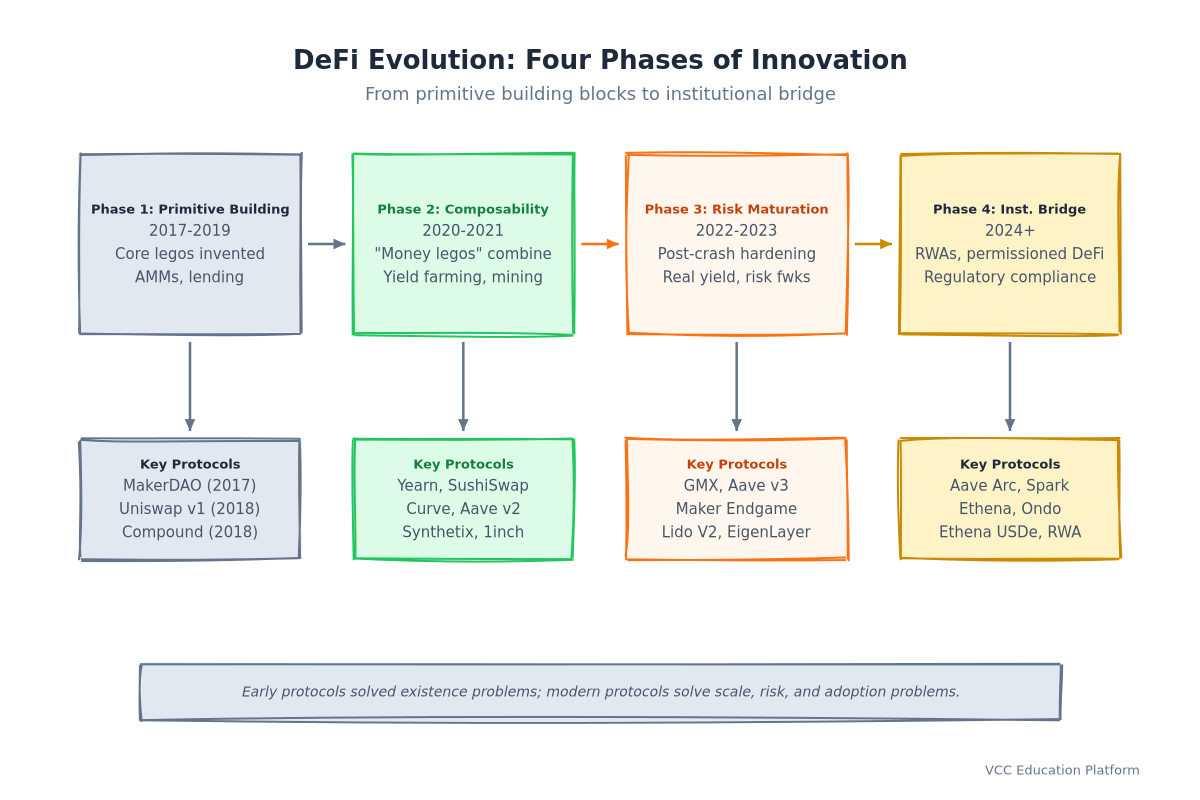
Understanding this framework helps contextualize each case study: early protocols solved existence problems (can this work?); modern protocols solve scale, risk, and adoption problems.
Case Study 1: Uniswap — The AMM That Changed Everything
The Problem: Liquidity Fragmentation in Early DEXs
Before Uniswap, decentralized exchanges used order books—mirroring centralized exchanges but suffering from thin liquidity, high slippage, and poor UX. Market makers couldn't efficiently provide liquidity without sophisticated infrastructure.
The Innovation: Constant Product AMM (x × y = k)
Uniswap v1 (November 2018) introduced a radical alternative: automated market makers where liquidity providers deposit token pairs into pools, and prices are determined algorithmically by the invariant x × y = k.
`markdown Key Insight: Anyone could become a market maker with two tokens and a single transaction—no order book management, no inventory risk beyond impermanent loss. `
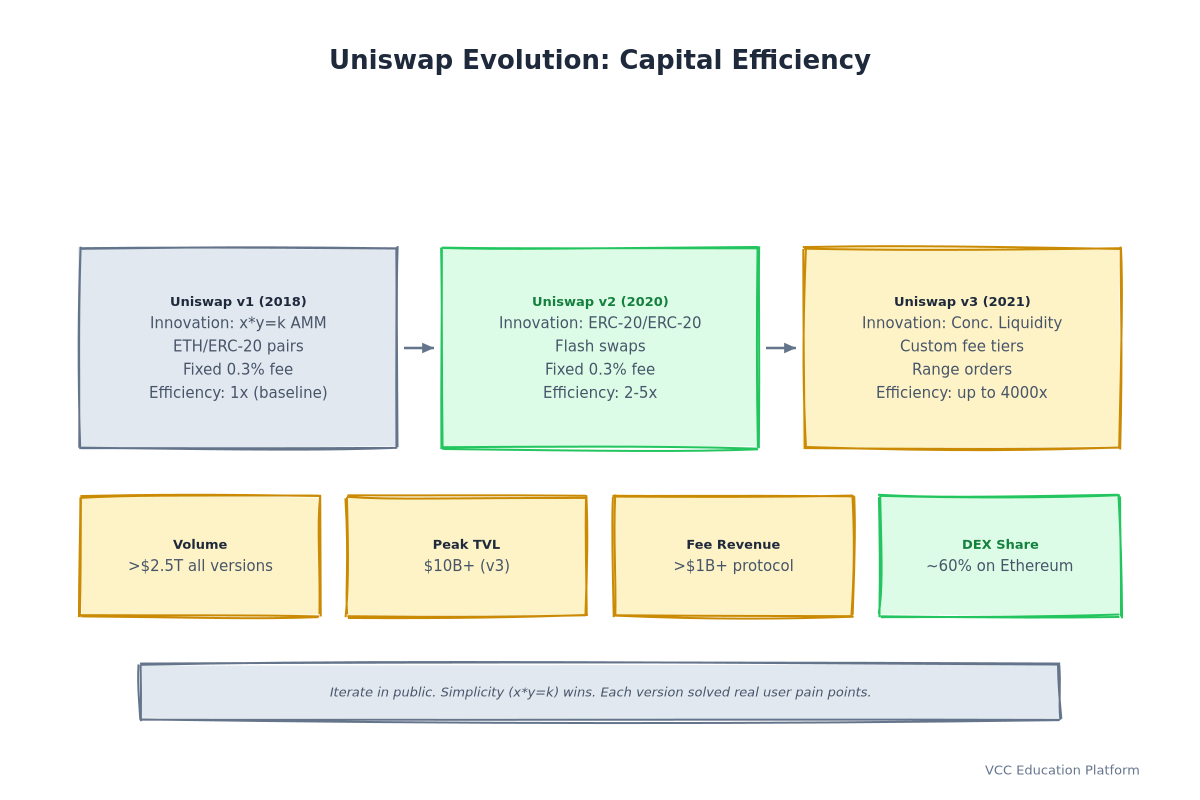
Evolution Across Three Versions
| Version | Launch | Innovation | Capital Efficiency Gain |
|---|---|---|---|
| v1 | Nov 2018 | ETH/ERC-20 pairs only, fixed 0.3% fee | Baseline |
| v2 | May 2020 | ERC-20/ERC-20 direct pairs, flash swaps | 2–5x via direct routing |
| v3 | May 2021 | Concentrated liquidity, custom fee tiers | Up to 4000x in stable pairs |
Metrics That Matter (as of 2024)
- Cumulative Volume: >$2.5T across all versions
- Peak TVL: $10B+ (v3 concentrated positions)
- Fee Revenue: >$1B+ protocol fees generated
- Market Share: ~60% of DEX volume on Ethereum mainnet
Lessons Learned
- Simplicity wins: The x×y=k formula is understandable by non-technical users.
- Iterate in public: Each version addressed specific pain points from real usage.
- Concentrated liquidity = capital efficiency: v3's range orders let LPs allocate capital where price action happens.
- Permissionless innovation: Uniswap's open-source license spawned 100+ forks (SushiSwap, PancakeSwap, QuickSwap).
Case Study 2: Aave — Flash Loans and the Lending Standard
The Problem: Capital Inefficiency in Peer-to-Pool Lending
Compound pioneered peer-to-pool lending, but capital sat idle until borrowed. Users couldn't access liquidity instantly without overcollateralization.
The Innovation: Flash Loans + aTokens + Safety Module
Aave (launched January 2020 as ETHLend rebrand) introduced three breakthroughs:
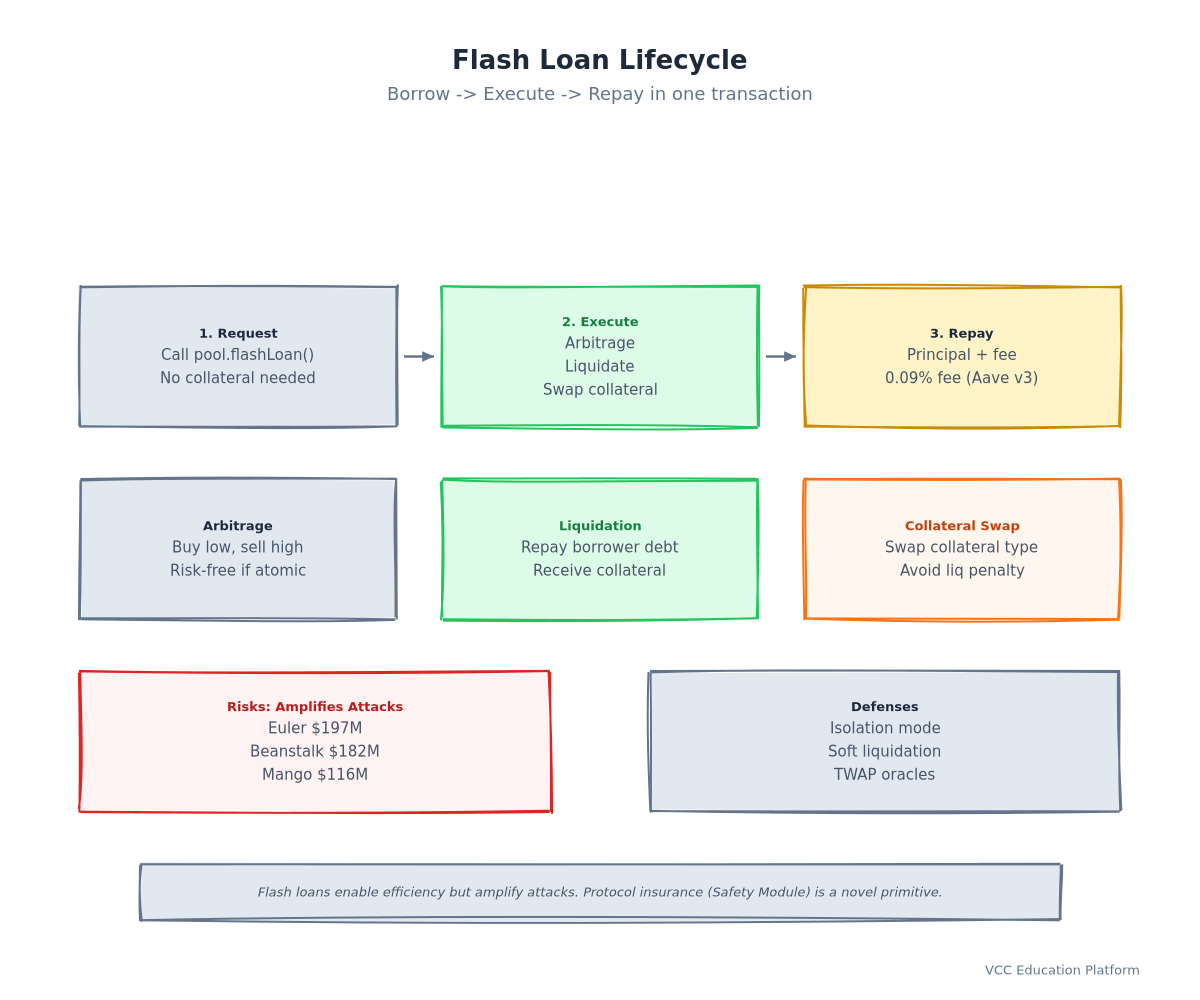
- Flash Loans: Uncollateralized loans borrowed and repaid within a single transaction. Enabled arbitrage, liquidations, and collateral swaps without upfront capital.
- aTokens: Interest-bearing tokens that accrue yield in real-time (balance increases in wallet).
- Safety Module: Staked AAVE acts as protocol backstop—slashing covers bad debt, aligning token holders with protocol health.
Aave v3: Cross-Chain & Capital Efficiency (2022)
- Portal: Native cross-chain messaging for aToken transfers
- E-mode: High loan-to-value (up to 97%) for correlated assets (e.g., stETH/ETH)
- Isolation Mode: New assets listed with restricted borrowing to limit systemic risk
- Supply/Borrow Caps: Governance-controlled risk parameters per asset
Metrics That Matter
- Peak TVL: $20B+ (multi-chain aggregate)
- Flash Loan Volume: >$500B cumulative
- Chains Deployed: Ethereum, Polygon, Avalanche, Arbitrum, Optimism, Base, Metis, Fantom
- Safety Module Staked: ~$1B+ AAKE at peak
Lessons Learned
- Flash loans are a double-edged sword: Enable efficiency but also amplify attacks (Euler, Beanstalk, Mango Markets).
- Protocol-owned insurance works: Safety Module created a novel risk primitive—stakers earn yield for bearing tail risk.
- Cross-chain is hard: Portal bridges aTokens but introduces bridge risk; Aave v3 on each chain operates independently.
- Governance maturity matters: Aave's risk framework (Gauntlet, Chaos Labs) sets industry standard for parameter management.
Case Study 3: MakerDAO — Proving Algorithmic Stablecoins at Scale
The Problem: Crypto Volatility Blocks Adoption
Bitcoin and ETH volatility prevented crypto from functioning as money. Early stablecoins (Tether, USDC) were centralized—counterparty risk contradicted decentralization.
The Innovation: Overcollateralized CDPs → Multi-Collateral DAI
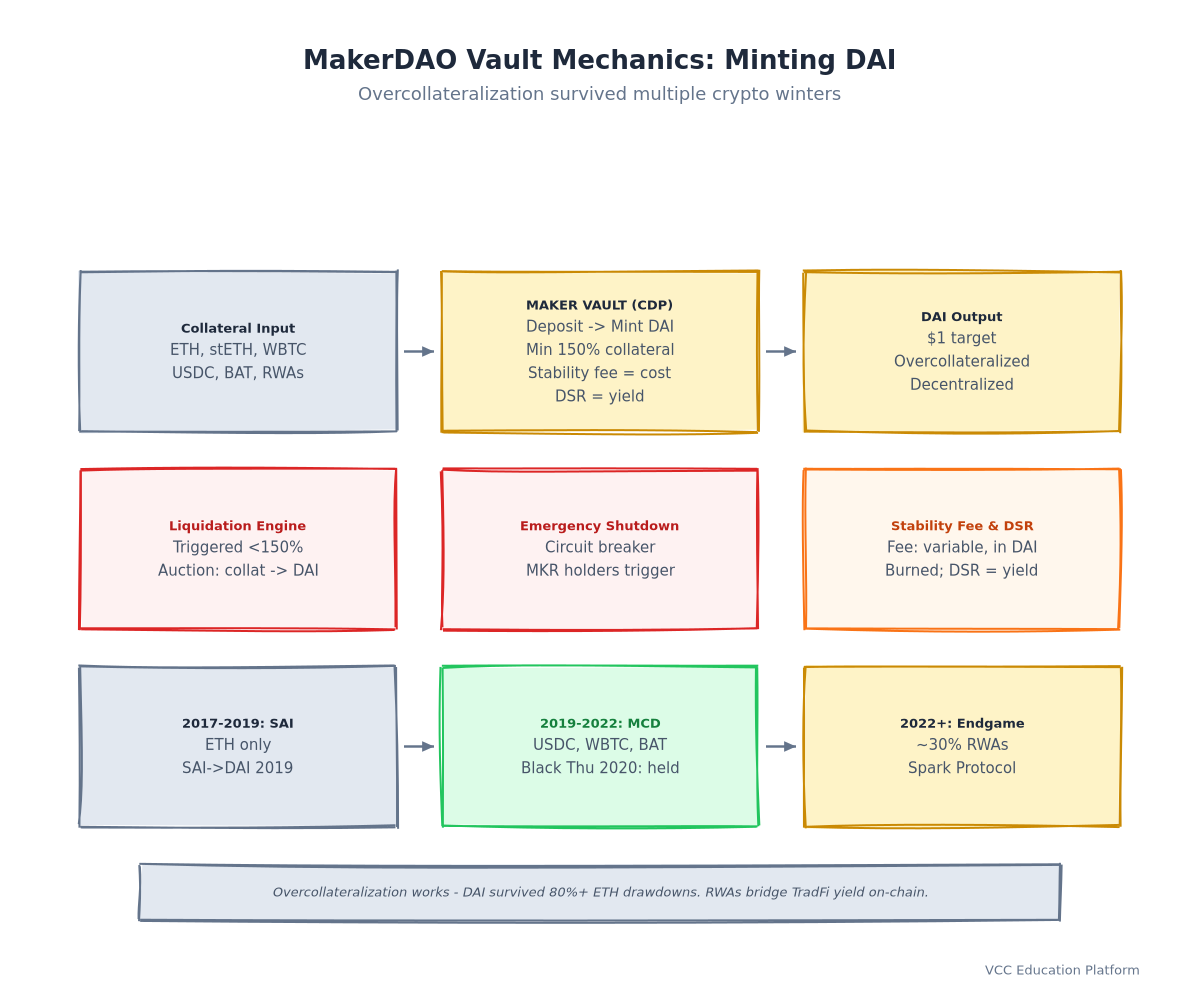
MakerDAO (launched December 2017) created DAI: a decentralized stablecoin backed by overcollateralized crypto assets in Collateralized Debt Positions (CDPs), later renamed Vaults.
`markdown Core Mechanism: Deposit $150 ETH → Mint 100 DAI (150% collateralization). If ETH drops, vault liquidates to repay DAI. Stability fee = borrowing cost. DAI Savings Rate (DSR) = yield for holders. `
Critical Evolution: Single-Collateral (SAI) → Multi-Collateral DAI (2019) → RWA Integration (2022+)
- 2019: Added USDC, WBTC, BAT as collateral types
- 2020: "Black Thursday" crash tested liquidation engine—system held but exposed oracle latency
- 2022–2023: Endgame Plan — RWA vaults (US Treasury bonds), SubDAOs, governance restructuring
- 2024: Spark Protocol — Permissioned lending for institutions, DAI direct deposit module
Metrics That Matter
- DAI Supply: 5B+ at peak (2022), ~4.5B (2024)
- Collateral Mix: ~30% RWAs (US Treasuries), ~25% ETH/stETH, ~20% USDC, rest diverse
- Revenue: >$200M+ annually from stability fees + RWA yield
- Peg Stability: Maintained $1 ± 1% through multiple crypto winters
Lessons Learned
- Overcollateralization works: DAI survived 80%+ ETH drawdowns without depegging.
- Governance is attack surface: Emergency shutdown (ESM) is the ultimate circuit breaker.
- RWAs bridge TradFi yield: US Treasury backing brings 4–5% risk-free yield on-chain—major institutional signal.
- Stablecoin design space is vast: DAI (overcollateralized) vs. USDC (custodial) vs. FRAX (fractional) vs. UST (algorithmic, failed) — each makes different trust/liquidity tradeoffs.
Case Study 4: Curve Finance — Specialized AMMs Win Niche Markets
The Problem: Stablecoin Swaps on Uniswap = High Slippage
Swapping USDC/USDT on Uniswap v2 incurred 0.3%+ slippage even for small trades—unacceptable for stablecoin arbitrage and large treasury operations.
The Innovation: StableSwap Invariant (Hybrid Constant Sum + Constant Product)
Curve (launched January 2020) designed an AMM optimized for correlated assets (stablecoins, wrapped BTC, stETH/ETH):
` Invariant: A × Σxᵢ + Πxᵢ = constant Where A = amplification coefficient (tunes between constant sum and constant product) `
High A = near-constant sum (1:1 swaps with minimal slippage). Low A = behaves like Uniswap.
The veCRV Flywheel: Aligning LPs, Traders, and Protocol
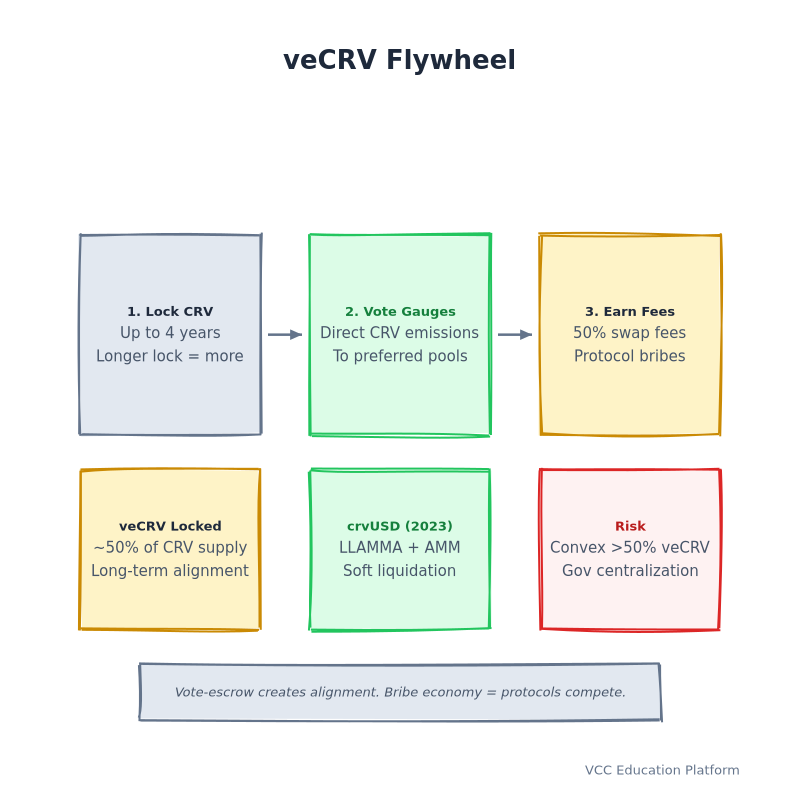
- veCRV (vote-escrowed CRV): Lock CRV up to 4 years → voting power + fee share + gauge weight control
- Gauges: veCRV holders direct CRV emissions to specific pools
- Bribes: Protocols (Convex, Frax, Yearn) pay veCRV voters for emissions → "Curve Wars"
Metrics That Matter
- Stablecoin Swap Volume: >$500B cumulative
- veCRV Locked: ~50% of CRV supply (long-term alignment)
- crvUSD (2023): LLAMMA lending + AMM hybrid — soft liquidation via price bands
- Convex Finance: Built on Curve, controls >50% veCRV, $10B+ TVL
Lessons Learned
- Specialization beats generalization: Curve dominates stable swaps; Uniswap dominates volatile pairs.
- Vote-escrow tokenomics create alignment: veCRV locks align long-term holders with protocol success.
- Bribe economy is a new primitive: Protocols compete for emissions—creates sustainable demand for governance tokens.
- Concentration risk is real: Convex controlling majority veCRV raises governance centralization concerns.
Case Study 5: Lido — Liquid Staking Unlocks Staked Capital
The Problem: Staking = Illiquid Opportunity Cost
Ethereum's transition to Proof-of-Stake (2022) required 32 ETH + technical ops to run a validator. Staked ETH was locked until withdrawals (enabled March 2023). Users faced: stake and lose liquidity OR don't stake and lose yield.
The Innovation: stETH — Liquid Staking Token
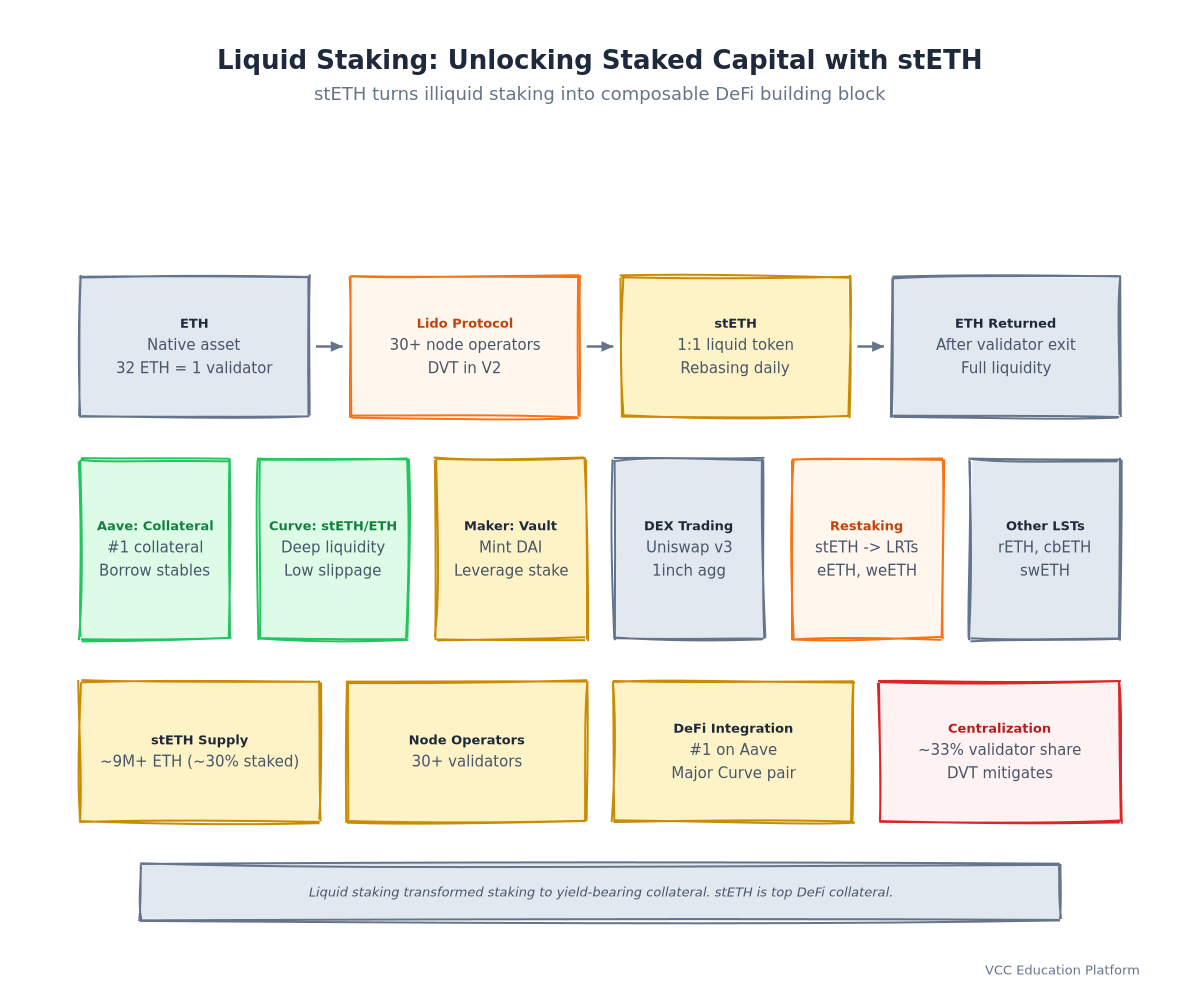
Lido (launched December 2020) issues stETH 1:1 for staked ETH. stETH is:
- Rebasing: Balance increases daily with staking rewards
- Composable: Usable as collateral on Aave, Maker, Curve; tradeable on DEXs
- Distributed: 30+ professional node operators (DVT in V2)
Lido V2 (2023): Withdrawals + Staking Router + DVT
- Withdrawal Queue: Request ETH → receive after validator exit queue (~1–5 days)
- Staking Router: Modular architecture for new node operator onboarding
- DVT (Distributed Validator Technology): Split validator keys across operators — reduces slashing risk
Metrics That Matter
- stETH Supply: ~9M+ ETH (~30% of all staked ETH)
- Node Operators: 30+ professional validators (down from 100+ target for decentralization)
- DeFi Integration: stETH is #1 collateral on Aave, major pair on Curve (stETH/ETH)
- Fee Split: 10% of staking rewards → 5% node operators, 5% Lido DAO treasury
Lessons Learned
- Liquid staking > native staking for DeFi users: stETH turned staking yield into DeFi building block.
- Centralization tradeoff: Lido's ~33% validator share concerns Ethereum researchers; DVT mitigates but doesn't eliminate.
- Withdrawals change everything: Post-Shapella (March 2023), stETH/ETH peg tightened; arb opportunities compressed.
- LSTs (Liquid Staking Tokens) are a category: rETH (Rocket Pool), cbETH (Coinbase), swETH (Swell) — each makes different decentralization/UX tradeoffs.
Case Study 6: GMX — Perpetual DEX Competing with CEXs
The Problem: Order Book DEXs Fail on UX; AMM Perps Have Oracle Risk
dYdX (order book) achieved CEX-like UX but required off-chain matching. Early AMM perps (Perpetual Protocol v1) suffered from oracle manipulation and poor pricing for low-liquidity assets.
The Innovation: GLP — Multi-Asset Liquidity Pool as Counterparty
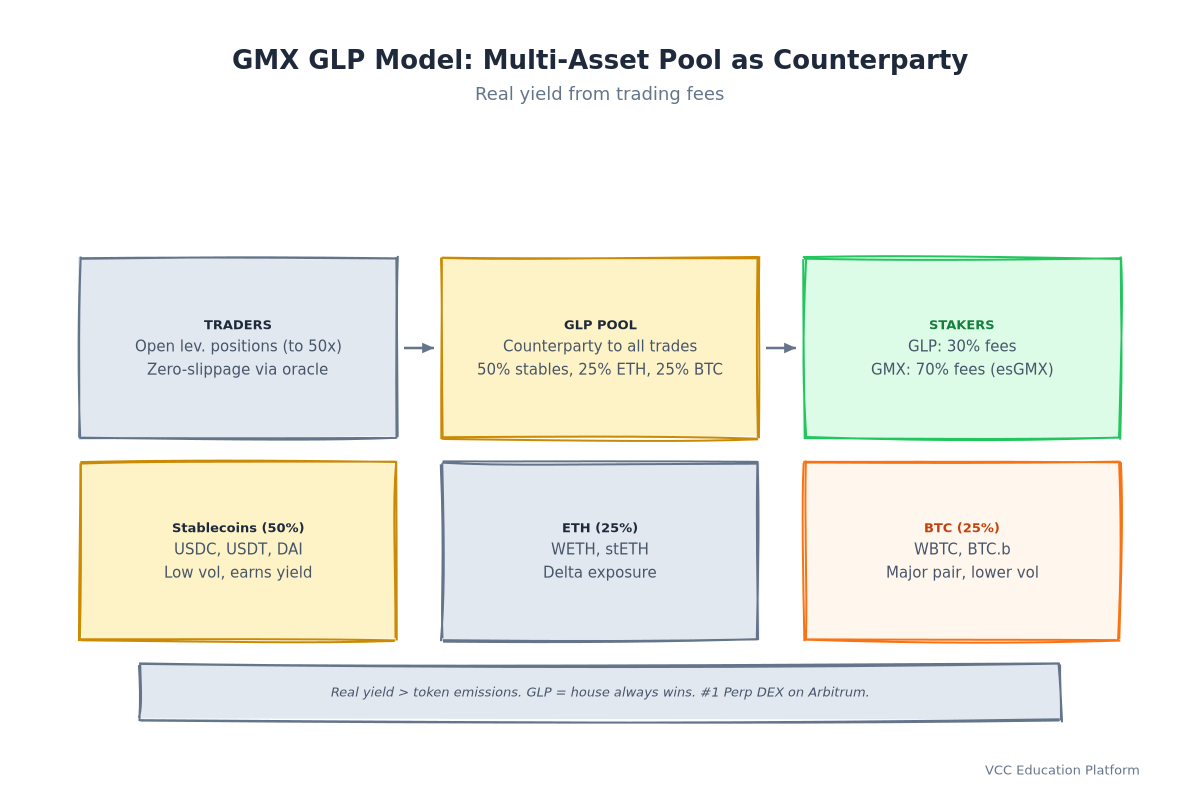
GMX (launched September 2021 on Arbitrum) uses GLP (GMX Liquidity Provider) token:
- Composition: ~50% stablecoins, ~25% ETH, ~25% BTC (adjustable)
- Traders vs. GLP: Traders open leveraged positions; GLP holders are the counterparty (house)
- Zero-Slippage Swaps: Chainlink oracles + price impact formula = CEX-like execution up to large sizes
- Real Yield: 30% platform fees → GLP stakers; 70% → GMX token stakers (esGMX)
GMX V2 (2023): Modular Perps + Synthetic Assets
- GM Pools: Isolated markets (e.g., ETH/USDC, BTC/USDC, ARB/USDC) — risk isolation
- Synthetic Assets: gmBTC, gmETH — oracle-backed synthetic tokens for spot trading
- Improved Oracle: TWAP + Chainlink + custom price aggregation
Metrics That Matter
- Cumulative Volume: >$200B+ (Arbitrum + Avalanche)
- Fee Revenue: >$150M+ annually (real yield, not token emissions)
- GLP APR: 15–25% (fees + escrowed GMX rewards)
- Market Share: #1 perp DEX by volume on Arbitrum
Lessons Learned
- Real yield > token emissions: GMX proved sustainable fee-sharing beats mercenary liquidity mining.
- Oracle risk is manageable: TWAP + premium/discount bounds + strict position limits contain manipulation.
- GLP model = "house always wins": Long-term, GLP holders profit from trader losses (fees + liquidations).
- L2 first strategy works: Launching on Arbitrum captured early adopters; Ethereum mainnet deployment followed.
Case Study 7: Cross-Chain DeFi — Bridges, Messaging, and Native Swaps
The Problem: Fragmented Liquidity Across Chains
DeFi liquidity fragmented across Ethereum, BSC, Polygon, Arbitrum, Optimism, Solana, Avalanche. Users needed bridges—creating $2B+ in hack losses (2022–2023).
Three Architectural Approaches
| Approach | Protocol | Mechanism | Trust Model | Notable Incident |
|---|---|---|---|---|
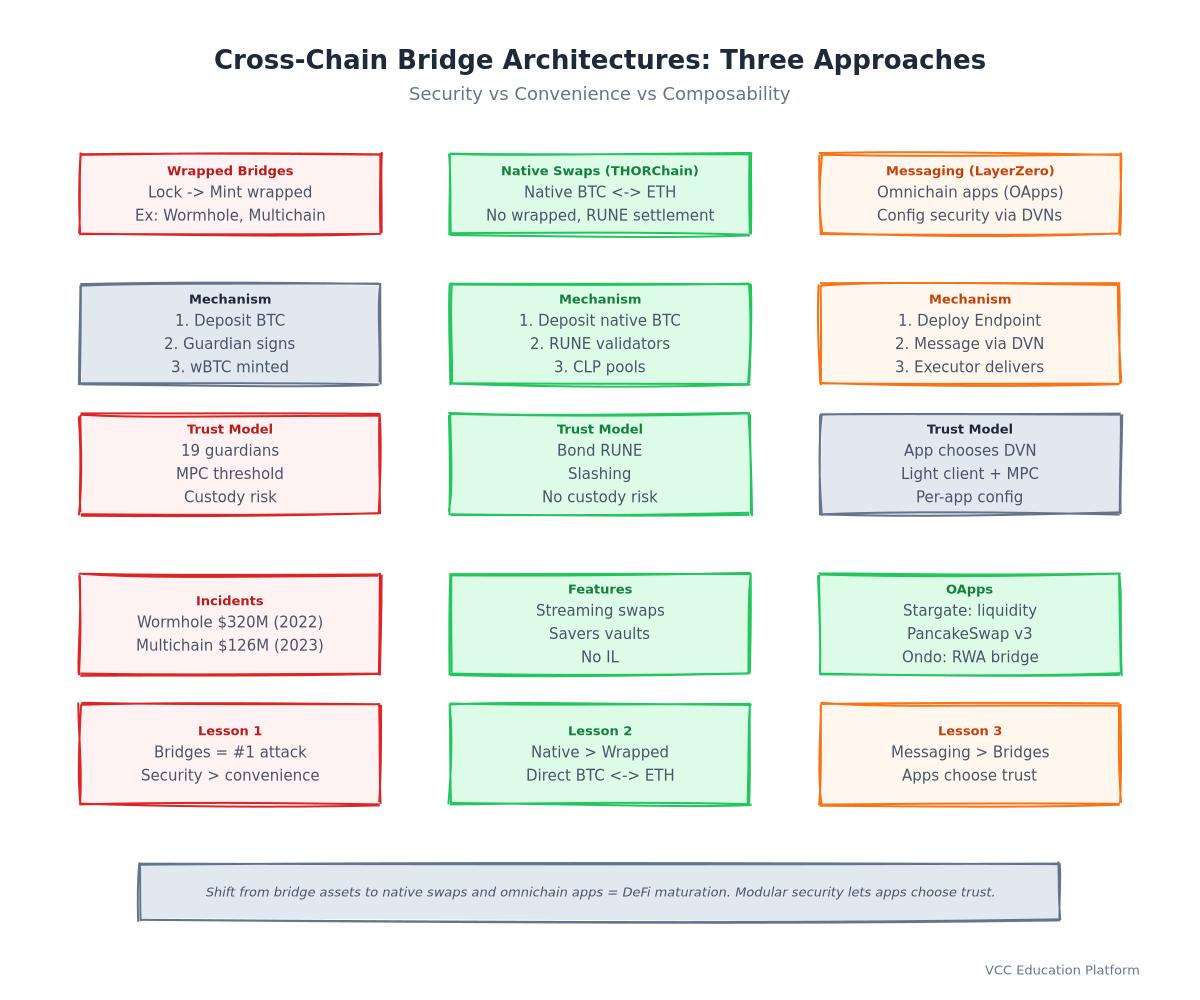
| Asset Bridge (Wrapped) | Wormhole, Multichain | Lock on source → mint wrapped on dest | Guardian set / MPC | Wormhole $320M (2022), Multichain $126M (2023) |
| Native Swap | THORChain | RUNE-bonded validators, CLP pools, slip-based fees | Economic security (RUNE stake) | $8M exploit (2022), recovered |
| Messaging Layer | LayerZero, Axelar, Wormhole (NFT) | Ultra-light clients / MPC / PoS relayers | Configurable (app chooses) | Nomad $190M (2022) — message verification bug |
THORChain Deep Dive: Native Asset Swaps
- No Wrapped Assets: Swap BTC → ETH directly (no wBTC)
- RUNE as Settlement Asset: Every pool paired with RUNE (BTC/RUNE, ETH/RUNE)
- Streaming Swaps: Large orders split over time to minimize slippage
- Savers Vaults: Single-sided yield on native assets (BTC, ETH) — no IL
LayerZero: Omnichain Applications (OApps)
- Endpoints: Lightweight on-chain contracts (1 per chain)
- DVNs (Decentralized Verifier Networks): App-configurable security (Google Cloud, LayerZero Labs, custom)
- Use Cases: Stargate (omnichain liquidity), PancakeSwap v3 (cross-chain), Ondo (RWA bridging)
Lessons Learned
- Bridges are the #1 attack vector: $2B+ lost — security > convenience.
- Native swaps > wrapped assets: THORChain eliminates bridge risk for supported chains.
- Messaging layers enable composability: LayerZero allows applications to go cross-chain, not just assets.
- Modular security wins: Apps should choose their trust assumptions (LayerZero DVNs) rather than inherit bridge risk.
Case Study 8: DeFi Failures — The Tuition Paid for Innovation
Every major DeFi failure catalyzed new primitives. Here's the failure taxonomy:
| Failure | Date | Root Cause | TVL Lost | Primitive Born |
|---|---|---|---|---|
| Terra/LUNA | May 2022 | Algorithmic stablecoin death spiral (UST/UST) | $40B+ | Overcollateralized stablecoin dominance; FRAX v2, crvUSD |
| FTX/Celsius | Nov 2022 / Jun 2022 | Centralized custody + commingled funds | $8B+ / $4B+ | Proof-of-Reserves, self-custody emphasis, CeDeFi scrutiny |
| Euler Finance | Mar 2023 | Oracle manipulation + missing liquidation checks | $197M | Soft liquidation, Dutch auction liquidations, Euler v2 |
| Mango Markets | Oct 2022 | Oracle manipulation (MNGO thin liquidity) | $116M | Perpetual oracle standards, position limits |
| Beanstalk | Apr 2022 | Flash loan governance attack (supermajority vote) | $182M | Timelock governance, flash loan resistance |
| Nomad Bridge | Aug 2022 | Message verification bug (root = 0x00) | $190M | Multi-verifier messaging (LayerZero DVNs) |
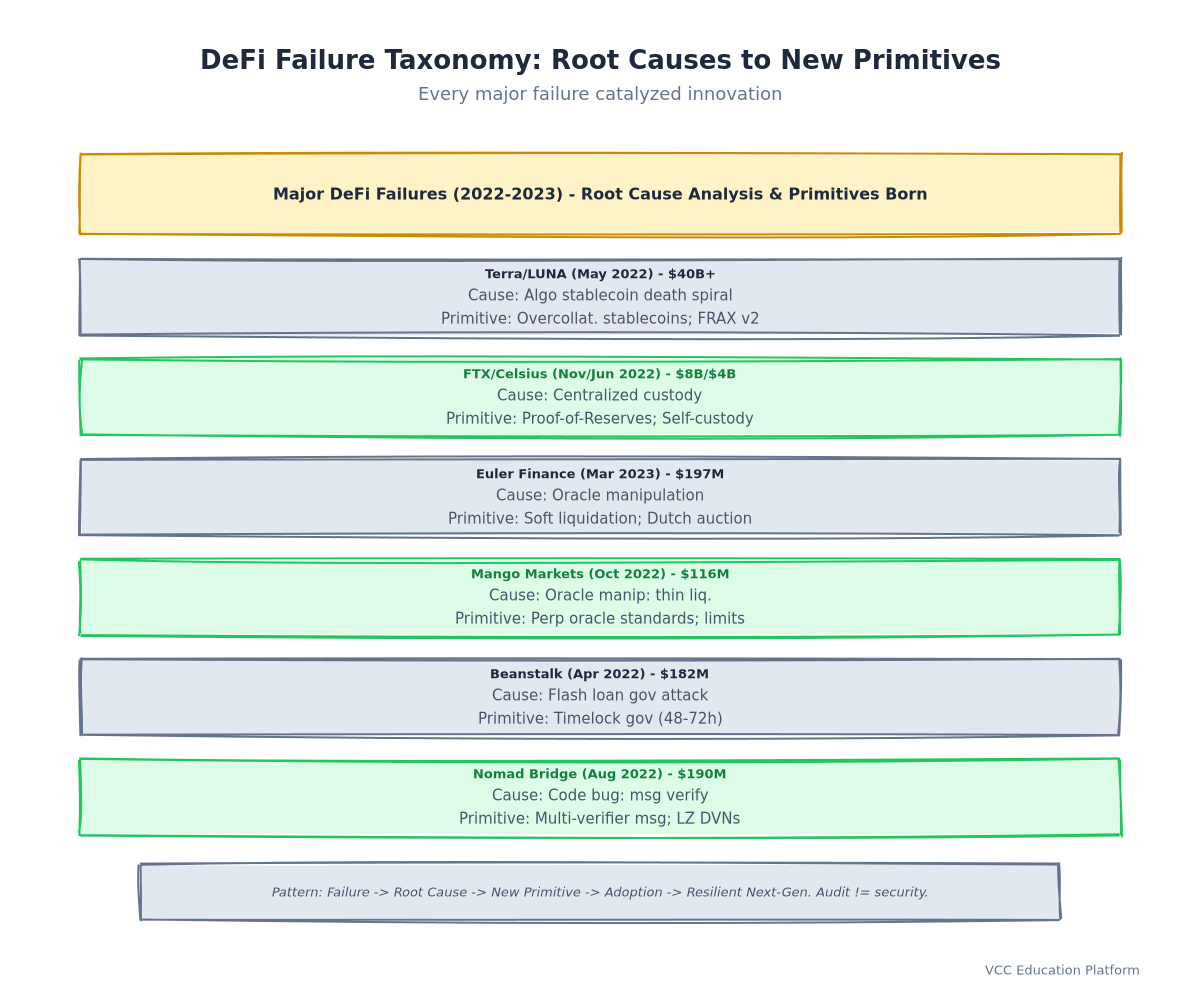
The Failure → Innovation Pattern
` Failure Event ↓ Root Cause Analysis (post-mortems, audits) ↓ New Primitive / Design Pattern ↓ Industry-Wide Adoption ↓ Next-Gen Protocols More Resilient `
Lessons Learned
- Economic attacks > code bugs: Most losses from incentive design flaws, not smart contract bugs.
- Oracle security is foundational: Chainlink dominance + TWAP + manipulation bounds now standard.
- Governance needs timelocks: 48–72 hour delays prevent flash loan governance attacks.
- Audit ≠ security: Multiple audits missed Euler/Nomad bugs; formal verification + bug bounties + monitoring needed.
- Resilience compounds: Aave, Maker, Curve survived 2022 crashes because they had battle-tested risk frameworks.
Synthesis: What DeFi Case Studies Teach Us
Pattern 1: Specialization Beats Generalization
- Uniswap → general AMM
- Curve → stablecoin specialist
- GMX → perp specialist
- Lido → liquid staking specialist
Winner: Protocols that own a niche before expanding.
Pattern 2: Tokenomics Must Align Incentives Long-Term
- veCRV (Curve): 4-year lock → protocol loyalty
- stETH (Lido): 1:1 rebasing → DeFi composability
- GLP (GMX): real yield → sustainable LP retention
- Safety Module (Aave): stakers bear tail risk → protocol insurance
Loser: Mercenary liquidity mining (high emissions, zero loyalty).
Pattern 3: Real Yield > Inflationary Rewards
Protocols generating revenue from usage (fees, interest, spreads) outlast those paying yield in native tokens. GMX, Aave, Maker, Curve, Lido all have real revenue streams.
Pattern 4: Composability Creates Moats
stETH on Aave + Curve + Maker creates a flywheel: more integrations → more utility → more demand → more integrations. Protocols that become "DeFi legos" win.
Pattern 5: Risk Management Is a Product Feature
Aave's isolation mode, Euler's soft liquidation, Maker's ESM, GMX's position limits — risk controls are now competitive differentiators, not afterthoughts.
Vietnam-Specific DeFi Context
Vietnam ranks #1 globally in crypto adoption (Chainalysis 2023), driven by:
- Mobile-first users: 70%+ access via smartphone → favors simple UX (Coin98, simple DEX interfaces)
- High retail participation: Yield farming, airdrop hunting, memecoin trading dominate vs. institutional DeFi
- Local innovation: Kyber Network (DMM AMM), Coin98 Wallet (multi-chain), Ninety Eight (Web3 gaming + DeFi)
- Regulatory gray zone: SBV doesn't recognize crypto as payment but doesn't ban holding → DeFi operates in "tolerated" space
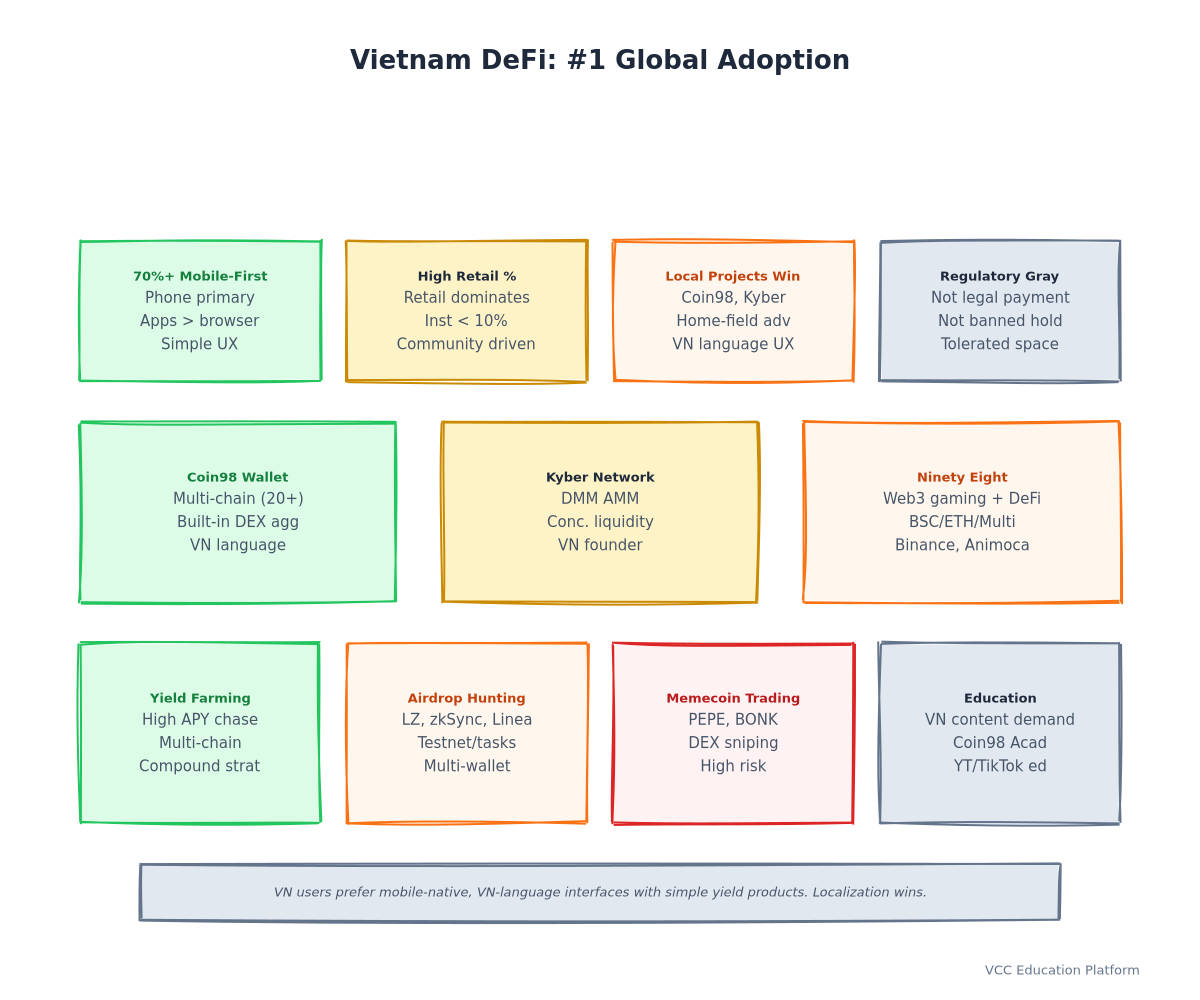
Implication for builders: Vietnamese users prefer mobile-native, Vietnamese-language interfaces with simple yield products over complex strategy vaults. Coin98's success proves localization wins.
Quick Reference: Protocol Comparison Matrix
| Protocol | Category | Launch | Key Innovation | TVL Peak | Status (2024) |
|---|---|---|---|---|---|
| Uniswap | DEX (AMM) | 2018 | x×y=k, concentrated liquidity | $10B | Dominant |
| Aave | Lending | 2020 | Flash loans, aTokens, Safety Module | $20B | Multi-chain leader |
| MakerDAO | Stablecoin | 2017 | Overcollateralized DAI, RWAs | $8B (DAI supply) | Institutional bridge |
| Curve | DEX (StableSwap) | 2020 | Low-slippage stable swaps, veCRV | $10B | Stable swap king |
| Lido | Liquid Staking | 2020 | stETH, DVT, withdrawal queue | $30B+ (stETH) | ETH staking leader |
| GMX | Perp DEX | 2021 | GLP multi-asset pool, real yield | $800M | Perp DEX leader |
| THORChain | Cross-chain | 2021 | Native swaps, RUNE bonding | $200M | Native swap pioneer |
| LayerZero | Messaging | 2022 | Omnichain apps, DVNs | N/A (infra) | OApp standard |
FAQ: DeFi Case Studies
Q: Which DeFi protocol has the best risk-adjusted returns for LPs? A: Depends on risk tolerance. GLP (GMX) offers real yield with market-neutral exposure. Curve stable pools offer low IL but lower yield. Aave lending offers variable rates with Safety Module backstop. Diversify across primitives.
Q: Are algorithmic stablecoins dead after Terra? A: Pure algorithmic (UST-style) are discredited. Fractional-algorithmic (FRAX v2, crvUSD) and overcollateralized (DAI, LUSD) thrive. The spectrum shifted toward collateralization.
Q: How to evaluate a new DeFi protocol's safety? A: Check: (1) Audit count + firms, (2) Time in production + TVL history, (3) Risk framework (Gauntlet/Chaos Labs), (4) Governance timelocks, (5) Oracle redundancy, (6) Bug bounty size, (7) Insurance coverage (Nexus Mutual, Sherlock).
Q: What's the next major DeFi primitive? A: Permissioned DeFi (Aave Arc, Maker Spark) for institutions; RWA tokenization (Ondo, Maple, Centrifuge); Intent-centric architectures (Anoma, SUAVE); ZK-proven DeFi (privacy + compliance).
Q: How does DeFi in Vietnam differ from global DeFi? A: Higher retail %, mobile-first, Vietnamese-language UX critical, airdrop/yield farming culture, local projects (Kyber, Coin98) have home-field advantage. Regulatory uncertainty favors self-custody wallets.
Key Takeaways
- DeFi evolves in public: Each protocol builds on predecessors' lessons—open source accelerates iteration.
- Failures are tuition: $2B+ in hacks/crashes funded the risk frameworks protecting today's $100B+ TVL.
- Specialization + composability = moat: Own a niche, become a lego for others.
- Real yield sustains: Fee revenue > token emissions for long-term LP retention.
- Institutional adoption via RWAs: Tokenized Treasuries, permissioned lending, compliant stablecoins are the 2024+ wedge.
- Vietnam is a DeFi powerhouse: Local builders should leverage mobile-first, Vietnamese-language, retail-friendly design.
Further Reading & Primary Sources
Whitepapers & Docs:
- Uniswap v3 Whitepaper: https://uniswap.org/whitepaper-v3.pdf
- Aave v3 Whitepaper: https://github.com/aave/aave-v3-core
- MakerDAO Endgame: https://blog.makerdao.com/endgame-plan/
- Curve StableSwap: https://curve.fi/files/curve-whitepaper.pdf
- Lido V2 Spec: https://docs.lido.fi/
- GMX V2 Docs: https://gmx.io/docs/v2
- THORChain Docs: https://dev.thorchain.org/
- LayerZero V2: https://layerzero.network/docs/v2
Research Reports:
- Messari: Aave, Uniswap, GMX, Lido protocol reports
- Delphi Digital: MakerDAO, Curve, DeFi primitives
- DefiLlama: TVL analytics, Curve Wars, cross-chain landscape
- Paradigm: AMM research, MEV, bridge security
- Electric Capital: Developer reports, cross-chain DeFi
Post-Mortems:
- Terra/LUNA: LFG Report, CoinDesk deep dive
- FTX: Bankruptcy filings, Coindesk timeline
- Euler: Euler Finance blog post-mortem
- Nomad: Paradigm bridge security analysis
This reference guide is updated quarterly. Last updated: September 2026. For real-time metrics, consult DeFi Llama, Token Terminal, and Dune Analytics dashboards.