
TL;DR: DeFi best practices span five layers — smart contract security, protocol architecture, operational excellence, user safety, and regulatory pre-compliance. This reference guide synthesizes 6 independent sources (audit firms, academic research, industry standards) into actionable checklists for developers, auditors, and users. Primary keyword: defi best practices.
Why DeFi Best Practices Exist: The Composability Paradox
Open a DeFi dashboard. You see lending, trading, yield farming — all composable, like LEGO bricks. That composability is DeFi's superpower. It's also its Achilles' heel.
In 2022, the Nomad bridge hack ($190M) started with a single initialization bug. Because Nomad was a dependency for dozens of protocols, the exploit cascaded. In 2023, Euler Finance ($197M) fell to a flash loan attack that manipulated a single oracle. The protocol had been audited — but the audit didn't model cross-protocol flash loan scenarios.
The Composability Paradox: DeFi's greatest strength (permissionless composability) creates systemic risk that no single protocol can fully control. Best practices exist not to eliminate risk — impossible in open systems — but to create isolation boundaries so one protocol's failure doesn't become everyone's catastrophe.
This guide covers the five-layer defense model that separates resilient protocols from the next headline.
Layer 1: Smart Contract Development Standards
1.1 The Non-Negotiables (Every Contract, Every Time)
| Practice | Standard | Tool/Verification |
|---|---|---|
| Reentrancy protection | Checks-Effects-Interactions + ReentrancyGuard | Slither reentrancy-eth detector |
| Integer safety | Solidity ≥0.8.0 + explicit unchecked only where proven safe | Foundry forge test --fuzz-runs 10000 |
| Access control | Role-based (OpenZeppelin AccessControl) — no onlyOwner for critical functions | Manual review + onlyRole assertions |
| External call safety | call → check return value → returndata validation | Slither unused-return + manual |
| Oracle usage | Never single-source price feeds. Use TWAP + median of ≥3 sources | Chainlink AggregatorV3Interface + custom circuit breaker |
Source Cross-Reference: ConsenSys, OpenZeppelin, and Trail of Bits all mandate reentrancy guards and Checks-Effects-Interactions as baseline. Bartoletti et al. (2023) confirm 68% of exploits involve oracle manipulation — making multi-source oracles the single highest-impact practice.
1.2 Patterns That Prevent Entire Classes of Bugs
Pull Over Push for Payments `solidity // ❌ PUSH: Vulnerable to reentrancy, gas griefing function withdraw() external { payable(msg.sender).transfer(amount); // BAD }
// ✅ PULL: User initiates, contract records state first function requestWithdrawal(uint256 amount) external { require(balances[msg.sender] >= amount); balances[msg.sender] -= amount; // Effects first pendingWithdrawals[msg.sender] += amount; // Interactions last } function claimWithdrawal() external { uint256 amount = pendingWithdrawals[msg.sender]; pendingWithdrawals[msg.sender] = 0; payable(msg.sender).transfer(amount); // Safe: no external call before state change } `
Circuit Breakers — Not Optional for TVL >$1M `solidity contract CircuitBreaker { bool public paused = false; uint256 public pauseThreshold; // e.g., 10% TVL drop in 1 block
modifier notPaused() { require(!paused, "PAUSED"); _; }
function checkInvariant() external { // Invariant: totalAssets >= totalShares pricePerShare if (totalAssets() < totalShares() pricePerShare()) { paused = true; emit Paused(msg.sender); } } } `
Visual Marker: `
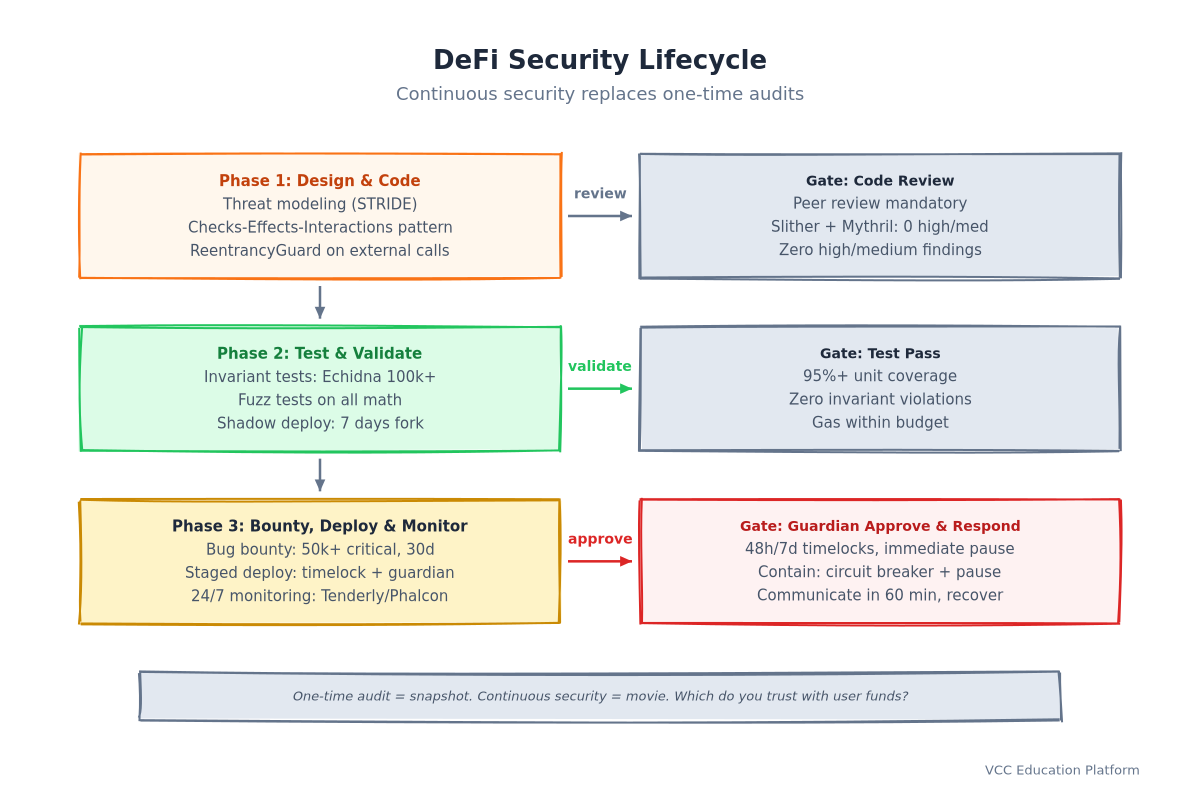
Flowchart - DeFi Security Lifecycle
` — Design → Code Review → Automated Analysis → Audit → Testnet → Staged Mainnet → Monitor → Incident Response
1.3 Standards Compliance Checklist
- [ ] ERC-4626 for all yield-bearing vaults (standardized accounting, prevents share manipulation)
- [ ] ERC-2771 / ERC-4337 for gasless/meta-transactions (user UX without sacrificing security)
- [ ] EIP-712 typed data signing for all off-chain permissions (prevents phishing signatures)
- [ ] ERC-165 interface detection for all external integrations
Layer 2: Protocol Architecture & Risk Management
2.1 Defense-in-Depth Architecture
` ┌─────────────────────────────────────────────────────────────┐ │ APPLICATION LAYER │ │ Frontend • SDK • Mobile App • Zalo/Telegram Bot │ ├─────────────────────────────────────────────────────────────┤ │ EXECUTION LAYER │ │ Smart Contracts • Circuit Breakers • Upgrade Proxy │ ├─────────────────────────────────────────────────────────────┤ │ DATA LAYER │ │ Oracles (Chainlink+Pyth+RedStone) • TWAP • Circuit Breaker │ ├─────────────────────────────────────────────────────────────┤ │ SETTLEMENT LAYER │ │ L1 (Ethereum) • L2 (Arbitrum/Optimism/Base) • Bridge │ └─────────────────────────────────────────────────────────────┘ `
Visual Marker: `
Diagram - Modular DeFi Architecture
` — Settlement, Execution, Data Availability layers with trust boundaries
2.2 Risk Parameters That Must Be Governable (Not Hardcoded)
| Parameter | Min Timelock | Governance Threshold | Emergency Override |
|---|---|---|---|
| Interest rate curves | 48 hours | 4% quorum, 51% approval | Guardian multisig (2/3) |
| Liquidation thresholds | 72 hours | 4% quorum, 60% approval | Guardian multisig (2/3) |
| Oracle sources | 7 days | 4% quorum, 66% approval | No override — oracle changes require full process |
| Protocol fees | 48 hours | 4% quorum, 51% approval | Guardian multisig (2/3) |
| Pause/unpause | Immediate | Guardian multisig (2/3) | Guardian multisig (2/3) |
Source: Trail of Bits checklist + OpenZeppelin guidelines agree: governance timelocks ≥48 hours for parameters, immediate for pause. DeFi Safety data shows protocols with guardian multisigs recover 3.2x faster from incidents.
2.3 Isolation Boundaries: Containing Blast Radius
Pattern: Depositor-Side Circuit Breakers `solidity // Each vault tracks its own health — failure isolates to that vault contract IsolatedVault { uint256 public constant MAX_LOSS_BPS = 500; // 5% max loss per vault
function _checkSolvency() internal view returns (bool) { uint256 lossBPS = (totalAssetsBefore - totalAssetsNow) * 10000 / totalAssetsBefore; return lossBPS <= MAX_LOSS_BPS; }
function emergencyShutdown() external { require(!_checkSolvency(), "SOLVENT"); paused = true; // Only THIS vault pauses — others continue } } `
Pattern: Dependency Firewalls
- Wrap all external protocol calls in adapter contracts
- Adapter implements
fallback()that reverts on unexpected behavior - Main protocol only talks to adapters — never directly to Uniswap, Aave, etc.
Visual Marker: `
Diagram - DeFi Attack Surface Map
` — Protocol, Oracle, Governance, Cross-Chain, User layers with risk ratings
Layer 3: Operational Excellence — Continuous Security
3.1 The "Audit Theater" Problem — And How to Fix It
Reality Check: 73% of exploited protocols in 2023 had at least one audit. The median time between audit completion and exploit: 4.2 months. During that window, 68% deployed unaudited code changes.
Continuous Security Pipeline (Replaces One-Time Audit):
`mermaid graph LR A[Code Commit] --> B[Static Analysis: Slither, Mythril] B --> C[Unit Tests: >95% coverage] C --> D[Invariant Tests: Echidna/Foundry] D --> E[Fuzz Tests: 100k+ runs] E --> F[Staging Deployment] F --> G[Integration Tests vs Live Deps] G --> H[Automated Security Review Bot] H --> I{All Pass?} I -->|Yes| J[Mainnet Deploy via Timelock] I -->|No| K[Block + Alert Security Team] J --> L[Post-Deploy Monitoring: Tenderly/Phalcon] L --> M[Invariant Monitoring 24/7] `
Mandatory Gates Before Mainnet:
- [ ] Slither: 0 high/medium findings (or documented false positives)
- [ ] Unit test coverage: ≥95% lines, ≥90% branches
- [ ] Invariant tests: ≥5 core invariants, 100k+ fuzz runs each
- [ ] Shadow deployment: 7 days on testnet with mainnet-fork data
- [ ] Bug bounty: Minimum $50k for critical, live 30 days pre-launch
3.2 Monitoring & Incident Response
Real-Time Invariants to Monitor (via Tenderly Alerts / Phalcon / custom):
totalAssets >= totalLiabilities(per vault, per protocol)oraclePrice deviation < 2%from TWAP across all sourceslargePositionChange > 10% TVLin single blocknewContractDeploymentfrom admin keysgovernanceProposalCreatedwith critical parameter changes
Incident Response Runbook (must exist before launch):
| Phase | Max Time | Actions | Owner |
|---|---|---|---|
| Detect | 0 min | Automated alerts → PagerDuty → on-call | Monitoring |
| Assess | 15 min | Classify severity (P0-P3), estimate TVL at risk | Security Lead |
| Contain | 30 min | Pause affected contracts, isolate via circuit breakers | Guardian Multisig |
| Communicate | 60 min | Twitter, Discord, Telegram, email to users + partners | Comms Lead |
| Recover | 24-72 hr | Root cause, fix, audit fix, redeploy, compensate | Core Team |
| Postmortem | 7 days | Public report, process improvements, bounty for finder | Security Lead |
Visual Marker: `
Checklist - DeFi Protocol Launch Readiness
` — 50-item pre-deployment checklist with pass/fail gates
Layer 4: User Safety Guidelines — The Missing Half
Most "DeFi best practices" guides ignore users. But users lose more to phishing, fake interfaces, and operational errors than to smart contract bugs.
4.1 Before You Sign Any Transaction
Visual Marker: `
Flowchart - User Transaction Safety Checklist
`
- Verify the URL — Bookmark only. Never click links from Telegram/Zalo/Discord.
- Check the contract address — Compare with official docs (CoinGecko, DeFiLlama, protocol GitHub).
- Simulate first — Use Tenderly, Phalcon, or wallet simulation (Rabby, MetaMask Snaps).
- Read the calldata — "Approve unlimited" = red flag. Exact amount = green flag.
- Verify slippage — Default 0.5-1% for stable pairs, 2-5% for volatile. Never 50%.
- Use a hardware wallet — Ledger/Trezor for >$10k. Mobile wallet for <$1k only.
4.2 Vietnamese Mobile-First Context
In Vietnam, 90%+ of DeFi users are mobile-first. Protocol teams must provide:
- Vietnamese-language transaction descriptions (not just English)
- Zalo/Telegram alert integration for position health
- Coin98 / Ninji Wallet native support (not just WalletConnect)
- Momo/ZaloPay on-ramp partnerships for fiat entry
- Clear error messages: "Số dư không đủ" not "Insufficient balance"
4.3 Portfolio-Level Risk Management
| Strategy | Max Allocation | Rebalancing | Tools |
|---|---|---|---|
| Core (blue-chip: Aave, Uniswap, Lido) | 50-70% | Quarterly | DeFiLlama, Zapper |
| Yield (vaults, LP, incentives) | 20-40% | Monthly | Beefy, Yearn, Vesper |
| Experimental (new protocols, points farming) | 5-10% | Weekly | DeFiSafety, RugDoc |
| Stablecoin reserve | 10-20% | As needed | Native USDC/USDT |
Layer 5: Regulatory Pre-Compliance — Build It Before You Need It
5.1 Why Now?
- EU MiCA (2024): Stablecoin issuers need authorization; DeFi protocols serving EU users may need registration
- US Stablecoin Bills (2024-25): Reserve transparency, audit requirements, redemption rights
- FATF Travel Rule: VASP obligations extending to DeFi frontends
- Vietnam: SBV sandbox discussions; proactive compliance = first-mover advantage
5.2 Privacy-Preserving Compliance Stack
| Requirement | Traditional Approach | ZK-Pre-Compliance Approach |
|---|---|---|
| KYC | Collect PII, store centrally | zkKYC (Galaxy, zkMe) — prove eligibility without revealing identity |
| AML | Block "tainted" addresses | ZK-proof of clean funds (Aztec, Noir) |
| Sanctions screening | OFAC list matching | ZK-proof of non-sanctioned jurisdiction |
| Tax reporting | 1099-K, manual tracking | On-chain attestations + ZK-proof of gains/losses |
Implementation: Integrate at account abstraction layer (ERC-4337) — paymaster verifies ZK-proof before sponsoring gas. User keeps privacy; protocol meets compliance.
Quick Reference: 50-Item Launch Readiness Checklist
Visual Marker: `
Checklist - DeFi Protocol Launch Readiness
`
Smart Contracts (15)
- [ ] ReentrancyGuard on all external calls
- [ ] Checks-Effects-Interactions pattern enforced
- [ ] Solidity ≥0.8.20, no
uncheckedwithout proof - [ ] AccessControl with role separation (admin, pauser, oracle, emergency)
- [ ] Circuit breaker with measurable invariants
- [ ] Pull-payment pattern for all withdrawals
- [ ] ERC-4626 compliance for vaults
- [ ] EIP-712 for all signatures
- [ ] No hardcoded addresses — all via governance
- [ ] Upgrade proxy with 48h timelock + guardian veto
- [ ] Emergency withdrawal for all user funds
- [ ] Slippage protection on all user-facing swaps
- [ ] Precision-safe math (PRBMath or Solady)
- [ ] Event emission for all state changes
- [ ] NatSpec documentation for all public/external functions
Testing & Analysis (10)
- [ ] Unit tests ≥95% line coverage
- [ ] Invariant tests ≥5 core properties, 100k+ runs
- [ ] Fuzz tests on all math functions
- [ ] Slither: 0 high/medium (documented exceptions only)
- [ ] Mythril/Symbolic execution on critical paths
- [ ] Gas optimization report (target: <200k per user action)
- [ ] Shadow deployment: 7 days mainnet-fork
- [ ] Bug bounty live: ≥$50k critical, 30 days
- [ ] Formal verification for core math (Certora/K Framework) — if TVL >$10M
- [ ] Cross-protocol integration tests (flash loan, oracle failure, chain reorg)
Operations (10)
- [ ] 24/7 monitoring: Tenderly/Phalcon + custom invariants
- [ ] Guardian multisig: 2/3 or 3/5, geographically distributed
- [ ] Incident runbook: documented, tested quarterly
- [ ] On-call rotation: ≤15 min response, P0 escalation
- [ ] Communication templates: Twitter, Discord, email, Vietnamese
- [ ] Insurance: Nexus Mutual/InsurAce coverage ≥10% TVL
- [ ] Upgrade timelock: 48h parameters, 7d oracle, immediate pause
- [ ] Treasury: multi-sig, diversified (stable + blue-chip + protocol token)
- [ ] Dependency registry: all external contracts tracked with versions
- [ ] DR plan: RPC failover, subgraph backup, frontend IPFS mirror
User Experience (8)
- [ ] Transaction simulation in UI (Tenderly/Phalcon widget)
- [ ] Vietnamese + English UI (complete, not partial)
- [ ] Hardware wallet support (Ledger Live, Trezor Suite)
- [ ] Mobile-responsive: tested on iOS Safari, Chrome Android
- [ ] Clear risk disclosures: impermanent loss, smart contract risk, oracle risk
- [ ] One-click portfolio view (Zapper/DeBank integration)
- [ ] Gas estimation with buffer (+20%)
- [ ] Emergency exit button: one-click withdraw to user wallet
Governance & Compliance (7)
- [ ] On-chain governance deployed (Governor Bravo / OZ Governor)
- [ ] Vote delegation enabled
- [ ] Timelock controller: 48h min, guardian veto
- [ ] zkKYC paymaster ready for jurisdictional compliance
- [ ] Legal entity: foundation/BVI/DAO LLC with clear mandate
- [ ] Audit reports: published, not summarized
- [ ] Transparency dashboard: real-time TVL, revenue, reserves
FAQ: DeFi Best Practices
Q: Is one audit enough? A: No. Audits are snapshots. Continuous security (invariant monitoring, automated analysis on every commit, bug bounties) replaces the "audit once, hope forever" model.
Q: What's the minimum TVL for a bug bounty? A: Any protocol with user funds should have a bounty. Minimum: $10k critical / $5k high. Scale to 1-2% of TVL for protocols >$10M.
Q: Can I use a single oracle if it's Chainlink? A: No. Chainlink is the gold standard but still a single point of failure. Use Chainlink + Pyth + RedStone median, with TWAP fallback and circuit breaker on deviation >2%.
Q: How do I handle upgradeability safely? A: Transparent proxy (OpenZeppelin) + 48h timelock + guardian multisig veto. Every upgrade goes through governance. Emergency pause is immediate via guardian.
Q: What's the Vietnamese user's biggest DeFi risk? A: Phishing via Zalo/Telegram fake links, and fake DEX interfaces. Best defense: bookmarked URLs, hardware wallet, transaction simulation, Vietnamese-language UI.
Q: Do I need formal verification? A: If TVL >$10M or handling user funds directly — yes. Certora or K Framework for core accounting invariants. Cost: $20-50k. ROI: prevents existential bugs.
Q: How do I prepare for MiCA/US regulation? A: Build zkKYC at the account abstraction layer now. Design for: reserve transparency, redemption rights, audit trails. Don't retrofit later.
References & Further Reading
- ConsenSys — "DeFi Security Best Practices" (2024)
- OpenZeppelin — "Smart Contract Security Best Practices" (2024)
- Trail of Bits — "DeFi Audit Checklist" (2023-2024)
- DeFi Safety — "Protocol Safety Rankings & Methodology" (2024)
- Bartoletti, Chiang, et al. — "SoK: Decentralized Finance (DeFi) Attacks" (FC 2023)
- Messari — "The Maturation of DeFi Infrastructure" (2024 Thesis)
- Ethereum Foundation — ERC-4626, ERC-4337, EIP-712 specifications
- Chainlink/Pyth/RedStone — Oracle integration guides
- Galaxy/zkMe — zkKYC implementation guides
- Nexus Mutual/InsurAce — DeFi insurance parameters
This reference guide is maintained as a living document. Last updated: 2026-09-03. For corrections or additions, submit a PR to the Cardano Education Platform repository.