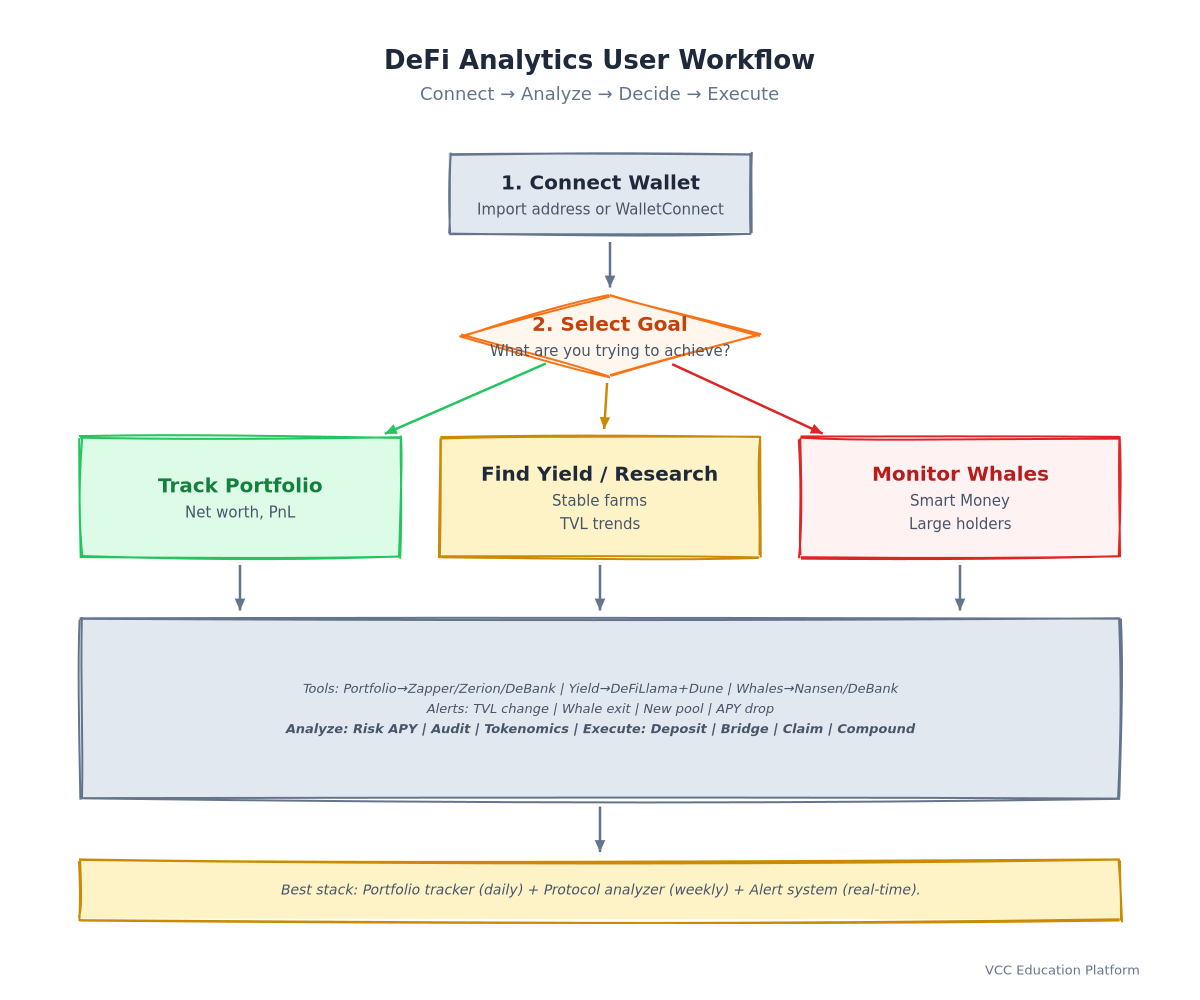
Imagine walking into a massive, unlit warehouse filled with thousands of unmarked boxes. Some contain gold. Others are empty. A few might even be rigged to explode. You have a flashlight — but it only illuminates a few feet ahead.
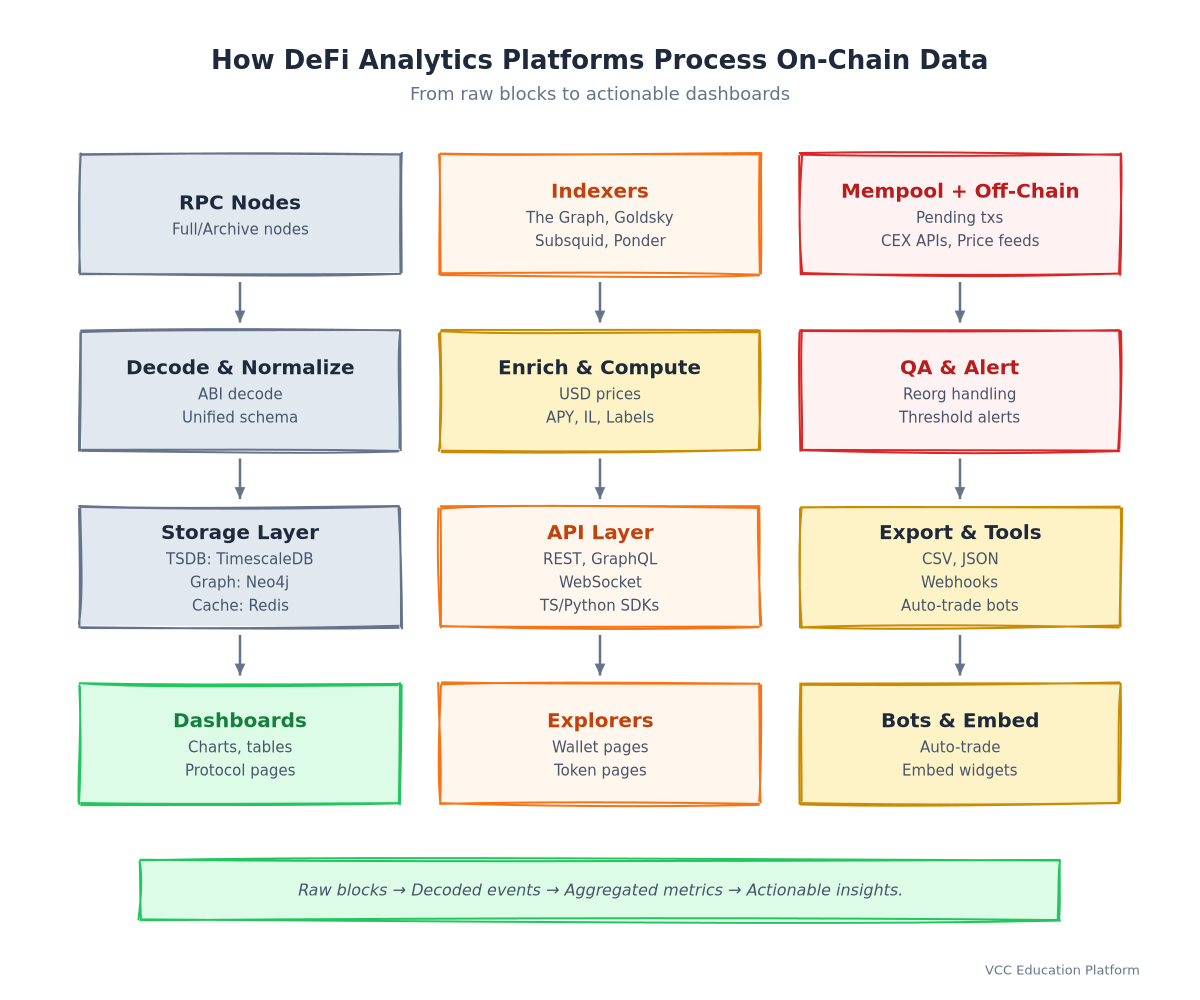
That's DeFi without analytics. The blockchain records everything transparently, but "transparent" doesn't mean "readable." Raw on-chain data is a firehose of hex-encoded logs, internal transactions, and contract interactions. Making sense of it requires tools that decode, aggregate, and visualize — tools that turn noise into signal.
DeFi analytics platforms are those tools. They're the night-vision goggles, the metal detectors, the treasure maps. Whether you're tracking a portfolio across five chains, hunting for the next 100x yield opportunity, or checking if a protocol's TVL is legitimate, the right analytics platform makes the difference between informed decisions and gambling in the dark.
This guide walks through the landscape of DeFi analytics platforms, the core metrics that matter, how to match tools to your workflow, and where the industry is heading.
Why DeFi Analytics Platforms Exist
DeFi protocols don't have quarterly earnings calls. They don't file 10-Ks. Their "financial statements" are written in real-time on public blockchains — but in a language only machines speak fluently.
Every swap, deposit, borrow, and liquidation emits events. A single Uniswap V3 swap might touch three contracts, generate five log entries, and involve nested multicall wrappers. Multiply that by millions of daily transactions across Ethereum, Solana, Arbitrum, Base, and dozens of other chains, and you have a data problem that no human can solve with a block explorer alone.
DeFi analytics platforms solve three problems:
- Decoding — Translating raw contract events into human-readable actions ("Alice deposited 10,000 USDC into Aave v3 on Arbitrum")
- Aggregating — Computing metrics across time, chains, and protocols (TVL, volume, fees, APY)
- Surfacing — Presenting insights via dashboards, alerts, and APIs so users can act
Without them, you're manually summing token balances across 20 contracts on 5 chains every time you want to know your net worth. With them, you connect a wallet and see the full picture in seconds.
Core Metrics Every DeFi User Should Track
Not all metrics are created equal. Some are vital signs; others are vanity metrics. Here's what actually matters.
Total Value Locked (TVL)
What it is: The dollar value of all assets deposited in a protocol's contracts. Why it matters: TVL is DeFi's market cap equivalent. It signals trust, liquidity depth, and protocol dominance. Caveats: TVL can be gamed. Incentive programs (liquidity mining) inflate it temporarily. Bridged assets get double-counted if not adjusted. DeFiLlama's "adjusted TVL" removes known distortions — always check which methodology a platform uses.
Volume & Fees
What it is: Trading volume (DEXes) or borrow volume (lending) and the fees generated. Why it matters: Fees = real revenue. A protocol with $1B TVL but $100 daily fees is a ghost town. Fee trends reveal genuine usage vs. mercenary capital.
APY / APR
What it is: Annualized yield on deposited assets. Critical distinction: APR = simple interest. APY = compounded. Most DeFi displays APY assuming constant reinvestment — which rarely happens automatically. Always verify: is this base APY or boosted (token incentives)?
Impermanent Loss (IL)
What it is: The opportunity cost of providing liquidity vs. simply holding the tokens. Why it matters: A 50% APY pool with 40% IL is worse than a 15% APY stablecoin pool with near-zero IL. Good analytics platforms calculate IL automatically for your positions.
Wallet & Entity Labels
What it is: Attributing addresses to known entities (Binance hot wallet, Wintermute market maker, "Smart Money" wallet #482). Why it matters: Seeing that a top-10 holder just exited a position is actionable. Seeing "0x7a9... deposited" is not.
Categories of DeFi Analytics Platforms
The market segments by primary use case. Most serious users combine 2-3 tools.
1. Protocol Analyzers — "How is this protocol doing?"
Best for: Comparing protocols, tracking TVL trends, fundamental research Leaders: DeFiLlama, Token Terminal, DeFi Pulse (legacy) Key differentiator: Breadth of coverage (chains, protocols) and data quality
2. Custom Query Engines — "Answer my specific question"
Best for: Deep dives, custom metrics, competitive analysis, building dashboards Leaders: Dune Analytics, Flipside Crypto, Footprint Analytics Key differentiator: SQL flexibility vs. no-code limitations
3. Wallet Intelligence — "What are they doing?"
Best for: Whale watching, copy-trading, Smart Money tracking, airdrop farming Leaders: Nansen, Arkham Intelligence, DeBank (whale features) Key differentiator: Label coverage, accuracy, alerting sophistication
4. Portfolio Trackers — "What do I have and what's it worth?"
Best for: Net worth tracking, position monitoring, tax reporting, multi-chain aggregation Leaders: Zapper, Zerion, DeBank, Rotki (open-source, local-first) Key differentiator: UX, chain coverage, DeFi position decoding accuracy
5. Yield & Strategy Optimizers — "Where should I put my money?"
Best for: Finding best risk-adjusted yields, comparing strategies, automation Leaders: Yearn (vaults), Beefy, DefiLlama's yield page, APY.vision Key differentiator: Strategy transparency, historical backtesting, gas optimization
Deep Dive: The Major Platforms
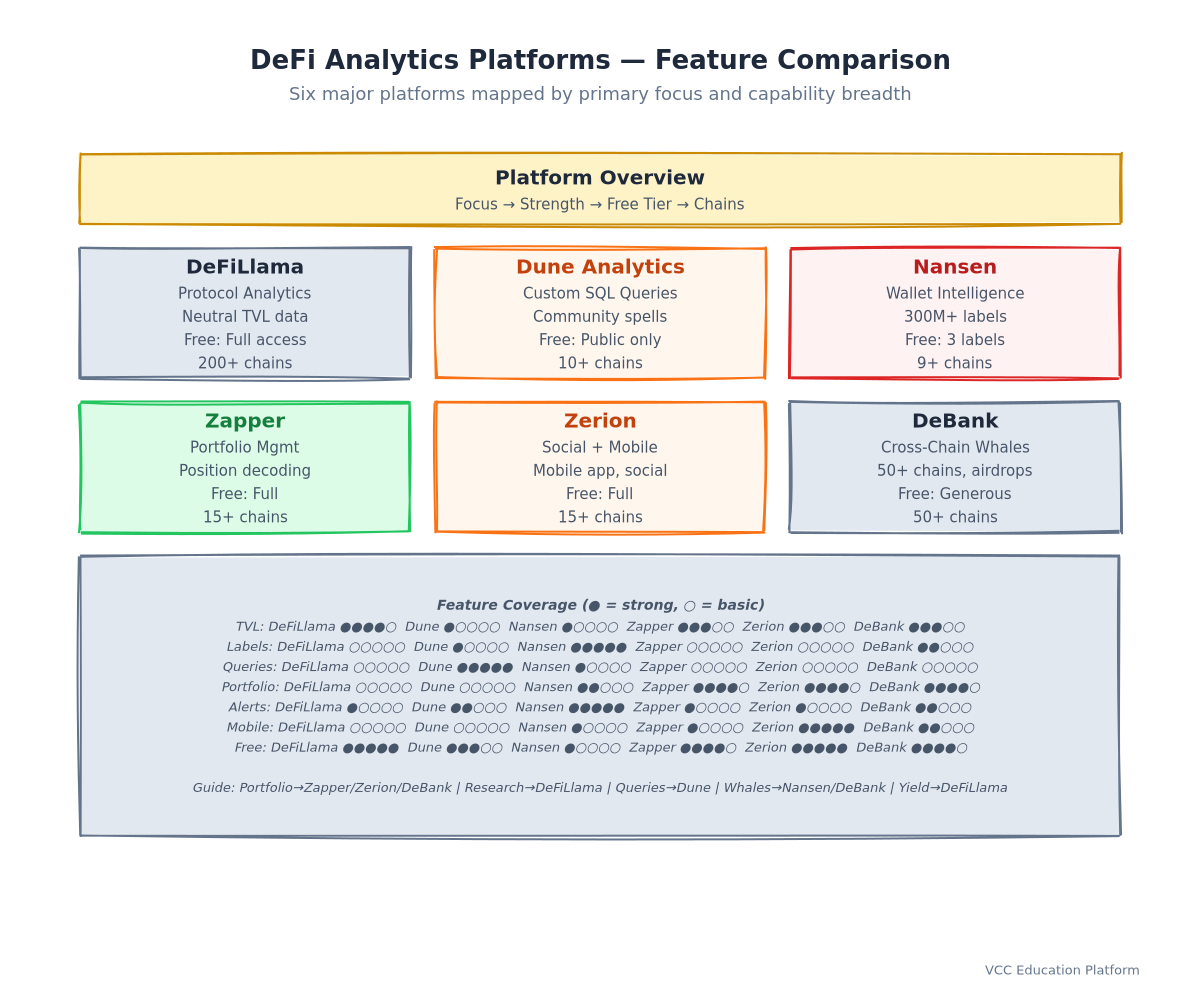
DeFiLlama — The TVL Standard
Free tier: Generous (almost everything) Chains: 200+ (every EVM + Solana, Cosmos, Move, Bitcoin L2s, etc.) Superpower: Neutral, transparent methodology. Open-source adapters. No token. No paywall for core data. Best for: Protocol comparison, TVL historical charts, chain ecosystem overviews, finding new protocols early. Limitations: No wallet tracking. Limited custom queries. No alerting.
Pro tip: Use DeFiLlama's "Chains" page to spot emerging ecosystems before they hit CT. A chain going from $50M to $500M TVL in 30 days often precedes token launches and airdrop speculation.
Dune Analytics — The SQL Playground
Free tier: 100K result rows, public dashboards only Chains: Ethereum, Polygon, BSC, Optimism, Arbitrum, Base, Avalanche, Gnosis, Fantom, Solana (via spelled tables) Superpower: "Spells" — community-maintained decoded tables (e.g., uniswap_v3_ethereum.swaps). Write once, query forever. Best for: Custom research, building shareable dashboards, protocol revenue analysis, token holder distributions. Limitations: Steep learning curve (SQL). No private dashboards on free tier. Query timeout limits complex aggregations.
Pro tip: Don't start from scratch. Search existing dashboards for your protocol — 90% of questions are already answered. Fork and modify.
Nansen — The Wallet Intelligence Leader
Free tier: Limited (3 wallet labels, basic portfolio) Paid tiers: $150+/month for Standard, $1000+/month for Pro Chains: Ethereum, Polygon, BSC, Arbitrum, Optimism, Base, Avalanche, Fantom, Solana Superpower: 300M+ labeled wallets. "Smart Money" algorithm (top 0.1% by consistency + volume). Real-time alerts on labeled wallet activity. Best for: Whale watching, Smart Money copy-trading, token god mode (holder analysis), NFT wallet tracking. Limitations: Expensive. Labels can lag (new wallets take weeks to label). "Smart Money" often exits before you see the alert.
Zapper — The User-Friendly Portfolio Hub
Free tier: Full portfolio tracking Chains: 15+ EVM chains + Solana Superpower: Best-in-class DeFi position decoding (LP tokens, vault shares, reward tokens). Clean UI. Zapper API for developers. Best for: Daily portfolio checks, exploring new protocols via "Explore" tab, bridging, gas estimation. Limitations: No custom queries. Limited historical data. No whale alerts.
Zerion — The Social + Mobile-First Wallet
Free tier: Full features Chains: 15+ EVM + Solana + Starknet + zkSync Superpower: Social features (follow wallets, see what friends hold). Excellent mobile app. Web3 browser built-in. Transaction simulation. Best for: Mobile-first users, social discovery, NFT gallery, on-ramp integration. Limitations: Less protocol depth than DeFiLlama. No custom analytics.
DeBank — The Cross-Chain Whale Tracker
Free tier: Generous Chains: 50+ (broadest coverage including non-EVM: Tron, Bitcoin, Cosmos, Aptos, Sui) Superpower: Whale tracking across chains. Airdrop eligibility checker. Protocol list with user counts. "DeBank Hi" social layer. Best for: Multi-chain portfolio (especially non-EVM), airdrop farmers, whale watching on Solana/Tron/Cosmos. Limitations: UI can feel cluttered. DeFi position decoding less accurate than Zapper/Zerion for complex vaults.
CoinGecko DeFi & Token Terminal — Financial Analytics
CoinGecko DeFi: Free, protocol rankings by TVL/volume, trust scores, category filters. Token Terminal: Freemium. Standardized financial statements for protocols (P/F ratio, revenue, fees, active users). Treats protocols like public companies. Best for: Fundamental valuation, comparing protocols on financial metrics, TradFi-style analysis.
How to Choose: A Decision Framework
Don't pick one tool. Build a stack matched to your workflow.
| Your Primary Goal | Primary Tool | Secondary Tool | Alert Tool |
|---|---|---|---|
| Track my net worth across chains | Zapper / Zerion | DeBank | — |
| Research a protocol before investing | DeFiLlama | Token Terminal | — |
| Find highest-yield stablecoin farms | DeFiLlama Yields | APY.vision | Nansen (whale exits) |
| Copy-trade successful wallets | Nansen | Arkham | Nansen alerts |
| Build custom dashboard for DAO/vesting | Dune | Flipside | Dune alerts (paid) |
| Monitor protocol health (TVL drop, exploit) | DeFiLlama | — | DeFiLlama webhook / custom script |
Rule of thumb: Start free. Pay only when the free tier blocks a specific workflow (private dashboards, real-time alerts, API access).
Advanced Use Cases
1. New Protocol Detection
Workflow: DeFiLlama "New Chains" + "New Protocols" filters → sort by TVL growth rate (7d, 30d) → cross-reference on Dune for holder distribution → check Token Terminal for revenue. Signal: Protocol with >50% MoM TVL growth, >1000 unique users, fee revenue > incentives = organic adoption.
2. Whale Watching for Alpha
Workflow: Nansen "Token God Mode" for a token → filter "Smart Money" + "Fund" labels → set alerts for >1% supply moves → verify on Arkham for entity attribution. Signal: Multiple Smart Money wallets accumulating over 2-3 weeks = high-conviction positioning.
3. Yield Optimization Across Chains
Workflow: DeFiLlama Yields → filter by chain, risk tier (audited, battle-tested), asset type (stablecoin, BTC, ETH) → compare base APY vs. boosted → calculate net APY after gas/bridging/IL. Signal: Arbitrum USDC-USDT pool at 8% base APY often beats Ethereum mainnet at 12% boosted (when you factor gas + IL risk).
4. Airdrop Farming Analytics
Workflow: DeBank "Airdrop" tab + Nansen "New Wallet" labels + Dune query for "contract interactions with no prior history" → identify protocols with high airdrop probability (LayerZero, zkSync, Linea patterns). Signal: Protocols with VC backing, no token, testnet live >3 months, mainnet <6 months.
Limitations & Risks: What Analytics Can't Tell You
Data Lag & Completeness
- Indexer lag: The Graph, Alchemy, Goldsky can be minutes to hours behind chain tip
- Missing chains: New L2s (Base, Linea, Scroll) take weeks to appear on all platforms
- Internal transactions: Most platforms only index top-level calls; nested calls (multicall, flashloans) get missed
Labeling Accuracy
- Nansen's 300M labels sound impressive — but how many are correct and current?
- A wallet labeled "Smart Money" in 2022 may be inactive or compromised in 2024
- Always verify: check the wallet's recent history yourself before copying
TVL Manipulation
- Incentive distortion: Protocols paying 100%+ APY in tokens attract mercenary TVL that vanishes when rewards end
- Double-counting: Bridged assets (wBTC on Ethereum + BTC on Bitcoin) counted twice if not deduplicated
- Wash trading: DEX volume inflated by bots trading with themselves for token rewards
The "Public Alpha" Paradox
If a signal is visible on a public dashboard, it's already priced in. The edge comes from:
- Speed: Acting before the dashboard updates (mempool monitoring, custom indexers)
- Synthesis: Combining multiple data sources into a unique thesis
- Contrarian interpretation: Reading the same data differently (e.g., TVL dropping while fees rising = higher capital efficiency)
Centralization Risk
Most platforms rely on a handful of RPC providers (Alchemy, Infura, QuickNode) and indexers. If Alchemy goes down, half the analytics ecosystem goes dark. Decentralized indexing (The Graph, Subsquid) mitigates this but isn't universal yet.
The Future: Where DeFi Analytics Is Heading
AI-Powered Natural Language Queries
"Show me all protocols where TVL grew >20% last week but fees dropped" — typed in English, returned as a chart. Dune and Nansen are both building this. The SQL barrier is falling.
Unified Cross-Chain Views
Today: "Ethereum TVL" + "Arbitrum TVL" + "Base TVL" = manual sum. Tomorrow: "Ethereum ecosystem TVL" including all L2s, with shared liquidity netted out. DeFiLlama's "Ecosystem" pages are early versions.
Intent-Based Analytics
From "What happened?" to "What should I do?"
- "I have 100 ETH. Show me the highest risk-adjusted yield across all chains, net of gas and bridging."
- "Alert me when a protocol I use has a governance proposal that could affect my position."
On-Chain Attribution for Off-Chain Events
Linking token price moves to specific on-chain flows (exchange deposits, whale transfers, unlock schedules) automatically. Arkham and Nansen are racing here.
Decentralized & Verifiable Analytics
- ZK-proven queries: Prove a Dune query result is correct without trusting Dune's server
- User-owned data: Rotki-style local-first analytics; your keys, your data, your compute
- Protocol-native dashboards: Protocols publishing their own verified analytics (Uniswap Info v2, Aave Analytics)
FAQ
What's the best free DeFi analytics platform?
DeFiLlama for protocol data. Zapper/Zerion/DeBank for portfolio tracking. Dune for custom queries (public dashboards free). No single platform does everything free.
Do I need to pay for Nansen?
Only if you need: real-time Smart Money alerts, >3 wallet labels, token god mode, or API access. For casual whale watching, DeBank + Arkham free tiers cover 80% of use cases.
How accurate is TVL on DeFiLlama?
Highly accurate for major protocols. DeFiLlama adjusts for double-counted bridged assets and excludes known incentive distortions. Always check the "Adjusted TVL" toggle. For new/unaudited protocols, TVL may include unaudited contracts — verify on the protocol's own dashboard.
Can I trust "Smart Money" labels?
They're heuristics, not ground truth. Nansen's algorithm weights consistency, volume, and PnL. A wallet can be "Smart Money" for one strategy (stablecoin farming) but terrible at another (meme coins). Always check the wallet's recent history in your target category.
What's the difference between Dune and Flipside?
Dune: SQL (Trino), larger community, more spells, public-by-default. Flipside: SQL (Snowflake), faster for massive queries, better for enterprise, stronger on non-EVM chains (Solana, Cosmos, Near). Both have free tiers.
How do I track positions in complex vaults (Yearn, Beefy, EigenLayer)?
Zapper and Zerion have the best position decoding for major vault standards. For niche vaults, check the protocol's own dashboard or use Dune with the vault's specific contract addresses.
Is there a DeFi analytics platform for Vietnam users?
No major platform has full Vietnamese localization. The VN community uses English interfaces + local Telegram/Discord groups for translated insights. Coin68 and local KOLs often share DeFiLlama/Dune screenshots with VN commentary.
Key Takeaways
- No single platform does it all. Build a stack: portfolio tracker + protocol analyzer + alerting.
- TVL is a starting point, not the answer. Always check fees, revenue, user growth, and incentive dependency.
- Public analytics = table stakes. Alpha comes from speed, synthesis, or contrarian interpretation.
- Verify labels, trust but verify. Wallet intelligence is powerful but laggy and sometimes wrong.
- The stack is evolving fast. AI queries, unified cross-chain views, and intent-based recommendations will change the workflow within 12-18 months.
Your Next Steps
- Pick your portfolio tracker: Connect your main wallet to Zapper, Zerion, and DeBank. See which UX clicks. Keep the winner.
- Bookmark DeFiLlama: Make it your homepage for protocol research.
- Learn one Dune query: Fork a popular dashboard for a protocol you use. Modify one parameter. Run it. You're now a Dune user.
- Set one alert: On Nansen (free) or DeBank, alert when a "Smart Money" wallet moves >$100K in a token you hold.
- Join a data community: Dune Discord, Nansen Telegram, or a local VN DeFi group. The best insights are shared, not found alone.
The blockchain is transparent. The tools make it legible. The rest is up to you.