
Imagine you're in a busy Vietnamese market — say, Bến Thành in Ho Chi Minh City — looking to buy fresh mangoes. You could visit one stall and accept their price. Or you could walk the entire market, compare prices at every stall, negotiate with each vendor, and piece together your purchase from the best offers. You'd get better mangoes for less money, but you'd spend hours walking in the heat.
DeFi aggregator platforms are the digital equivalent of a personal shopping assistant who instantly checks every stall, negotiates the best combined price, and delivers your mangoes in a single transaction — all while you sip cà phê sữa đá.
In the fragmented world of decentralized finance, where liquidity is scattered across dozens of DEXes, hundreds of pools, and multiple blockchains, DeFi aggregator platforms solve the liquidity fragmentation problem by routing your trades through the optimal path across all available sources. They're the Google Maps of DeFi: you specify the destination (token B), and they find the fastest, cheapest route through a constantly shifting landscape of liquidity.
Why Liquidity Fragmentation Demands Aggregation
The Problem: A Thousand Pools, No Single Best Price
As of 2024, the DeFi landscape spans:
- 50+ major DEXes across Ethereum, BSC, Polygon, Arbitrum, Optimism, Base, Solana, and more
- 10,000+ active liquidity pools on Ethereum mainnet alone
- $100B+ in combined TVL fragmented across venues
- New pools launching daily — Uniswap V3 concentrated positions, Curve stable pools, Balancer weighted pools, Solidly-style volatile pools
When you want to swap USDC for WETH on Ethereum, the "best price" isn't on a single DEX. It might be:
- 40% on Uniswap V3 (0.05% fee tier)
- 30% on Curve (tricrypto pool)
- 20% on Balancer (weighted pool)
- 10% via an off-chain market maker quote (RFQ)
No single venue has deep enough liquidity for large orders without massive slippage. Aggregation stitches these fragments together.
The Cost of Ignoring Aggregation
A 2023 study by Kaiko Research found that non-aggregated swaps on Ethereum mainnet lost users an average of 0.3-0.8% to slippage and suboptimal routing — on a $10,000 trade, that's $30-80 left on the table per transaction. For active traders or DAOs managing treasuries, this compounds to thousands annually.
How DeFi Aggregation Works Under the Hood
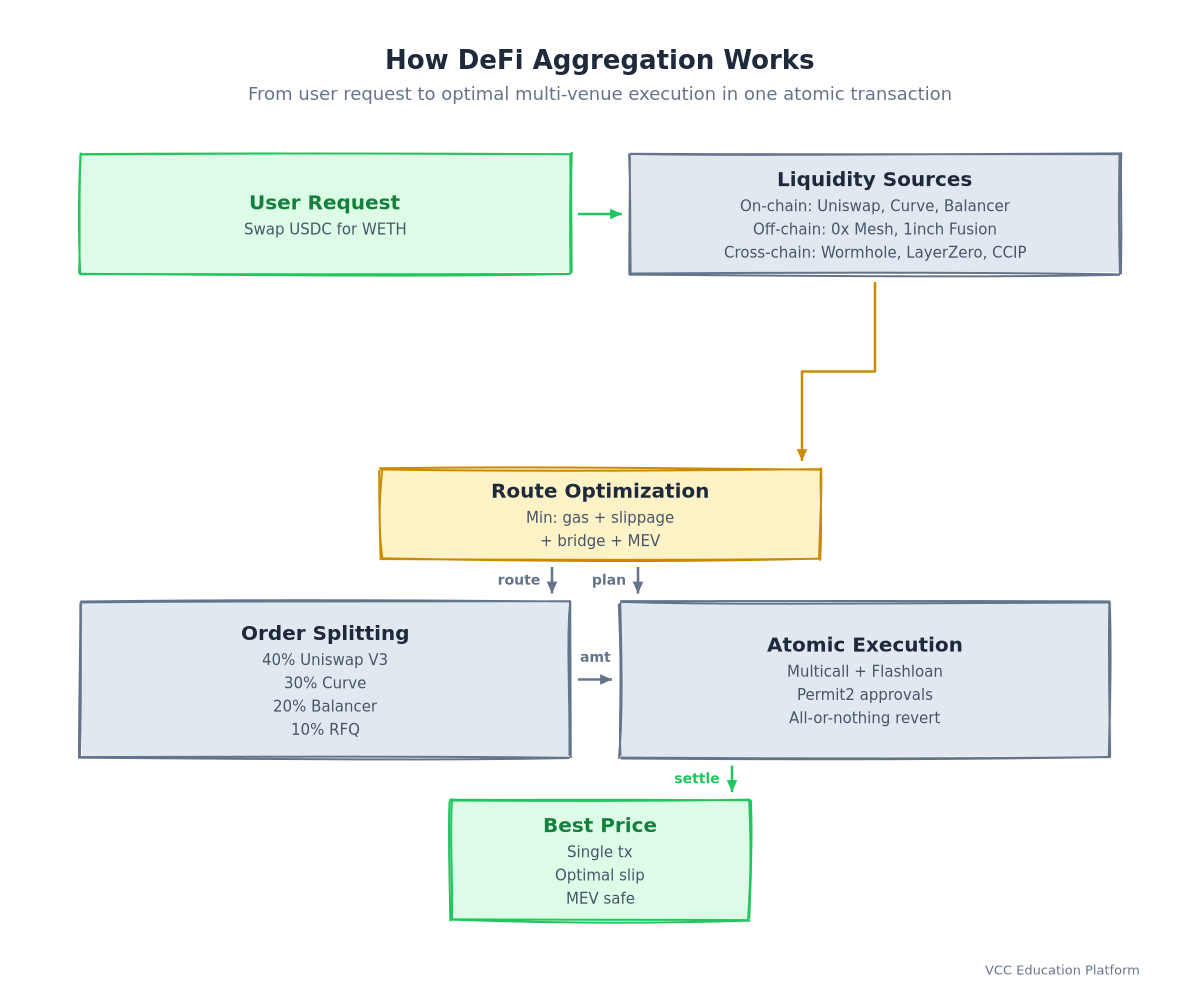
Flowchart - How DeFi Aggregation Works
Step 1: Liquidity Discovery — Querying Every Source Simultaneously
When you initiate a swap on an aggregator, its backend doesn't just check one DEX. It simultaneously queries:
On-chain sources (real-time, trustless):
- Uniswap V2 / V3 / V4 (all fee tiers)
- Curve (stable, crypto, tricrypto, factory pools)
- Balancer (weighted, stable, boosted pools)
- SushiSwap, PancakeSwap, Trader Joe, Camelot, Velodrome
- Chain-specific DEXes: Jupiter (Solana), PancakeSwap (BSC), QuickSwap (Polygon)
Off-chain sources (speed, size):
- RFQ (Request for Quote) networks: 0x Mesh, 1inch Fusion, Paraswap Augustus — professional market makers compete to fill your order
- CEX liquidity via bridges: Some aggregators tap Binance/Coinbase liquidity through institutional bridges
Cross-chain sources:
- Bridge + DEX combinations (Wormhole → Jupiter, LayerZero → PancakeSwap)
- Native cross-chain protocols: Thorchain, Maya Protocol
Intent-based networks (emerging):
- UniswapX fillers, CoW Protocol solvers, 1inch Fusion resolvers — you state what you want, solvers compete on how
Step 2: Route Optimization — The Algorithmic Brain
Each aggregator runs proprietary routing algorithms. Here's how the major ones differ:
| Aggregator | Algorithm | Key Innovation |
|---|---|---|
| 1inch Pathfinder | Graph search (Dijkstra variant) | Multi-hop up to 4 hops, gas-aware edge weights, dynamic pruning |
| 0x / Matcha | RFQ + Mesh + On-chain hybrid | RFQ for >$10k orders, on-chain for small, Mesh for maker diversity |
| Paraswap Augustus v6 | Weighted graph with gas cost | Booster (gas refund via MEV capture), dynamic gas estimation |
| UniswapX | Dutch auction (off-chain) | Price improves over time, fillers compete, no swap fees |
| CoW Protocol | Batch auctions (CoW) | Coincidence of wants matching, surplus returned to user |
Core optimization challenge: Find the path minimizing total_cost = gas_cost + slippage_cost + bridge_fees + opportunity_cost
This is NP-hard in the general case (subset sum + shortest path). Production systems use:
- Heuristic pruning: Discard paths >3 hops unless gas is very low
- Gas-aware scoring: Edge weight =
estimated_gas × gas_price + price_impact - Caching: Reuse recent route calculations for similar pairs
- Simulation: Fork mainnet state, simulate execution, measure actual output
Step 3: Order Splitting — Proportional Allocation
Once the optimal route graph is computed, the aggregator splits your order:
` Total USDC → 40% Uniswap V3 (0.05%) → 30% Curve tricrypto → 20% Balancer weighted → 10% RFQ market maker `
Splitting logic considers:
- Liquidity depth: Deeper pools get larger shares
- Price impact: Marginal slippage per additional dollar
- Gas efficiency: Fewer hops when gas > 50 gwei
- MEV risk: Avoid routes known for sandwich attacks
Step 4: Atomic Execution — All or Nothing
The magic: all splits execute in a single transaction. If any leg fails (price moved, pool drained), the entire transaction reverts. You never end up with partial fills at bad prices.
This is achieved through:
- Multicall contracts: Batch multiple DEX interactions
- Flashloan-assisted routing: Borrow intermediate tokens, repay in same tx
- Permit2 / EIP-2612: Gasless approvals for ERC-20 tokens
Major Aggregator Platforms: Head-to-Head Comparison
Comparison - Major Aggregator Platforms
1inch: The Volume Leader
- Chains: 10+ (Ethereum, BSC, Polygon, Arbitrum, Optimism, Base, Avalanche, Gnosis, Fantom, Solana)
- Routing: Pathfinder v5/v6 (on-chain) + Fusion (intent-based)
- Unique features: Limit orders, Fusion mode (gasless, MEV-protected), 1inch Earn (yield aggregation)
- Best for: High-volume traders, multi-chain users, limit order needs
- Trade-off: Complex UI, Fusion requires 1INCH staking for best rates
Matcha / 0x: The RFQ Pioneer
- Chains: 8 EVM chains
- Routing: RFQ (professional makers) + Mesh (decentralized) + On-chain fallback
- Unique features: Gasless trades via meta-transactions, 0x API for developers, Matcha Auto (DCA)
- Best for: Large orders (>$10k), developers building on 0x, gas-sensitive users
- Trade-off: Fewer chains than 1inch, RFQ less effective for small orders
Paraswap: The Gas Optimizer
- Chains: 9 EVM chains
- Routing: Augustus v6 (weighted graph, gas-aware)
- Unique features: Booster (gas refund up to 90% via MEV capture), institutional API, Paraswap Yield
- Best for: Gas optimization, high-frequency traders, institutions
- Trade-off: Smaller market maker network than 0x Mesh
UniswapX: The Intent-Based Challenger
- Chains: Ethereum + L2s (Arbitrum, Optimism, Base, Polygon)
- Routing: Dutch auction (off-chain fillers compete)
- Unique features: Zero swap fees, built-in MEV protection, no token approval needed (Permit2)
- Best for: Ethereum/L2 users prioritizing MEV protection, simple UX
- Trade-off: Limited to Uniswap ecosystem chains, no cross-chain yet
CoW Protocol: The Batch Auction Specialist
- Chains: Ethereum + 4 L2s
- Routing: Batch auctions (Coincidence of Wants)
- Unique features: Surplus returned to users, internal matching before external routing, CoW DAO governance
- Best for: Users wanting fair MEV distribution, ETH/L2 native tokens
- Trade-off: Longer settlement (auction periods), smaller token coverage
Jupiter: The Solana King
- Chains: Solana only
- Routing: Metis router (Solana-optimized)
- Unique features: Best Solana routing, token list management, DCA, limit orders, perpetuals
- Best for: Solana ecosystem users
- Trade-off: Single-chain only
OpenOcean / Li.Fi / Socket: The Cross-Chain Aggregators
- Chains: 20+ (EVM + non-EVM)
- Routing: Bridge + DEX aggregation, hybrid CEX/DEX
- Unique features: Cross-chain in one click, unified API for developers
- Best for: Cross-chain swaps, multi-chain portfolio management
- Trade-off: Bridge risk, longer finality, higher complexity
Cross-Chain Aggregation: The Next Frontier
Architecture - Cross-Chain Aggregation Architecture
Cross-chain aggregation promises "swap any token on any chain to any token on any chain in one click." But it introduces compounded risk layers:
The Cross-Chain Stack
` User Intent ↓ Aggregator Router (Li.Fi, 1inch Cross-chain, Socket) ↓ Bridge Layer ←→ [Wormhole] [LayerZero] [CCIP] [Axelar] [Hyperlane] ↓ ↓ ↓ ↓ ↓ Destination DEX Jupiter PancakeSwap Uniswap Trader Joe ↓ Settlement & Finality `
Risk Framework: What You're Actually Signing Up For
| Risk Layer | Description | Mitigation |
|---|---|---|
| Bridge Smart Contract Risk | Bridge contracts hold billions; hacks = total loss (Wormhole $320M, Nomad $190M) | Use audited bridges (CCIP, LayerZero v2), monitor bridge TVL |
| Finality Risk | Optimistic bridges (7-day challenge) vs ZK bridges (minutes) vs instant (CCIP) | Match urgency to bridge type; don't use optimistic for time-sensitive |
| Destination DEX Risk | Same risks as single-chain: rug pulls, admin keys, oracle manipulation | Stick to battle-tested DEXes on destination chain |
| Slippage Compounding | Slippage on source DEX + bridge fee + slippage on destination DEX | Aggregators should show total all-in cost, not just swap price |
| Atomicity Gap | True atomic cross-chain swaps don't exist yet (except HTLC/HTLC) | Understand: you may receive funds before source chain finalizes |
When Cross-Chain Aggregation Makes Sense
- Moving stablecoins between chains for yield farming
- Rebalancing multi-chain portfolios
- Accessing chain-specific opportunities (Solana memes, Base airdrops)
- Avoid for: Large treasury moves, time-sensitive arbitrage, risk-averse users
The Gas vs. Price Trade-off: Finding the Sweet Spot
Graph - Gas vs Price Trade-off Frontier
One of the most misunderstood aspects of aggregation: more routes ≠ always better.
The Pareto Frontier
` Price Improvement (%) ↑
| ● Cross-chain (high gas, high reach) |
|---|
| ● Advanced splitting (3-4 hops) |
| ● |
| ● Basic aggregation (2 hops) |
| ● Single DEX (baseline) |
+--------------------------------→ Gas Cost Low High `
Quantitative Example: $5,000 USDC → WETH on Ethereum (gas @ 30 gwei)
| Strategy | Hops | Est. Gas | Gas Cost | Price Improvement | Net Benefit |
|---|---|---|---|---|---|
| Single DEX (Uniswap V3) | 1 | 180k | $16.20 | 0% (baseline) | Baseline |
| Basic aggregation | 2 | 280k | $25.20 | 0.15% ($7.50) | -$17.70 |
| Advanced splitting | 3 | 420k | $37.80 | 0.35% ($17.50) | -$20.30 |
| 1inch Pathfinder (optimized) | 2-3 | 310k | $27.90 | 0.28% ($14.00) | -$13.90 |
Insight: On Ethereum mainnet at current gas prices, aggregation often loses money on trades under $10k unless gas is <15 gwei. The "sweet spot" shifts:
- Mainnet: >$10-20k trades, or gas <15 gwei
- L2s (Arbitrum, Optimism, Base): Almost always worth it (gas <$0.10)
- BSC/Polygon: Almost always worth it
- Solana: Always worth it (sub-cent gas)
Practical Rule for Vietnamese Users
Given VN users' high gas sensitivity: Default to L2 aggregators (Arbitrum/Base/Optimism) for trades under $5k. Only use Ethereum mainnet aggregation for >$20k or when L2 liquidity is insufficient.
Risks and Considerations: What Aggregators Don't Advertise
1. Smart Contract Risk
Aggregators route through multiple contracts: the aggregator router + each DEX router + token contracts. A bug in any component can drain funds.
- Mitigation: Use battle-tested aggregators (1inch, 0x, Paraswap audited by Trail of Bits, OpenZeppelin, Spearbit). Check audit reports.
2. Upgrade Risk
Most aggregator routers are upgradeable proxies. The admin (multisig/DAO) can change logic instantly.
- Mitigation: Monitor governance forums. 1inch uses timelock + DAO; 0x uses ZEIP process.
3. MEV Exposure
Even with aggregators, your transaction is visible in the mempool before execution. Sandwich attacks can still occur on the individual DEX legs.
- Mitigation: Use MEV-protected modes (1inch Fusion, UniswapX, CoW Protocol, Paraswap Booster). Private RPC (Flashbots Protect, BloXroute) for advanced users.
4. Price Impact Misestimation
Aggregators simulate routes against current state. But between simulation and execution (12 seconds on Ethereum), large trades by others can shift prices.
- Mitigation: Set reasonable slippage tolerance (0.5-1% for stable pairs, 1-3% for volatile). Aggregators should warn when simulated output ≠ guaranteed minimum.
5. Centralization Vectors
- 1inch: 1INCH token governance, core team influence
- 0x: ZRX governance, 0x Labs significant influence
- Paraswap: PSP governance, core team + investors
- UniswapX: Uniswap Labs controlled (currently)
- Implication: Protocol decisions may favor token holders over users
6. Data Privacy
Aggregator frontends (web/app) see your: wallet address, trade size, token preferences, timing patterns.
- Mitigation: Use privacy-focused frontends, consider aggregator APIs via your own interface for high-value trades.
How to Choose the Right Aggregator: A Decision Framework
Flowchart - Aggregator Selection Decision Matrix
Decision Matrix by User Profile
| If Your Priority Is... | Recommended Aggregator | Why |
|---|---|---|
| Best all-around (EVM) | 1inch | Broadest chain coverage, deepest liquidity, Fusion for MEV protection |
| Large orders (>$10k) | Matcha / 1inch Fusion | RFQ network taps professional makers for size |
| Gas optimization | Paraswap (Booster) / L2 aggregators | Gas refunds, L2-native routing |
| MEV protection | UniswapX / CoW Protocol / 1inch Fusion | Intent-based, batch auctions, private mempool |
| Cross-chain swaps | Li.Fi / Socket / OpenOcean / 1inch Cross-chain | Bridge + DEX aggregation in one flow |
| Solana ecosystem | Jupiter | Purpose-built for Solana, best token coverage |
| Developer integration | 0x API / 1inch API / Li.Fi SDK | Best documentation, SDKs, rate limits |
| Yield + aggregation | 1inch Earn / Paraswap Yield / Yearn | Auto-compounding on top of swap optimization |
Quick-Start Checklist for New Users
- Start on an L2 (Arbitrum/Base/Optimism) — gas is negligible, aggregation always wins
- Use 1inch or Matcha — best UX, broadest support, good defaults
- Enable MEV protection (Fusion/UniswapX) for trades >$1k
- Check slippage settings — default 0.5% for stables, 1-2% for volatile
- Verify the route — most aggregators show "route breakdown" before confirm
- Test with small amount first — $50-100 to confirm flow
The Future: Intent-Based, Solver Networks, and Chain Abstraction
From "User Specifies Path" to "User Specifies Intent"
Current model: User → chooses aggregator → aggregator computes route → executes Emerging model: User → signs intent ("swap 1000 USDC for WETH, min 0.3 WETH") → solver network competes → best execution wins
This shift (UniswapX, 1inch Fusion, CoW Protocol, Anoma, SUAVE) moves MEV from searchers extracting from users to solvers competing for user order flow. The surplus goes to users, not searchers.
Chain Abstraction: The End of "Which Chain?"
Projects like Particle Network, Near Chain Abstraction, Polygon AggLayer, LayerZero v2 aim to make chain selection invisible. You hold USDC on Arbitrum, want to buy a token on Base — the aggregator + abstraction layer handles bridging, gas payment, and execution seamlessly.
Implication for aggregators: They become the execution layer for intent-based, chain-abstracted interfaces. The "aggregator" brand may disappear, absorbed into wallets (Rabby, Zerion, Coin98) and intent layers.
Regulatory Considerations
- Aggregators as "brokers": Some jurisdictions may classify aggregators as brokers requiring KYC (US SEC guidance evolving)
- RFQ makers as market makers: Professional RFQ participants may need registration
- Cross-chain = cross-border: Bridge + DEX aggregation may trigger travel rule obligations
VN users should monitor: Vietnam's DeFi regulatory stance (currently unclear, but SBV has warned against crypto payments). Aggregators themselves don't custody funds, but frontend access could be restricted.
FAQ: DeFi Aggregator Platforms
What is a DeFi aggregator platform?
A DeFi aggregator platform is a protocol that sources liquidity from multiple decentralized exchanges (DEXes), market makers, and bridges simultaneously to provide users with optimal swap execution — best price, lowest gas, and MEV protection — in a single transaction.
How do DeFi aggregators make money?
Most aggregators charge a protocol fee (typically 0.05-0.2% of swap volume) on top of DEX fees. Some (UniswapX) charge zero swap fees and monetize via filler competition surplus. Others have governance tokens (1INCH, ZRX, PSP) capturing value through staking/yield.
Are DeFi aggregators safe?
Major aggregators (1inch, 0x, Paraswap, UniswapX) are audited by top firms and have processed billions in volume without major exploits. However, they introduce smart contract risk (router contracts), upgrade risk (admin keys), and bridge risk (for cross-chain). Always verify you're on the official domain.
Do I need to approve tokens for each DEX?
No. Modern aggregators use Permit2 (EIP-2612) or multicall to batch approvals. You typically sign one gasless permit signature, and the aggregator handles all DEX approvals internally.
What's the difference between a DEX aggregator and a yield aggregator?
- DEX/liquidity aggregator (1inch, Matcha): Optimizes swap execution — gets you the best price when trading token A for token B
- Yield aggregator (Yearn, Beefy, Autofarm): Optimizes yield farming — auto-compounds rewards, migrates strategies across protocols
Some platforms (1inch Earn, Paraswap Yield) now combine both.
Can I use aggregators on mobile?
Yes. All major aggregators have mobile-responsive web apps and some have native apps (1inch Wallet, Matcha Mobile, Coin98 integrates 1inch/Paraswap). For Vietnamese users on mobile data, L2 aggregators (Arbitrum/Base) are strongly recommended due to near-zero gas fees.
How do I know I'm getting the best price?
Check the route breakdown before confirming. Reputable aggregators show: each DEX used, percentage split, expected output, gas estimate, and minimum received (with slippage). Compare 2-3 aggregators for large trades.
What happens if a trade fails mid-execution?
Aggregators use atomic execution: all legs succeed or the entire transaction reverts. You never end up with half a swap. The only cost is gas for the failed transaction.
Are there aggregators for NFTs?
Yes — Blur, OpenSea Pro, Gem.xyz aggregate NFT marketplace listings. But they operate differently (order book aggregation vs AMM liquidity aggregation) and are a separate category.
Key Takeaways
- DeFi aggregator platforms are essential infrastructure — they solve liquidity fragmentation by routing trades across 50+ DEXes, RFQ networks, and bridges
- Not all aggregation is equal — algorithms (Pathfinder, RFQ, Dutch auction, batch auctions) produce different results for different trade sizes and chains
- Gas vs. price is a real trade-off — on Ethereum mainnet, aggregation only pays off above ~$10-20k or at low gas; on L2s/Solana, it almost always wins
- Cross-chain aggregation adds bridge risk — evaluate finality, audit status, and compounded slippage before using
- MEV protection is now table stakes — use Fusion, UniswapX, CoW Protocol, or Paraswap Booster for meaningful protection
- The future is intent-based — you state what you want, solvers compete on execution; aggregators become the execution layer for chain-abstracted wallets
Start Aggregating Today
For Vietnamese users new to aggregation:
- Visit 1inch.io or matcha.xyz on your mobile browser
- Connect your wallet (MetaMask, Coin98, Rabby)
- Switch to Arbitrum or Base network (top-right network selector)
- Try a $50 USDC → WETH swap — compare route breakdown across 2-3 aggregators
- Enable MEV protection (Fusion on 1inch, Auto on Matcha)
- Scale up as you gain confidence
The mangoes are waiting. Your personal shopper is ready.
Disclaimer: This article is for educational purposes only. DeFi involves significant risk including smart contract failure, market volatility, and total loss of funds. Always do your own research and never invest more than you can afford to lose.