
Imagine you've never had a bank loan. No credit card, no savings history a bank can read, nothing in the National Credit Information Center (CIC) worth showing. You pay your phone bill on time, you've been selling at the same market stall for five years, and every trader there knows you settle your debts. A bank looks at you and sees a blank page. Điểm tín dụng defi — a decentralized private credit score — is the technology that lets you carry that market reputation into DeFi and prove "I can repay this loan" without handing a lender your income, your debts, or your bank balance.
One sentence: a decentralized private credit score is a verifiable credential you hold yourself, and a zero-knowledge (ZK) proof is what lets you show a lender just enough of it to get a loan — nothing more.
This article walks through why credit scores exist, why both traditional bureaus and today's DeFi lending get them wrong, and how ZK proofs let a borrower prove repayment ability while keeping the details private. If you've wondered what tín dụng riêng tư blockchain really means, or what a zk credit score could do for Vietnam's underbanked majority, this is the breakdown for you.
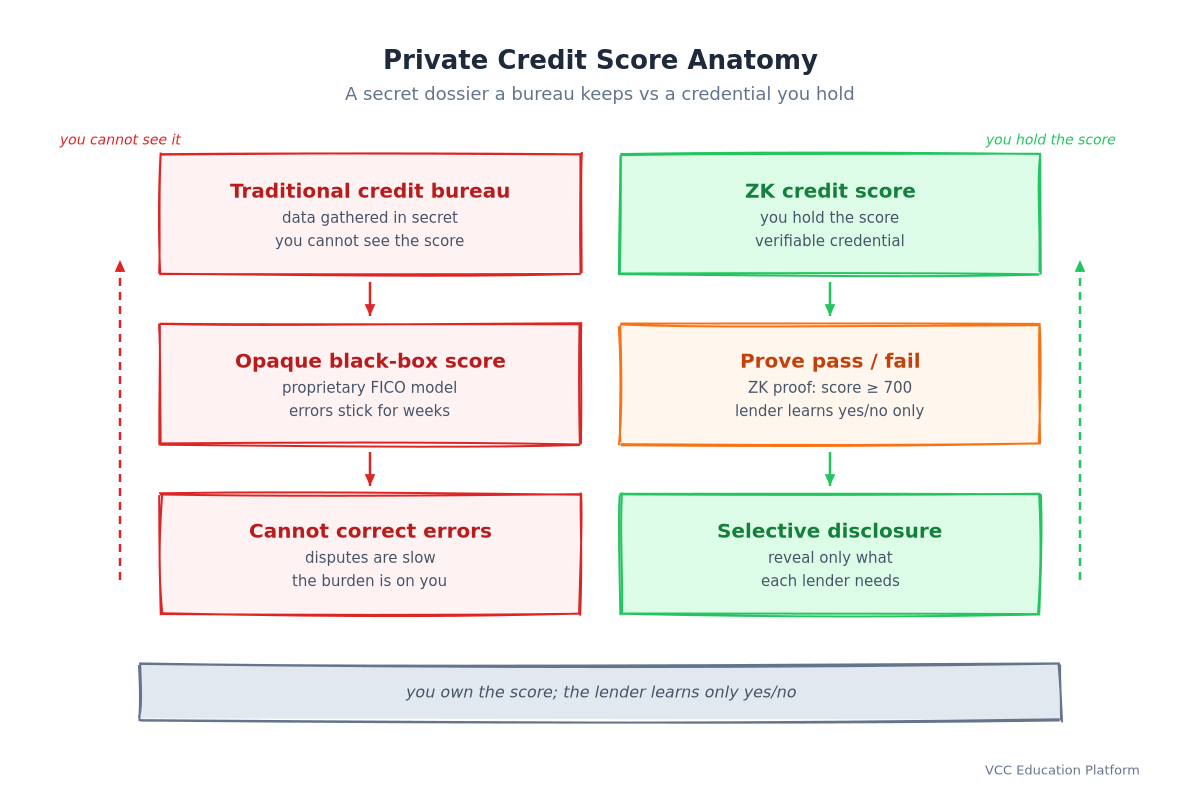
Figure 1: Private Credit Score Anatomy — a secret dossier a bureau keeps vs a credential you hold; you own the score, the lender learns only yes/no
Why Credit Scores Exist — And Who Owns the Answer
The quiet question at the market
Before anyone lends you money, they ask one quiet question: will you give it back? In a floating market on the Mekong, that question is answered by reputation. A trader who has paid back the rice-boat seller for years needs no paperwork — everyone already knows. The community carries the answer in its heads.
Credit scores were invented to make that same judgment fast, numeric, and usable by strangers. A lender who has never met you can look at one number and decide whether to extend you a loan. The score exists because trust, converted into a number, lets money flow to people who deserve it.
The bureau that scores you in the dark
Here is the uncomfortable part: in most of the world, that number is not yours. In the United States, the three big bureaus — Experian, Equifax, and TransUnion — gather your payment history from banks and lenders, package it, and sell access to it. About 90% of top US lenders rely on a FICO score, a number produced by a proprietary model that is largely a black box. The consumer protection agency (CFPB) has had to remind lenders that they must still explain why someone was rejected even when the decision came from a complex algorithm they barely understand.
The score is a secret about you, kept by a third party. You cannot see the full model. You can request your report, but correcting an error takes weeks and often sits with the consumer to prove. Studies cited by the scoring industry itself put inaccurate information on around 11% of US credit reports, and credit-report disputes are the most common complaint consumers file with the CFPB. You did not create this file. You cannot control it. You can only argue with it.
One database, one target
A centralized score means a centralized database — and a centralized database is a target. The Equifax breach of 2017 exposed roughly 147 million Americans' records because one company's single repository was cracked.
Vietnam has its own version of this story. In September 2025, the National Credit Information Center (CIC), the State Bank of Vietnam's credit registry, was hit by a major cyberattack. Reports from security researchers describe over 160 million exposed records — names, government and tax IDs, addresses, employment histories, credit records — being sold on dark-web forums. A national database holding the financial history of tens of millions of Vietnamese citizens became a honeypot.
This is the moment to ask a sharper version of the market's question: not just will you repay, but who should hold the answer?
The DeFi Credit Gap: Everything Must Be Collateral
Aave and Compound: the collateral rule
Decentralized finance solved the "stranger lending to stranger" problem by removing the person from the equation. On Aave or Compound, a lender supplies stablecoins into a pool, and a borrower borrows from it — all governed by smart contracts, no banker in the middle.
But because the protocol cannot see your face or your history, it demands the one thing it can verify: collateral. Borrowing typically requires posting assets worth more than the loan — commonly around 150% — with a loan-to-value cap per asset and a health factor that triggers automated liquidation if your collateral dips. Deposit $150 of ETH, borrow $100 of USDC. Miss the threshold, and your collateral is sold automatically.
The mechanism works. Aave and Compound have processed hundreds of billions of dollars of loans without a credit officer. But it is deeply capital-inefficient: the borrower locks up more value than they receive, and the loan is only as good as the volatile collateral behind it.
No reputation, no unsecured loan
The deeper problem is exclusion. Over-collateralized lending says "your assets are your credit" — which means people without assets, however reliable they are, cannot borrow. A freelancer with five years of on-time rent payments but no crypto stack gets nothing. A market seller who has never defaulted in a decade gets nothing, because no protocol can see that record.
In traditional finance, unsecured credit is normal — credit cards, personal loans, the Vietnamese bank's tín chấp for salaried workers. DeFi simply has no equivalent, because the reputation signal that makes unsecured lending possible is invisible on-chain. That gap — collateral in, credit out — is exactly what a decentralized private credit score is designed to close.
What Is a Decentralized Private Credit Score?
A decentralized private credit score is a tín dụng riêng tư blockchain idea: a record of your repayment reliability that you carry yourself, verified by issuers, and proven to lenders only when and how you choose.
A credential you hold, not a file they keep
Think of the difference between a driver's license you carry and a dossier the police keep on you. Today's score is the dossier: assembled in secret, held by a third party, shown to whoever pays for it. A decentralized score is the license: a document in your wallet, signed by a trusted issuer, that you present when asked.
The technical substrate already exists and is standardized. The World Wide Web Consortium publishes the Verifiable Credentials (VC) data model — now at version 2.0 — for exactly these signed, machine-checkable documents, plus Decentralized Identifiers (DIDs), identifiers you control rather than one assigned to you by a company. In the standard Issuer-Holder-Verifier model, a bank or an on-chain scoring service signs a claim ("this person has made 12 on-time loan payments"); you hold it; a lender verifies the signature.
What makes this a private credit score is what happens next: the claim is proven with zero-knowledge cryptography, so the lender learns the answer without ever seeing the underlying data.
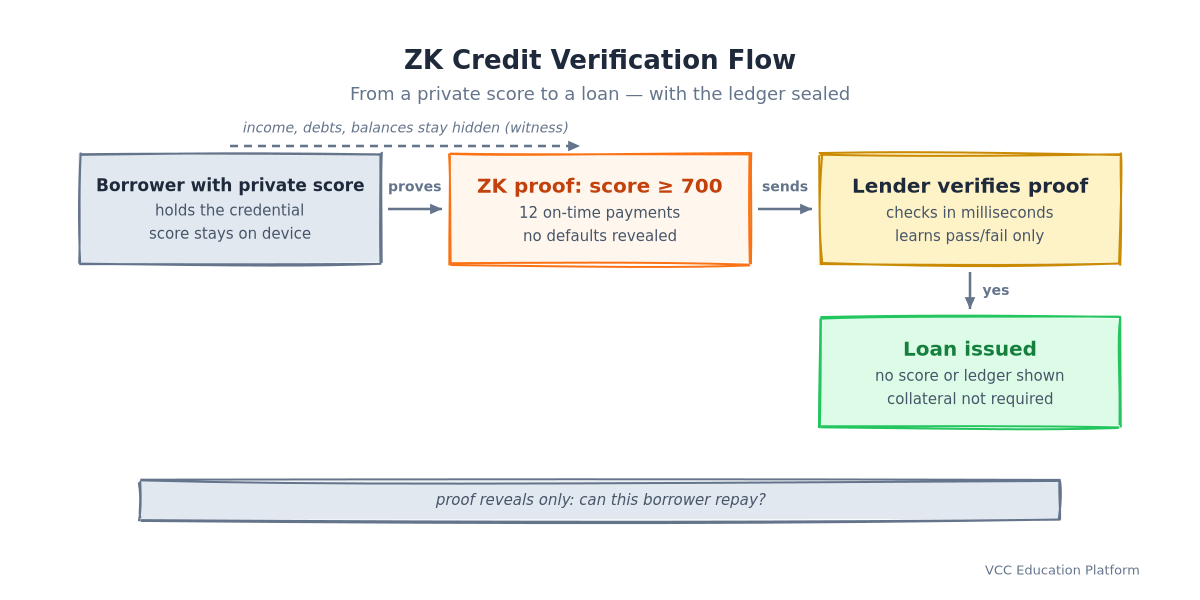
Figure 2: ZK Credit Verification Flow — proof reveals only: can this borrower repay? The ledger stays sealed
How ZK Proves You Can Repay — Without Showing Your Ledger
The circuit: private facts in, one yes/no out
Zero-knowledge proofs let you demonstrate that a statement is true without revealing why. The trick is a mathematical circuit: you feed it private facts (called the witness) and it produces a tiny proof that a specific claim is valid. The lender runs the proof through a verifier and learns — with cryptographic certainty — only that the claim is true.
Say a lender's policy is "borrowers with a credit score of at least 700 get the good rate." A circuit can be built where:
- Private inputs (witness): your actual score, your payment history, your balances, your debts
- Public statement: "my score ≥ 700"
- Output: a proof the lender verifies in milliseconds
The lender learns score ≥ 700 is true. It never learns your score, your income, your debts, or your balances. They stay in the witness, which never leaves your device.
Three proofs a lender might actually ask for
Real underwriting rarely needs one number; it needs a few thresholds. Each becomes its own circuit, each reveals nothing but pass/fail:
- Score threshold — "my score ≥ 700" (or any band: ≥ 650, ≥ 750). The exact number stays private.
- Payment discipline — "I have made N on-time payments" (say, 12). The lender learns only that the count cleared the bar, not the amounts or dates.
- Clean window — "no defaults in the past 24 months." No default details, no dispute history — just the clean flag.
This is the heart of the zk credit score: the borrower answers every underwriting question as a yes/no the lender can trust, while the supporting ledger stays sealed.
Selective disclosure: one credential, many proofs
Because the proof is generated on demand, one credential can answer many different questions. A mortgage lender needs "score ≥ 750, no defaults in 5 years." A BNPL checkout needs only "no defaults in 12 months." A car lease wants "score ≥ 680." Each is a different circuit over the same held credential, each revealing a different sliver. This is selective disclosure — and it is exactly how you avoid the old pattern of handing your entire financial history to every business that asks for it.
The honest limit: proofs verify data, not truth
One thing to keep in your pocket: a ZK proof proves that a statement about your data is true — it cannot make false data true. If the score was issued from a wrong bank record, the proof is beautifully valid and wrong. The chain of trust moves from the score-holder to the issuer (a bank, a scoring service, a verifier of on-chain behavior) and the oracles that feed them. A private credit score fixes who holds and controls the answer; it does not automatically fix who knows the facts. Both links matter.
Real Protocols Building This Today
This is not a thought experiment. Several teams are shipping pieces of it.
Teller Finance built an algorithmic credit-risk protocol specifically to offer unsecured DeFi loans. In a proof-of-concept with Chainlink, Teller used DECO, a privacy-preserving oracle technique, to prove in zero-knowledge that a borrower held a minimum bank balance — enough to lower the collateral demanded — without revealing the balance itself. Teller's current on-chain score aggregates swap volume, borrow repayments, holdings, and verified income onto a 0–1000 scale.
Cred Protocol scores wallets in real time across more than ten blockchains and 30-plus lending protocols, including Aave and Compound — useful precisely because it can score an address that has never borrowed before, using its behavior elsewhere.
On-chain scoring broadly — RociFi's non-fungible credit score, Spectral's MACRO score (an on-chain analog of FICO's 300–850), Credence's composite of on-chain and ZK-attested signals — shows the same pattern: wallet behavior becomes underwriting.
zkMe bridges traditional US FICO scores on-chain using zkTLS and zero-knowledge proofs, issuing a reusable credential that DeFi protocols can check without touching the underlying report. Arc, a stablecoin-native Layer 1 from Circle's team, bakes verifiable credentials and selective disclosure into the base layer for identity-based undercollateralized lending. And in 2025, Untangled Finance and Moody's Ratings completed a proof-of-concept that publishes and updates credit ratings on-chain with ZKP, protecting proprietary rating data while making it composable in DeFi.
| Protocol | What it proves | How privacy is kept |
|---|---|---|
| Teller + Chainlink DECO | off-chain bank balance / income | zero-knowledge oracle proof |
| Cred Protocol | on-chain wallet risk (10+ chains) | score computed off-chain, query on-demand |
| RociFi / Spectral | on-chain behavioral score | score-as-token, no raw history shown |
| zkMe | traditional FICO score | zkTLS + ZK proof, credential-based |
| Arc | verifiable identity + income claims | selective disclosure at layer 1 |
| Untangled + Moody's | credit ratings | ZKP publication, proprietary data hidden |
None of these is "the answer" by itself — they are proofs of the pattern, at different stages of maturity.
The Hard Problems Nobody Handwaves Away
Where does the score come from?
A score has to be built from something. Behavioral scores need years of on-chain history — which new wallets do not have (the cold-start problem). Off-chain scores need an issuer and an oracle to move the data in without leaking it. Both are solvable, neither is free.
Sybil: one human, one wallet
If a new wallet is cheap, a borrower can simply start over after a default — the score resets to zero. Serious unsecured lending needs "one human, one wallet," which pulls the whole system toward some identity anchor. Vietnam has an unusually good answer available: VNeID, with more than 67 million accounts and deep eKYC infrastructure under Nghi định 13/2023, can attest "this is a real person" without ever revealing the CCCD number to the lender. Identity-anchored, privacy-preserving scoring is where ZK and VNeID meet.
Privacy versus fraud
Full privacy is also full cover for bad actors. Loan fraud and account-takeover scams — which Vietnamese readers know all too well after large-scale data leaks — thrive when no one can see anything. The industry's realistic answer is selective disclosure, not total secrecy: reveal the minimum a lender or regulator legitimately needs, prove everything else. Privacy and fraud prevention are a balance, not a one-sided win.
Adoption and standards
Scores only matter if lenders accept them. That requires shared credential standards (W3C helps), wallets people actually use, and lending protocols willing to underwrite against proofs. The cold start is as much institutional as technical.
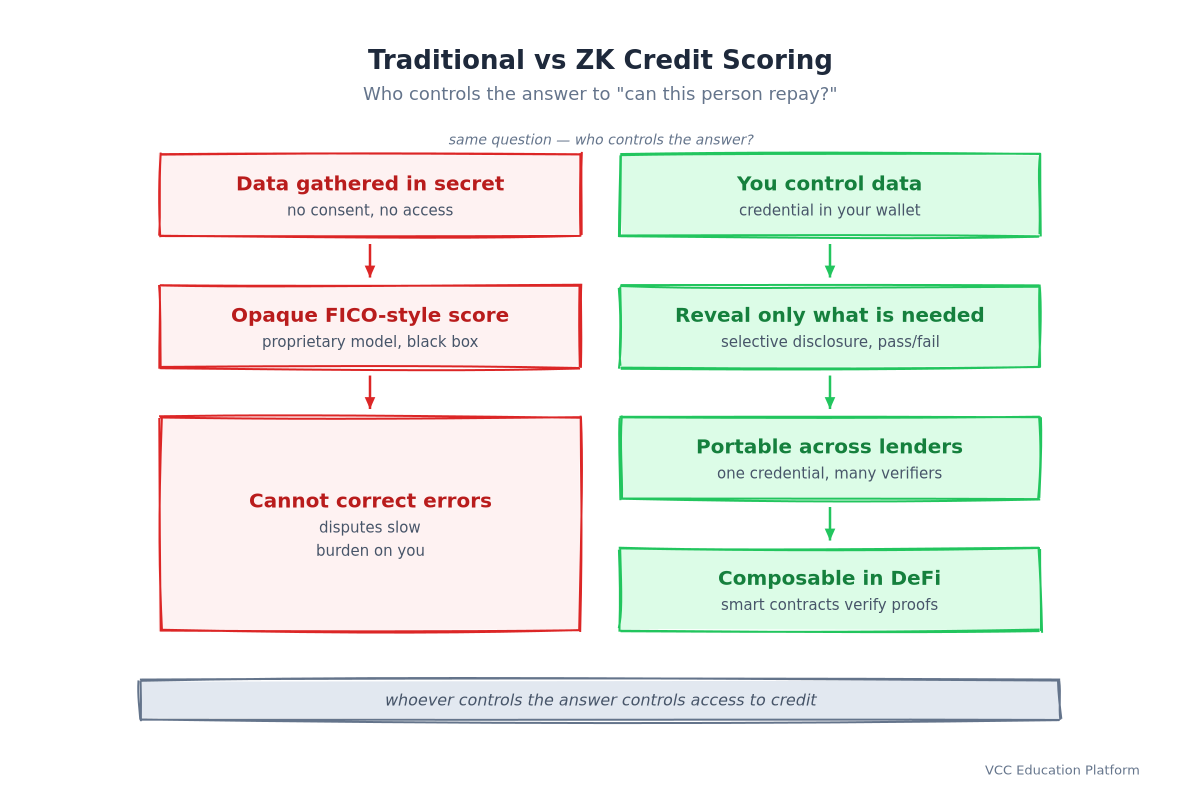
Figure 3: Traditional vs ZK Credit Scoring — same question, who controls the answer?
Vietnam: A Financial Inclusion Story Waiting to Be Written
Vietnam may be closer to this than almost any market, because the three layers needed are already built.
The identity layer exists. VNeID has become a genuine national identity backbone — over 67 million accounts by the end of 2025, with Level-2 verification handling banking and government flows. eKYC under Nghi định 13/2023 made remote identity verification standard. This is the anchor a Vietnamese zk credit score needs: proof that the borrower is one real person, without the lender ever seeing the CCCD.
The distribution layer exists. Vietnamese finance is mobile-first. MoMo serves more than 30 million users and handled 5.5 billion transactions in a single quarter. Cake by VPBank became Vietnam's first profitable digital-only bank and processes over a million credit applications a month. VNPT Money rides the state telecom's reach. The wallets and apps that would carry a credit credential are already on everyone's phone.
The demand layer exists. Buy-now-pay-later has exploded — the BNPL market grew at nearly 60% a year through 2021–2024 and is heading toward US$8.5 billion by 2030. Fundiin, Kredivo, Atome, and the e-wallet BNPL products are extending thin-file credit to people no bank would score. BNPL is the visible proof that Vietnamese consumers want uncollateralized credit — they are just getting it on the least transparent rails.
The cultural shift is real. Traditional Vietnamese credit is collateral-first: the sổ đỏ (red book) for land, the house, the motorbike. Banks ask what you own. A decentralized private credit score asks what you have reliably done — five years of on-time rent, a decade of settled market debts, consistent repayment history. That is the same shift tín chấp banking started for salaried employees, extended to the informal economy that a large share of Vietnamese workers actually live in. Freelancers, market sellers, ride-hailing drivers — the people the banks literally cannot see — become scoreable.
None of this requires permission from a bureau. It requires a credential, a proof, and a lender willing to accept a yes/no instead of a dossier. Given how the centralized option ended in September 2025, that trade is easier to justify every quarter.
Frequently Asked Questions
What is a decentralized private credit score?
A record of your repayment reliability that you hold yourself as a verifiable credential, issued by a trusted party, and proven to lenders with zero-knowledge proofs — so a lender learns whether you qualify without seeing your income, debts, or balances.
How is a "zk credit score" different from a normal credit score?
A normal score is a number a bureau computes from your data and keeps in its database. A zk credit score is a set of claims about your creditworthiness, and the proof you generate from them. The lender verifies the proof and gets a pass/fail answer — the underlying data never leaves your device and no central database exists to breach.
Can I borrow with less collateral because of this?
That is the entire point. Protocols like Teller, Cred, and others are already using credit signals to lower collateral requirements, and the reputation research in the space cites cases where strong scores cut required collateral dramatically. In full form, a high score can support genuinely undercollateralized or unsecured loans — the DeFi equivalent of tín chấp.
Doesn't this just move the privacy problem to the issuer?
Partly. ZK guarantees the proof is mathematically honest, but the data underneath must be trustworthy — that trust sits with issuers and oracles. What changes is the balance of power: the score-holder controls what is revealed and to whom, instead of a bureau deciding and selling access.
Is this legal in Vietnam?
Vietnam is actively building the supporting infrastructure — VNeID, eKYC under Nghi định 13/2023, fintech sandbox discussions from the State Bank of Vietnam. DeFi itself sits in a regulatory grey zone, as it does globally. The technology is designed for exactly the data-minimization principle regulators keep citing: prove what is needed, reveal nothing extra.
The Bottom Line
Credit exists to answer one question: can this person repay? The centralized answer — a secret file held by a bureau — is opaque, breachable, and blind to everyone without a bank history. The DeFi answer — collateral or nothing — is safe but exclusionary.
A decentralized private credit score is the third way: điểm tín dụng defi turns your repayment reputation into a credential you hold, and zero-knowledge proofs turn that credential into a yes/no the lender can trust — without you ever emptying your pocket onto the table. The floating market's traders will recognize the logic instantly: reputation earns trust; the technology just finally lets it travel.