
Trading perpetual futures on a centralized exchange feels effortless — deep liquidity, sub-millisecond matching, 100x leverage, and a "Close All" button that actually works. Try the same on-chain and you hit a wall: fragmented liquidity, 5-10 second confirmations, oracle delays that trigger unfair liquidations, and a UI that looks like it was built in 2017.
Decentralized derivatives aim to close that gap. In 2024, the top five protocols — GMX, Hyperliquid, dYdX, Synthetix, and Derive — process over $2 billion in daily volume combined. Yet most traders still default to Binance or Bybit. Why? And what would it take for on-chain derivatives to become the default?
This guide walks through the architecture, the protocols, the risks, and a practical path for Vietnamese traders to start — without losing capital to the learning curve.
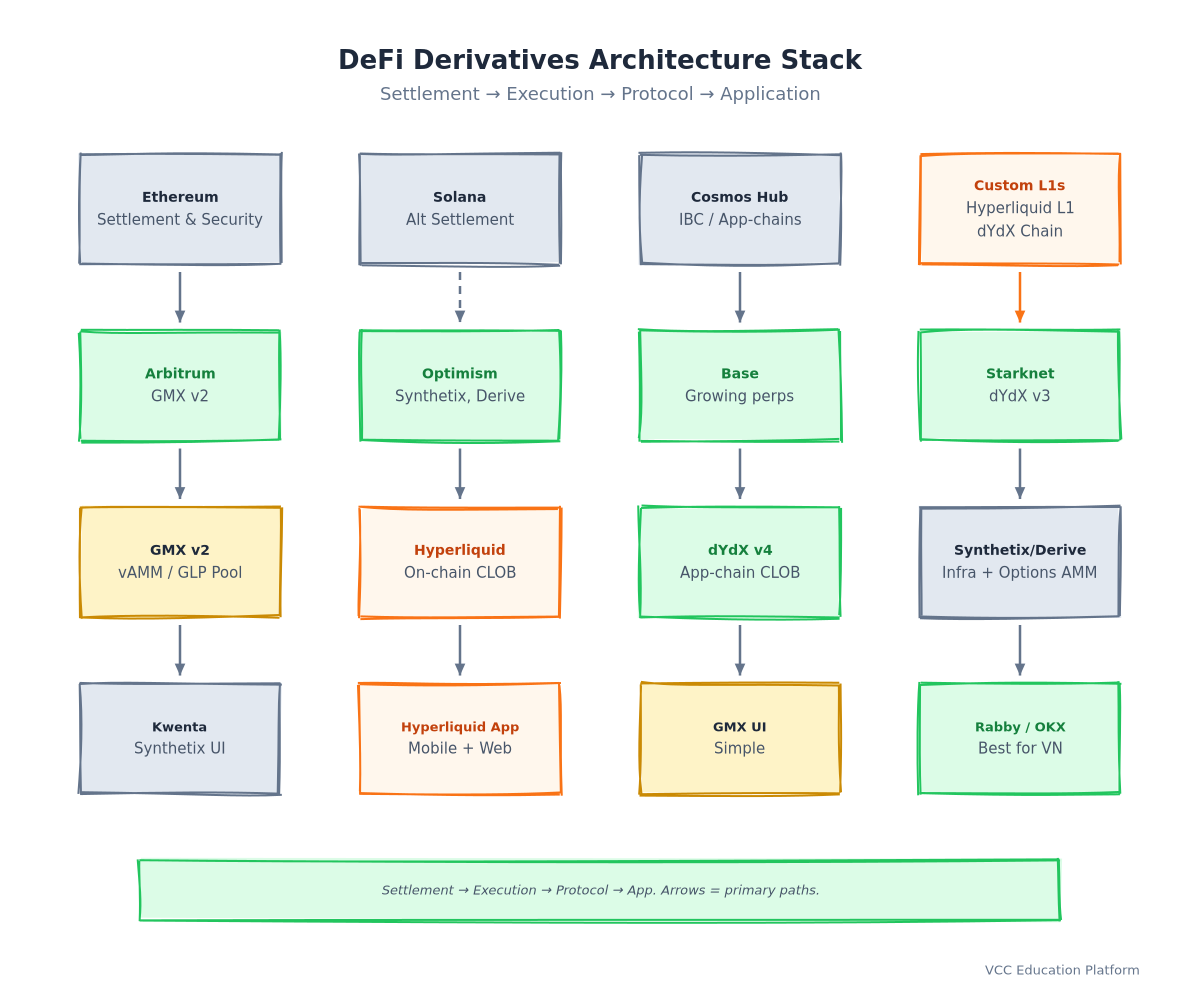
Flowchart - DeFi derivatives architecture layers
From Order Books to Intent: How We Got Here
Generation 1: Order Books on Ethereum (2017-2020)
Early attempts — dYdX v1, Dolomite, Radar Relay — replicated the CLOB (Central Limit Order Book) model on Ethereum mainnet. Every order, cancellation, and match was an on-chain transaction. Result: $50-200 gas per action, 15-second block times, zero market makers. Volume never exceeded $10M/day.
Generation 2: vAMMs — Virtual AMMs (2020-2022)
Perpetual Protocol, futureSwap, and later GMX v1 replaced the order book with a virtual Automated Market Maker. Liquidity providers deposit a single pool (e.g., USDC); the protocol simulates an order book using a constant-product formula with a virtual depth parameter. Breakthrough: Zero gas for traders (LPs pay), instant execution, no market makers needed. Trade-off: Price impact scales with trade size; funding rates disconnected from CEX; limited to long/short — no options, no spreads.
Diagram - Virtual AMM (vAMM) mechanism
Generation 3: Hybrid & App-Chains (2022-2023)
- dYdX v3 (StarkEx): Order book off-chain, settlement on ZK-rollup. CEX-like UX, but still custodial bridging.
- GMX v2 (Arbitrum/Avalanche): Multi-asset GLP pool, Chainlink oracles, zero price impact (oracle price = mark price).
- Synthetix v3 (Optimism): Modular "markets" — anyone deploys a perp/option market with custom parameters; protocol handles settlement, liquidation, oracle.
Generation 4: Intent-Based & Custom L1s (2024+)
Hyperliquid (custom L1, Tendermint): Fully on-chain CLOB, 20k TPS, sub-second finality, no gas fees — traders sign intents, validators execute. Derive (Lyra v2 on Optimism): Options AMM with Black-Scholes pricing, skew-adjusted IV, vega hedging for LPs. Vertex, Aevo, Paradex: RFQ (Request-for-Quote) + order book hybrids targeting institutional flow.
The Perp Trilemma: Why No Protocol Has Won Yet
Every perpetual DEX design faces three competing goals. You can optimize for two — the third suffers.
| Goal | What It Means | Protocols Prioritizing It |
|---|---|---|
| Capital Efficiency | High leverage, low collateral, minimal idle capital | GMX (zero price impact), Hyperliquid (cross-margin) |
| Oracle Independence | Mark price manipulation resistance without trusted feeds | dYdX (TWAP + external oracles), Synthetix (Pyth + Chainlink aggregation) |
| CEX-Parity UX | Order types, partial close, portfolio margin, sub-second latency | Hyperliquid, Vertex, dYdX v3 |
GMX nails Capital Efficiency + Oracle Independence (GLP pool absorbs counterparty risk; oracle price is truth). But you can't set a stop-limit, scale out of a position, or hedge with options.
dYdX v3 nailed CEX UX + Oracle Independence (professional order types, custom oracle aggregation). But makers posted collateral 1:1 — capital inefficient.
Hyperliquid nails CEX UX + Capital Efficiency (cross-margin, portfolio netting, instant finality). But its oracle is a custom validator-set TWAP — if 2/3 validators collude, mark price moves.
No protocol has solved all three. The next breakthrough likely comes from intent-based settlement (Anoma, SUAVE) or ZK-proven oracle aggregation (Chainlink CCIP + ZK-TLS) — where the oracle proves its honesty cryptographically rather than trusting a validator set.
Protocol Deep Dives
GMX v2: The Liquidity Pool That Became a Perpetual Engine
- Model: Multi-asset GLP pool (BTC, ETH, USDC, etc.). Traders trade against the pool; PnL settles in pool assets.
- Pricing: Chainlink + custom aggregation → mark price. Zero price impact (trade size doesn't move mark).
- Funding: Skew-based (longs pay shorts when open interest skewed).
- Leverage: Up to 50x (v2), isolated margin per market.
- Strengths: Simplest UX for beginners; LPs earn real yield (fees + borrowing costs); composable — other protocols build on GMX (Gains Network, Kwenta).
- Weaknesses: No advanced order types; funding can spike violently; GLP holders bear tail risk (black swan = pool insolvency).
- TVL: ~$400M (Aug 2024) | Daily Volume: ~$150M
Hyperliquid: The "Binance on Chain" That Isn't a Chain
- Model: Custom L1 (HyperBFT consensus, 20k TPS). Fully on-chain CLOB — every order, cancel, match is a transaction.
- Pricing: Validator TWAP oracle (2/3 honest assumption). No external oracle dependency.
- Funding: Premium/discount to mark price, settled every hour.
- Leverage: Up to 50x, cross-margin + portfolio margin (offsetting positions reduce margin).
- Killer feature: No gas fees. Users sign EIP-712 intents; validators execute and batch-settle. Fees = maker/taker spread (0.02%/0.05%).
- Strengths: Best UX in DeFi; institutional-grade order types (iceberg, TWAP, post-only); referral program drives organic growth.
- Weaknesses: Centralized validator set (4 validators at launch, ~20 now); oracle = validator set = single trust assumption; no options.
- TVL: ~$800M (Aug 2024) | Daily Volume: ~$800M (often #1)
Flowchart - Order flow on intent-based DEX (Hyperliquid)
dYdX v4: The App-Chain That Left Ethereum
- Model: Sovereign Cosmos SDK chain (dYdX Chain). CometBFT consensus, ~1s blocks.
- Pricing: External oracles (Pyth, Chainlink) + on-chain TWAP. Governance can add/remove oracles.
- Funding: Standard 8-hour funding, skew-adjusted.
- Leverage: Up to 20x (conservative), cross-margin.
- Strengths: Proven order book at scale; decentralized governance (DYDX token); IBC enables cross-chain deposits.
- Weaknesses: Lower leverage than competitors; volume migrated to Hyperliquid; Cosmos ecosystem less familiar to EVM users.
- TVL: ~$300M | Daily Volume: ~$200M
Synthetix v3: The Infrastructure Layer, Not the DEX
- Model: Market-agnostic, collateral-agnostic. Anyone deploys a "market" (perp, option, structured product) with custom parameters. Front-ends (Kwenta, Polynomial, dHedge) plug in.
- Pricing: Per-market oracle config (Pyth, Chainlink, custom). Markets isolated — no shared pool risk.
- Funding: Per-market, configurable (skew, premium, fixed).
- Leverage: Per-market, up to 100x+ for crypto perps.
- Strengths: Maximum flexibility; cross-chain via CCIP; SNX stakers earn protocol fees from all markets.
- Weaknesses: Fragmented liquidity across markets; front-end UX varies; complex for beginners.
- TVL: ~$200M across markets | Daily Volume: ~$100M
Derive (Lyra v2): The Only Serious On-Chain Options Protocol
- Model: Options AMM on Optimism. LPs provide single-sided collateral (USDC); protocol prices options via Black-Scholes + skew adjustment.
- Pricing: Real-time IV surface per expiry/strike. Skew parameter adjusts for market bias (puts > calls = positive skew).
- Greeks: Delta, gamma, vega, theta exposed to traders. LPs auto-hedge vega via perp positions on Synthetix/GMX.
- Products: European options (cash-settled), weekly/monthly/quarterly expiries.
- Strengths: Only protocol with professional options pricing; composable with perp hedging; institutional interest (Wintermute, Selini Capital are LPs).
- Weaknesses: Options volume <5% of perps; complex for retail; LP impermanent loss + vega risk.
- TVL: ~$50M | Monthly Options Volume: ~$15M
Graph - TVL & volume trends top 5 protocols
Comparative Matrix: Which Protocol for Which Trader?
Comparison - CEX vs DEX derivatives feature matrix
| Feature | GMX v2 | Hyperliquid | dYdX v4 | Synthetix (Kwenta) | Derive |
|---|---|---|---|---|---|
| Best For | Beginners, LPs, set-and-forget | Active traders, scalpers, institutions | Cosmos natives, governance participants | Builders, structured products | Options traders, vol arb |
| Order Types | Market, Limit, TP/SL | Full CLOB (IOC, FOK, Post-Only, Iceberg, TWAP) | Full CLOB | Market, Limit, TP/SL | Limit, RFQ |
| Max Leverage | 50x | 50x | 20x | 100x+ | 10x (options) |
| Margin Mode | Isolated | Cross + Portfolio | Cross | Isolated | Isolated |
| Gas Fees | L2 gas (~$0.05) | Zero | L1 gas (~$0.01) | L2 gas | L2 gas |
| Oracle | Chainlink + custom | Validator TWAP | Pyth + Chainlink + TWAP | Per-market configurable | Perp oracle (Synthetix/GMX) |
| Options | No | No | No | Yes (via markets) | Yes (core) |
| Mobile App | No | Yes (iOS/Android) | No | No | No |
| VN-Friendly | Medium (simple UI) | High (mobile, no gas) | Low (Cosmos wallet) | Low (complex) | Low (options complexity) |
Risk Framework: What Can Go Wrong (And Often Does)
1. Oracle Manipulation — The #1 Killer
Mechanism: Attacker pushes spot price on low-liquidity venue → oracle reports manipulated price → protocol marks positions at bad price → liquidations cascade. Real incidents: Mango Markets ($117M, 2022), Eisenberg exploited thin SOL-PERP oracle. Mitigation: Multi-oracle aggregation (Chainlink + Pyth + TWAP), circuit breakers (max price deviation per block), manipulation-resistant TWAP (Hyperliquid's validator set). Your check: Does the protocol disclose its oracle stack? Is there a max deviation cap? What happens if oracle fails?
2. Liquidation Cascades — The Death Spiral
Mechanism: Price drops → long positions liquidated → market sells amplify drop → more liquidations → protocol bad debt. GMX-specific: GLP pool is the counterparty. If liquidations exceed pool buffers, GLP holders take haircut. Hyperliquid-specific: Cross-margin means one bad position can liquidate entire portfolio. Mitigation: Partial liquidation (not full), insurance funds (dYdX, Hyperliquid), ADL (Auto-Deleveraging) as last resort. Your check: What's the insurance fund size? Is liquidation partial or full? ADL history?
Diagram - Liquidation cascade anatomy
3. Smart Contract / Upgrade Risk
Reality: Every protocol is upgradeable. Admin keys (multisig or DAO) can change parameters, pause markets, or — in theory — drain funds. Mitigation: Timelocks (48h+), DAO governance, audit trail, bug bounty ($1M+ for critical). Your check: Who holds upgrade keys? Timelock duration? Audit reports public?
4. Funding Rate Arbitrage & Toxic Flow
Mechanism: CEX funding ≠ DEX funding → arbitrageurs exploit gap → DEX LPs pay for CEX-DEX basis. GMX example: When BTC funding on Binance = 0.01%/8h but GMX = 0.05%, shorts on GMX get paid 5x — but GMX LPs (long GLP) bleed. Your check: Compare funding rates before sizing. Don't assume DEX funding = "free money."
Comparison - Protocol fee structures & tokenomics
5. Regulatory & Counterparty Risk (Vietnam Context)
- No legal recognition: Vietnam SSC Circular 12/2023/TT-NHNN bans issuance/offering of crypto derivatives. Trading on DEXes is not explicitly prohibited for individuals — but no legal protection exists.
- Tax black hole: 20% capital gains tax theoretically applies. No reporting infrastructure for on-chain perps. Declare at your own risk.
- Banking risk: VND on-ramp to DeFi requires P2P USDT → bridge → DEX. Banks may flag/freeze accounts receiving P2P crypto proceeds.
- No recourse: If Hyperliquid validators collude, or GMX oracle fails, or a bridge hacks your funds — no Vietnamese court will hear your case.
Checklist - Risk assessment framework
Vietnam On-Ramp: From VND to Your First Perp Trade
The Current Path (3-5 steps, 2-5% fees, 15-30 min)
`
- VND → USDT (TRC-20 on Tron) via P2P
- Platforms: Binance P2P, Remitano, local Telegram groups
- Rate: ~24,500 VND/USDT (spread 0.5-1%)
- Risk: Counterparty, bank freeze, scam
- USDT (Tron) → USDT (Arbitrum/Optimism/Base) via Bridge
- Tools: Orbiter Finance, Rhino.fi, official bridge
- Fee: $5-15 gas + 0.05-0.1% bridge fee
- Time: 3-10 min
- Connect Wallet → DEX
- Wallet: Rabby (best multi-chain UX), MetaMask, OKX Wallet
- DEX: Hyperliquid (app.hyperliquid.xyz) or GMX (gmx.io)
- Deposit → Trade
- Hyperliquid: Deposit USDC → auto-converts to USDC.e → trade
- GMX: Deposit USDC → mint gmUSDC → trade
- Withdraw → Reverse
- Same path in reverse. P2P cash-out spreads wider (1-2%).
`
Pro Tips for Vietnamese Traders
- Start on Hyperliquid — no gas fees means you can size small ($10-50) to learn without bleed.
- Use Rabby Wallet — auto-switches chains, simulates txns, shows "you will receive" before signing.
- Track funding rates — use
fundingrate.comorcoinglass.comto compare CEX vs DEX before entering. - Never max leverage — 10-20x is plenty. 50x liquidation distance = 2% move.
- Keep a CEX account — for hedging, funding arb, and emergency VND exit.
- Record every trade — spreadsheet with date, pair, size, entry, exit, funding paid/received, gas/fees. Essential for future tax compliance.
FAQ
Q: What is the primary difference between GMX and Hyperliquid?
A: GMX uses a virtual AMM (vAMM) backed by a multi-asset liquidity pool (GLP). You trade against the pool. Hyperliquid runs a fully on-chain central limit order book (CLOB). You trade against other traders. GMX = simpler, zero price impact, limited order types. Hyperliquid = CEX-like UX, advanced orders, no gas, but validator-set oracle trust.
Q: Are on-chain perpetuals safer than CEX perpetuals?
A: Different risk profile. CEX risks: Custody (FTX), regulatory seizure, opaque solvency. DEX risks: Smart contract bugs, oracle manipulation, bridge hacks, no legal recourse. DEXes are transparent (code + state visible) but uninsured. Diversify across both.
Q: Can I trade options on-chain in Vietnam?
A: Yes, via Derive (app.derive.xyz) on Optimism. You'll need USDC on Optimism (bridge from Arbitrum/Ethereum). Volume is low (~$15M/month) so spreads are wide. Only suitable if you understand Greeks and vol surfaces.
Q: How are funding rates calculated on DeFi perps?
A: Three main methods:
- Skew-based (GMX, dYdX): Funding ∝ (Long OI - Short OI) / Total OI. Longs pay shorts when longs dominate.
- Premium/Discount (Hyperliquid): Funding = (Mark Price - Index Price) / Index Price. Settled hourly.
- Fixed/Configurable (Synthetix): Per-market governance sets formula.
Q: What happens if the oracle goes wrong?
A: Most protocols have circuit breakers (max price change per block/epoch). If triggered, trading pauses, governance intervenes. Insurance funds cover bad debt up to a point. Beyond that: socialized loss (GMX GLP haircut) or ADL (Hyperliquid/dYdX).
Q: Is there a "best" protocol for beginners in Vietnam?
A: Hyperliquid — mobile app, zero gas, CEX-like UI, Vietnamese-language community growing (Telegram: @HyperliquidVN). Start with $50-100, 5-10x leverage, BTC/ETH perps only.
Q: How do I calculate real PnL including funding and fees?
A: Realized PnL = (Exit Price - Entry Price) × Size × Direction - Σ Funding Paid + Σ Funding Received - Σ Trading Fees - Σ Gas/Bridge Fees. Most DEX UIs show "Unrealized PnL" excluding funding. Export history to CSV and build your own sheet.
Key Takeaways
- DeFi derivatives are real — $2B+ daily volume, professional infrastructure, improving UX monthly.
- No free lunch — every protocol sacrifices something (Trilemma). Match your needs: GMX for simplicity/LP yield, Hyperliquid for active trading, Derive for options, Synthetix for building.
- Oracle risk is existential — read the oracle docs before depositing meaningful capital.
- Vietnam path exists but is messy — P2P → Bridge → DEX. No regulatory safety net. Size accordingly.
- The next 12 months — watch intent-based settlement (Hyperliquid → SUAVE), ZK oracles, and unified margin across spot/perp/options.
Next Steps for You
| If You Are... | Do This First |
|---|---|
| Never traded perps | Open Hyperliquid testnet (testnet.hyperliquid.xyz), trade $100 fake USDC for 1 week |
| CEX perp trader | Bridge $500 to Arbitrum, open GMX + Hyperliquid, run same strategy on both for 2 weeks |
| Options curious | Read Derive docs, paper-trade on Derive testnet, learn Greeks first |
| Builder/Developer | Study Synthetix v3 SDK, deploy a test market on Sepolia |
| Risk-averse LP | Start with GMX GLP (small allocation), track daily PnL vs. benchmark |
Disclaimer: This article is educational, not financial advice. Derivatives trading carries high risk of total loss. Vietnam regulatory status is uncertain. Never trade with money you cannot afford to lose. Verify all protocol parameters before depositing — contracts upgrade, parameters change, and front-ends can be compromised.