
You've heard that blockchain is "trustless" — no central authority, no bank, no referee. But if there's no referee, how do thousands of computers around the world agree on anything? How does the network decide which transactions are valid, in what order, and who gets to add the next block? The answer is consensus — and it's the single most important innovation in blockchain.
Here's the one-sentence version: consensus is a set of rules that lets thousands of independent computers agree on a single shared state, even when some of them are dishonest or offline. That's it. Everything else — Proof of Work, Proof of Stake, Ouroboros, mining, staking — is a different way of implementing those rules.
The Problem: The Byzantine Generals Problem
Before blockchain, there was a classic computer science puzzle called the Byzantine Generals Problem. Imagine several generals surrounding a city, each commanding their own army. They can only communicate by messengers. They must agree on a single plan: attack or retreat. But some generals might be traitors, sending false messages to confuse the others. How can the loyal generals reach agreement when they can't trust the messengers — or each other?
This is exactly the problem blockchain solves. The "generals" are nodes. The "messengers" are network messages. The "traitors" are malicious actors. The "plan" is the next block of transactions. Consensus is the protocol that lets honest nodes agree, even with traitors in the mix.
The breakthrough (attributed to Satoshi Nakamoto in the Bitcoin whitepaper, 2008) was solving this at scale with economic incentives instead of trusted identities. You don't need to know who the nodes are — you just need it to be more expensive to cheat than to play honestly.
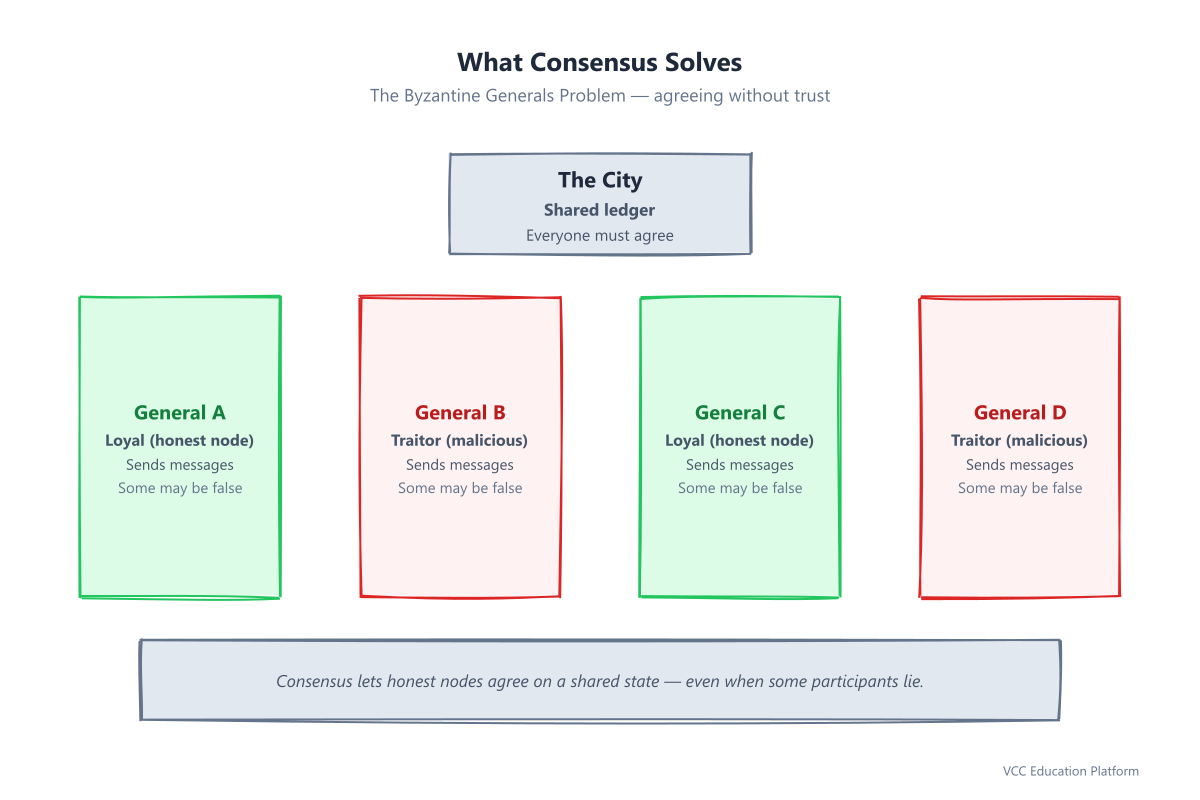
Figure 1: The Byzantine Generals Problem — agreeing without trust
The Two Main Approaches: Proof of Work vs Proof of Stake
There are many consensus mechanisms, but two dominate: Proof of Work (PoW) and Proof of Stake (PoS). Here's how they differ:
Proof of Work (Bitcoin)
- How it works: Miners compete to solve a cryptographic puzzle (find a hash below a target). The first to solve gets to add the next block and earn the reward.
- Security comes from: the cost of computing power. To attack the network, you'd need more hash power than all honest miners combined (51% attack) — economically irrational because you'd crash the value of the coins you're attacking.
- Cost: enormous energy. Bitcoin consumes ~150 TWh/year — more than many countries.
- Decentralization: anyone can mine, but in practice, mining farms and ASIC manufacturers concentrate power.
Proof of Stake (Cardano, Ethereum post-Merge)
- How it works: Instead of burning energy, validators "stake" their coins as collateral. The protocol randomly selects a validator to produce each block. Produce honestly → earn rewards. Cheat → lose your stake (slashing).
- Security comes from: skin in the game. To attack, you'd need to control 51% of all staked coins — and if caught, you lose them all.
- Cost: minimal energy. Cardano consumes ~0.01 TWh/year — about 15,000x less than Bitcoin.
- Decentralization: anyone can stake (no ASIC needed), but large staking services can concentrate stake.
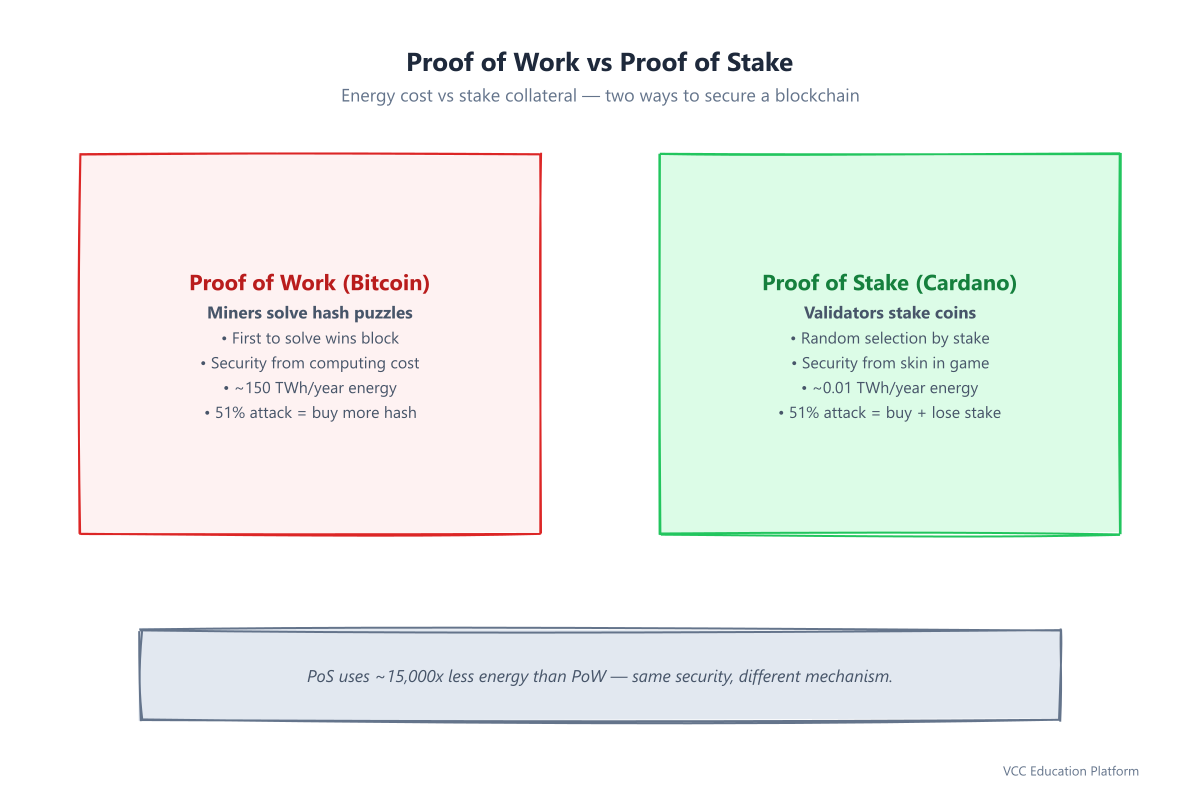
Figure 2: Proof of Work vs Proof of Stake — energy cost vs stake collateral
The Blockchain Trilemma: You Can't Have Everything
Every consensus mechanism trades off three properties — the blockchain trilemma:
- Security: Can the network resist attacks (51%, censorship, double-spend)?
- Scalability: How many transactions per second (TPS)?
- Decentralization: How many independent participants? Can anyone join?
You can maximize two, but not all three simultaneously:
- Bitcoin (PoW): maxes security + decentralization, sacrifices scalability (~7 TPS).
- Cardano (PoS/Ouroboros): balances all three — strong security, good decentralization (~3000 pools), moderate scalability (~250 TPS, improving with Leios).
- Solana (PoH+PoS): maxes scalability (~65,000 TPS), sacrifices some decentralization (high hardware requirements).
There is no "best" — only "best for which use case." For a store of value (Bitcoin), security matters most. For a global payment network (Cardano), balance matters. For high-frequency trading (Solana), speed matters.
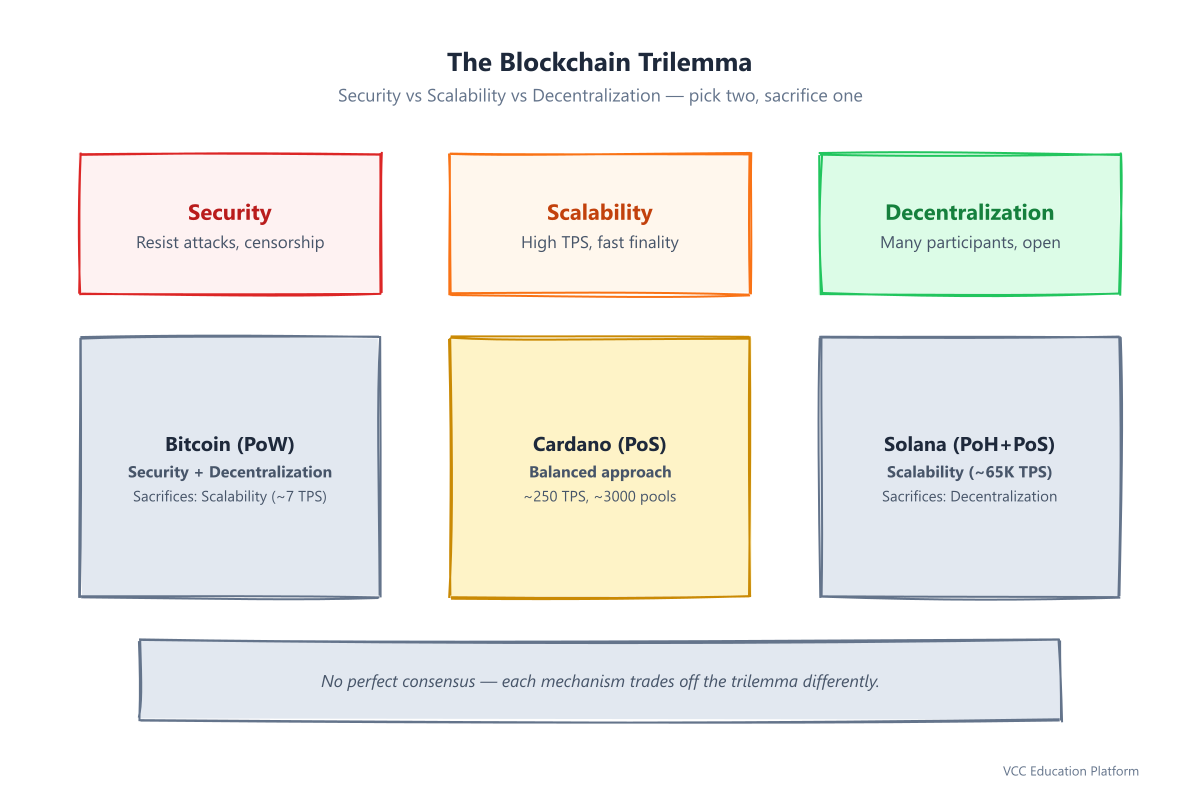
Figure 3: The blockchain trilemma — pick two, sacrifice one
Cardano's Consensus: The Ouroboros Family
Cardano doesn't use a single consensus protocol — it uses the Ouroboros family, a series of peer-reviewed protocols that improve over time:
- Ouroboros (original, 2017): The first PoS protocol with a formal security proof. Established that PoS could be as secure as PoW.
- Ouroboros Praos (2018): Added VRF (Verifiable Random Function) for leader selection — makes it unpredictable who produces the next block, preventing targeted attacks.
- Ouroboros Genesis (2019): Solved the "bootstrap problem" — how a new node joining the network can trustlessly sync from genesis without trusting a checkpoint.
- Ouroboros Chronos: Added timestamps to improve synchronization across nodes.
- Ouroboros Leios (upcoming): A major throughput upgrade — separates block production into "endorsement" and "voting" tiers to dramatically increase TPS while maintaining security.
Each Ouroboros variant is published as an academic paper, peer-reviewed at cryptography conferences, before implementation. This is Cardano's distinguishing feature: consensus backed by formal mathematical proofs, not just "it seems to work."
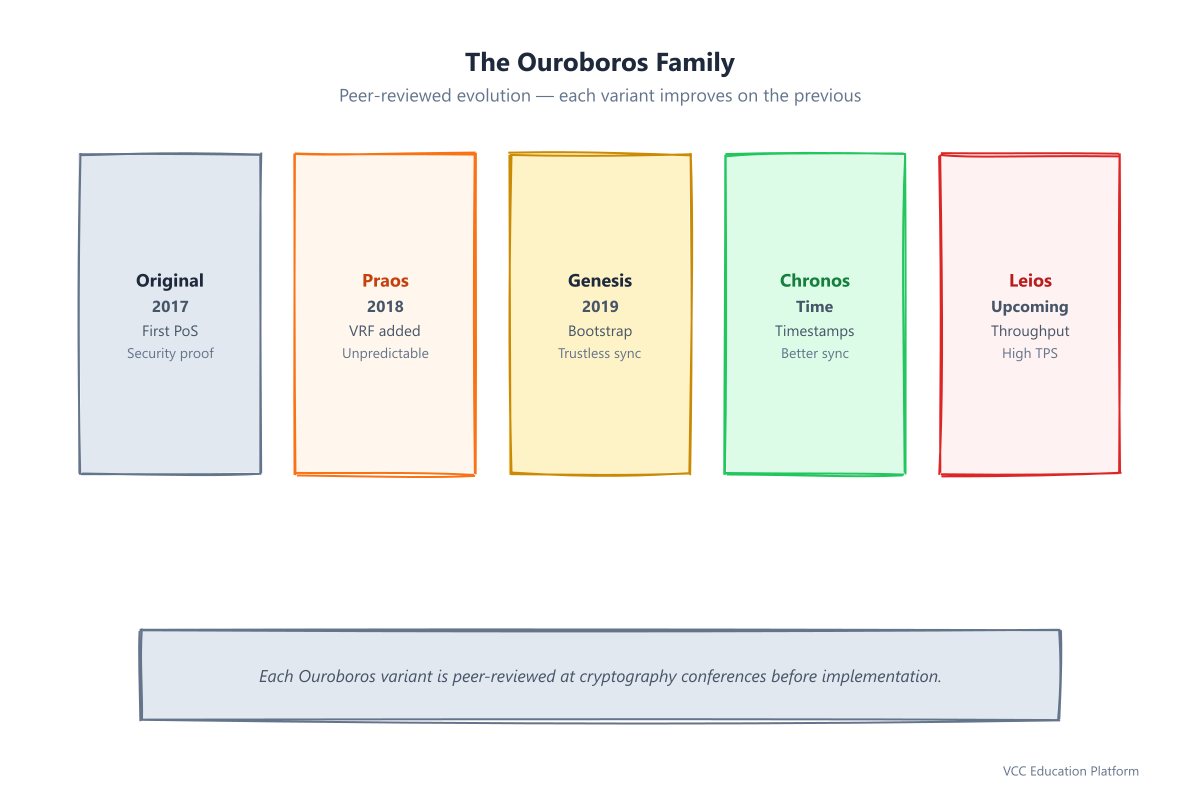
Figure 4: The Ouroboros family — peer-reviewed evolution
How Ouroboros Works (Plain Language)
Here's how a block gets produced on Cardano, step by step:
- Epoch begins. Cardano divides time into 5-day epochs, each split into 432,000 slots (1 second each).
- Slot leader selected. For each slot, the protocol uses VRF to randomly select a stake pool as the "slot leader." The more stake delegated to a pool, the higher its chance of being selected — but it's probabilistic, not guaranteed.
- Slot leader produces block. The selected pool gathers pending transactions, validates them, creates a new block, and broadcasts it.
- Nodes verify. Every node checks the block: valid transactions? Correct slot leader? Proper VRF proof? If yes, they add it to their chain.
- Next slot. A new leader is selected for the next slot. The process repeats.
No energy is burned on puzzles. No mining farms. The "work" is replaced by "stake" — your economic commitment to the network. Cheat, and you lose stake. Play honestly, and you earn rewards.
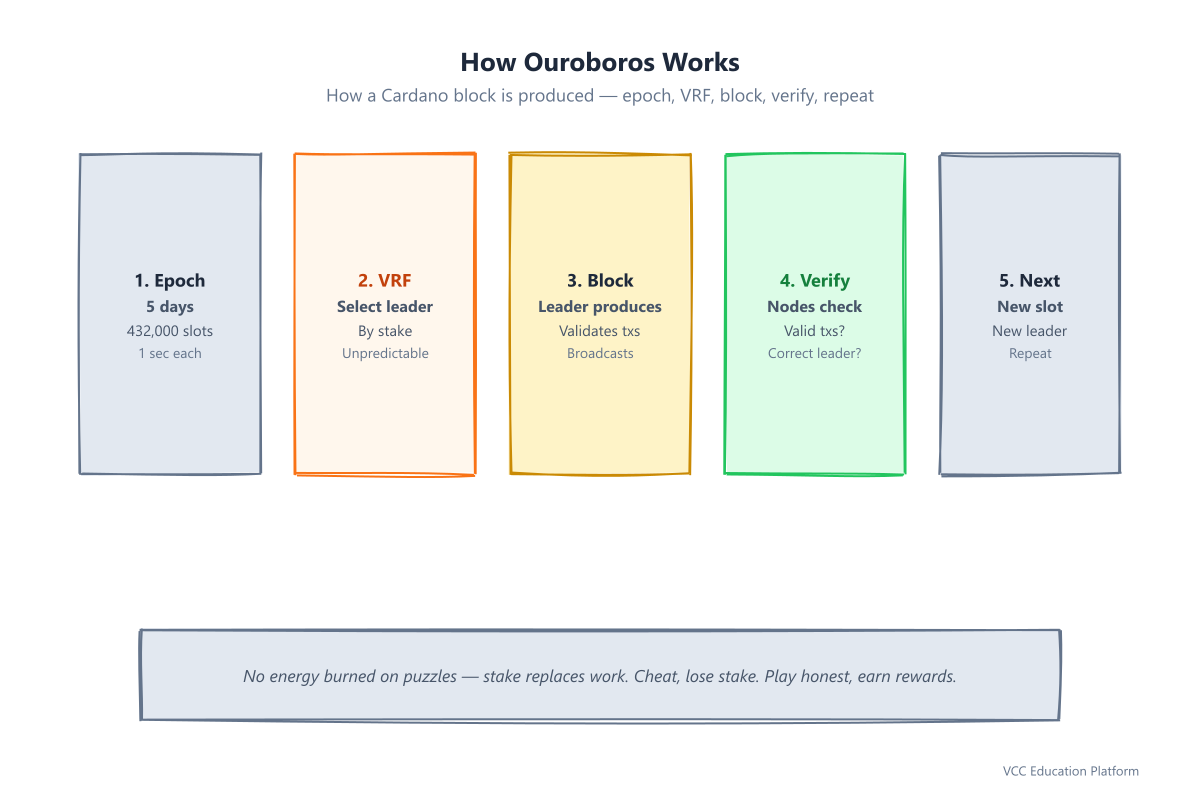
Figure 5: How a Cardano block is produced — epoch, VRF, block, verify, repeat
For Vietnamese Readers: "Đồng Thuận" at Scale
"Đồng thuận" (consensus) is a familiar concept in Vietnamese culture — a family meeting where everyone must agree before acting, a village decision where all elders sign off. Blockchain consensus is the same idea, but scaled to thousands of strangers who don't trust each other.
The key insight: traditional "đồng thuận" relies on trust (you know the family members, you trust the village elders). Blockchain consensus removes the need for trust — the rules are mathematical, the incentives are economic, and anyone can verify. You don't need to know or trust the other nodes — you just need to trust the protocol.
This is why consensus matters: it's the foundation that makes "no central authority" possible. Without consensus, you'd need a bank to settle disputes. With consensus, the protocol settles them — transparently, predictably, and without anyone being able to cheat.
Quick Reference
| Term | Definition |
|---|---|
| Consensus | Rules that let independent nodes agree on a shared state, even with dishonest participants |
| Byzantine Generals Problem | The classic puzzle: how to reach agreement when some participants are traitors |
| Proof of Work (PoW) | Miners solve hash puzzles; security from computing cost (Bitcoin) |
| Proof of Stake (PoS) | Validators stake coins; security from skin in the game (Cardano, Ethereum) |
| Ouroboros | Cardano's PoS consensus family — peer-reviewed, formally proven |
| VRF | Verifiable Random Function — unpredictably selects slot leaders (Praos) |
| Slot leader | Stake pool selected to produce a block for a given slot |
| Epoch | 5-day period on Cardano, divided into 432,000 1-second slots |
| Slashing | Punishment for dishonest validators — lose staked coins |
| Blockchain trilemma | Security vs scalability vs decentralization — pick two |
| Leios | Upcoming Ouroboros upgrade for dramatically higher throughput |