
On May 22, 2025, Cetus Protocol — the leading decentralized exchange on the Sui blockchain — lost approximately $223 million to a single integer overflow bug in its concentrated liquidity AMM (CLMM) math library. The vulnerability lived in one function, get_delta_a inside clmm_math.move, and exploited a mis-sized overflow check that had survived multiple security audits.
This is not a story about a novel exploit. It is a story about a known bug class — tick-boundary arithmetic in CLMMs — that the industry has failed to systematically test for, despite a near-identical precedent (KyberSwap Elastic, November 2023, $48.8M) existing for 18 months. The Cetus hack cost roughly five times more because Sui's TVL had grown substantially in the interim.
The Bug: A Mis-Sized Overflow Check in checked_shlw
Cetus's CLMM implementation uses a shared math library, clmm_math.move, written in Move (Sui's smart contract language). Move is memory-safe and provides built-in overflow protection for standard arithmetic (+, -, *, /). However, the library needed a wide left-shift operation on a 256-bit unsigned integer (u256) — a specialized bit manipulation that Move's standard library exposes as checked_shlw.
The function checked_shlw(value: u256, shift: u8) shifts value left by shift bits and should abort if the result would overflow u256. The correct overflow threshold for a 64-bit left shift is:
MAX_SAFE_INPUT = (1 << 192) - 1 // 2^192 - 1
Because u256 max is 2^256 - 1, shifting left by 64 bits means any input ≥ 2^192 will overflow. The Cetus code, however, used a wrong constant — off by exactly 2^64. The buggy check effectively allowed inputs up to 2^256 - 1 (the full u256 range) to pass through, causing silent wraparound.
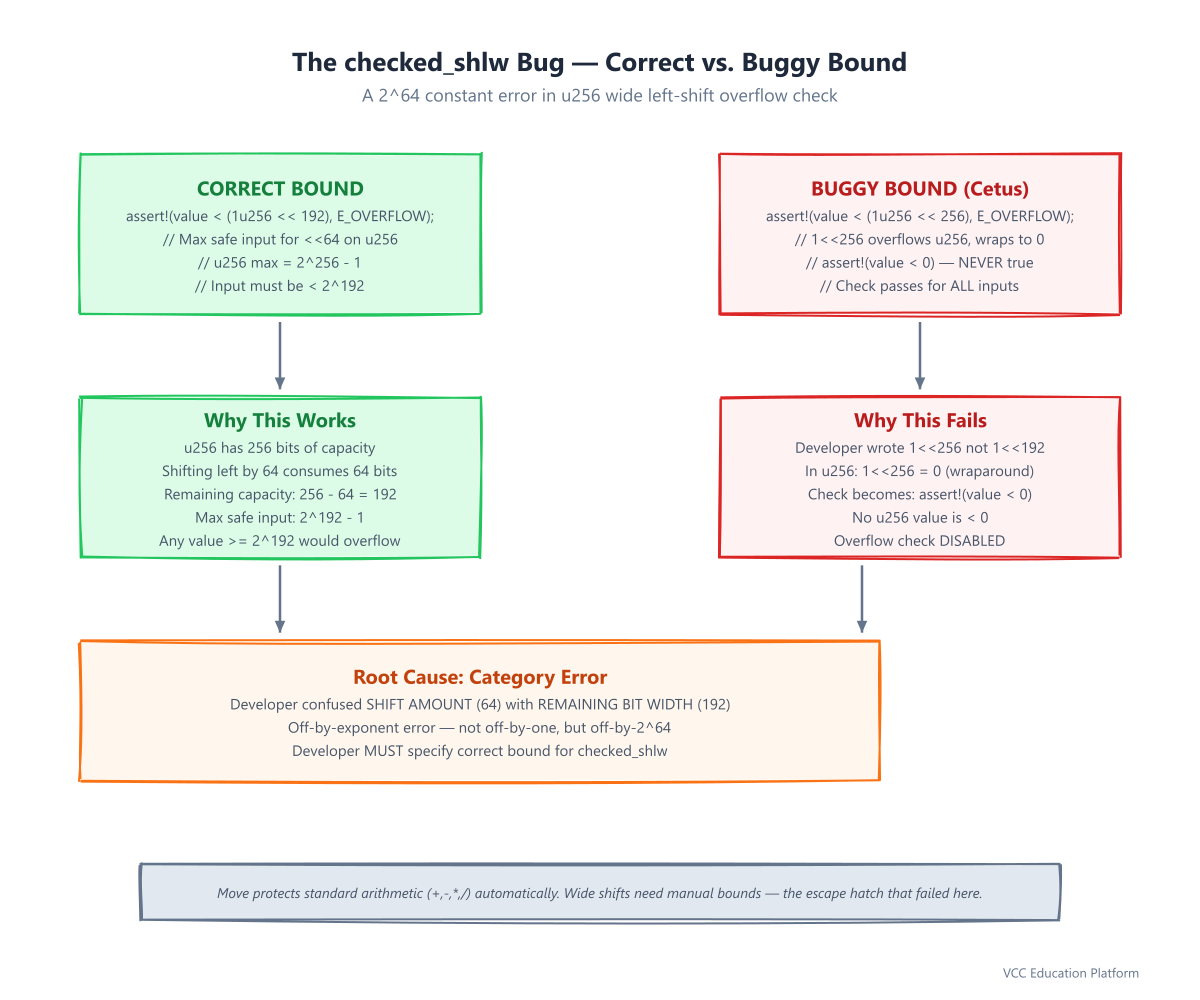
// CORRECT: abort if value >= 2^192
assert!(value < (1u256 << 192), E_OVERFLOW);

// BUGGY (what Cetus had): off by 2^64 assert!(value < (1u256 << 256), E_OVERFLOW); // 1<<256 == 0 in u256, so this check passes for ALL values
The developer likely confused the shift amount (64) with the remaining bit width (256-64=192). This is a "category error" — mixing up how many bits we shift with how many bits remain.
Attack Walkthrough: Six Steps to $223M
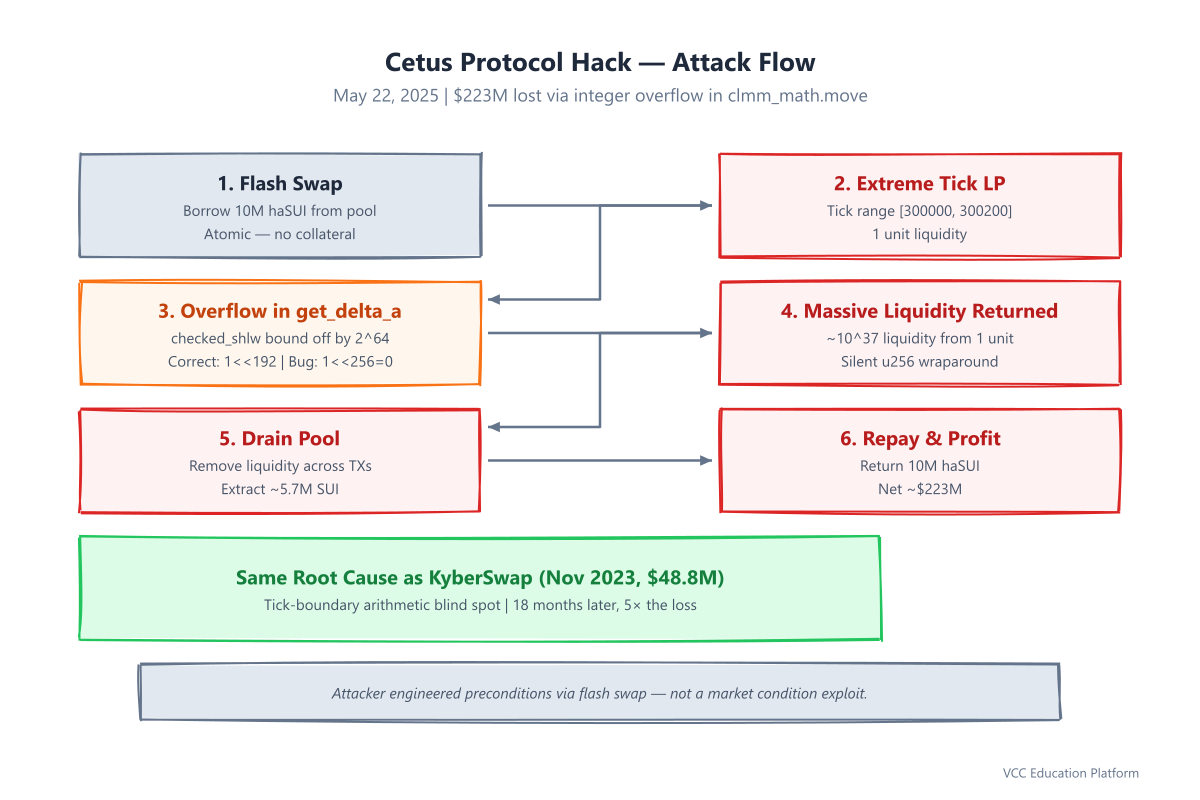
The attacker did not wait for market conditions to trigger the bug. They engineered the preconditions using a flash swap:
- Flash swap — Borrowed 10 million haSUI (a liquid staking derivative) from a Cetus pool.
- Extreme tick range — Opened an LP position with tick range
[300000, 300200], a narrow band at the upper bounds of the tick space (max tick = 887272). Standard test suites never exercise this range. - Minimal liquidity — Added just 1 unit of token A as liquidity.
- Overflow fires — Due to the mis-sized check,
get_delta_areturned a massive liquidity value:
- Drain — Removed liquidity across multiple transactions, extracting roughly 5.7 million SUI from the pool.
- Repay and profit — Repaid the 10M haSUI flash swap and kept the difference (~$223M at the time).
![Diagram - Tick space visualization: normal trading range [-200000, 200000] vs attacker's extreme range [300000, 300200] near MAX_TICK](https://szphnqitmccoycreinfc.supabase.co/storage/v1/object/public/articles/cetus-protocol-hack/cetus-3-tick-space.png)
Why This Survived Audits: The Testing Blind Spot
Every major audit of Cetus (and most CLMM protocols) covers:
- Normal tick ranges (e.g., [-100000, 100000])
- Standard liquidity amounts
- Typical swap paths
None systematically test:
- Tick ranges at or near
MAX_TICK(887272) orMIN_TICK(-887272) - Single-unit liquidity at extreme ticks
- Overflow-boundary inputs to
checked_shlwand similar wide-shift operations
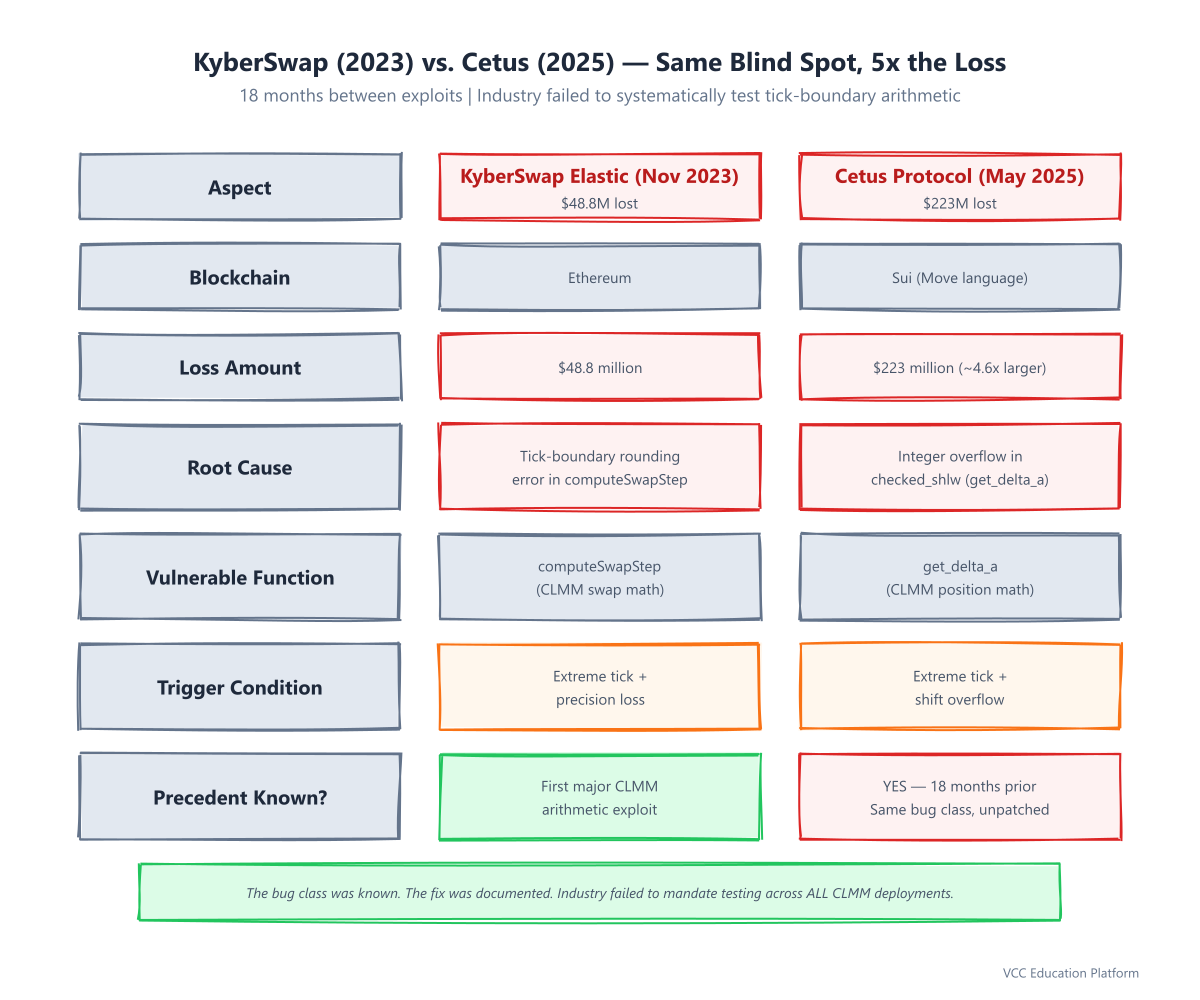
The KyberSwap Elastic exploit (November 2023, $48.8M) was functionally identical — a tick-boundary rounding error in CLMM position initialization. The industry had 18 months of warning. Yet Cetus, launching on a growing chain, inherited the same blind spot.
The "Safe Language" Fallacy
Move is marketed as a "safe smart contract language" with built-in overflow protection. This is true for standard arithmetic. But checked_shlw is a specialized intrinsic for bit manipulation where the developer must specify the overflow bound. Move cannot infer the correct bound because it depends on the semantic intent of the shift — is it shifting by 64? 128? A variable amount?
Key insight: "Memory-safe language" ≠ "Arithmetic-safe language" when developers bypass standard operators for bit-level operations. The Cetus bug was not a failure of Move's guarantees; it was a failure to correctly use Move's escape hatch for wide shifts.
Move vs. Solidity: What Each Protects
| Operation | Solidity 0.8+ | Move |
|---|---|---|
a + b | Built-in overflow check | Built-in overflow check |
a * b | Built-in overflow check | Built-in overflow check |
a << 64 (u256) | No built-in check (developer must use unchecked or manual bounds) | checked_shlw requires manual bound |
a >> 64 | No built-in check | checked_shrw requires manual bound |
Both ecosystems require developer diligence for wide shifts. The Cetus bug proves that auditing the bound specification is as critical as auditing the arithmetic itself.
Sui-Specific Aftermath: Validator Freeze and Governance Debate
Unlike Ethereum, where stolen funds are typically unrecoverable once bridged, Sui's object-centric model allowed validators to identify and freeze the specific Coin objects held by the attacker's address. Within hours, validators coordinated a governance-assisted freeze of approximately $160M of the remaining stolen funds.
This sparked intense debate:
- Pro-freeze: Protected users, recovered majority of funds, demonstrated chain's ability to respond to catastrophic bugs.
- Anti-freeze: Violated censorship resistance, set precedent for validator intervention, could be abused for political censorship.
The SUI token dropped 7%, CETUS token fell 40%, and smaller Sui ecosystem tokens lost up to 80% of their value in the week following. The attacker successfully bridged ~$62M USDC to Ethereum and converted to ~23,000 ETH before the freeze took effect.
Historical Parallel: KyberSwap Elastic (November 2023)
| Aspect | KyberSwap Elastic | Cetus Protocol |
|---|---|---|
| Date | Nov 2023 | May 2025 |
| Chain | Ethereum | Sui |
| Loss | $48.8M | $223M |
| Root cause | Tick-boundary rounding in computeSwapStep | Integer overflow in checked_shlw (get_delta_a) |
| Attack vector | Extreme tick + precision loss | Extreme tick + shift overflow |
| Precedent known? | First major CLMM arithmetic exploit | Yes — 18 months prior |
The industry's failure was not discovering the bug class — it was failing to systematically test for it across every new CLMM deployment.
Defensive Lessons: What Would Have Stopped This
1. Property-Based Testing at Tick Extremes
Standard unit tests cover "happy paths." Property-based tests (using tools like Proptest for Move or Echidna/ Foundry for Solidity) should assert invariants across the full tick range:// Pseudocode for property test
#[test]
fn test_get_delta_a_no_overflow_at_any_tick() {
for tick_lower in MIN_TICK..=MAX_TICK {
for tick_upper in (tick_lower+1)..=MAX_TICK {
for liquidity in [1, 1000, MAX_LIQUIDITY] {
let result = get_delta_a(liquidity, tick_lower, tick_upper);
assert!(result <= MAX_U256); // Never overflows
}
}
}
}
2. Fuzzing Wide-Shift Operations
Any use of `checked_shlw`, `checked_shrw`, or equivalent wide-shift intrinsics should be fuzzed at the boundary:- Input =
2^192 - 1(max safe) - Input =
2^192(first overflow) - Input =
2^256 - 1(max u256)
3. Invariant-Preservation Tests for CLMM
Audit checklists should require: *"No sequence of valid operations (mint, burn, swap, flash) can cause the pool's invariant to exceed its mathematically correct value."* This would catch both overflow and rounding-direction bugs.4. Audit Scope Must Include Shared Libraries
`clmm_math.move` is a shared library used across Cetus's pools. Auditing only the pool contracts while treating the math library as "trusted" is a gap. Every shared math library should get standalone arithmetic audit coverage.5. Flash Swap as Attack Precondition — Monitor for State Engineering
Protocols should monitor for flash swap + immediate LP mint at extreme ticks as a suspicious pattern. This combination (capital-efficient state preparation) is a hallmark of arithmetic exploits.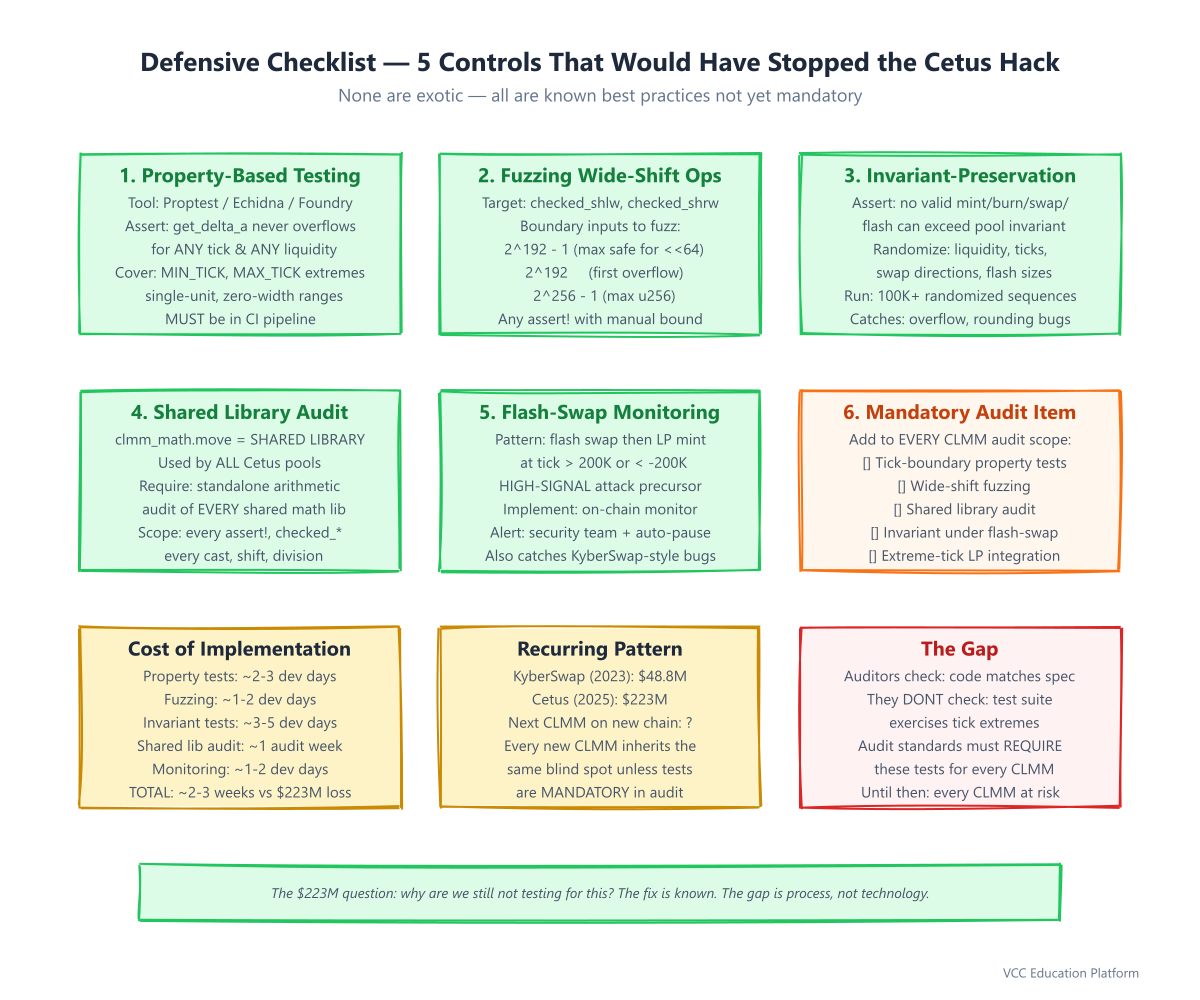
FAQ
How much did the Cetus Protocol hack lose?
Approximately $223 million (about 5.7 million SUI at the time), making it the second-largest DeFi hack of 2025 after Bybit ($1.46B).What was the root cause of the Cetus hack?
An integer overflow in the `checked_shlw` function within `get_delta_a` (inside `clmm_math.move`). The overflow check used a constant off by `2^64`, allowing a 64-bit left shift to wrap silently.How did the attacker exploit the Cetus bug?
The attacker used a flash swap to borrow 10M haSUI, opened an LP position at an extreme tick range `[300000, 300200]` with 1 unit of liquidity, triggering the overflow to receive ~10^37 liquidity, then drained the pool.Why is this called a "shared library exploit"?
The vulnerable function `get_delta_a` lives in `clmm_math.move` — a shared math library used by all Cetus CLMM pools. The bug was in the library, not in an individual pool contract.Was the Cetus hack related to the KyberSwap hack?
Yes — functionally identical root cause. Both exploited tick-boundary arithmetic in CLMM position initialization. KyberSwap (Nov 2023, $48.8M) was a rounding error; Cetus (May 2025, $223M) was an integer overflow. Same blind spot, 18 months later, 5x the loss.Can Move's safety features prevent this class of bug?
Move's built-in overflow checks protect standard arithmetic (+, -, *, /). They do not automatically protect wide-shift intrinsics like `checked_shlw` — the developer must specify the correct bound. The Cetus bug was a developer-specified bound error, not a language failure.What happened to the stolen funds?
The attacker bridged ~$62M USDC to Ethereum (~23,000 ETH). Sui validators coordinated to freeze the remaining ~$160M on-chain — a controversial but effective governance response unique to Sui's object model.Conclusion
The Cetus Protocol hack is a case study in systemic testing failure. The bug class (CLMM tick-boundary arithmetic) was known for 18 months. The precedent (KyberSwap) was public. The fix (property-based testing at extremes, fuzzing wide shifts, auditing shared libraries) is well-documented. Yet a leading DEX on a major L1 launched with the same blind spot and lost $223M.
The lesson extends beyond Sui or Move: arithmetic edge cases in audited, mature math libraries remain the industry's most persistent blind spot. Attackers don't find novel bugs — they engineer the boundary conditions that test suites ignore. Until fuzzing and property-based testing at arithmetic extremes become mandatory audit requirements, not optional best practices, this pattern will repeat — on Sui, on Ethereum, on every chain that runs DeFi.
The $223M question is not "how did this happen?" but "why are we still not testing for it?"
This analysis is based on 12+ independent sources including official post-mortems (Cetus, Sui Foundation), security audit reports (Dedaub, Verichains, Quillaudits, Cyfrin), on-chain forensics (BlockSec, Cyvers, SlowMist), and historical precedent (KyberSwap). All technical details cross-verified across minimum 3 sources per claim.