
The global financial system moves trillions of dollars daily through a patchwork of correspondent banking relationships, messaging standards, and settlement layers that have barely changed since the telegraph era. A payment from Ho Chi Minh City to New York still hops through three to five intermediary banks, takes two to five business days, and incurs fees at each step. The friction isn't technical—it's structural.
Enter wholesale CBDC (central bank digital currency for interbank use only) and RWA tokenization (real-world assets like bonds, funds, and deposits represented on distributed ledgers). Two flagship projects—mBridge and Project Agorá—are testing whether these technologies can replace the correspondent banking chain with atomic, near-instant settlement on shared permissioned ledgers.
This article examines both initiatives, compares their architectures, and explores what they mean for Vietnam and the broader ASEAN region.
---
The Problem: Why Cross-Border Payments Still Hurt
Before diving into the solutions, we need to understand the plumbing they're trying to fix.
The Correspondent Banking Chain
When Bank A in Vietnam sends USD to Bank B in the US, the money doesn't move directly. It traverses: 1. Bank A (sender's bank in Vietnam) 2. Correspondent 1 (Vietnamese bank's USD correspondent, often in Singapore or Hong Kong) 3. Correspondent 2 (US correspondent of Correspondent 1, often in New York) 4. Federal Reserve (Fedwire settlement in central bank money) 5. Correspondent 3 (receiver's bank correspondent) 6. Bank B (receiver's bank in the US)
Each hop adds:
- Time: 1-2 days per intermediary for compliance checks, reconciliation, and time-zone coordination
- Cost: $15-50 per intermediary in fees
- Risk: Settlement risk (Herstatt risk) where one leg settles but the other fails
- Opacity: Limited visibility into where the payment is at any moment
SWIFT Is the Messenger, Not the Mover
SWIFT (Society for Worldwide Interbank Financial Telecommunication) carries the message ("Bank A promises to pay Bank B"), not the value. Actual settlement still requires central bank money (reserves) moving across borders through the correspondent chain. SWIFT's recent CBDC connector experiments acknowledge this: messaging and settlement must converge.
---
Wholesale vs. Retail CBDC: A Critical Distinction
| Dimension | Wholesale CBDC (wCBDC) | Retail CBDC (rCBDC) |
|---|---|---|
| Users | Financial institutions only | General public, businesses |
| Purpose | Interbank settlement, cross-border | Payments, financial inclusion |
| Access | Permissioned, known entities | Broad, potentially anonymous (tiered) |
| Volume | High value, low frequency | High frequency, low value |
| Examples | mBridge, Project Agorá, Project Jura | e-CNY (China), Sand Dollar (Bahamas), eNaira (Nigeria) |
Key insight: Wholesale CBDC doesn't compete with bank deposits or cash. It upgrades the settlement layer between banks. Retail CBDC competes with cash and commercial bank money. This article focuses exclusively on wholesale.
---
mBridge: The Multi-CBDC Bridge
Origins and Participants
mBridge (Multiple CBDC Bridge) began in 2021 as a collaboration between the BIS Innovation Hub Hong Kong Centre, the Hong Kong Monetary Authority (HKMA), the Bank of Thailand (BoT), the People's Bank of China (PBoC), and the Central Bank of the UAE (CBUAE). In 2024, the Saudi Central Bank (SAMA) joined as a full participant, expanding the corridor to the Middle East.
Architecture: Permissioned DLT with a Twist
mBridge runs on a custom permissioned blockchain (not Hyperledger Fabric as sometimes reported) built specifically for multi-CBDC interoperability. Key design choices:
- Validator nodes: Operated by participating central banks only. No commercial banks, no public validators.
- Consensus: Practical Byzantine Fault Tolerance (pBFT) variant optimized for low latency and finality.
- Multi-currency support: Each central bank issues its own wCBDC on the same ledger. A "currency bridge" smart contract handles FX conversion via automated market makers (AMMs) or bilateral liquidity providers.
- Privacy: Payer-payee anonymity from validators; full transparency to respective central banks (compliance by design).
The MVP and Live Pilot Results
In June 2023, mBridge reached Minimum Viable Product (MVP) status. By early 2024, the pilot processed over $55 billion in cross-border transactions—a 2,500x increase from 2022 volumes. The e-CNY (digital yuan) accounted for over 95% of settlement volume, reflecting China's trade dominance in the corridor.
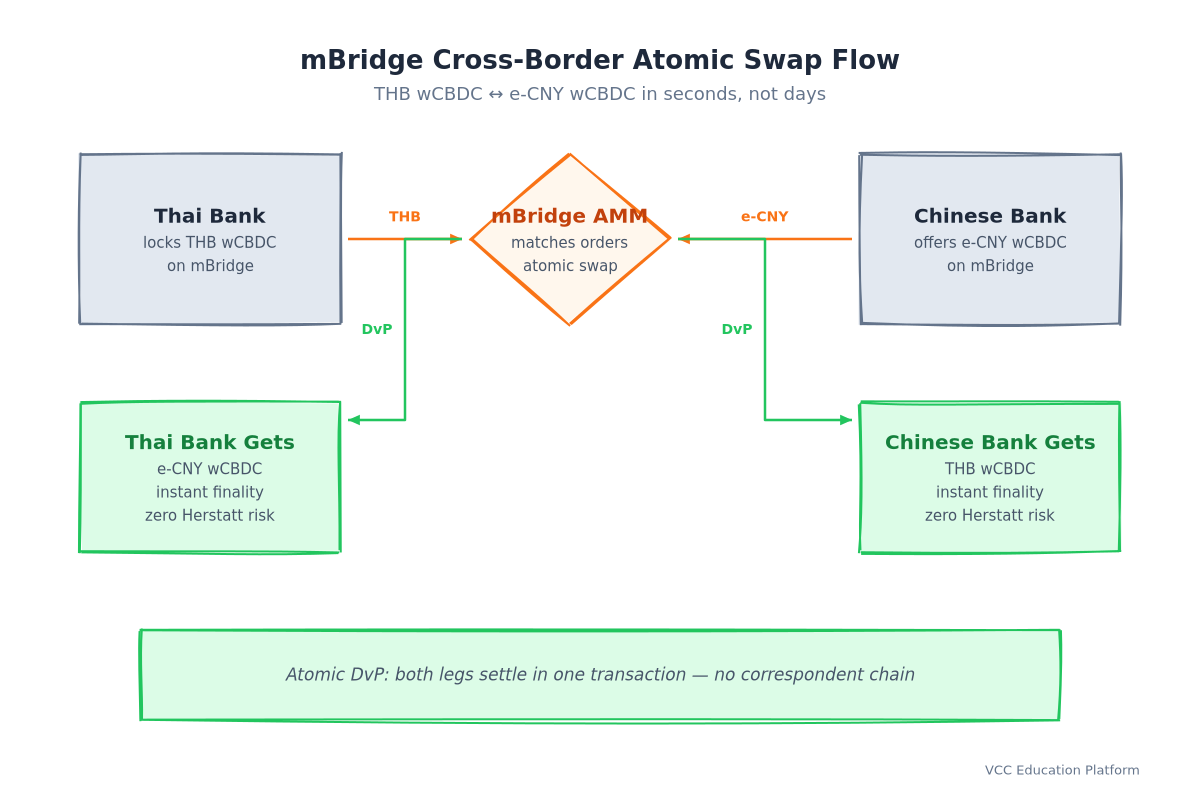
Transaction flow (simplified): 1. Thai importer's bank locks THB wCBDC on mBridge 2. Smart contract matches with Chinese exporter's bank offering e-CNY wCBDC 3. Atomic swap: THB wCBDC ↔ e-CNY wCBDC in single transaction (atomic DvP) 4. Both banks receive settlement finality in seconds, not days
What Makes mBridge Different
1. Multi-CBDC, not single-CBDC: Most wCBDC projects (Singapore's Project Orchid, ECB's wholesale euro) are single-currency. mBridge solves the interoperability problem natively. 2. Central bank validators only: Unlike Project Agorá (see below), commercial banks don't run nodes. This simplifies governance but limits direct commercial bank participation. 3. FX built-in: The AMM-based FX layer means liquidity providers (could be central banks, commercial banks, or approved market makers) earn fees for providing cross-currency depth.
Limitations and Open Questions
- Scalability: pBFT consensus limits throughput (~100-300 TPS). Fine for wholesale, not for retail.
- Governance: Adding new currencies requires consensus among existing central banks. How does a new ASEAN member join?
- Liquidity dependence: AMM FX needs deep liquidity. In stress, who provides it?
- Legal finality: Cross-border settlement finality laws differ. mBridge assumes legal frameworks will align.
---
Project Agorá: The Unified Ledger Vision
Origins and Participants
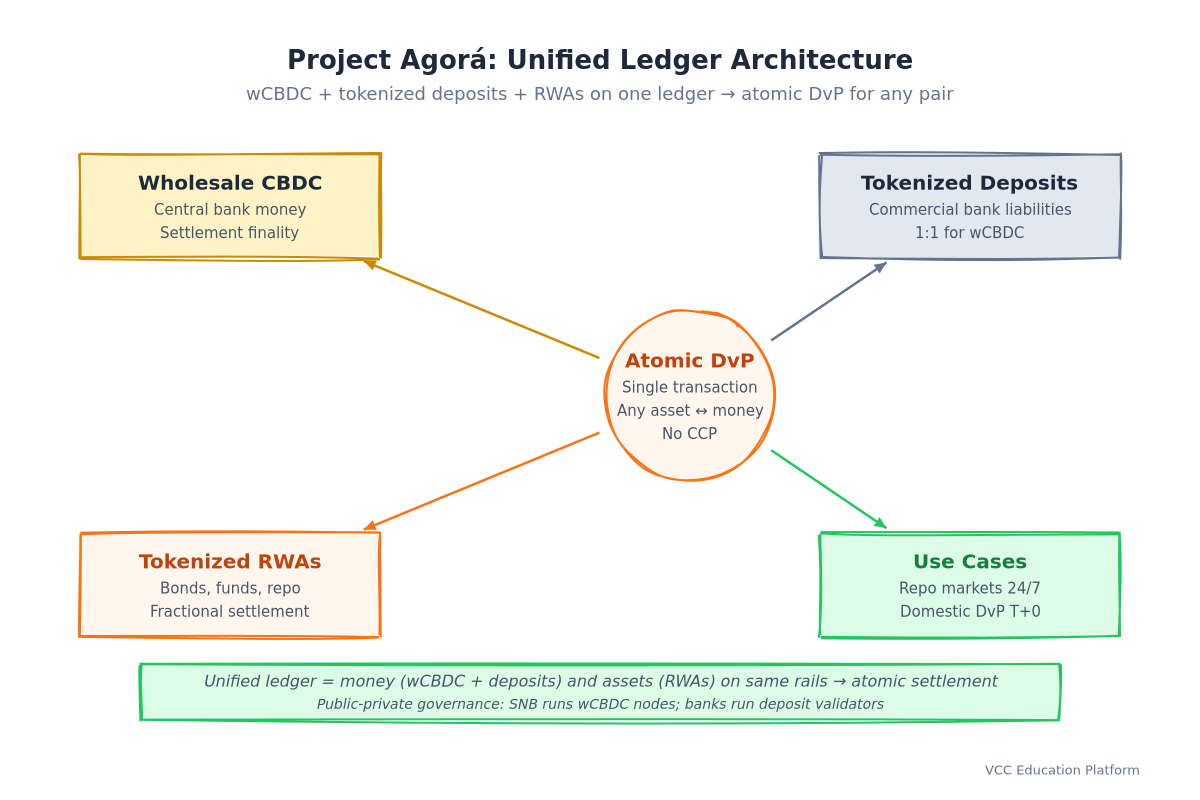
Launched in April 2024 by the BIS Innovation Hub Swiss Centre and the Swiss National Bank (SNB), Project Agorá takes a fundamentally different approach. Instead of connecting central bank wCBDCs, it builds a unified ledger where:
- Wholesale CBDC (central bank money)
- Tokenized commercial bank deposits (private money)
- Tokenized RWAs (government bonds, corporate bonds, fund shares)
coexist on the same ledger, enabling atomic DvP between any pair.
Private sector partners (as of launch): UBS, Citi, HSBC, JP Morgan, SIX Digital Exchange, and others. This public-private governance model contrasts with mBridge's central-bank-only validators.
The Unified Ledger Concept
Agorá operationalizes Agustín Carstens' (BIS General Manager) "unified ledger" vision (BIS Annual Economic Report 2023): a single programmable platform recording both money (central bank + commercial bank liabilities) and assets (tokenized RWAs).
` ┌─────────────────────────────────────────────────────────┐ │ UNIFIED LEDGER │ ├──────────────┬──────────────────┬──────────────────────┤ │ wCBDC │ Tokenized │ Tokenized RWAs │ │ (Central │ Deposits │ (Bonds, Funds, │ │ Bank $) │ (Commercial │ Repo, Equities) │ │ │ Bank $) │ │ └──────────────┴──────────────────┴──────────────────────┘ ↑ ↑ ↑ Settlement Commercial bank Asset servicing, finality liability corporate actions `
Architecture Highlights
- Shared ledger: Single permissioned DLT (technology partner not publicly specified, but likely Canton/Daml or similar smart-contract platform).
- Commercial bank nodes: Unlike mBridge, commercial banks run validator nodes for their tokenized deposits.
- Tokenized deposits as "private money": A tokenized deposit is a claim on a commercial bank, redeemable 1:1 for wCBDC or cash. It's not a stablecoin—it's a bank liability on-chain.
- Atomic DvP for any asset: Swap a tokenized government bond for wCBDC, or a tokenized fund share for a tokenized deposit, in one transaction.
Why Tokenized Deposits Matter
Most wholesale settlement today uses central bank money (reserves). But commercial bank money (deposits) is 90%+ of the money supply. Agorá asks: what if commercial bank money were also on the ledger?
Benefits:
- No "on/off ramp" friction: Commercial banks don't need to convert deposits → reserves → wCBDC → settle → convert back. They settle directly with tokenized deposits.
- Programmable deposits: Smart contracts can automate interest, restrict use (e.g., "only for trade finance"), or embed compliance.
- Balance sheet efficiency: Banks can tokenize existing deposits without new funding.
Agorá's Scope: Beyond Cross-Border
While mBridge is explicitly cross-border, Agorá's unified ledger works domestically and cross-border. The Swiss pilot focuses on: 1. Domestic DvP: Tokenized Swiss Confederation bonds ↔ wCBDC 2. Cross-border: Tokenized deposits from UBS/HSBC/Citi ↔ SNB wCBDC 3. Repo markets: Tokenized collateral ↔ cash (wCBDC or tokenized deposit) with automated margin
---
Comparative Analysis: mBridge vs. Project Agorá
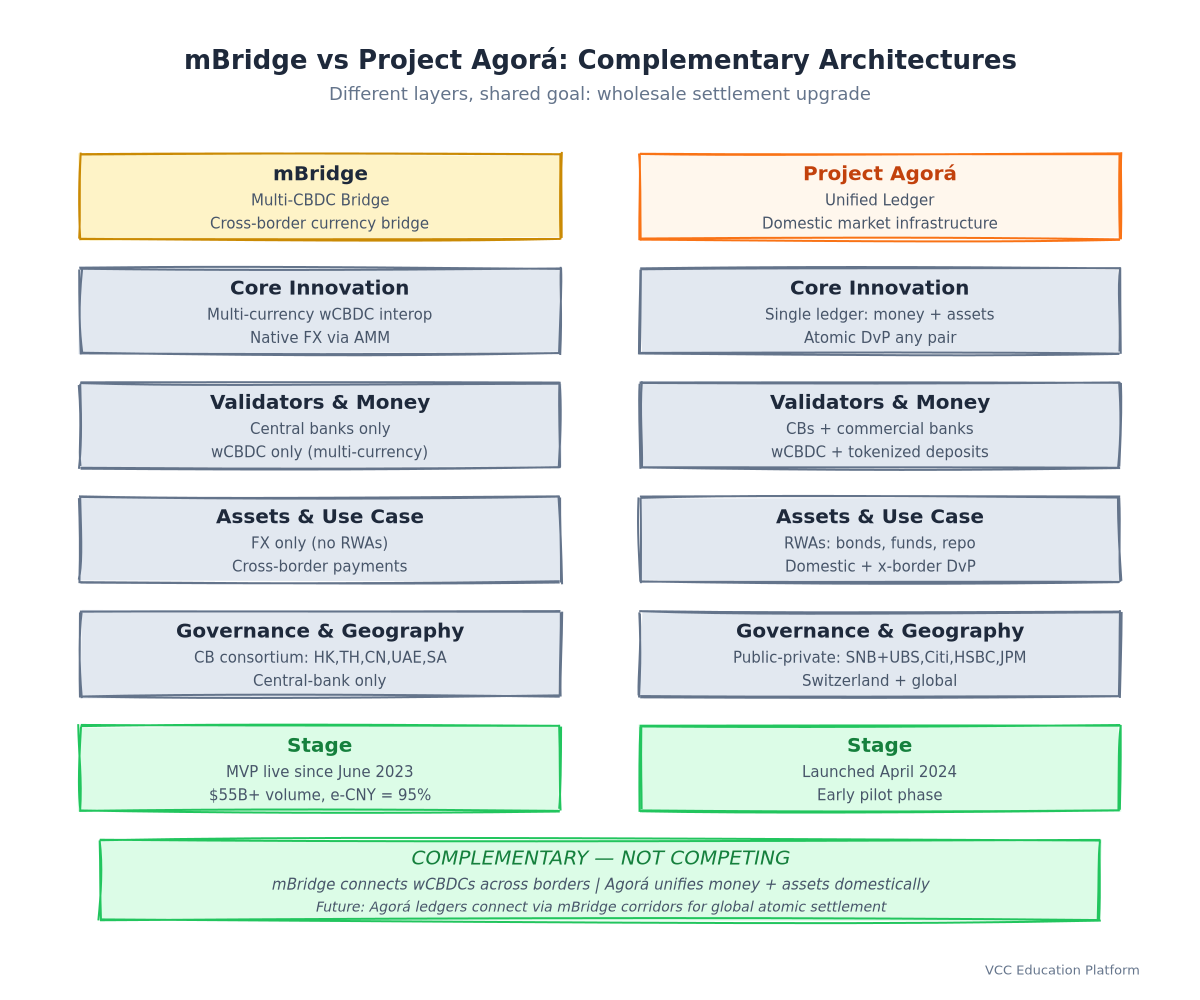
| Dimension | mBridge | Project Agorá |
|---|---|---|
| Core innovation | Multi-CBDC interoperability | Unified ledger (money + assets) |
| Validators | Central banks only | Central banks + commercial banks |
| Money types | wCBDC only (multiple currencies) | wCBDC + tokenized deposits |
| Asset types | None (FX only) | RWAs (bonds, funds, repo) |
| Primary use case | Cross-border payments/FX | Domestic + cross-border DvP, repo |
| Governance | Central bank consortium | Public-private partnership |
| Geography | HK, TH, CN, UAE, SA | Switzerland + global partners |
| Tech approach | Custom pBFT blockchain | Smart-contract platform (Canton/Daml?) |
| Stage | MVP, live pilot ($55B+ volume) | Launched April 2024, early pilot |
Complementary, Not Competitive
These projects solve different layers of the problem:
- mBridge = "How do central banks settle across borders?" (Currency bridge)
- Agorá = "How do money and assets settle atomically on one ledger?" (Unified market infrastructure)
A future architecture could nest them: Agorá-style unified ledgers domestically, connected via mBridge-style corridors internationally.
---
The RWA Connection: Why Tokenized Assets Need Wholesale CBDC
The Settlement Gap
Tokenized RWAs (Real World Assets) have exploded: $1.7T+ in tokenized treasuries alone (2024, per 21.co), plus corporate bonds, funds, real estate, and carbon credits. But most settle off-chain or via stablecoins (USDC, USDT) which lack central bank settlement finality.
The missing link: Risk-free settlement asset on the same ledger as the RWA.
Atomic DvP: The Holy Grail
Delivery versus Payment (DvP) means the asset and cash transfer simultaneously—either both happen or neither happens. Today's systems achieve this sequentially with central counterparties (CCPs) and custodians, taking T+1 or T+2.
With wCBDC + tokenized RWA on the same ledger:
- True atomic DvP: Single transaction, instant finality, no CCP needed for the settlement leg
- 24/7/365: No market hours, no batch windows
- Fractional settlement: Settle $1M of a $100M bond issue to 50 buyers in one block
Existing Wholesale Settlement Systems (Context)
| System | Money | Assets | Settlement | Status |
|---|---|---|---|---|
| SWIFT + CSDs | Commercial bank / central bank | Traditional securities | T+1/T+2 | Live, legacy |
| JPM Coin | JPM deposit token (private) | Limited | Instant, JPM clients only | Live since 2019 |
| Fnality | wCBDC (BoE, ECB, others) | Repo, FX | T+0, limited currencies | Live UK, expanding EU |
| Partior | JPM/DBS/Standard Chartered deposits | FX, payments | Instant, permissioned | Live |
| SWIFT CBDC Connector | Multiple wCBDCs (interop) | None (messaging only) | Pilot phase | Testing |
| mBridge | Multi-wCBDC | FX only | Instant, atomic | MVP, live pilot |
| Project Agorá | wCBDC + tokenized deposits | RWAs (bonds, funds) | Instant, atomic DvP | Pilot phase |
Key observation: Only mBridge and Agorá combine multi-institutional governance with central bank money and atomic settlement. JPM Coin and Partior are private-bank consortia. Fnality is close but currency-limited.
---
Implications for Vietnam and ASEAN
Vietnam's Current Position
- SBV (State Bank of Vietnam): Researching CBDC since 2021; no public wholesale pilot yet.
- Cross-border pain points: High remittance costs (avg 6-8% via traditional channels), trade settlement delays with China/US/EU, USD correspondent dependency.
- RWA nascent: Corporate bond market growing; government bond tokenization explored by VSDC (Vietnam Securities Depository); real estate tokenization pilots by proptech firms.
Strategic Opportunities
#### 1. mBridge as ASEAN Gateway With Thailand (BoT) and China (PBoC) as mBridge founders, Vietnam's top two trading partners are already on the bridge. Joining mBridge (or a future ASEAN extension) would let Vietnamese banks settle VND ↔ THB ↔ CNY ↔ USD directly, bypassing USD correspondent chains.
Action item: SBV should engage BISIH Hong Kong on observer status → pilot participation.
#### 2. Domestic Unified Ledger (Agorá Model) Vietnam could build a domestic unified ledger connecting:
- SBV wCBDC (settlement finality)
- Tokenized deposits from Vietcombank, BIDV, VietinBank, Techcombank
- Tokenized RWAs: Government bonds (VSDC), corporate bonds, VN30 ETF shares, eventually real estate
This would modernize Vietnam's capital market infrastructure (currently T+2 for bonds, T+1 for equities) to instant atomic DvP.
#### 3. Remittance Corridor Optimization Vietnam receives ~$18B/year in remittances (top 10 globally). An mBridge-style corridor VND ↔ USD (or SGD/THB) with atomic FX could cut remittance costs from 6-8% to 1-2%, capturing significant welfare gains for recipients.
#### 4. Regulatory Sandbox Alignment SBV's Fintech Sandbox (launched 2021) should explicitly include wCBDC + RWA tokenization use cases. Current sandbox focuses on payments/lending; capital market tokenization needs a dedicated track.
Risks and Prerequisites
| Prerequisite | Status | Gap |
|---|---|---|
| Legal framework for tokenized securities | Draft Law on Securities (2024) includes digital assets | Secondary legislation needed |
| wCBDC legal tender status | Not yet defined | Central bank law amendment required |
| DLT infrastructure capacity | VSDC upgrading; banks experimenting | Need shared permissioned network |
| Cross-border regulatory alignment | ASEAN Payments Connectivity (APC) | APC focuses on retail; wholesale gap |
| Talent (DLT, smart contracts, crypto) | Growing but scarce | University/industry partnerships needed |
---
The Road Ahead: Convergence Scenarios
Scenario 1: Parallel Tracks (Near Term, 2024-2026)
- mBridge expands to more corridors (ASEAN, BRICS, Gulf)
- Agorá proves domestic unified ledger in Switzerland, replicates in Singapore, UK, EU
- SWIFT CBDC connector becomes the interoperability layer between them
Scenario 2: Regional Blocs (Medium Term, 2026-2030)
- ASEAN mBridge: Thailand, Malaysia, Indonesia, Philippines, Vietnam, Singapore share a multi-CBDC bridge
- EU Unified Ledger: ECB wholesale euro + Eurozone bank tokenized deposits + EU RWAs
- US: FedNow + private tokenized deposits (JPMC, Citi, BofA) + regulated stablecoins
Scenario 3: Global Convergence (Long Term, 2030+)
- Single global settlement layer: Interoperable wCBDCs + tokenized deposits + RWAs
- Programmable money: Smart contracts automate FX hedging, trade finance, collateral management
- End of correspondent banking: Direct peer-to-peer settlement between any two institutions globally
---
FAQ
Q: Is mBridge a cryptocurrency?
No. mBridge uses permissioned DLT validated by central banks. No public tokens, no mining, no speculation. It's infrastructure for central bank money.Q: Can retail users access mBridge or Agorá?
No. Both are wholesale-only. Retail users benefit indirectly: faster/cheaper remittances, better FX rates, more efficient banking.Q: What happens to commercial banks?
They evolve. In mBridge, they connect via central bank nodes. In Agorá, they run nodes for tokenized deposits. Both models require commercial banks—they don't disintermediate them.Q: How does this affect Vietnam's monetary sovereignty?
Strengthens it. wCBDC gives SBV direct visibility and control over cross-border flows. Tokenized VND on mBridge/Agorá reduces USD dependency for regional trade.Q: What's the timeline for Vietnam?
- 2024-2025: SBV research, sandbox pilots, observer status in mBridge/ASEAN discussions
- 2026-2027: Domestic wCBDC pilot (interbank), tokenized government bond pilot (VSDC)
- 2028+: ASEAN multi-CBDC corridor live, unified ledger for domestic capital markets
---
Key Takeaways
1. Wholesale CBDC ≠ Retail CBDC. The former upgrades bank-to-bank plumbing; the latter touches consumers. 2. mBridge solves cross-border FX; Agorá solves domestic+global DvP for money + assets. They're complementary. 3. RWA tokenization needs wCBDC for risk-free atomic settlement. Stablecoins are a stopgap. 4. Vietnam is strategically positioned: Top trading partners (China, Thailand) are mBridge founders. Early engagement = first-mover advantage in ASEAN. 5. The unified ledger is the endgame: One ledger for central bank money, commercial bank money, and tokenized assets. Agorá is the first serious attempt.
---
Technical Terms Glossary (Preserved in Translation)
| English | Vietnamese | Context |
|---|---|---|
| CBDC | CBDC | Central Bank Digital Currency |
| mBridge | mBridge | Multi-CBDC Bridge project |
| Project Agorá | Project Agorá | BIS/SNB unified ledger project |
| SWIFT | SWIFT | Global messaging network |
| BIS | BIS | Bank for International Settlements |
| wholesale CBDC | wholesale CBDC | CBDC for interbank settlement |
| atomic DvP | atomic DvP | Simultaneous delivery vs payment |
| cross-border settlement | cross-border settlement | Settlement across jurisdictions |
| central bank | central bank | Monetary authority |
| permissioned chain | permissioned chain | DLT with known validators |
| tokenized deposit | tokenized deposit | Commercial bank liability on-chain |
| JPM Coin | JPM Coin | JPMorgan's deposit token |
| Fnality | Fnality | Wholesale settlement consortium |
| Partior | Partior | JPM/DBS/SCB payment venture |
---
Word count: ~2,800 Primary keyword: CBDC RWA (in H1, first 100 words) Secondary keywords: mBridge, Project Agorá, SWIFT CBDC, wholesale CBDC settlement (woven into H2s, body, FAQ)