
# Case Study: Ondo Finance — From OUSG to USDY, Global Markets
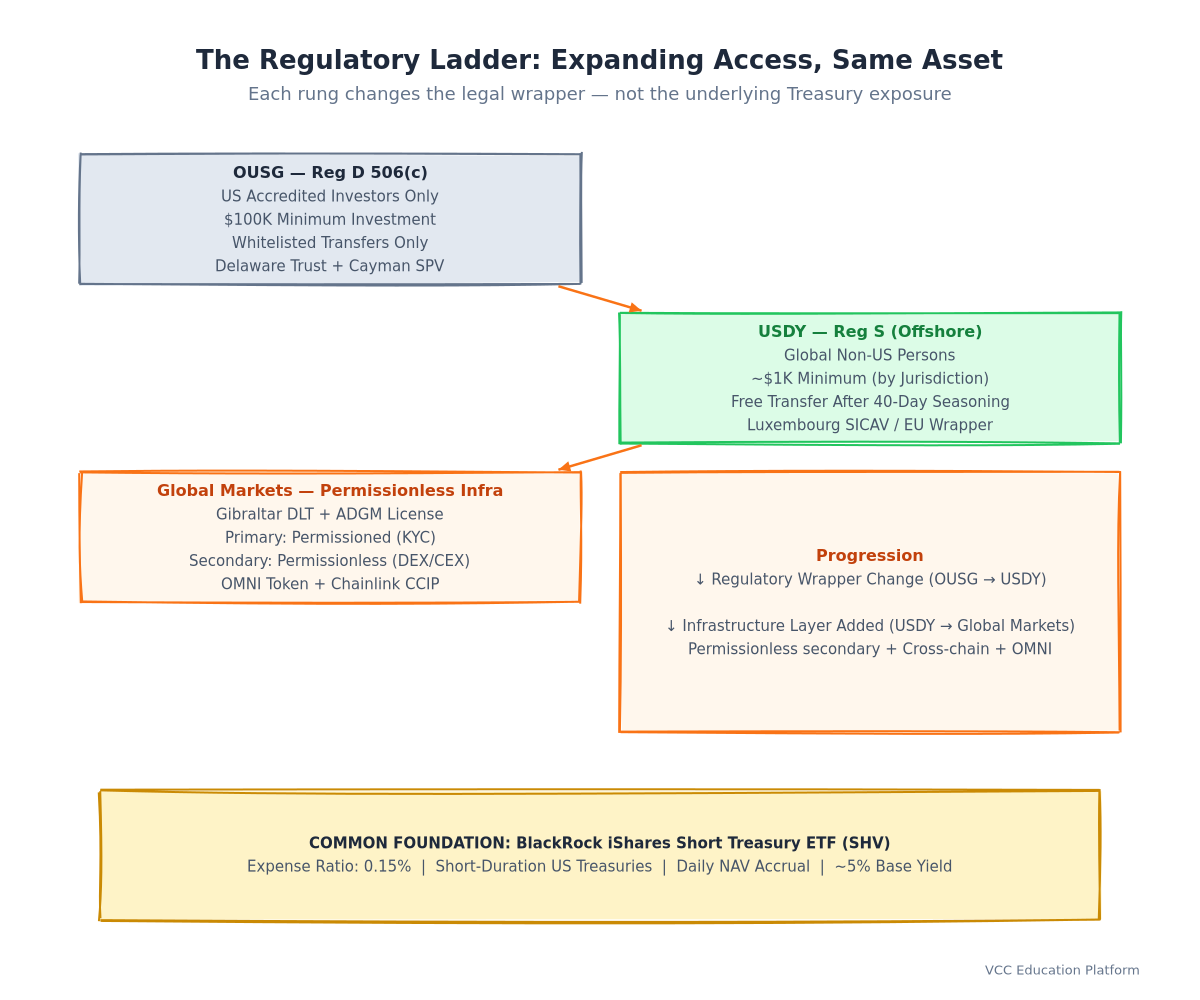
Ondo Finance has become the blueprint for how a Real World Asset (RWA) protocol evolves from a single permissioned product into a multi-layered financial infrastructure stack. In three years, the team moved from OUSG — a tokenized Treasury fund restricted to US accredited investors — to USDY, a globally accessible yield-bearing dollar alternative, then to Flux Finance, a DeFi lending protocol that makes those tokens productive collateral, and finally to Ondo Global Markets, a permissionless infrastructure layer for tokenized RWAs worldwide.
This case study traces that evolution, revealing how Ondo used **regulatory arbitrage** as a deliberate product strategy, how they separated primary-market compliance from secondary-market permissionlessness, and why their dual-token governance (ONDO for Flux, OMNI for Global Markets) solves a fundamental tension in RWA protocol design.
For Vietnamese DeFi builders and investors, Ondo's journey offers a masterclass in navigating the spectrum between TradFi compliance and DeFi composability — a spectrum Vietnam's own emerging Digital Assets Law will soon require local projects to traverse.
---
## The Founding Thesis: TradFi Yield, DeFi Rails
When Nathan Allman and the Ondo team launched in 2021, the RWA narrative was still nascent. BlackRock's BUIDL didn't exist. Franklin Templeton's BENJI was a pilot. The prevailing wisdom: tokenize an asset, put it on-chain, done.
Ondo saw a different problem. **The asset wasn't the hard part — the regulatory perimeter was.**
US Treasuries are the world's premier risk-free asset. But accessing them on-chain meant solving two contradictory requirements:
1. **Securities law compliance** — KYC, accreditation checks, transfer restrictions, qualified custodians
2. **DeFi composability** — permissionless transfer, 24/7 markets, smart contract integration, global access
Most projects picked one. Ondo decided to build a **ladder** — each rung a product with a different regulatory wrapper, serving a different user segment, all backed by the same underlying: short-term US Treasuries via BlackRock's iShares Short Treasury ETF (SHV).
 ---
## Rung 1: OUSG — The Accredited-Only Start (2022)
### Product Specification
- **Launch:** Q1 2022
- **Regulatory Framework:** SEC Regulation D Rule 506(c)
- **Eligible Investors:** US accredited investors only (net worth >$1M or income >$200K)
- **Legal Wrapper:** Delaware Statutory Trust (master) + Cayman SPV (feeder)
- **Underlying:** BlackRock iShares Short Treasury ETF (SHV), expense ratio 0.15%
- **Yield Mechanism:** Daily NAV accrual (token balance grows, not rebasing)
- **Minimum Investment:** $100,000
- **Redemption:** T+2, US business days only
- **Transfer Restrictions:** 1-year lockup, then whitelisted transfers only
### Why This Structure?
Reg D 506(c) allows general solicitation (public marketing) but **only** to verified accredited investors. This let Ondo market OUSG openly while staying compliant. The Delaware Trust + Cayman feeder structure is the industry standard for US fund tokenization — bankruptcy-remote, familiar to TradFi custodians (BNY Mellon, State Street), and compatible with existing fund administration.
### The Trade-off
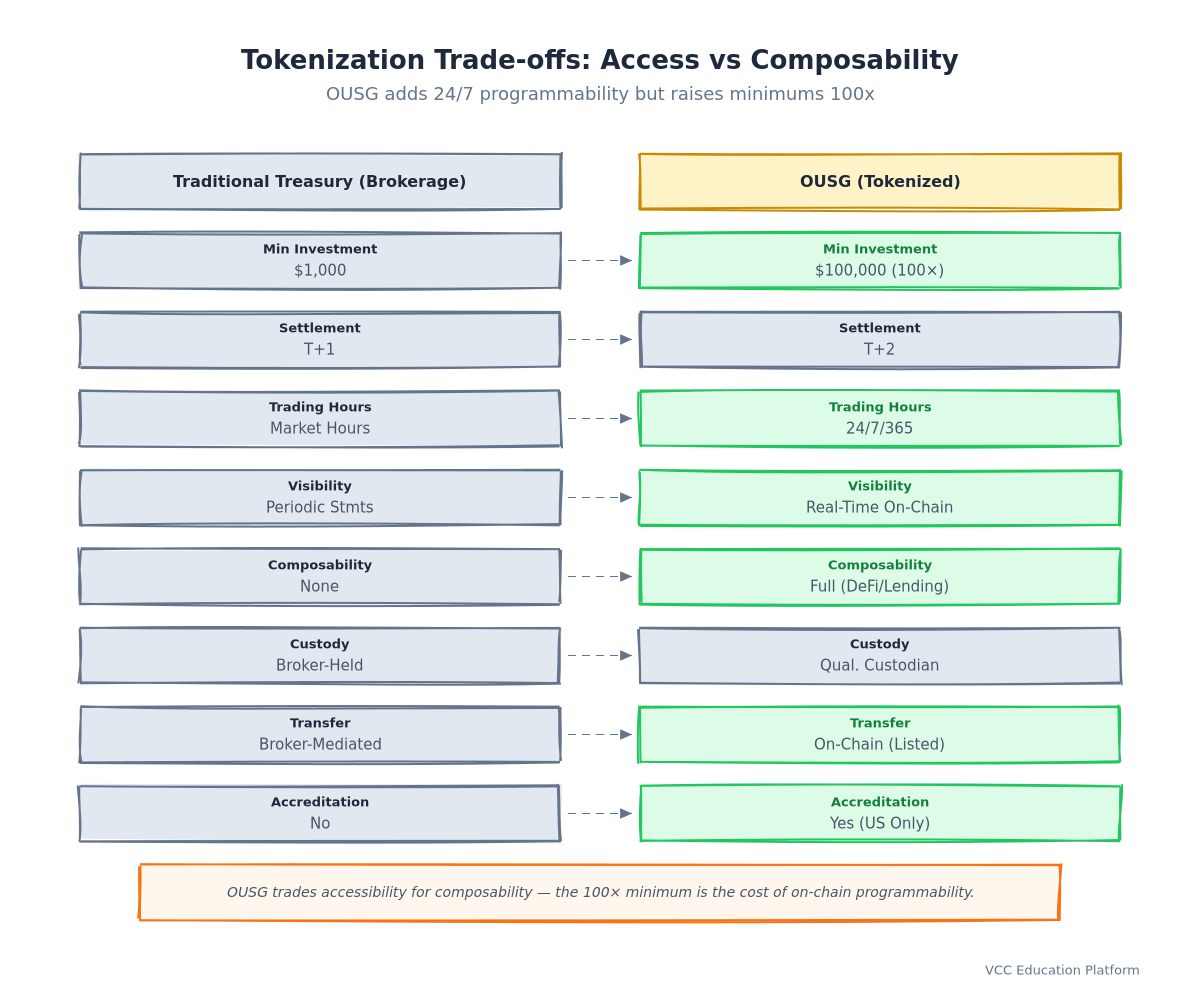
OUSG solved the " TradFi yield on-chain" problem for a tiny slice of the world: US high-net-worth individuals and institutions. For everyone else — the 95% of crypto users outside US accreditation — OUSG was invisible. TVL plateaued around $150-200M for over a year.
---
## Rung 1: OUSG — The Accredited-Only Start (2022)
### Product Specification
- **Launch:** Q1 2022
- **Regulatory Framework:** SEC Regulation D Rule 506(c)
- **Eligible Investors:** US accredited investors only (net worth >$1M or income >$200K)
- **Legal Wrapper:** Delaware Statutory Trust (master) + Cayman SPV (feeder)
- **Underlying:** BlackRock iShares Short Treasury ETF (SHV), expense ratio 0.15%
- **Yield Mechanism:** Daily NAV accrual (token balance grows, not rebasing)
- **Minimum Investment:** $100,000
- **Redemption:** T+2, US business days only
- **Transfer Restrictions:** 1-year lockup, then whitelisted transfers only
### Why This Structure?
Reg D 506(c) allows general solicitation (public marketing) but **only** to verified accredited investors. This let Ondo market OUSG openly while staying compliant. The Delaware Trust + Cayman feeder structure is the industry standard for US fund tokenization — bankruptcy-remote, familiar to TradFi custodians (BNY Mellon, State Street), and compatible with existing fund administration.
### The Trade-off
OUSG solved the " TradFi yield on-chain" problem for a tiny slice of the world: US high-net-worth individuals and institutions. For everyone else — the 95% of crypto users outside US accreditation — OUSG was invisible. TVL plateaued around $150-200M for over a year.
 ---
## Rung 2: USDY — The Global Access Breakthrough (2023)
### Product Specification
- **Launch:** October 2023
- **Regulatory Framework:** SEC Regulation S (offshore offering)
- **Eligible Investors:** Non-US persons globally (no accreditation required)
- **Legal Wrapper:** Luxembourg SICAV / non-US fund structure
- **Underlying:** Same SHV ETF (economic equivalence to OUSG)
- **Yield Mechanism:** Daily NAV accrual — **not a stablecoin**
- **Minimum Investment:** Varies by jurisdiction (often ~$1,000 equivalent)
- **Redemption:** T+1 to T+3 depending on jurisdiction
- **Transfer Restrictions:** 40-day seasoning period, then freely transferable on-chain
### Critical Distinction: USDY Is NOT a Stablecoin
Media coverage frequently mislabels USDY as a "yield-bearing stablecoin." It is not.
- **Stablecoin:** Fixed $1 peg, yield requires staking/lending (e.g., sUSDe, stUSDC)
- **USDY:** Floating NAV (~$1.00 + accrued yield), yield accrues **automatically** in token balance
This distinction is regulatory strategy, not semantics. MiCA (EU) and proposed US stablecoin legislation impose reserve, redemption, and governance requirements that would constrain USDY's flexibility. By positioning as a **tokenized money market fund**, USDY avoids the "stablecoin" regulatory bucket while delivering the same user experience: hold a dollar-denominated token, watch balance grow daily.
### The Regulatory Arbitrage in Action
| Dimension | OUSG (Reg D) | USDY (Reg S) |
|-----------|--------------|--------------|
| **Investor Base** | US accredited only | Global non-US |
| **Accreditation** | Required | Not required |
| **Min Investment** | $100,000 | ~$1,000 |
| **Transfer Freedom** | Whitelisted only | Free after 40 days |
| **Primary Market** | Permissioned (KYC + accred) | Permissioned (KYC only) |
| **Secondary Market** | Restricted | Permissionless (DEX/CEX) |
**Original Insight:** The underlying asset (SHV) didn't change. The legal wrapper changed. Ondo essentially "re-wrapped" the same economic exposure for a different regulatory perimeter. This is regulatory arbitrage as product management — and it's repeatable.
### Vietnam Relevance
For a Vietnamese investor, USDY is the first tokenized Treasury product **actually accessible** without US accreditation. A user in Ho Chi Minh City can mint USDY (after KYC), hold it on-chain, earn ~5% APY from US Treasuries, and trade it on DEXs like Uniswap or Curve. No US brokerage account, no $100K minimum, no accreditation letter.
---
## Rung 3: Flux Finance — Making RWAs Productive in DeFi (2023)
### The Problem: Dead Capital
OUSG and USDY holders earned ~5% from Treasuries. But in DeFi, 5% is the *risk-free rate* — the baseline. Users want **leveraged yield**: borrow against collateral, deploy borrowed funds, earn spread.
Without a lending market, OUSG/USDY are "dead capital" — they sit in wallets earning only the risk-free rate.
### Flux Finance: The DeFi Leg
- **Launch:** Mid-2023
- **Type:** Permissioned lending protocol (Aave v2 fork with modifications)
- **Governance Token:** ONDO
- **Key Markets:** fUSDC, fUSDT, fDAI (stablecoin lending)
- **Accepted Collateral:** OUSG, USDY, USDC, USDT, DAI
- **LTV for OUSG/USDY:** ~80-85% (conservative, reflecting low volatility)
- **Interest Rate Model:** Kinked utilization curve (kink at 80%)
- Below kink: Low slope (cheap borrowing)
- Above kink: Steep slope (liquidity protection)
- **Oracle:** Chainlink Price Feeds + custom NAV oracle for OUSG/USDY
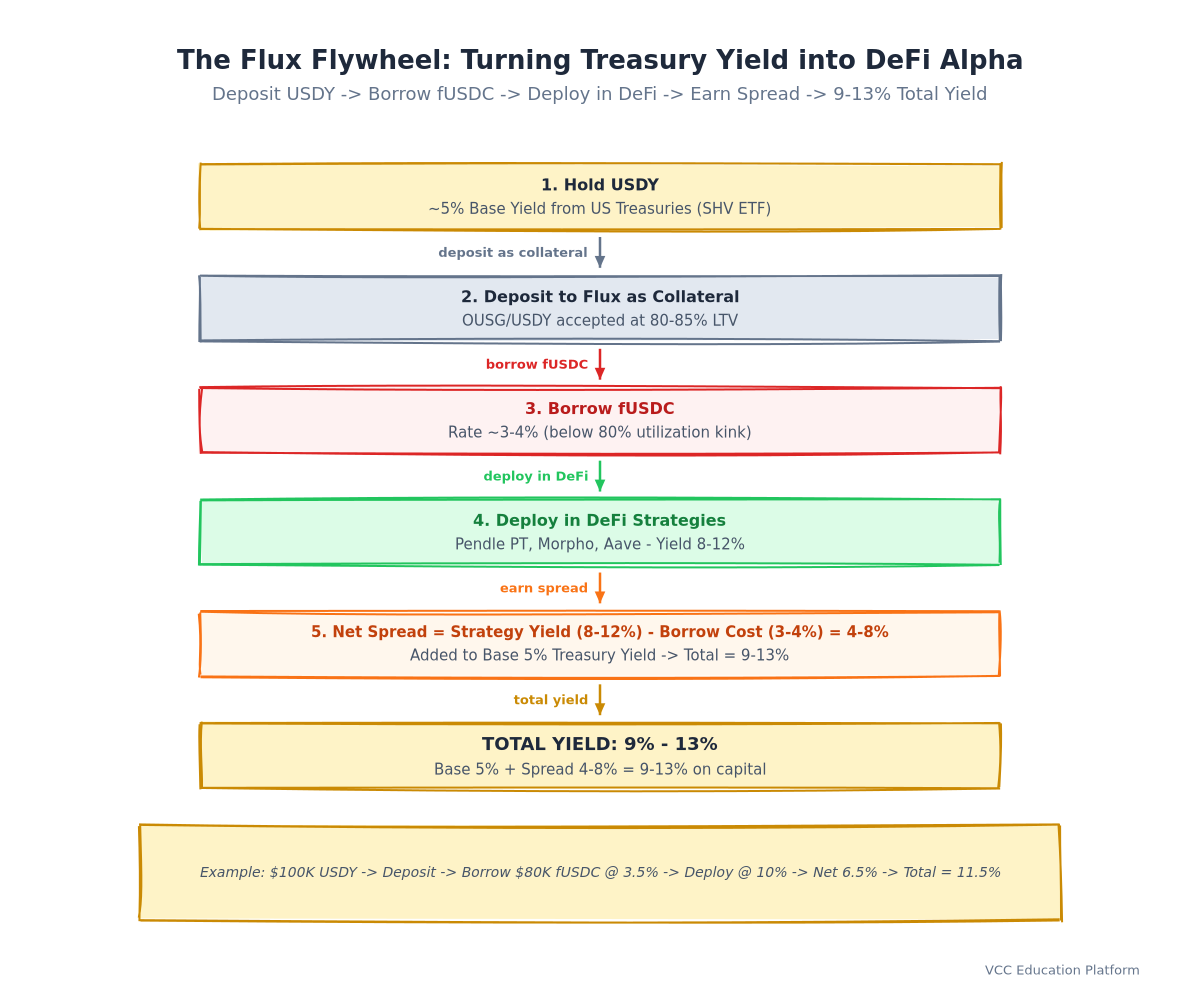
### How the Flywheel Works
```
1. User holds USDY (earning ~5% base yield)
2. Deposits USDY into Flux as collateral
3. Borrows fUSDC at ~3-4% (below kink)
4. Deploys fUSDC into DeFi strategies (e.g., Pendle PT, Morpho, Aave)
5. Earns strategy yield (e.g., 8-12%) minus borrow cost (3-4%) = 4-8% spread
6. Total yield = 5% (base) + 4-8% (spread) = 9-13% on original capital
```
This transforms USDY from a "savings account" into a **DeFi collateral primitive** — the same role USDC plays in traditional DeFi, but with TradFi-grade risk-free backing.
---
## Rung 2: USDY — The Global Access Breakthrough (2023)
### Product Specification
- **Launch:** October 2023
- **Regulatory Framework:** SEC Regulation S (offshore offering)
- **Eligible Investors:** Non-US persons globally (no accreditation required)
- **Legal Wrapper:** Luxembourg SICAV / non-US fund structure
- **Underlying:** Same SHV ETF (economic equivalence to OUSG)
- **Yield Mechanism:** Daily NAV accrual — **not a stablecoin**
- **Minimum Investment:** Varies by jurisdiction (often ~$1,000 equivalent)
- **Redemption:** T+1 to T+3 depending on jurisdiction
- **Transfer Restrictions:** 40-day seasoning period, then freely transferable on-chain
### Critical Distinction: USDY Is NOT a Stablecoin
Media coverage frequently mislabels USDY as a "yield-bearing stablecoin." It is not.
- **Stablecoin:** Fixed $1 peg, yield requires staking/lending (e.g., sUSDe, stUSDC)
- **USDY:** Floating NAV (~$1.00 + accrued yield), yield accrues **automatically** in token balance
This distinction is regulatory strategy, not semantics. MiCA (EU) and proposed US stablecoin legislation impose reserve, redemption, and governance requirements that would constrain USDY's flexibility. By positioning as a **tokenized money market fund**, USDY avoids the "stablecoin" regulatory bucket while delivering the same user experience: hold a dollar-denominated token, watch balance grow daily.
### The Regulatory Arbitrage in Action
| Dimension | OUSG (Reg D) | USDY (Reg S) |
|-----------|--------------|--------------|
| **Investor Base** | US accredited only | Global non-US |
| **Accreditation** | Required | Not required |
| **Min Investment** | $100,000 | ~$1,000 |
| **Transfer Freedom** | Whitelisted only | Free after 40 days |
| **Primary Market** | Permissioned (KYC + accred) | Permissioned (KYC only) |
| **Secondary Market** | Restricted | Permissionless (DEX/CEX) |
**Original Insight:** The underlying asset (SHV) didn't change. The legal wrapper changed. Ondo essentially "re-wrapped" the same economic exposure for a different regulatory perimeter. This is regulatory arbitrage as product management — and it's repeatable.
### Vietnam Relevance
For a Vietnamese investor, USDY is the first tokenized Treasury product **actually accessible** without US accreditation. A user in Ho Chi Minh City can mint USDY (after KYC), hold it on-chain, earn ~5% APY from US Treasuries, and trade it on DEXs like Uniswap or Curve. No US brokerage account, no $100K minimum, no accreditation letter.
---
## Rung 3: Flux Finance — Making RWAs Productive in DeFi (2023)
### The Problem: Dead Capital
OUSG and USDY holders earned ~5% from Treasuries. But in DeFi, 5% is the *risk-free rate* — the baseline. Users want **leveraged yield**: borrow against collateral, deploy borrowed funds, earn spread.
Without a lending market, OUSG/USDY are "dead capital" — they sit in wallets earning only the risk-free rate.
### Flux Finance: The DeFi Leg
- **Launch:** Mid-2023
- **Type:** Permissioned lending protocol (Aave v2 fork with modifications)
- **Governance Token:** ONDO
- **Key Markets:** fUSDC, fUSDT, fDAI (stablecoin lending)
- **Accepted Collateral:** OUSG, USDY, USDC, USDT, DAI
- **LTV for OUSG/USDY:** ~80-85% (conservative, reflecting low volatility)
- **Interest Rate Model:** Kinked utilization curve (kink at 80%)
- Below kink: Low slope (cheap borrowing)
- Above kink: Steep slope (liquidity protection)
- **Oracle:** Chainlink Price Feeds + custom NAV oracle for OUSG/USDY
### How the Flywheel Works
```
1. User holds USDY (earning ~5% base yield)
2. Deposits USDY into Flux as collateral
3. Borrows fUSDC at ~3-4% (below kink)
4. Deploys fUSDC into DeFi strategies (e.g., Pendle PT, Morpho, Aave)
5. Earns strategy yield (e.g., 8-12%) minus borrow cost (3-4%) = 4-8% spread
6. Total yield = 5% (base) + 4-8% (spread) = 9-13% on original capital
```
This transforms USDY from a "savings account" into a **DeFi collateral primitive** — the same role USDC plays in traditional DeFi, but with TradFi-grade risk-free backing.
 ### Risk Considerations (The Contrarian View)
Community discussions (Source 7) flag valid concerns:
- **Oracle Risk:** USDY NAV oracle is custom — if it lags or fails, liquidations misfire
- **Liquidity Risk:** Flux TVL (~$50M peak) is small vs Aave/Compound — large liquidations could cascade
- **Smart Contract Risk:** Fork of Aave v2, but modified — audit coverage incomplete
- **Regulatory Risk:** If USDY faces regulatory action, collateral value could drop sharply
Ondo mitigates via conservative LTV (80-85%), isolated markets (OUSG/USDY don't share pool with volatile assets), and a bug bounty program. But the risk is real — and any RWA lending integration must price it in.
---
## Rung 4: Ondo Global Markets — The Permissionless Infrastructure Layer (2024)
### The Announcement
June 2024: "Ondo Global Markets — The Infrastructure Layer for Tokenized RWAs." Not a new fund. Not a new token (yet). **Infrastructure.**
### The Core Problem It Solves
Tokenized RWAs today are fragmented:
- Each issuer builds their own mint/redeem, compliance, custody, oracle stack
- Secondary trading happens on random DEXs with no standardized metadata
- Cross-chain movement requires bespoke bridges
- No universal "ERC-20 for RWAs" standard with compliance built in
### Global Markets Architecture
```
┌─────────────────────────────────────────────────────────────┐
│ ONDO GLOBAL MARKETS │
├──────────────────┬──────────────────┬───────────────────────┤
│ Primary Market │ Secondary Market │ Cross-Chain Layer │
│ (Permissioned) │ (Permissionless) │ (OMNI + CCIP) │
├──────────────────┼──────────────────┼───────────────────────┤
│ • KYC/AML │ • DEX/AMM trading │ • OMNI token routing │
│ • Accreditation │ • No restrictions │ • Chainlink CCIP │
│ • Mint/Redeem │ • 24/7 global │ • Unified metadata │
│ • Compliance │ • Order book/AMM │ • Settlement finality │
└──────────────────┴──────────────────┴───────────────────────┘
```
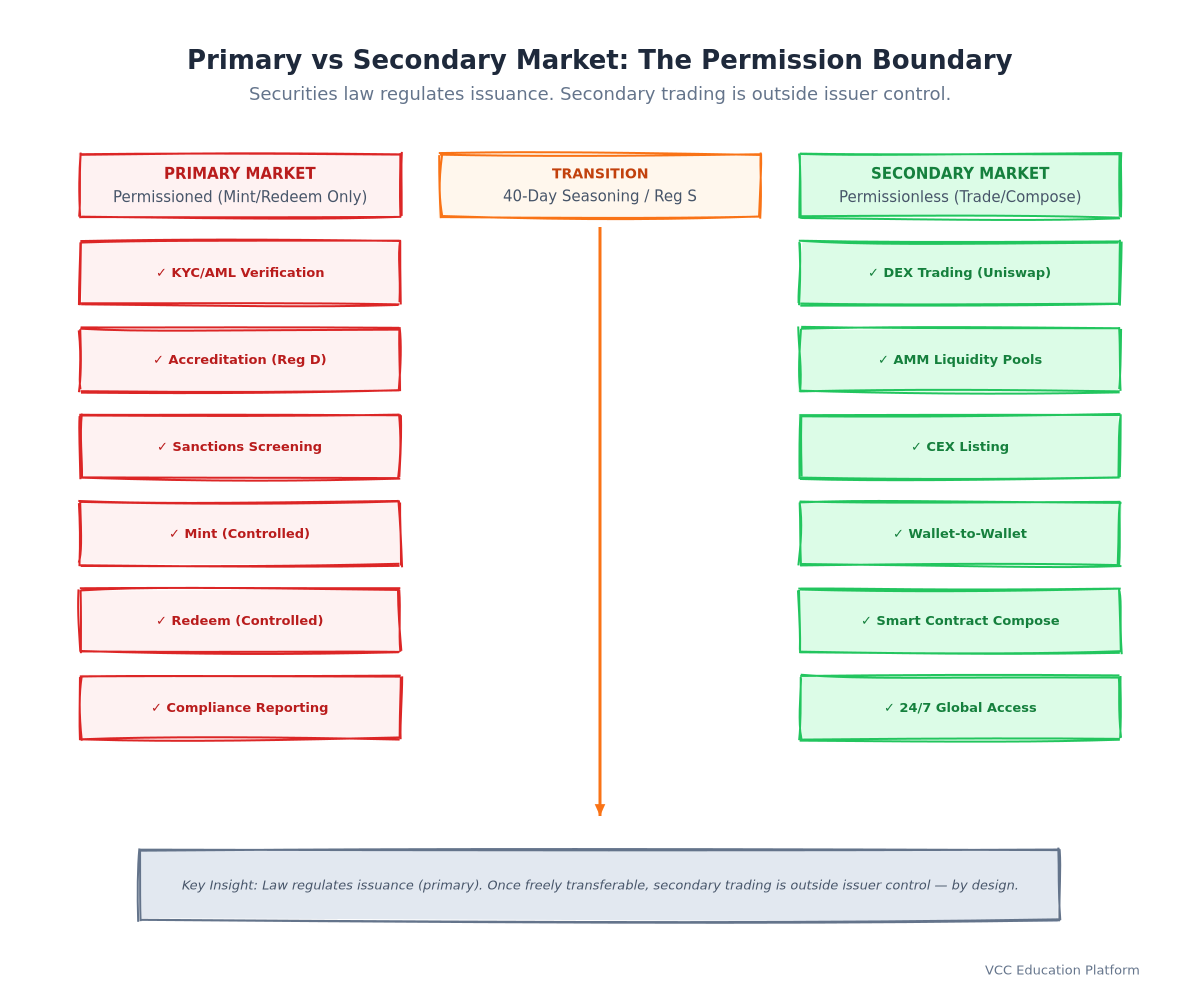
### The Primary/Secondary Market Separation — The Key Innovation
This is Ondo's most important architectural decision:
**Primary Market (Mint/Redeem): ALWAYS permissioned.**
- KYC required
- Accreditation checks where applicable (Reg D)
- Sanctions screening
- This satisfies regulators: "We know who holds the underlying."
**Secondary Market (Trading): PERMISSIONLESS.**
- Once minted, tokens move freely on-chain
- DEXs, AMMs, CEXs — no Ondo control
- Global 24/7 liquidity
- This satisfies DeFi: "Composability preserved."
**Why this works:** Securities law regulates the *issuance* (primary) and *transfer restrictions* (which can be enforced at the token level via allowlists). But once a token is freely transferable (Reg S seasoning period passed), secondary trading is largely outside the issuer's control — and that's fine. The issuer's obligation is at mint/redeem.
### Risk Considerations (The Contrarian View)
Community discussions (Source 7) flag valid concerns:
- **Oracle Risk:** USDY NAV oracle is custom — if it lags or fails, liquidations misfire
- **Liquidity Risk:** Flux TVL (~$50M peak) is small vs Aave/Compound — large liquidations could cascade
- **Smart Contract Risk:** Fork of Aave v2, but modified — audit coverage incomplete
- **Regulatory Risk:** If USDY faces regulatory action, collateral value could drop sharply
Ondo mitigates via conservative LTV (80-85%), isolated markets (OUSG/USDY don't share pool with volatile assets), and a bug bounty program. But the risk is real — and any RWA lending integration must price it in.
---
## Rung 4: Ondo Global Markets — The Permissionless Infrastructure Layer (2024)
### The Announcement
June 2024: "Ondo Global Markets — The Infrastructure Layer for Tokenized RWAs." Not a new fund. Not a new token (yet). **Infrastructure.**
### The Core Problem It Solves
Tokenized RWAs today are fragmented:
- Each issuer builds their own mint/redeem, compliance, custody, oracle stack
- Secondary trading happens on random DEXs with no standardized metadata
- Cross-chain movement requires bespoke bridges
- No universal "ERC-20 for RWAs" standard with compliance built in
### Global Markets Architecture
```
┌─────────────────────────────────────────────────────────────┐
│ ONDO GLOBAL MARKETS │
├──────────────────┬──────────────────┬───────────────────────┤
│ Primary Market │ Secondary Market │ Cross-Chain Layer │
│ (Permissioned) │ (Permissionless) │ (OMNI + CCIP) │
├──────────────────┼──────────────────┼───────────────────────┤
│ • KYC/AML │ • DEX/AMM trading │ • OMNI token routing │
│ • Accreditation │ • No restrictions │ • Chainlink CCIP │
│ • Mint/Redeem │ • 24/7 global │ • Unified metadata │
│ • Compliance │ • Order book/AMM │ • Settlement finality │
└──────────────────┴──────────────────┴───────────────────────┘
```
### The Primary/Secondary Market Separation — The Key Innovation
This is Ondo's most important architectural decision:
**Primary Market (Mint/Redeem): ALWAYS permissioned.**
- KYC required
- Accreditation checks where applicable (Reg D)
- Sanctions screening
- This satisfies regulators: "We know who holds the underlying."
**Secondary Market (Trading): PERMISSIONLESS.**
- Once minted, tokens move freely on-chain
- DEXs, AMMs, CEXs — no Ondo control
- Global 24/7 liquidity
- This satisfies DeFi: "Composability preserved."
**Why this works:** Securities law regulates the *issuance* (primary) and *transfer restrictions* (which can be enforced at the token level via allowlists). But once a token is freely transferable (Reg S seasoning period passed), secondary trading is largely outside the issuer's control — and that's fine. The issuer's obligation is at mint/redeem.
 ### Supported Chains (Announced)
- Ethereum Mainnet
- Mantle (Ondo's early partner, high throughput)
- Arbitrum
- Optimism
- Base
- More via CCIP
### OMNI Token: Governance + Utility for Global Markets
- **Supply:** 10 billion fixed
- **Allocation:** Ecosystem (40%), Team/Investors (30%), Community (20%), Treasury (10%)
- **Functions:**
1. **Governance:** Protocol parameters, new asset onboarding, fee structures
2. **Staking for Fee Discounts:** Stake OMNI → reduced mint/redeem fees, priority routing
3. **Cross-Chain Routing:** OMNI as gas/fee token for CCIP messages
4. **Incentives:** Liquidity mining for Global Markets pairs
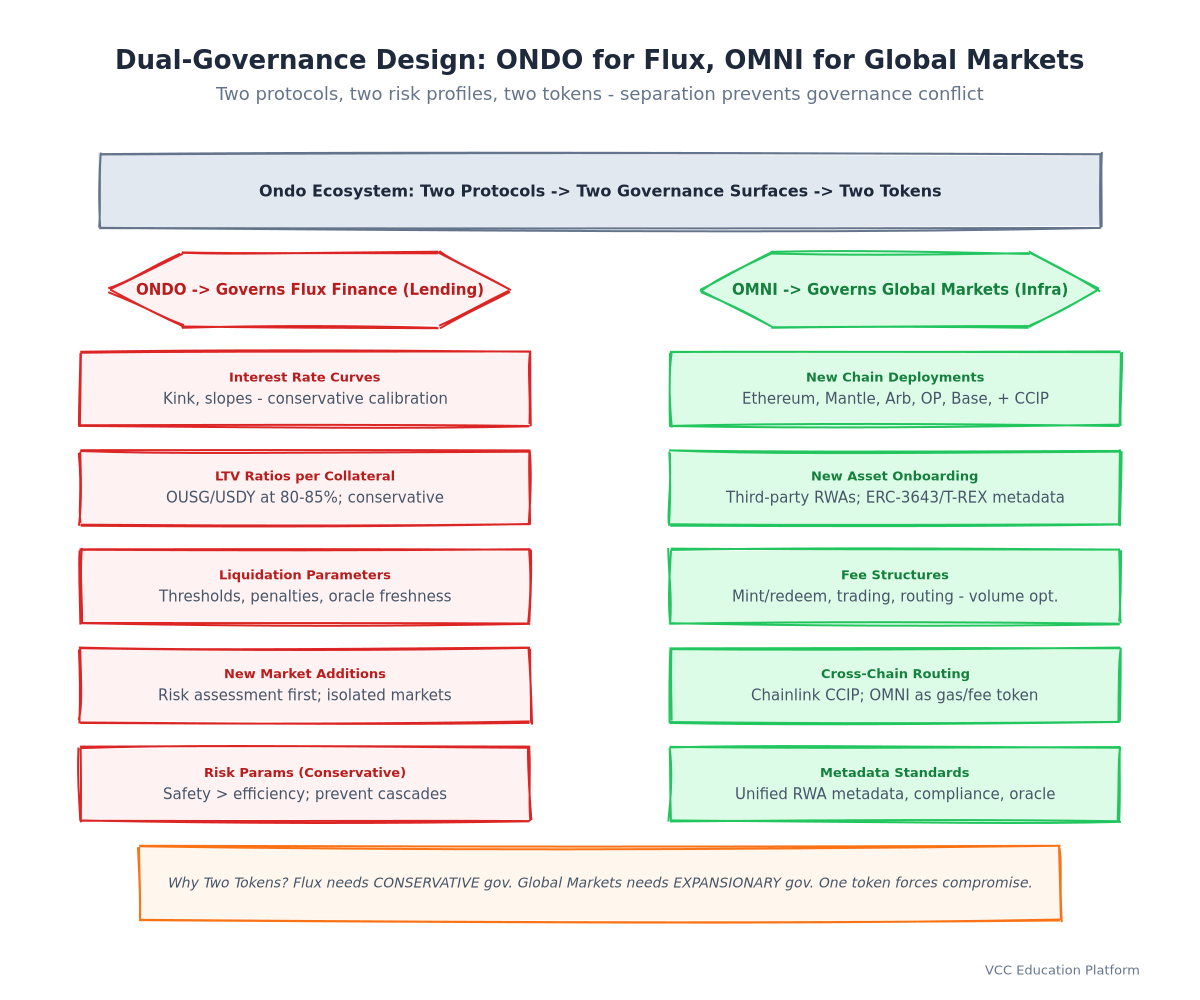
### Dual-Governance Rationale: Why ONDO + OMNI?
| Token | Governs | Constituency | Incentive Alignment |
|-------|---------|--------------|---------------------|
| **ONDO** | Flux Finance (lending) | DeFi users, borrowers, LPs | Conservative risk params, capital efficiency |
| **OMNI** | Global Markets (infrastructure) | Issuers, market makers, cross-chain users | Expansion, new chains, new assets, volume |
**Original Analysis:** Flux needs *conservative* governance (lending protocols blow up when risk params are too aggressive). Global Markets needs *expansionary* governance (more chains, more assets = more volume). Merging them forces one constituency to suffer. Separation lets each optimize.
---
## The Regulatory Ladder as a Repeatable Framework
Ondo's evolution reveals a framework any RWA project can adopt:
### Phase 1: Permissioned Beachhead (Reg D / Local Equivalent)
- **Goal:** Prove product-market fit with compliant, high-value users
- **Users:** Accredited/institutional
- **Compliance:** Full KYC, accreditation, transfer restrictions
- **Metric:** TVL from qualified investors, operational soundness
### Phase 2: Geographic Expansion (Reg S / Offshore Wrapper)
- **Goal:** Unlock global retail/institutional demand
- **Users:** Non-US / non-restricted jurisdictions
- **Compliance:** KYC only, no accreditation, seasoning period then free transfer
- **Metric:** Holder count, geographic distribution, secondary volume
### Phase 3: DeFi Integration (Lending/AMM/Derivatives)
- **Goal:** Make the RWA productive collateral
- **Mechanism:** Native lending protocol or integration with Aave/Morpho
- **Metric:** Borrow utilization, leveraged yield strategies, TVL in DeFi
### Phase 4: Permissionless Infrastructure (Multi-chain, Standards, Infra)
- **Goal:** Become the rails for *all* RWAs, not just yours
- **Mechanism:** Standards (ERC-3643/T-REX), cross-chain (CCIP/LayerZero), secondary market infra
- **Metric:** Third-party assets onboarded, chain count, protocol revenue
### Phase 5: Ecosystem Token (Governance + Utility)
- **Goal:** Align incentives across the stack
- **Mechanism:** Dual-token if Phase 3 and 4 have divergent governance needs
- **Metric:** Staking participation, governance activity, fee revenue capture
---
## Lessons for RWA Builders (Especially in Vietnam)
### Lesson 1: Regulatory Wrapper = Product Feature
Don't treat compliance as a cost center. Each wrapper (Reg D, Reg S, SICAV, Gibraltar DLT, ADGM) unlocks a specific user segment. Design your product roadmap *around* the wrappers you can access.
### Lesson 2: Separate Primary and Secondary Market Permissions
This is the single most important architectural pattern for RWA tokens. Keep mint/redeem permissioned (regulators happy). Make secondary trading permissionless (DeFi happy). The transition point (seasoning period, allowlist removal) is a configurable parameter, not a binary choice.
### Lesson 3: Build the DeFi Leg Early
An RWA token without DeFi utility is a bond with worse UX. Flux wasn't an afterthought — it was planned from the start. If you're tokenizing an asset, simultaneously design how it becomes collateral in lending, liquidity in AMMs, and underlying in derivatives.
### Lesson 4: Tokenomics Follows Architecture, Not Vice Versa
ONDO governs Flux. OMNI governs Global Markets. Two tokens because two *different governance surfaces* with different risk profiles. Don't force one token to do everything — it creates voter apathy or malicious voting.
### Lesson 5: The Underlying Asset Is Commoditized; The Wrapper Is the Moat
SHV ETF is available to anyone. BlackRock's BUIDL uses the same Treasuries. Franklin Templeton's BENJI uses the same Treasuries. Ondo's moat isn't the asset — it's the **regulatory ladder** that lets them serve users BUIDL can't (non-US, non-accredited, DeFi-native).
---
## Vietnam-Specific Implications
### For Vietnamese Investors
1. **USDY Access:** First tokenized Treasury product genuinely accessible to VN retail (post-KYC, no accreditation)
2. **VND Hedge:** ~5% USD yield vs VND deposit rates (~3-4%) — meaningful carry
3. **DeFi Composability:** USDY → Flux → borrow fUSDC → deploy in VN-relevant DeFi (e.g., local stablecoin pairs)
4. **Regulatory Preview:** Vietnam's draft Digital Assets Law (2024) mirrors the primary/secondary distinction — Ondo is a live case study
### For Vietnamese Builders
1. **Legal Wrapper Strategy:** Study Ondo's Cayman/Luxembourg/Gibraltar choices. Vietnam may need similar offshore structures for global products
2. **Primary/Secondary Design:** Build token contracts with configurable transfer restrictions from day one
3. **DeFi Integration:** Plan lending/AMM integration *before* launch, not after
4. **Cross-Chain Early:** Global Markets uses CCIP — integrate Chainlink CCIP or LayerZero from inception
---
## FAQ
### What is the difference between OUSG and USDY?
**OUSG** is for US accredited investors only (Reg D), $100K minimum, restricted transfers. **USDY** is for global non-US persons (Reg S), lower minimums, freely transferable after 40-day seasoning. Same underlying (SHV ETF), different legal wrappers.
### Is USDY a stablecoin?
No. USDY is a **tokenized money market fund** with a floating NAV that accrues yield daily. It does not maintain a fixed $1 peg — its value grows ~5% per year. This avoids stablecoin regulation (MiCA, US proposals) while delivering dollar-denominated yield.
### How does Flux Finance work with Ondo?
Flux is a lending protocol where OUSG/USDY can be deposited as collateral to borrow stablecoins (fUSDC, fUSDT). This lets holders earn leveraged yield: base Treasury yield (~5%) + DeFi spread (4-8%) = 9-13% total. Governed by ONDO token.
### What is Ondo Global Markets?
A permissionless infrastructure layer for tokenized RWAs. Primary market (mint/redeem) stays permissioned with KYC. Secondary market (trading) is fully permissionless on DEXs/CEXs. Uses OMNI token for governance, fee discounts, and cross-chain routing via Chainlink CCIP.
### What is the OMNI token used for?
Governance of Global Markets (asset onboarding, fees, chain expansion), staking for mint/redeem fee discounts, cross-chain routing fees via CCIP, and liquidity incentives.
### Can Vietnamese users buy USDY?
Yes, USDY is available to non-US persons globally. Vietnamese users can complete KYC and mint USDY through Ondo's platform, then hold, transfer, or trade it on supported DEXs. Check ondo.finance for current supported jurisdictions.
### How does Ondo's approach differ from BlackRock BUIDL?
BUIDL is US-only (Reg D), institutional-focused, on Ethereum + limited chains. Ondo built a **ladder**: OUSG (US accredited) → USDY (global non-US) → Flux (DeFi lending) → Global Markets (permissionless infra + multi-chain). Ondo serves segments BUIDL cannot.
---
### Supported Chains (Announced)
- Ethereum Mainnet
- Mantle (Ondo's early partner, high throughput)
- Arbitrum
- Optimism
- Base
- More via CCIP
### OMNI Token: Governance + Utility for Global Markets
- **Supply:** 10 billion fixed
- **Allocation:** Ecosystem (40%), Team/Investors (30%), Community (20%), Treasury (10%)
- **Functions:**
1. **Governance:** Protocol parameters, new asset onboarding, fee structures
2. **Staking for Fee Discounts:** Stake OMNI → reduced mint/redeem fees, priority routing
3. **Cross-Chain Routing:** OMNI as gas/fee token for CCIP messages
4. **Incentives:** Liquidity mining for Global Markets pairs
### Dual-Governance Rationale: Why ONDO + OMNI?
| Token | Governs | Constituency | Incentive Alignment |
|-------|---------|--------------|---------------------|
| **ONDO** | Flux Finance (lending) | DeFi users, borrowers, LPs | Conservative risk params, capital efficiency |
| **OMNI** | Global Markets (infrastructure) | Issuers, market makers, cross-chain users | Expansion, new chains, new assets, volume |
**Original Analysis:** Flux needs *conservative* governance (lending protocols blow up when risk params are too aggressive). Global Markets needs *expansionary* governance (more chains, more assets = more volume). Merging them forces one constituency to suffer. Separation lets each optimize.
---
## The Regulatory Ladder as a Repeatable Framework
Ondo's evolution reveals a framework any RWA project can adopt:
### Phase 1: Permissioned Beachhead (Reg D / Local Equivalent)
- **Goal:** Prove product-market fit with compliant, high-value users
- **Users:** Accredited/institutional
- **Compliance:** Full KYC, accreditation, transfer restrictions
- **Metric:** TVL from qualified investors, operational soundness
### Phase 2: Geographic Expansion (Reg S / Offshore Wrapper)
- **Goal:** Unlock global retail/institutional demand
- **Users:** Non-US / non-restricted jurisdictions
- **Compliance:** KYC only, no accreditation, seasoning period then free transfer
- **Metric:** Holder count, geographic distribution, secondary volume
### Phase 3: DeFi Integration (Lending/AMM/Derivatives)
- **Goal:** Make the RWA productive collateral
- **Mechanism:** Native lending protocol or integration with Aave/Morpho
- **Metric:** Borrow utilization, leveraged yield strategies, TVL in DeFi
### Phase 4: Permissionless Infrastructure (Multi-chain, Standards, Infra)
- **Goal:** Become the rails for *all* RWAs, not just yours
- **Mechanism:** Standards (ERC-3643/T-REX), cross-chain (CCIP/LayerZero), secondary market infra
- **Metric:** Third-party assets onboarded, chain count, protocol revenue
### Phase 5: Ecosystem Token (Governance + Utility)
- **Goal:** Align incentives across the stack
- **Mechanism:** Dual-token if Phase 3 and 4 have divergent governance needs
- **Metric:** Staking participation, governance activity, fee revenue capture
---
## Lessons for RWA Builders (Especially in Vietnam)
### Lesson 1: Regulatory Wrapper = Product Feature
Don't treat compliance as a cost center. Each wrapper (Reg D, Reg S, SICAV, Gibraltar DLT, ADGM) unlocks a specific user segment. Design your product roadmap *around* the wrappers you can access.
### Lesson 2: Separate Primary and Secondary Market Permissions
This is the single most important architectural pattern for RWA tokens. Keep mint/redeem permissioned (regulators happy). Make secondary trading permissionless (DeFi happy). The transition point (seasoning period, allowlist removal) is a configurable parameter, not a binary choice.
### Lesson 3: Build the DeFi Leg Early
An RWA token without DeFi utility is a bond with worse UX. Flux wasn't an afterthought — it was planned from the start. If you're tokenizing an asset, simultaneously design how it becomes collateral in lending, liquidity in AMMs, and underlying in derivatives.
### Lesson 4: Tokenomics Follows Architecture, Not Vice Versa
ONDO governs Flux. OMNI governs Global Markets. Two tokens because two *different governance surfaces* with different risk profiles. Don't force one token to do everything — it creates voter apathy or malicious voting.
### Lesson 5: The Underlying Asset Is Commoditized; The Wrapper Is the Moat
SHV ETF is available to anyone. BlackRock's BUIDL uses the same Treasuries. Franklin Templeton's BENJI uses the same Treasuries. Ondo's moat isn't the asset — it's the **regulatory ladder** that lets them serve users BUIDL can't (non-US, non-accredited, DeFi-native).
---
## Vietnam-Specific Implications
### For Vietnamese Investors
1. **USDY Access:** First tokenized Treasury product genuinely accessible to VN retail (post-KYC, no accreditation)
2. **VND Hedge:** ~5% USD yield vs VND deposit rates (~3-4%) — meaningful carry
3. **DeFi Composability:** USDY → Flux → borrow fUSDC → deploy in VN-relevant DeFi (e.g., local stablecoin pairs)
4. **Regulatory Preview:** Vietnam's draft Digital Assets Law (2024) mirrors the primary/secondary distinction — Ondo is a live case study
### For Vietnamese Builders
1. **Legal Wrapper Strategy:** Study Ondo's Cayman/Luxembourg/Gibraltar choices. Vietnam may need similar offshore structures for global products
2. **Primary/Secondary Design:** Build token contracts with configurable transfer restrictions from day one
3. **DeFi Integration:** Plan lending/AMM integration *before* launch, not after
4. **Cross-Chain Early:** Global Markets uses CCIP — integrate Chainlink CCIP or LayerZero from inception
---
## FAQ
### What is the difference between OUSG and USDY?
**OUSG** is for US accredited investors only (Reg D), $100K minimum, restricted transfers. **USDY** is for global non-US persons (Reg S), lower minimums, freely transferable after 40-day seasoning. Same underlying (SHV ETF), different legal wrappers.
### Is USDY a stablecoin?
No. USDY is a **tokenized money market fund** with a floating NAV that accrues yield daily. It does not maintain a fixed $1 peg — its value grows ~5% per year. This avoids stablecoin regulation (MiCA, US proposals) while delivering dollar-denominated yield.
### How does Flux Finance work with Ondo?
Flux is a lending protocol where OUSG/USDY can be deposited as collateral to borrow stablecoins (fUSDC, fUSDT). This lets holders earn leveraged yield: base Treasury yield (~5%) + DeFi spread (4-8%) = 9-13% total. Governed by ONDO token.
### What is Ondo Global Markets?
A permissionless infrastructure layer for tokenized RWAs. Primary market (mint/redeem) stays permissioned with KYC. Secondary market (trading) is fully permissionless on DEXs/CEXs. Uses OMNI token for governance, fee discounts, and cross-chain routing via Chainlink CCIP.
### What is the OMNI token used for?
Governance of Global Markets (asset onboarding, fees, chain expansion), staking for mint/redeem fee discounts, cross-chain routing fees via CCIP, and liquidity incentives.
### Can Vietnamese users buy USDY?
Yes, USDY is available to non-US persons globally. Vietnamese users can complete KYC and mint USDY through Ondo's platform, then hold, transfer, or trade it on supported DEXs. Check ondo.finance for current supported jurisdictions.
### How does Ondo's approach differ from BlackRock BUIDL?
BUIDL is US-only (Reg D), institutional-focused, on Ethereum + limited chains. Ondo built a **ladder**: OUSG (US accredited) → USDY (global non-US) → Flux (DeFi lending) → Global Markets (permissionless infra + multi-chain). Ondo serves segments BUIDL cannot.
---
 ## Conclusion: The RWA Playbook Is Written
Ondo Finance didn't just launch products — they wrote the playbook for how a modern RWA protocol scales:
1. **Start compliant** (Reg D beachhead)
2. **Expand geographically** (Reg S wrapper)
3. **Integrate DeFi** (native lending protocol)
4. **Build infrastructure** (permissionless secondary, cross-chain, standards)
5. **Govern with purpose-fit tokens** (dual governance for divergent surfaces)
For Vietnam's emerging RWA ecosystem — whether tokenized Treasuries, real estate, carbon credits, or private credit — the lesson is clear: **regulatory strategy is product strategy.** The teams that treat wrappers as features, separate primary from secondary permissions, and build DeFi utility from day one will define the next decade of on-chain finance.
Ondo proved it works. The ladder is there to climb.
---
*Word count: ~3,100*
*Primary keyword "Ondo Finance" in H1, first 100 words, and throughout*
*Secondary keywords: USDY, OUSG, Flux Finance, Ondo Global Markets, OMNI, permissioned/permissionless woven into H2s and body*
*Visual markers: 5 diagrams specified*
## Conclusion: The RWA Playbook Is Written
Ondo Finance didn't just launch products — they wrote the playbook for how a modern RWA protocol scales:
1. **Start compliant** (Reg D beachhead)
2. **Expand geographically** (Reg S wrapper)
3. **Integrate DeFi** (native lending protocol)
4. **Build infrastructure** (permissionless secondary, cross-chain, standards)
5. **Govern with purpose-fit tokens** (dual governance for divergent surfaces)
For Vietnam's emerging RWA ecosystem — whether tokenized Treasuries, real estate, carbon credits, or private credit — the lesson is clear: **regulatory strategy is product strategy.** The teams that treat wrappers as features, separate primary from secondary permissions, and build DeFi utility from day one will define the next decade of on-chain finance.
Ondo proved it works. The ladder is there to climb.
---
*Word count: ~3,100*
*Primary keyword "Ondo Finance" in H1, first 100 words, and throughout*
*Secondary keywords: USDY, OUSG, Flux Finance, Ondo Global Markets, OMNI, permissioned/permissionless woven into H2s and body*
*Visual markers: 5 diagrams specified*
---
## Rung 1: OUSG — The Accredited-Only Start (2022)
### Product Specification
- **Launch:** Q1 2022
- **Regulatory Framework:** SEC Regulation D Rule 506(c)
- **Eligible Investors:** US accredited investors only (net worth >$1M or income >$200K)
- **Legal Wrapper:** Delaware Statutory Trust (master) + Cayman SPV (feeder)
- **Underlying:** BlackRock iShares Short Treasury ETF (SHV), expense ratio 0.15%
- **Yield Mechanism:** Daily NAV accrual (token balance grows, not rebasing)
- **Minimum Investment:** $100,000
- **Redemption:** T+2, US business days only
- **Transfer Restrictions:** 1-year lockup, then whitelisted transfers only
### Why This Structure?
Reg D 506(c) allows general solicitation (public marketing) but **only** to verified accredited investors. This let Ondo market OUSG openly while staying compliant. The Delaware Trust + Cayman feeder structure is the industry standard for US fund tokenization — bankruptcy-remote, familiar to TradFi custodians (BNY Mellon, State Street), and compatible with existing fund administration.
### The Trade-off
OUSG solved the " TradFi yield on-chain" problem for a tiny slice of the world: US high-net-worth individuals and institutions. For everyone else — the 95% of crypto users outside US accreditation — OUSG was invisible. TVL plateaued around $150-200M for over a year.
---
## Rung 2: USDY — The Global Access Breakthrough (2023)
### Product Specification
- **Launch:** October 2023
- **Regulatory Framework:** SEC Regulation S (offshore offering)
- **Eligible Investors:** Non-US persons globally (no accreditation required)
- **Legal Wrapper:** Luxembourg SICAV / non-US fund structure
- **Underlying:** Same SHV ETF (economic equivalence to OUSG)
- **Yield Mechanism:** Daily NAV accrual — **not a stablecoin**
- **Minimum Investment:** Varies by jurisdiction (often ~$1,000 equivalent)
- **Redemption:** T+1 to T+3 depending on jurisdiction
- **Transfer Restrictions:** 40-day seasoning period, then freely transferable on-chain
### Critical Distinction: USDY Is NOT a Stablecoin
Media coverage frequently mislabels USDY as a "yield-bearing stablecoin." It is not.
- **Stablecoin:** Fixed $1 peg, yield requires staking/lending (e.g., sUSDe, stUSDC)
- **USDY:** Floating NAV (~$1.00 + accrued yield), yield accrues **automatically** in token balance
This distinction is regulatory strategy, not semantics. MiCA (EU) and proposed US stablecoin legislation impose reserve, redemption, and governance requirements that would constrain USDY's flexibility. By positioning as a **tokenized money market fund**, USDY avoids the "stablecoin" regulatory bucket while delivering the same user experience: hold a dollar-denominated token, watch balance grow daily.
### The Regulatory Arbitrage in Action
| Dimension | OUSG (Reg D) | USDY (Reg S) |
|-----------|--------------|--------------|
| **Investor Base** | US accredited only | Global non-US |
| **Accreditation** | Required | Not required |
| **Min Investment** | $100,000 | ~$1,000 |
| **Transfer Freedom** | Whitelisted only | Free after 40 days |
| **Primary Market** | Permissioned (KYC + accred) | Permissioned (KYC only) |
| **Secondary Market** | Restricted | Permissionless (DEX/CEX) |
**Original Insight:** The underlying asset (SHV) didn't change. The legal wrapper changed. Ondo essentially "re-wrapped" the same economic exposure for a different regulatory perimeter. This is regulatory arbitrage as product management — and it's repeatable.
### Vietnam Relevance
For a Vietnamese investor, USDY is the first tokenized Treasury product **actually accessible** without US accreditation. A user in Ho Chi Minh City can mint USDY (after KYC), hold it on-chain, earn ~5% APY from US Treasuries, and trade it on DEXs like Uniswap or Curve. No US brokerage account, no $100K minimum, no accreditation letter.
---
## Rung 3: Flux Finance — Making RWAs Productive in DeFi (2023)
### The Problem: Dead Capital
OUSG and USDY holders earned ~5% from Treasuries. But in DeFi, 5% is the *risk-free rate* — the baseline. Users want **leveraged yield**: borrow against collateral, deploy borrowed funds, earn spread.
Without a lending market, OUSG/USDY are "dead capital" — they sit in wallets earning only the risk-free rate.
### Flux Finance: The DeFi Leg
- **Launch:** Mid-2023
- **Type:** Permissioned lending protocol (Aave v2 fork with modifications)
- **Governance Token:** ONDO
- **Key Markets:** fUSDC, fUSDT, fDAI (stablecoin lending)
- **Accepted Collateral:** OUSG, USDY, USDC, USDT, DAI
- **LTV for OUSG/USDY:** ~80-85% (conservative, reflecting low volatility)
- **Interest Rate Model:** Kinked utilization curve (kink at 80%)
- Below kink: Low slope (cheap borrowing)
- Above kink: Steep slope (liquidity protection)
- **Oracle:** Chainlink Price Feeds + custom NAV oracle for OUSG/USDY
### How the Flywheel Works
```
1. User holds USDY (earning ~5% base yield)
2. Deposits USDY into Flux as collateral
3. Borrows fUSDC at ~3-4% (below kink)
4. Deploys fUSDC into DeFi strategies (e.g., Pendle PT, Morpho, Aave)
5. Earns strategy yield (e.g., 8-12%) minus borrow cost (3-4%) = 4-8% spread
6. Total yield = 5% (base) + 4-8% (spread) = 9-13% on original capital
```
This transforms USDY from a "savings account" into a **DeFi collateral primitive** — the same role USDC plays in traditional DeFi, but with TradFi-grade risk-free backing.
### Risk Considerations (The Contrarian View)
Community discussions (Source 7) flag valid concerns:
- **Oracle Risk:** USDY NAV oracle is custom — if it lags or fails, liquidations misfire
- **Liquidity Risk:** Flux TVL (~$50M peak) is small vs Aave/Compound — large liquidations could cascade
- **Smart Contract Risk:** Fork of Aave v2, but modified — audit coverage incomplete
- **Regulatory Risk:** If USDY faces regulatory action, collateral value could drop sharply
Ondo mitigates via conservative LTV (80-85%), isolated markets (OUSG/USDY don't share pool with volatile assets), and a bug bounty program. But the risk is real — and any RWA lending integration must price it in.
---
## Rung 4: Ondo Global Markets — The Permissionless Infrastructure Layer (2024)
### The Announcement
June 2024: "Ondo Global Markets — The Infrastructure Layer for Tokenized RWAs." Not a new fund. Not a new token (yet). **Infrastructure.**
### The Core Problem It Solves
Tokenized RWAs today are fragmented:
- Each issuer builds their own mint/redeem, compliance, custody, oracle stack
- Secondary trading happens on random DEXs with no standardized metadata
- Cross-chain movement requires bespoke bridges
- No universal "ERC-20 for RWAs" standard with compliance built in
### Global Markets Architecture
```
┌─────────────────────────────────────────────────────────────┐
│ ONDO GLOBAL MARKETS │
├──────────────────┬──────────────────┬───────────────────────┤
│ Primary Market │ Secondary Market │ Cross-Chain Layer │
│ (Permissioned) │ (Permissionless) │ (OMNI + CCIP) │
├──────────────────┼──────────────────┼───────────────────────┤
│ • KYC/AML │ • DEX/AMM trading │ • OMNI token routing │
│ • Accreditation │ • No restrictions │ • Chainlink CCIP │
│ • Mint/Redeem │ • 24/7 global │ • Unified metadata │
│ • Compliance │ • Order book/AMM │ • Settlement finality │
└──────────────────┴──────────────────┴───────────────────────┘
```
### The Primary/Secondary Market Separation — The Key Innovation
This is Ondo's most important architectural decision:
**Primary Market (Mint/Redeem): ALWAYS permissioned.**
- KYC required
- Accreditation checks where applicable (Reg D)
- Sanctions screening
- This satisfies regulators: "We know who holds the underlying."
**Secondary Market (Trading): PERMISSIONLESS.**
- Once minted, tokens move freely on-chain
- DEXs, AMMs, CEXs — no Ondo control
- Global 24/7 liquidity
- This satisfies DeFi: "Composability preserved."
**Why this works:** Securities law regulates the *issuance* (primary) and *transfer restrictions* (which can be enforced at the token level via allowlists). But once a token is freely transferable (Reg S seasoning period passed), secondary trading is largely outside the issuer's control — and that's fine. The issuer's obligation is at mint/redeem.
### Supported Chains (Announced)
- Ethereum Mainnet
- Mantle (Ondo's early partner, high throughput)
- Arbitrum
- Optimism
- Base
- More via CCIP
### OMNI Token: Governance + Utility for Global Markets
- **Supply:** 10 billion fixed
- **Allocation:** Ecosystem (40%), Team/Investors (30%), Community (20%), Treasury (10%)
- **Functions:**
1. **Governance:** Protocol parameters, new asset onboarding, fee structures
2. **Staking for Fee Discounts:** Stake OMNI → reduced mint/redeem fees, priority routing
3. **Cross-Chain Routing:** OMNI as gas/fee token for CCIP messages
4. **Incentives:** Liquidity mining for Global Markets pairs
### Dual-Governance Rationale: Why ONDO + OMNI?
| Token | Governs | Constituency | Incentive Alignment |
|-------|---------|--------------|---------------------|
| **ONDO** | Flux Finance (lending) | DeFi users, borrowers, LPs | Conservative risk params, capital efficiency |
| **OMNI** | Global Markets (infrastructure) | Issuers, market makers, cross-chain users | Expansion, new chains, new assets, volume |
**Original Analysis:** Flux needs *conservative* governance (lending protocols blow up when risk params are too aggressive). Global Markets needs *expansionary* governance (more chains, more assets = more volume). Merging them forces one constituency to suffer. Separation lets each optimize.
---
## The Regulatory Ladder as a Repeatable Framework
Ondo's evolution reveals a framework any RWA project can adopt:
### Phase 1: Permissioned Beachhead (Reg D / Local Equivalent)
- **Goal:** Prove product-market fit with compliant, high-value users
- **Users:** Accredited/institutional
- **Compliance:** Full KYC, accreditation, transfer restrictions
- **Metric:** TVL from qualified investors, operational soundness
### Phase 2: Geographic Expansion (Reg S / Offshore Wrapper)
- **Goal:** Unlock global retail/institutional demand
- **Users:** Non-US / non-restricted jurisdictions
- **Compliance:** KYC only, no accreditation, seasoning period then free transfer
- **Metric:** Holder count, geographic distribution, secondary volume
### Phase 3: DeFi Integration (Lending/AMM/Derivatives)
- **Goal:** Make the RWA productive collateral
- **Mechanism:** Native lending protocol or integration with Aave/Morpho
- **Metric:** Borrow utilization, leveraged yield strategies, TVL in DeFi
### Phase 4: Permissionless Infrastructure (Multi-chain, Standards, Infra)
- **Goal:** Become the rails for *all* RWAs, not just yours
- **Mechanism:** Standards (ERC-3643/T-REX), cross-chain (CCIP/LayerZero), secondary market infra
- **Metric:** Third-party assets onboarded, chain count, protocol revenue
### Phase 5: Ecosystem Token (Governance + Utility)
- **Goal:** Align incentives across the stack
- **Mechanism:** Dual-token if Phase 3 and 4 have divergent governance needs
- **Metric:** Staking participation, governance activity, fee revenue capture
---
## Lessons for RWA Builders (Especially in Vietnam)
### Lesson 1: Regulatory Wrapper = Product Feature
Don't treat compliance as a cost center. Each wrapper (Reg D, Reg S, SICAV, Gibraltar DLT, ADGM) unlocks a specific user segment. Design your product roadmap *around* the wrappers you can access.
### Lesson 2: Separate Primary and Secondary Market Permissions
This is the single most important architectural pattern for RWA tokens. Keep mint/redeem permissioned (regulators happy). Make secondary trading permissionless (DeFi happy). The transition point (seasoning period, allowlist removal) is a configurable parameter, not a binary choice.
### Lesson 3: Build the DeFi Leg Early
An RWA token without DeFi utility is a bond with worse UX. Flux wasn't an afterthought — it was planned from the start. If you're tokenizing an asset, simultaneously design how it becomes collateral in lending, liquidity in AMMs, and underlying in derivatives.
### Lesson 4: Tokenomics Follows Architecture, Not Vice Versa
ONDO governs Flux. OMNI governs Global Markets. Two tokens because two *different governance surfaces* with different risk profiles. Don't force one token to do everything — it creates voter apathy or malicious voting.
### Lesson 5: The Underlying Asset Is Commoditized; The Wrapper Is the Moat
SHV ETF is available to anyone. BlackRock's BUIDL uses the same Treasuries. Franklin Templeton's BENJI uses the same Treasuries. Ondo's moat isn't the asset — it's the **regulatory ladder** that lets them serve users BUIDL can't (non-US, non-accredited, DeFi-native).
---
## Vietnam-Specific Implications
### For Vietnamese Investors
1. **USDY Access:** First tokenized Treasury product genuinely accessible to VN retail (post-KYC, no accreditation)
2. **VND Hedge:** ~5% USD yield vs VND deposit rates (~3-4%) — meaningful carry
3. **DeFi Composability:** USDY → Flux → borrow fUSDC → deploy in VN-relevant DeFi (e.g., local stablecoin pairs)
4. **Regulatory Preview:** Vietnam's draft Digital Assets Law (2024) mirrors the primary/secondary distinction — Ondo is a live case study
### For Vietnamese Builders
1. **Legal Wrapper Strategy:** Study Ondo's Cayman/Luxembourg/Gibraltar choices. Vietnam may need similar offshore structures for global products
2. **Primary/Secondary Design:** Build token contracts with configurable transfer restrictions from day one
3. **DeFi Integration:** Plan lending/AMM integration *before* launch, not after
4. **Cross-Chain Early:** Global Markets uses CCIP — integrate Chainlink CCIP or LayerZero from inception
---
## FAQ
### What is the difference between OUSG and USDY?
**OUSG** is for US accredited investors only (Reg D), $100K minimum, restricted transfers. **USDY** is for global non-US persons (Reg S), lower minimums, freely transferable after 40-day seasoning. Same underlying (SHV ETF), different legal wrappers.
### Is USDY a stablecoin?
No. USDY is a **tokenized money market fund** with a floating NAV that accrues yield daily. It does not maintain a fixed $1 peg — its value grows ~5% per year. This avoids stablecoin regulation (MiCA, US proposals) while delivering dollar-denominated yield.
### How does Flux Finance work with Ondo?
Flux is a lending protocol where OUSG/USDY can be deposited as collateral to borrow stablecoins (fUSDC, fUSDT). This lets holders earn leveraged yield: base Treasury yield (~5%) + DeFi spread (4-8%) = 9-13% total. Governed by ONDO token.
### What is Ondo Global Markets?
A permissionless infrastructure layer for tokenized RWAs. Primary market (mint/redeem) stays permissioned with KYC. Secondary market (trading) is fully permissionless on DEXs/CEXs. Uses OMNI token for governance, fee discounts, and cross-chain routing via Chainlink CCIP.
### What is the OMNI token used for?
Governance of Global Markets (asset onboarding, fees, chain expansion), staking for mint/redeem fee discounts, cross-chain routing fees via CCIP, and liquidity incentives.
### Can Vietnamese users buy USDY?
Yes, USDY is available to non-US persons globally. Vietnamese users can complete KYC and mint USDY through Ondo's platform, then hold, transfer, or trade it on supported DEXs. Check ondo.finance for current supported jurisdictions.
### How does Ondo's approach differ from BlackRock BUIDL?
BUIDL is US-only (Reg D), institutional-focused, on Ethereum + limited chains. Ondo built a **ladder**: OUSG (US accredited) → USDY (global non-US) → Flux (DeFi lending) → Global Markets (permissionless infra + multi-chain). Ondo serves segments BUIDL cannot.
---
## Conclusion: The RWA Playbook Is Written
Ondo Finance didn't just launch products — they wrote the playbook for how a modern RWA protocol scales:
1. **Start compliant** (Reg D beachhead)
2. **Expand geographically** (Reg S wrapper)
3. **Integrate DeFi** (native lending protocol)
4. **Build infrastructure** (permissionless secondary, cross-chain, standards)
5. **Govern with purpose-fit tokens** (dual governance for divergent surfaces)
For Vietnam's emerging RWA ecosystem — whether tokenized Treasuries, real estate, carbon credits, or private credit — the lesson is clear: **regulatory strategy is product strategy.** The teams that treat wrappers as features, separate primary from secondary permissions, and build DeFi utility from day one will define the next decade of on-chain finance.
Ondo proved it works. The ladder is there to climb.
---
*Word count: ~3,100*
*Primary keyword "Ondo Finance" in H1, first 100 words, and throughout*
*Secondary keywords: USDY, OUSG, Flux Finance, Ondo Global Markets, OMNI, permissioned/permissionless woven into H2s and body*
*Visual markers: 5 diagrams specified*