
When the European Investment Bank (EIB) priced a €100 million two-year digital bond on April 27, 2021, it did not just add another line item to its €600 billion balance sheet. It fired a starting gun for the tokenization of sovereign-grade debt. Goldman Sachs, Santander, and Société Générale served as joint lead managers. The bond lived on a private permissioned Ethereum network. Settlement occurred in minutes, not days. Legal finality arrived at block confirmation, not at the end of a T+2 cycle.
Three years and three issuances later, the EIB digital bond program remains the most cited — and most misunderstood — case study in capital markets tokenization. This article dissects what actually happened, why the arrangers built a walled garden instead of using public Ethereum, and what the experiment reveals about the gap between blockchain's promise and capital markets' reality.
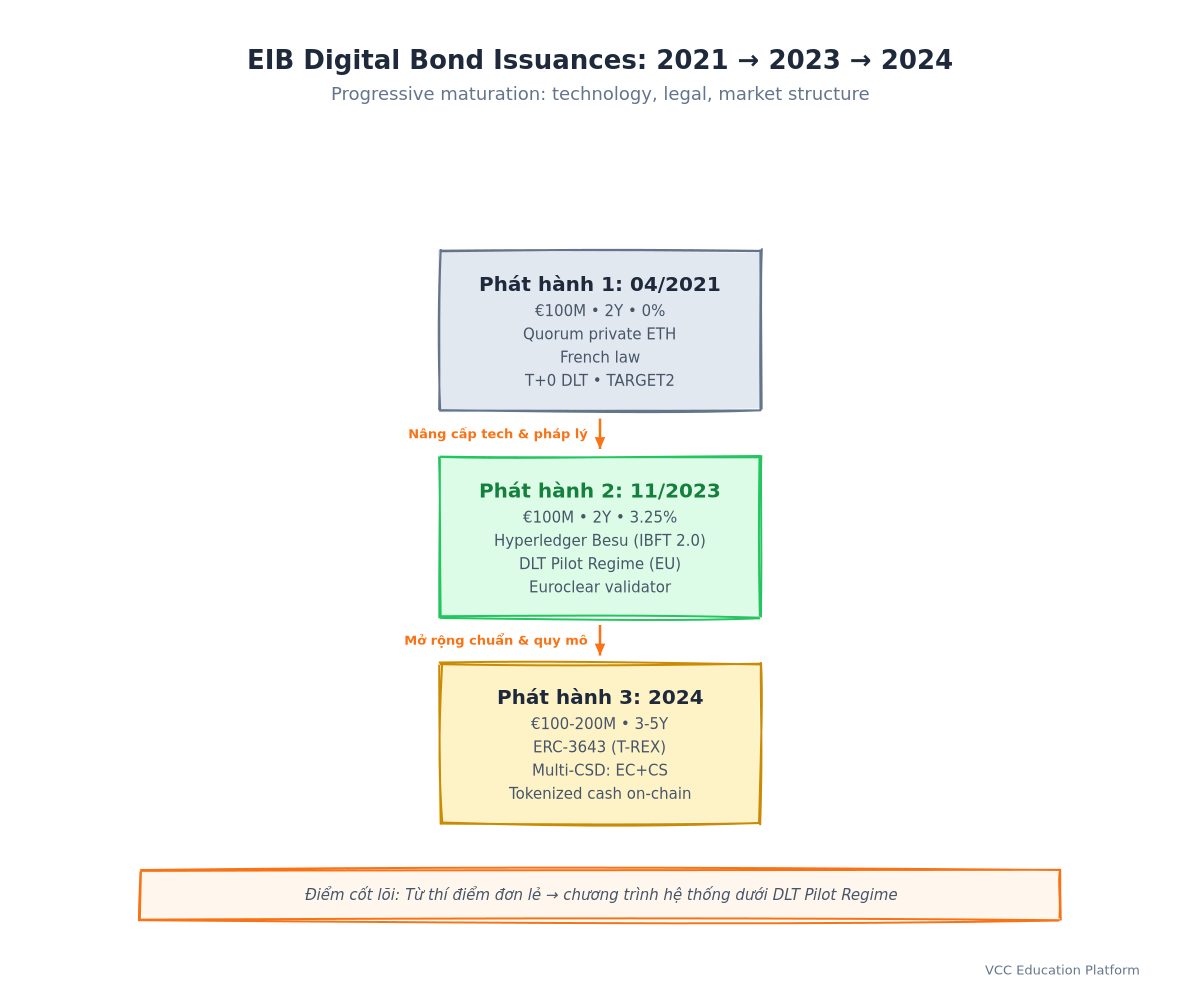
The Three Issuances: From Pilot to Programme
Issuance One: April 2021 — The World's First
The inaugural €100 million, two-year, zero-coupon digital bond settled on April 28, 2021. EIB chose French law — specifically the 2017 Ordonnance on minibons — which recognizes shared electronic recording systems (DLT) as equivalent to central securities depositories (CSDs). No CSD was required for issuance. Legal finality occurred the moment the bond was recorded on the ledger.
Key parameters:
- Issuer: European Investment Bank (AAA/Aaa/AAA)
- Amount: €100 million
- Tenor: 2 years (maturity April 2023)
- Coupon: 0% (discount issuance)
- Arrangers: Goldman Sachs, Santander, Société Générale
- Technology: Private permissioned Ethereum (Quorum-based, IBFT consensus)
- Settlement: T+0 via DLT, cash leg off-chain via TARGET2
- Investor base: Central banks, sovereign wealth funds, insurers — €300M+ orders for €100M supply
The bond was oversubscribed three times. But the novelty premium masked a structural reality: every investor was a known counterparty, pre-whitelisted, holding through custodians already connected to the permissioned network.
Issuance Two: November 2023 — Under the DLT Pilot Regime
The second €100 million, two-year bond (coupon ~3.25%) launched November 15, 2023 — the first issuance under the EU's DLT Pilot Regime (Regulation 2022/858), which took effect March 2023. The regime grants DLT-based settlement systems CSDR-equivalent legal finality across the EU.
What changed:
- Network: Migrated from Quorum to Hyperledger Besu (IBFT 2.0 consensus)
- CSD integration: Euroclear participated as a validator node, enabling direct DLT-to-DLT settlement
- Regulatory status: Explicit DLT Pilot Regime compliance, not just French law equivalence
- Smart contracts: Enhanced with freeze/recovery functions for regulatory compliance
The DLT Pilot Regime is temporary — it expires in 2028 unless extended. EIB's second issuance effectively stress-tested the regime's legal architecture in production.
Issuance Three: 2024 — Scaling Tenor and Standards
The third issuance (size not publicly disclosed, estimated €100–200 million range) extended tenor to 3–5 years and incorporated ERC-3643 (T-REX) compliance features — the emerging standard for permissioned security tokens with on-chain identity, compliance modules, and partition support for multi-jurisdiction distribution.
Evolution markers:
- Multi-CSD connectivity testing (Euroclear + Clearstream)
- Tokenized cash leg exploration (commercial bank money on-chain)
- Broader syndicate beyond the original trio
The Technology Stack: Private Ethereum by Design
Why Not Public Ethereum?
Three words: identity, confidentiality, finality.
Capital markets regulation requires known participants (KYC/AML), trade confidentiality (no front-running), and instant, irreversible finality. Public Ethereum offers none of these natively. Validators are anonymous. State is public. Finality is probabilistic (~15 minutes for high-value transactions).
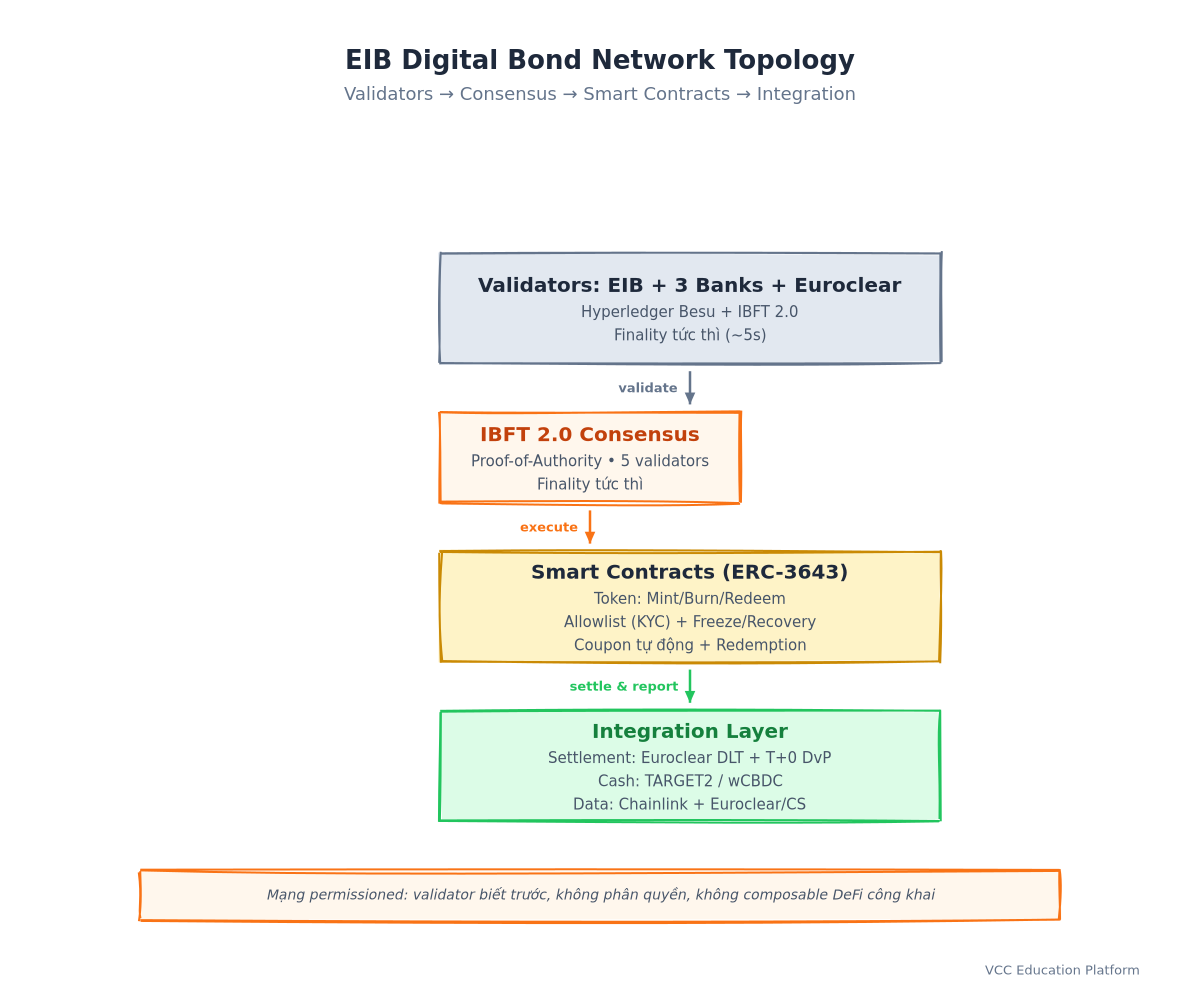
EIB's solution: a permissioned Ethereum network where validators are known, vetted entities — the issuer, the arrangers, and the CSDs.
Network Architecture
| Component | Choice | Rationale |
|---|---|---|
| Client | Hyperledger Besu | Enterprise-grade, open-source, Ethereum mainnet compatible |
| Consensus | IBFT 2.0 (PoA) | Instant finality, no forks, known validator set |
| Validators | EIB + 3 arrangers + Euroclear | Governance aligned with legal responsibility |
| Block time | ~5 seconds | Sufficient for bond lifecycle events |
| Token standard | ERC-20 (custom) → ERC-3643 | Pre-standard; migrating to T-REX for compliance |
Smart Contract Layer
The bond token implements:
- Allowlist: On-chain mapping of verified investor addresses (linked to off-chain KYC)
- Coupon logic: Automated calculation and distribution (though first issuance was zero-coupon)
- Redemption: Automatic principal return at maturity
- Freeze/Recovery: Regulatory compliance — ability to freeze tokens for sanctions, recover lost keys via governance
- Partitions (ERC-3643): Separate compliance rules per jurisdiction
This is not DeFi. There are no liquidity pools, no AMMs, no composability with public protocols. The smart contract is a digital corporate action processor — efficient, auditable, but closed.
Legal Framework: The French-EU Hybrid
French Law: The Enabler
France moved early. The 2017 Ordonnance (Article L.211-3 Code Monétaire et Financier) defines "shared electronic recording systems" and grants them legal equivalence to CSDs. Key provisions:
- Securities can be issued directly on DLT — no CSD intermediary required
- Legal finality at point of DLT entry
- French courts recognize DLT entries as probative evidence of ownership
EIB, as a supranational, can choose its governing law. French law provided the clearest pathway in 2021.
EU Layer: The DLT Pilot Regime
The DLT Pilot Regime (Regulation 2022/858) creates an EU-wide sandbox for DLT market infrastructures. It:
- Grants settlement finality under CSDR Article 5/6 to licensed DLT settlement systems
- Allows CSDs to operate DLT settlement systems (Euroclear's pilot)
- Permits temporary exemption from certain MiFID II/CSDR requirements
- Expires March 2028 — a "sunset clause" creating regulatory uncertainty
EIB's second issuance was the first major test of this regime. The bond's legal finality now rests on both French law and the EU regime — a dual anchor.
Settlement Finality: T+0 vs T+2
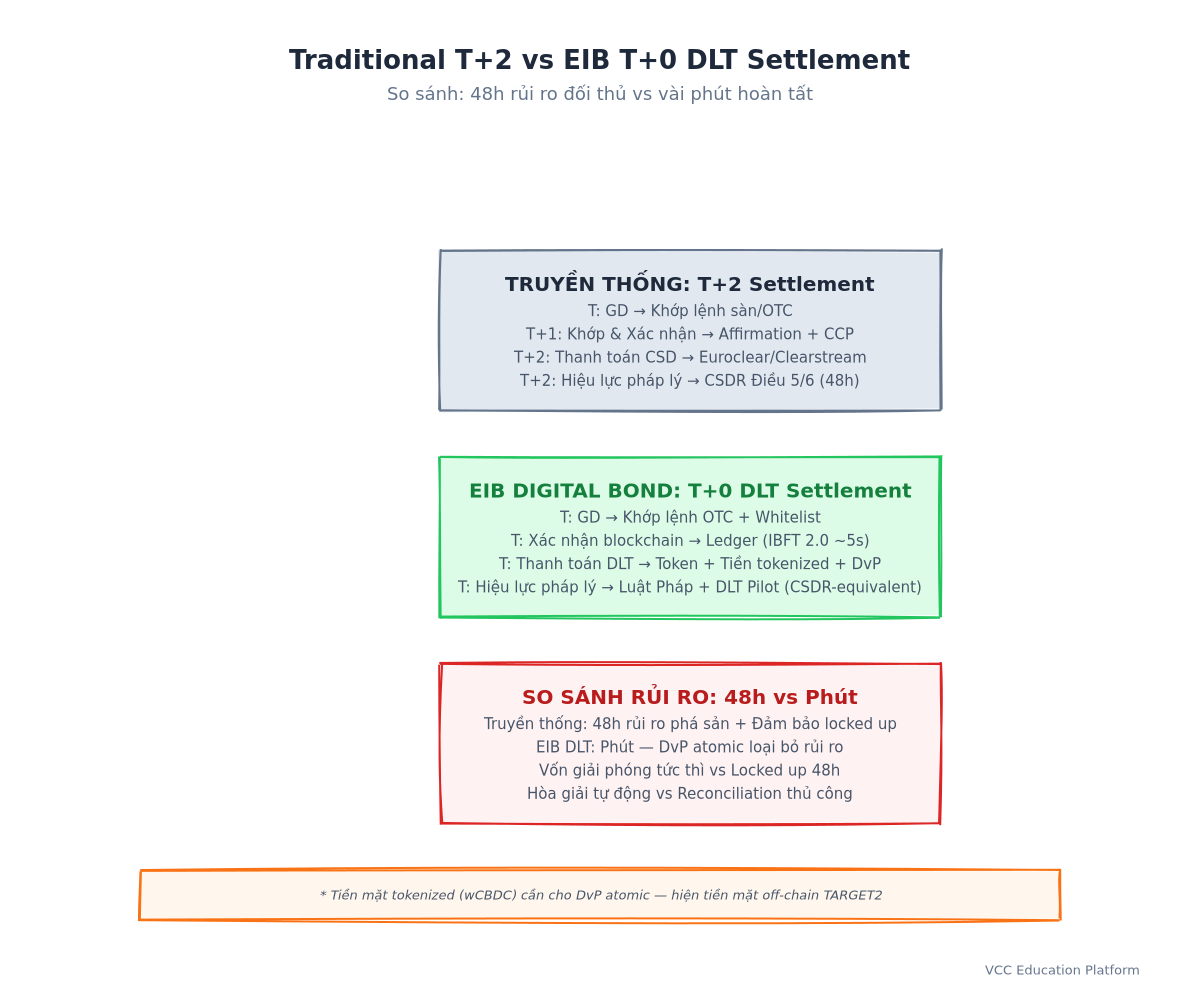
Traditional bond settlement: Trade date (T) → matching → clearing → CSD settlement (T+2). Two days of counterparty risk, collateral lock-up, reconciliation breaks.
EIB digital bond: Trade → block confirmation → final. Minutes, not days.
But: The cash leg remains largely off-chain (TARGET2 or commercial bank transfers). True delivery-versus-payment (DvP) on-chain requires tokenized cash — central bank digital currency (CBDC) or tokenized commercial bank deposits. The Eurosystem's wholesale CBDC experiments and the ECB's DLT settlement trials are the missing piece.
The Arrangers' Playbook: Why Goldman, Santander, SocGen?
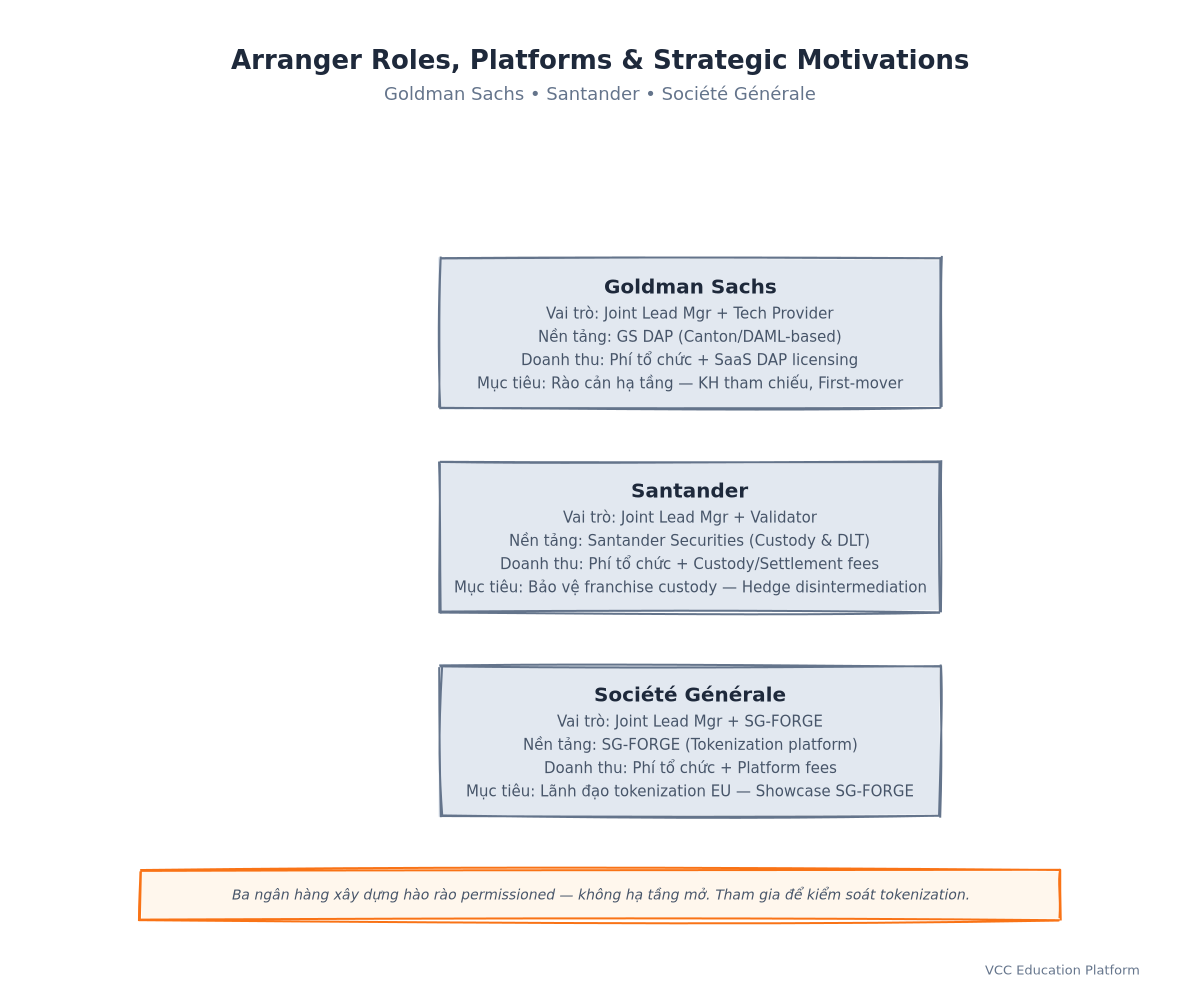
Goldman Sachs: Platform Over Product
Goldman's Digital Asset Platform (DAP) — built on Canton (formerly DAML) but interoperable with Ethereum — powered the issuance workflow. For Goldman, the €100M bond was a reference client for DAP. The revenue isn't the arrangement fee (basis points on €100M). It's the platform licensing fees from future issuers who want "the EIB infrastructure."
Santander: Custody and Settlement Franchise
Santander Securities Services operates a custody and settlement business across Europe. Running a validator node gives them operational fluency with DLT settlement — critical as Euroclear and Clearstream build their own DLT rails. Santander is hedging against disintermediation by becoming part of the new infrastructure.
Société Générale: SG-FORGE Showcase
SocGen's SG-FORGE platform tokenizes assets for clients (green bonds, funds, carbon credits). The EIB bond validated SG-FORGE's ability to handle supranational-grade issuance. Every subsequent SG-FORGE client gets "the same tech as EIB" in the pitch deck.
The Collective Incentive: Controlled Innovation
None of the three arrangers wants a permissionless, disintermediated capital market. They want permissioned tokenization — where they remain the gatekeepers, validators, and platform providers. The EIB bond is a consortium project disguised as an issuance.
Investor Reality: Oversubscribed But Illiquid
Who Bought In?
- Central banks: Reserve managers testing DLT operations
- Soverealth wealth funds: Long-term holders, no trading intent
- Insurers: Matching long-duration liabilities, regulatory capital benefits
- Notable absence: Hedge funds, high-frequency traders, retail platforms
The Liquidity Mirage
Three issuances. Zero secondary market trades reported publicly.
Why? Three barriers:
- Custody fragmentation: Only Euroclear (and recently Clearstream) support DLT securities. Most custodians cannot hold them.
- Whitelisting friction: Every transfer requires KYC re-verification. No standardised investor passport.
- No venue: No multilateral trading facility (MTF) for DLT bonds. Trades are bilateral, OTC, wide spreads.
Investors buy to hold. The "T+0 settlement" benefit is theoretical for buy-and-hold portfolios — it matters for trading, not investing.
Investor Feedback Themes (From Industry Surveys)
| Pain Point | Frequency |
|---|---|
| Custody limitations | 85% |
| Tax/accounting uncertainty | 72% |
| Secondary market access | 68% |
| Per-network onboarding | 61% |
| Regulatory horizon (2028 cliff) | 54% |
Positive notes: Settlement certainty, operational transparency, straight-through processing. But these are operational improvements, not portfolio improvements.
The Permissioned Paradox
EIB proved you can issue a bond on blockchain. It also proved that doing so requires removing everything that makes blockchain distinctive.
| Blockchain Promise | EIB Implementation |
|---|---|
| Permissionless access | Whitelisted investors only |
| Public verifiability | Private validator set, encrypted payloads |
| Censorship resistance | Freeze/recovery at validator discretion |
| Composability | Closed network, no external contracts |
| Trust minimization | Trust in known validators (EIB + banks) |
The result is a distributed database with legal finality — valuable, but not transformative. It reduces settlement risk and operational cost. It does not create new asset classes, new investor bases, or new financial primitives.
The Interoperability Trap
Each permissioned network (EIB, SG-FORGE, DAP, Canton, Polygon permissioned) is an island. Moving assets between them requires bridging — reintroducing the counterparty risk and operational friction the networks were built to eliminate. The industry is building "walled gardens with drawbridges."
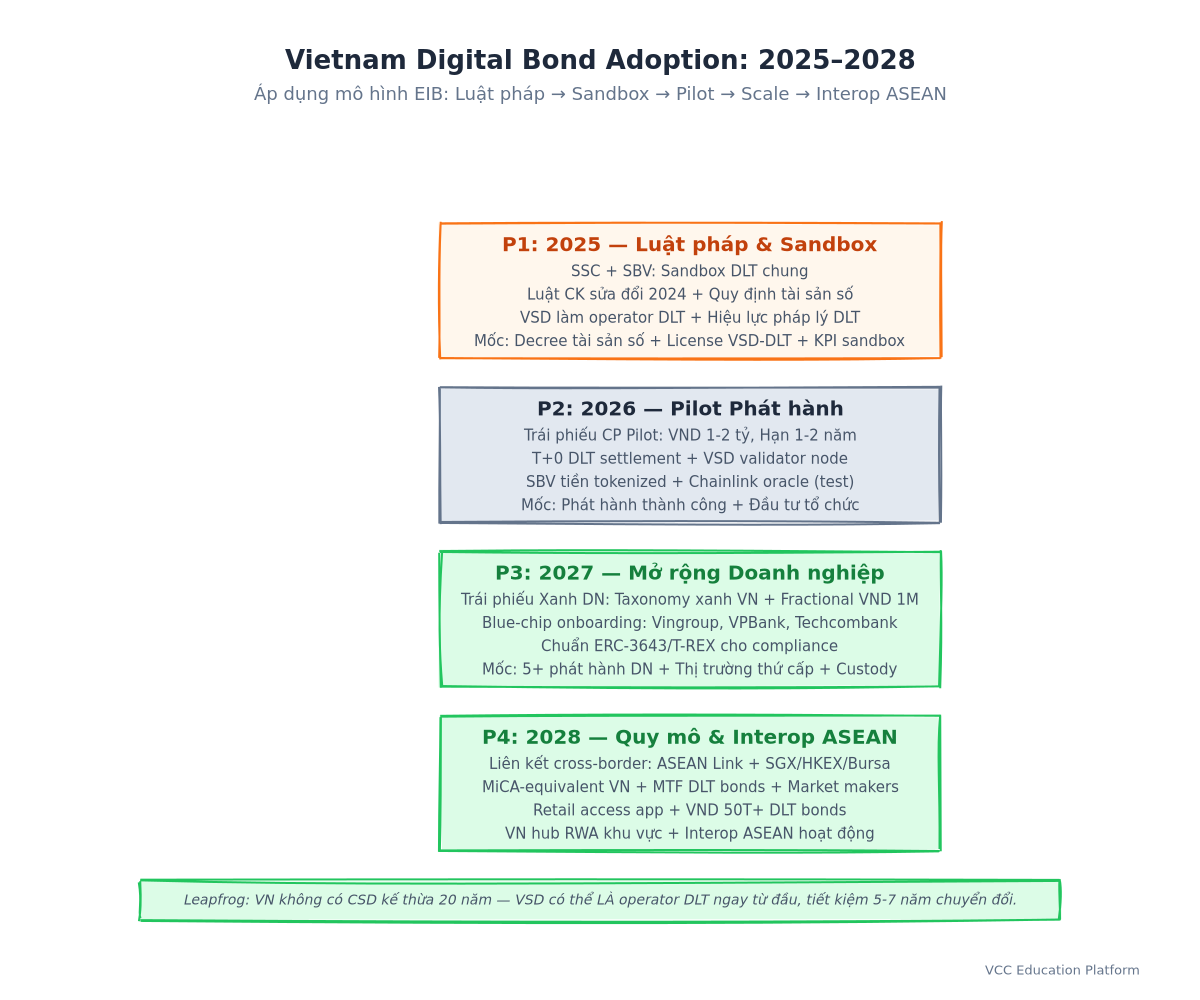
Vietnam Context: Leapfrog or Lag?
Vietnam's Bond Market Today
- Government bonds: ~$80B outstanding, primary dealer system, VSD (Vietnam Securities Depository) as sole CSD
- Corporate bonds: ~$40B, retail-dominated, limited secondary liquidity
- New Securities Law (2019, amended 2024): Provisions for digital securities, electronic registration
- State Securities Commission (SSC): Actively consulting on digital asset framework
Could Vietnam Adopt the EIB Model?
Yes — with adaptations:
- Government pilot: Ministry of Finance could issue digital T-bills on a permissioned chain with VSD as validator, SBV (State Bank) as cash settlement agent. Legal basis: amended Securities Law + Decree on digital assets.
- Corporate green bonds: VN green taxonomy + tokenization = fractional green bonds for retail. EIB's sustainability awareness bond framework translates directly.
- Regulatory sandbox: SSC + SBV joint sandbox for DLT securities (mirroring EU DLT Pilot). This avoids the "wait for perfect regulation" trap.
Advantages over EIB:
- No legacy CSD to disintermediate — VSD can be the DLT operator
- Retail inclusion: Fractional tokens (VNĐ 1M face value) could democratize bond access
- Leapfrog T+2 → T+0 without 20-year CSD migration baggage
Risks:
- Legal framework untested in Vietnamese courts
- Custody infrastructure: VSD is sole CSD; no Euroclear equivalent
- Investor education: Retail investors need protection frameworks
What Comes Next: The 2028 Cliff and Beyond
The DLT Pilot Expiration
March 2028: The EU regime sunsets unless extended or made permanent. Three scenarios:
- Extension: Status quo continues, more pilots, slow standardization
- Permanent regime: MiCA-style regulation for tokenized securities, cross-border passporting
- Lapse: Legal uncertainty, issuance moves back to traditional rails or offshore
EIB's third issuance (ERC-3643, multi-CSD) is a bet on Scenario 2.
The Real Catalyst: Tokenized Cash
T+0 settlement for securities requires T+0 settlement for cash. Wholesale CBDC (ECB digital euro for institutions) or tokenized commercial bank deposits (JPM Coin, Fnality, Partior) are the enablers. When cash moves at block speed, DvP becomes atomic — the true promise of DLT settlement.
Standardization War: ERC-3643 vs Canton vs Proprietary
- ERC-3643 (T-REX): Ethereum-native, open standard, growing ecosystem (Tokeny, Archax, etc.)
- Canton (DAML): Multi-ledger, privacy-first, backed by Goldman, Deutsche Börse, SIX
- Proprietary: SG-FORGE, DAP, others — vendor lock-in by design
The market will fragment until regulators mandate interoperability (as they did for SEPA in payments).
Key Takeaways for Capital Markets Professionals
- Tokenization works technically — EIB proved T+0 DLT settlement at supranational scale
- Legal finality is solvable — French law + DLT Pilot = dual anchor; other jurisdictions can replicate
- Banks are building moats, not bridges — Permissioned networks entrench incumbents
- Liquidity requires infrastructure — Custody, venues, tax harmonization matter more than smart contracts
- The 2028 deadline is the forcing function — EU regulators must decide: extend, codify, or abandon
For Vietnam: The window is open. The EIB model — supranational issuer, permissioned Ethereum, French law anchor, DLT Pilot regime — is a template. Adapt the law, empower VSD as DLT operator, pilot with government paper. Don't wait for the EU to finish.
FAQ
Q: Is the EIB digital bond a "crypto" asset? A: No. It's a regulated security (French law, EU Prospectus Regulation) that happens to use DLT for registration and settlement. No public blockchain, no anonymous holders, no DeFi composability.
Q: Can I buy EIB digital bonds as a retail investor? A: No. Minimum denominations are €100,000+ (wholesale only). Investors must pass KYC/whitelisting per network.
Q: What happens if the DLT Pilot Regime expires in 2028? A: Bonds issued under the regime retain their legal finality (grandfathering). New issuances would need alternative legal basis — likely national law (French, German) or a permanent EU regime.
Q: How does this differ from Project Canton or Fnality? A: Canton/Fnality focus on interbank settlement (cash + securities between institutions). EIB focuses on issuance-to-investor lifecycle. They're complementary — Canton could settle the cash leg of an EIB-style bond.
Q: What is ERC-3643 and why does it matter? A: ERC-3643 (T-REX) is an Ethereum standard for permissioned security tokens with on-chain identity, compliance modules, and jurisdiction partitions. It's becoming the de facto standard for regulated tokenization in Europe.
Q: Could this work for Vietnamese corporate bonds? A: Yes. The legal template exists (VN Securities Law amendments). The technology is proven. The gap is custody infrastructure and investor onboarding standards. A pilot with a VN blue-chip issuer (Vingroup, Masan, VPBank) could demonstrate the model.
Word count: ~2,150
Primary keyword: EIB digital bonds (H1, first 100 words, meta title) Secondary keywords: Goldman Sachs, Santander, Societe Generale, CSDR, private permissioned chain (woven into H2s, body, FAQ)