
When you send a message on Zalo, the app delivers it instantly. You trust Zalo's servers to handle it. But what if you could send value — ADA, a token, a digital asset — directly to someone without a company in the middle? That is the question blockchain answers. In this guide we explain what is blockchain in plain language, walk through how blockchain works, and show why it matters for everyday users in Việt Nam.
The Core Idea: A Shared Notebook
Imagine a notebook that thousands of people hold identical copies of. Every time someone writes a transaction — "Lan sends 10 ADA to Minh" — it appears in every copy at the same time. No single person controls the notebook; the group agrees on each new entry using a set of rules. Once written, an entry cannot be erased. That shared, tamper-resistant notebook is a blockchain.
This is not abstract theory. When you stake ADA, the blockchain records your delegation. When you mint an NFT, the blockchain records its creation. When you send a stablecoin on Cardano, the blockchain records the transfer. Every action leaves a permanent line in that shared notebook.
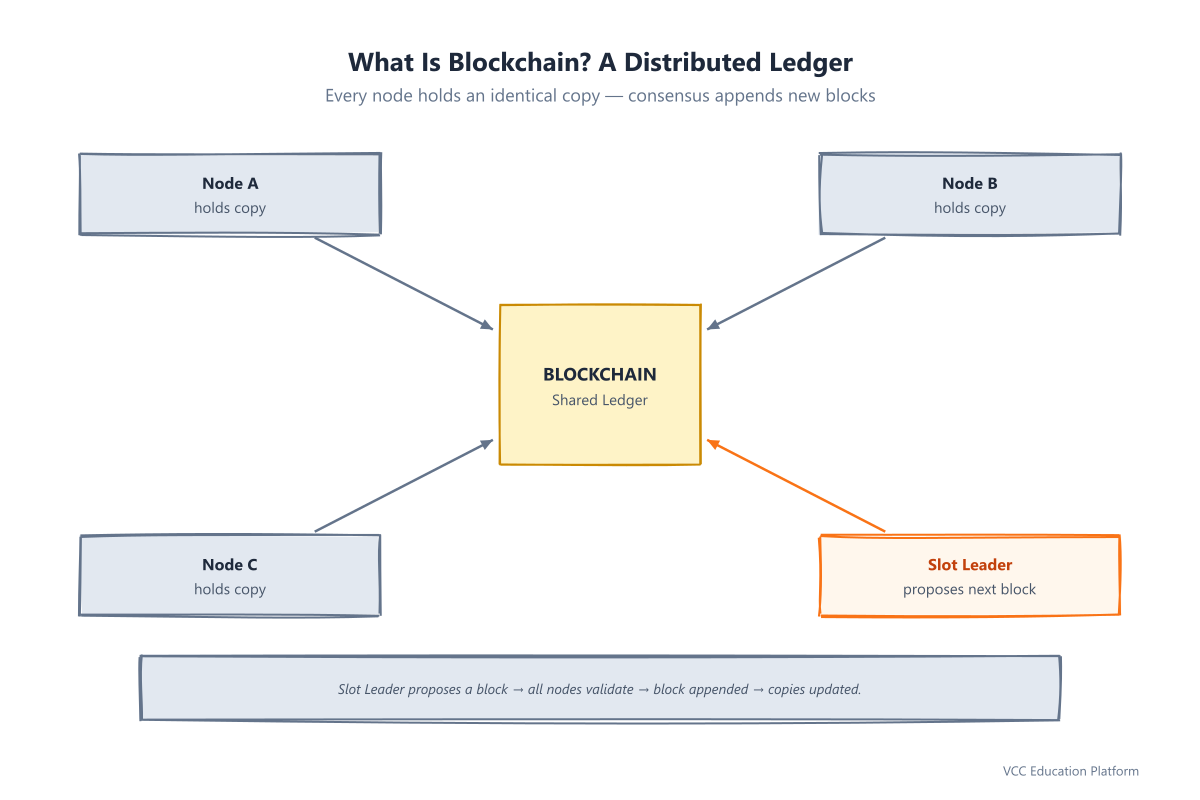
Figure 1: Blockchain as a distributed ledger — every node holds an identical copy, consensus appends new blocks
How Blockchain Works — Step by Step
1. A Transaction Is Created
You open your wallet (Eternl, Lace, or Daedalus) and enter the recipient's address and the amount. Your wallet builds a transaction: it selects your unspent outputs (UTXOs), adds the recipient's output, calculates the fee, and creates a change output back to you.2. You Sign With Your Private Key
The transaction is only a proposal until you sign it. Your private key — which never leaves your device — creates a digital signature proving you own the funds. This is like signing a cheque, but the signature is mathematically unforgeable.3. The Transaction Enters the Mempool
The signed transaction is broadcast to the network. It lands in the mempool — a waiting area held by every node. Think of it as a queue at a government office: your paperwork sits there until a clerk (a slot leader) calls your number.4. A Slot Leader Picks It Up
Cardano uses Ouroboros Proof of Stake. Every few seconds the protocol randomly selects a slot leader (weighted by staked ADA). That leader pulls transactions from the mempool, orders them, and bundles them into a new block.5. The Block Is Appended and Gossiped
The new block is cryptographically linked to the previous one — hence "block-chain." It is gossiped across the network in 1–2 seconds. Other nodes validate it, add it to their copy of the ledger, and the transaction is confirmed.6. Confirmations Stack Up
Each new block on top adds one confirmation. After a handful of confirmations the chance of a reversal becomes vanishingly small. For a coffee purchase, one confirmation (~9 seconds) is plenty. For a house deposit, you might wait 50 confirmations (~7.5 minutes at today's ~9-second block time).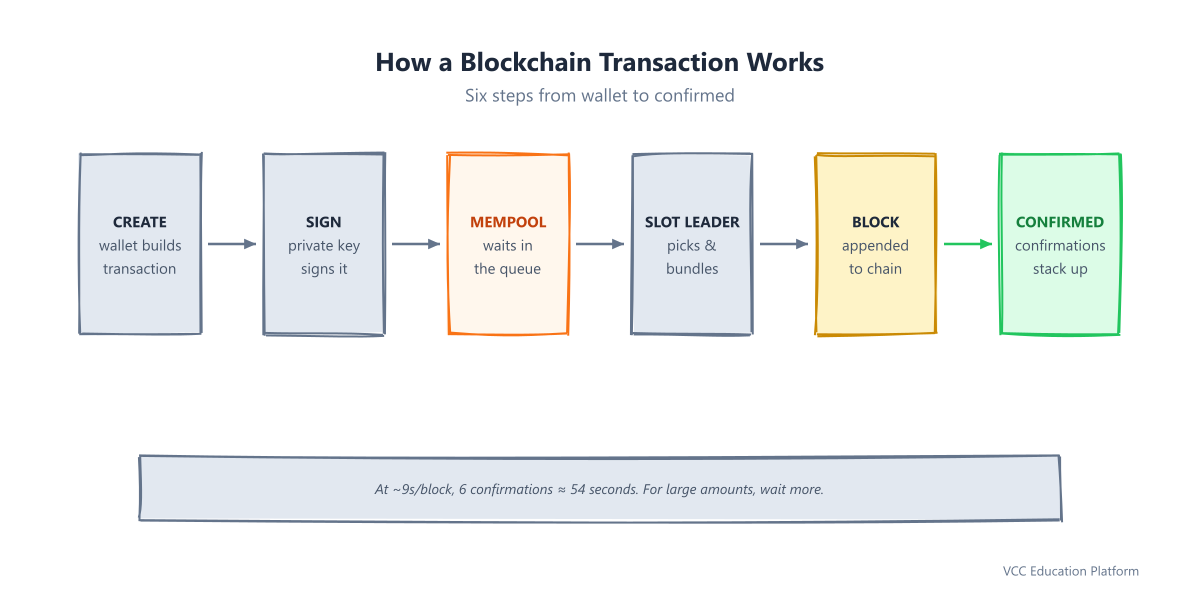
Figure 2: Six steps of a blockchain transaction — from wallet creation to confirmations stacking up
Why Blockchain Is Different From a Database
| Feature | Traditional Database | Blockchain |
|---|---|---|
| Control | Central admin (bank, company) | Distributed consensus |
| Tampering | Admin can edit/delete | Practically immutable |
| Trust | Trust the operator | Trust the math & protocol |
| Availability | Single point of failure | Runs 24/7/365 globally |
| Audit trail | Internal logs | Public, verifiable by anyone |
A bank database is a private notebook the bank owns. A blockchain is a public notebook anyone can read and no one can unilaterally rewrite.
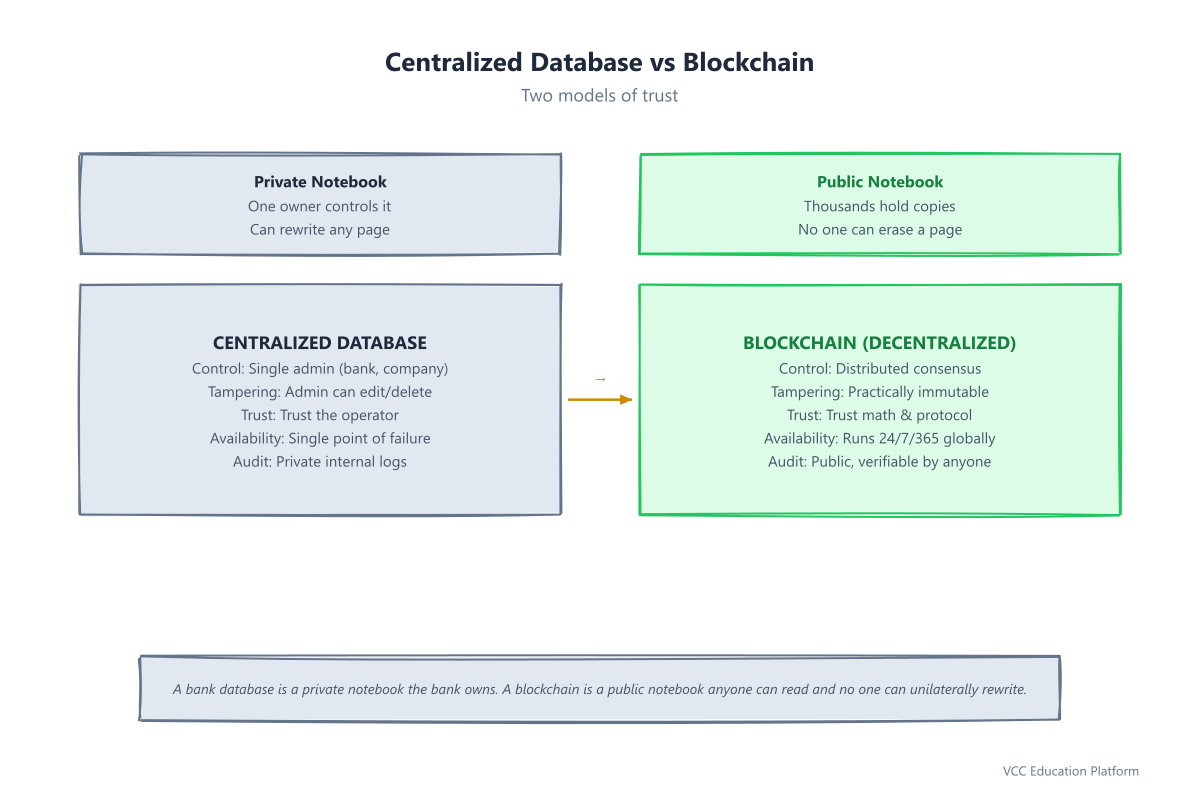
Figure 3: Centralized database vs blockchain — control, tampering, trust, availability, and audit trail compared
Key Concepts You Will Hear
- Block — a batch of transactions with a timestamp and a link to the previous block.
- Chain — the sequence of blocks, each pointing to its parent.
- Node — a computer running the protocol, storing the ledger, and gossiping blocks.
- Consensus — the rules (Ouroboros on Cardano) that decide which block comes next.
- Finality — the point where a transaction is economically irreversible.
- UTXO — Unspent Transaction Output, the "coins" you actually hold and spend.
Blockchain in Việt Nam: Why It Matters Here
Việt Nam has one of the world's highest crypto adoption rates. Millions use Momo, ZaloPay, and bank apps daily — they already trust digital value. Blockchain extends that trust without requiring a central company. A freelancer in Đà Nẵng can receive ADA from a client in Singapore in seconds, no SWIFT code, no intermediary fees, no weekend closure. A farmer in the Mekong Delta could one day prove land ownership on-chain, reducing disputes. The technology is infrastructure; the applications are limited only by imagination.
Frequently Asked Questions
Is blockchain just for cryptocurrency?
No. Cryptocurrency is the first and most famous application. Blockchain also powers supply-chain tracking, digital identity, voting systems, and tokenized real-world assets.Can a blockchain be hacked?
The protocol itself (consensus, cryptography) has not been broken on major chains. Losses usually come from smart-contract bugs, phishing, or exchange hacks — not the blockchain layer.Does blockchain use a lot of energy?
Proof of Work (Bitcoin) does. Proof of Stake (Cardano, Ethereum post-Merge) uses ~99% less energy — comparable to a few hundred laptops.What happens if I lose my private key?
You lose access to your funds. There is no "forgot password" button. This is why seed-phrase backup is critical (see our Seed Phrase Backup Guide).How many blockchains exist?
Hundreds of live networks, thousands of testnets. They differ in consensus, speed, fees, and use cases. Cardano focuses on security, formal methods, and sustainable governance.The Takeaway
Blockchain is a shared, append-only ledger secured by cryptography and consensus. It lets strangers coordinate value without a central referee. For users in Việt Nam and everywhere, it means sending ADA, stablecoins, or NFTs directly — fast, cheap, and verifiable by anyone. The next time you hear "on-chain," you will know exactly which notebook they are talking about.