
On April 17, 2022, the beanstalk farms hack rewrote the playbook for DeFi exploits. An attacker did not break cryptography, did not find a reentrancy bug, and did not exploit a price oracle. Instead, they used a flash loan to buy governance power, proposed a malicious upgrade, and executed it instantly via an emergencyCommit function that bypassed the standard 24-hour timelock. The result: $182 million drained from Beanstalk Farms in minutes — the first major flash loan governance attack in DeFi history.
TL;DR
- What happened: Attacker used $1B flash loan to acquire Stalk (governance tokens), proposed malicious BIP-18, executed via
emergencyCommit(bypassing 24h timelock), drained $182M - When: April 17, 2022 (exploit executed in ~20 minutes)
- Root cause: BIP-18
emergencyCommitallowed instant execution with 2/3 Stalk majority; no timelock, no flash loan resistance on Stalk - Attribution: Unknown attacker (sophisticated, deep Ethereum/Beanstalk knowledge); no nation-state link
- Impact: ~$182M drained across Bean, Uniswap v2 pools; protocol paused; Halborn audit commissioned
- Fix: Governance redesign — timelocks on upgrades, Stalk vesting, flash loan resistance, multi-sig on upgrades
The Protocol: Beanstalk — Credit-Based Stablecoin
Before the exploit, Beanstalk was a credit-based stablecoin protocol on Ethereum. Unlike overcollateralized stablecoins (DAI, USDC), Beanstalk maintained its $1 peg through credit dynamics — users lent BEAN to the protocol (Silo), earning Stalk (governance tokens) and Seeds (yield).
Key components:
- Bean: Stablecoin targeting $1 peg
- Silo: Staking module — deposit BEAN/LP tokens, earn Stalk (governance) + Seeds (yield)
- Field: Lending module — lend BEAN to protocol, earn Pods (future BEAN claim)
- Barn: Fundraising module — raise capital during peg deviations
- Diamond (Proxy): Upgradeable contract — facets for Silo, Field, Barn, Governance
- Governance (BIPs): Bean Improvement Proposals — Stalk holders vote on upgrades
Stalk (governance token): Earned by depositing BEAN/LP in Silo. 1 Stalk = 1 vote. No lockup, no vesting, instant liquidity — this was the critical flaw.
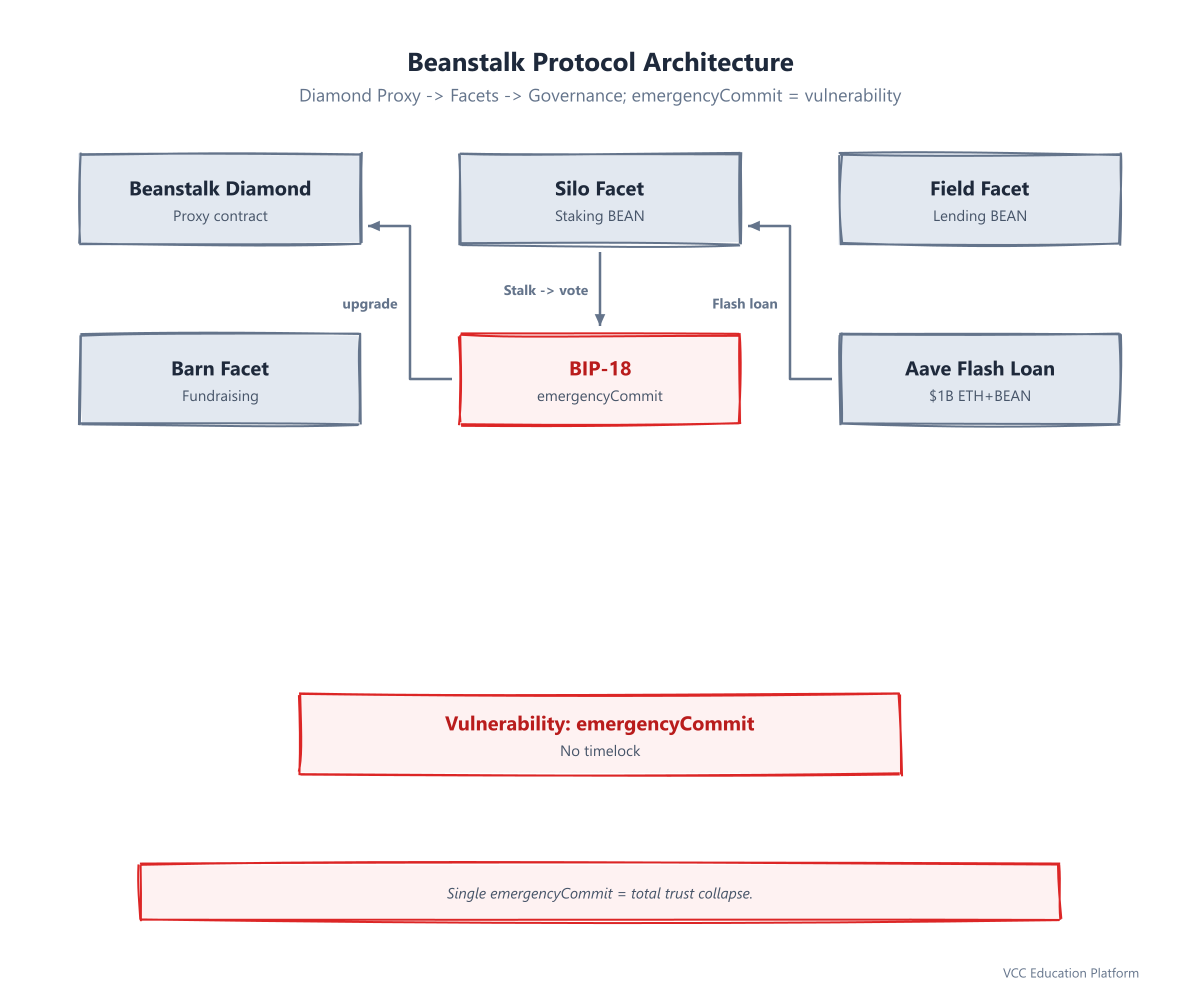
The Vulnerability: emergencyCommit in BIP-18
Beanstalk governance used Bean Improvement Proposals (BIPs). Standard BIPs had a 24-hour timelock after reaching quorum. But BIP-18 introduced emergencyCommit:
`solidity // Simplified BIP-18 emergencyCommit (conceptual) function emergencyCommit(uint256 bipId) external { require(stalkBalance[msg.sender] >= totalStalk * 2 / 3, "Need 2/3 Stalk"); // NO TIMELOCK! _executeBip(bipId); // IMMEDIATE EXECUTION } `
The bug: emergencyCommit allowed instant execution with 2/3 Stalk majority — no 24-hour timelock. The assumption: "no one can get 2/3 Stalk." Flash loans broke this assumption.
The Attack: Flash Loan Governance Takeover
April 17, 2022, ~18:00 UTC — Attacker borrows ~$1B flash loan from Aave v2: 24,830 ETH + 35M BEAN.
18:05 UTC — Attacker swaps ETH for BEAN on Uniswap, deposits BEAN into Silo → receives massive Stalk (governance power).
18:10 UTC — Attacker proposes BIP-18 with malicious upgrade contract (drains all protocol funds).
18:15 UTC — Attacker calls emergencyCommit on BIP-18. 2/3 Stalk threshold met instantly (attacker controls majority via flash loan). No timelock — immediate execution.
18:20 UTC — BIP-18 executes: upgrades Diamond facet to malicious contract → drains ~$182M from Bean, Uniswap v2 BEAN/ETH, BEAN/3CRV pools.
18:25 UTC — Attacker repays Aave flash loan (+ fees), keeps ~$80M profit.
The Numbers: $182M Drained in Minutes
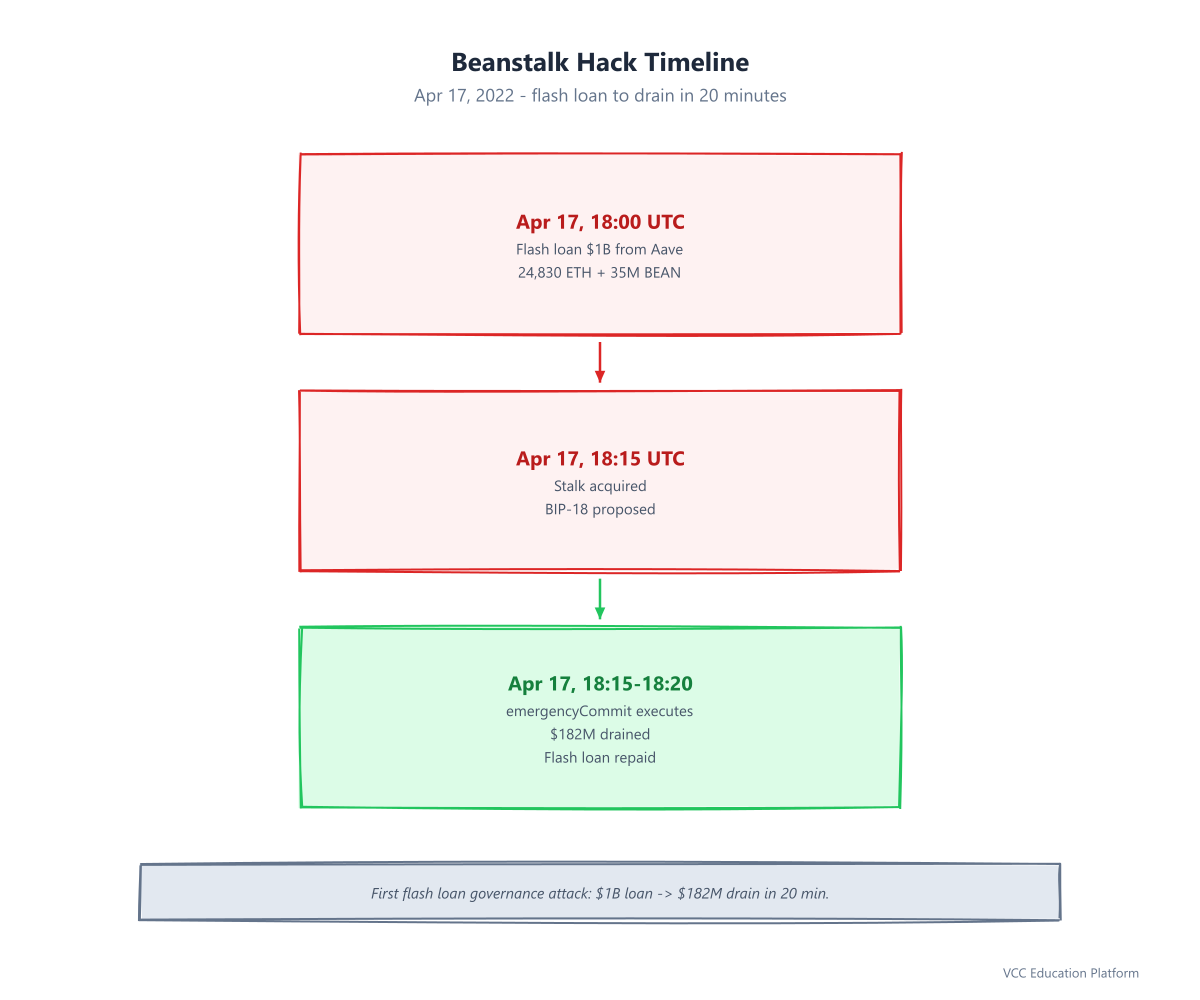
| Metric | Value |
|---|---|
| Total Drained | ~$182 million |
| Attacker Profit | ~$80 million |
| Protocol Loss | ~$102 million |
| Chains Affected | Ethereum Mainnet |
| Time Window | ~20 minutes |
| Flash Loan Size | ~$1B (24,830 ETH + 35M BEAN) |
| Stalk Acquired | >2/3 total supply (via flash loan) |
| Attackers | 1 (single actor) |
This was a "governance takeover" — not a bug in math or cryptography, but a flaw in governance design. The attacker used the protocol's own governance mechanism against it.
Root Cause Deep Dive: The emergencyCommit Flaw
The Governance Design
Beanstalk used Stalk (earned by staking BEAN) as governance power. 1 Stalk = 1 vote. BIPs required:
- Proposal submitted
- 24-hour voting period
- Quorum + majority → queued for 24h timelock
- Execution after timelock
BIP-18 added emergencyCommit for "urgent" fixes. It allowed instant execution with 2/3 Stalk majority — no timelock.
The Missing Checks
`solidity // Missing in emergencyCommit: require(block.timestamp >= proposal.timestamp + 24 hours, "Timelock required"); require(stalkNotFromFlashLoan(msg.sender), "Flash loan Stalk not allowed"); `
Neither check existed. The protocol assumed 2/3 Stalk was impossible to acquire — flash loans proved this wrong.
Exploit Construction
- Borrow $1B from Aave (24,830 ETH + 35M BEAN)
- Swap ETH → BEAN on Uniswap (slippage managed)
- Deposit 35M BEAN into Silo → receive massive Stalk (governance tokens)
- Propose BIP-18 with malicious Diamond facet upgrade
- Call
emergencyCommit— 2/3 Stalk threshold met → instant execution - Malicious facet drains all protocol funds
- Repay Aave flash loan, keep ~$80M profit
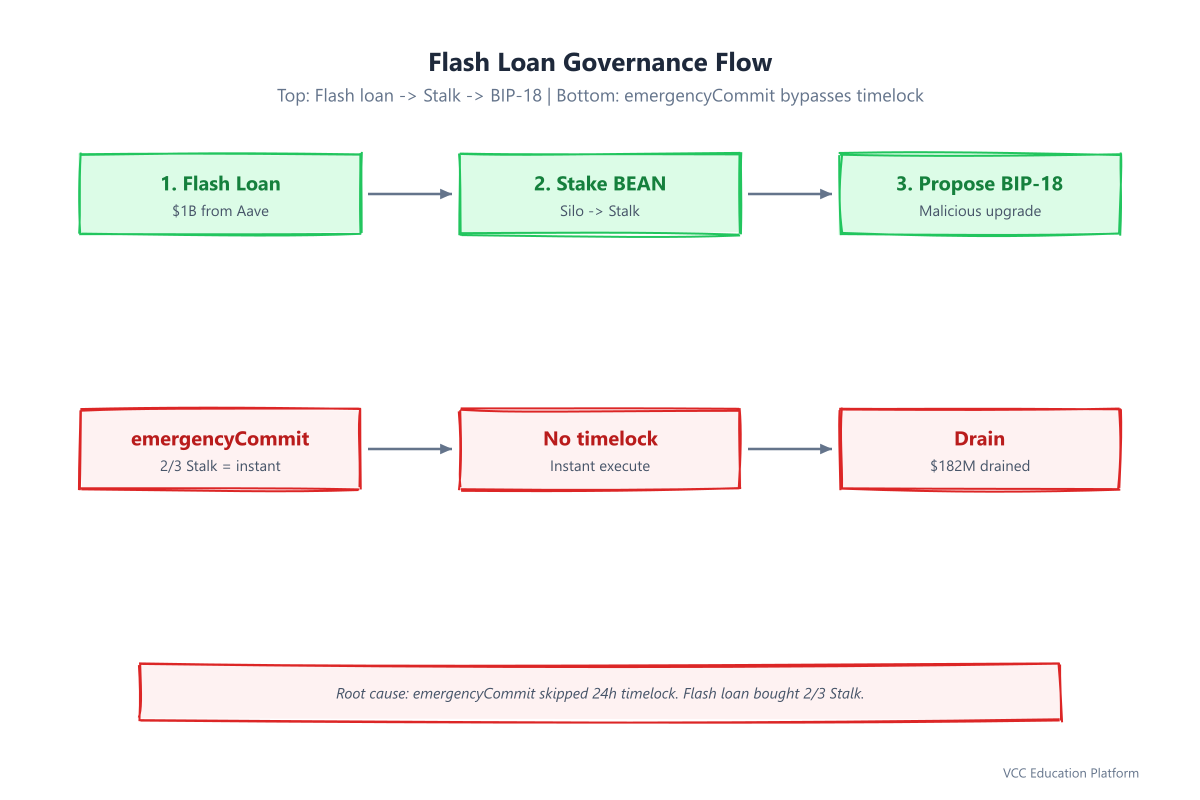
The Flash Loan Governance Playbook
This was the first major flash loan governance attack. The playbook:
- Identify governance token with no lockup (Stalk from Silo)
- Flash loan to acquire governance power (borrow assets → deposit → mint governance tokens)
- Propose malicious upgrade (drain funds, change parameters)
- Use emergency/shortcut path (bypass timelock)
- Execute, drain, repay flash loan, profit
Why it worked on Beanstalk:
- Stalk had no lockup, no vesting, instant minting from Silo deposits
emergencyCommithad no timelock — instant execution- No flash loan resistance on Stalk minting
- No anomaly detection on governance power accumulation
The Aftermath: Protocol Paused, Audit Commissioned
April 17, 2022, ~18:25 UTC — Attack complete. Beanstalk team pauses protocol (emergency pause).
April 18 — Community calls for recovery. Halborn engaged for full audit.
April 2022 - Present — Beanstalk v2 development: redesigned governance with timelocks, Stalk vesting, flash loan resistance, multi-sig on upgrades.
Losses: ~$182M total drained. No user funds recovered (protocol paused, no insurance). Attacker kept ~$80M profit.
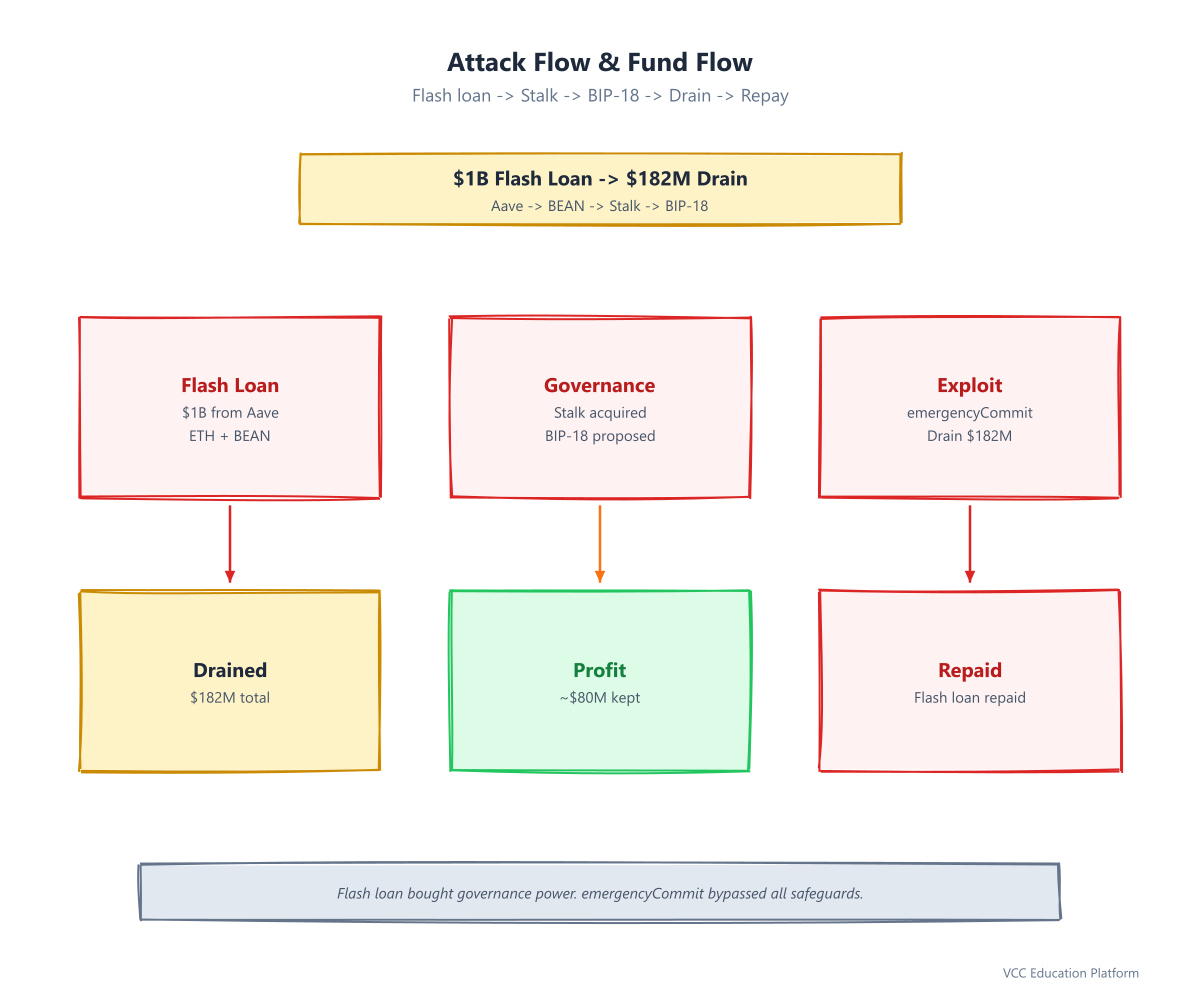
Lessons: What Would Have Prevented This
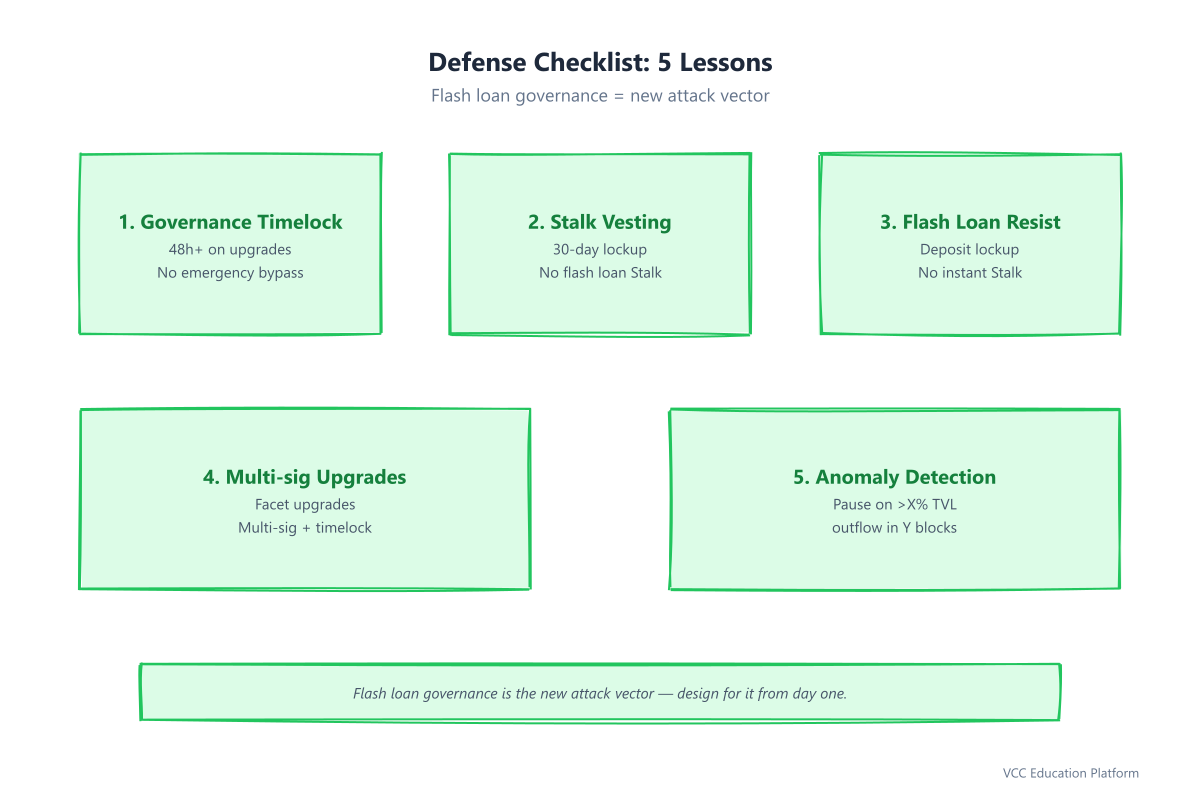
1. Governance timelocks are non-negotiable. No "emergency" path should bypass timelock. If emergency upgrades needed, use multi-sig + 48h delay minimum.
2. Governance tokens need lockup/vesting. Stalk should have had a vesting period (e.g., 30 days) or lockup before voting power activates. Flash loan Stalk = instant power = broken.
3. Flash loan resistance on governance tokens. Stalk should not be mintable from flash-loaned assets. Silo should check block.timestamp > depositTimestamp + lockupPeriod.
4. Diamond/proxy upgrades need multi-sig + timelock. Facet upgrades are the most powerful operation — they should require multi-sig + 48h timelock, not simple majority vote.
5. Anomaly detection on governance power. Circuit breaker that pauses governance when >X% of voting power acquired in Y blocks.
6. Formal verification of governance code. The emergencyCommit function was ~20 lines of critical code. It should have been formally verified (Certora, Coq).
Frequently Asked Questions
How much was stolen in the Beanstalk hack? ~$182 million drained from protocol (Bean, Uniswap v2 pools). Attacker profit ~$80M after flash loan repayment.
Was this a smart contract bug? Not a traditional bug (reentrancy, overflow). It was a governance design flaw: emergencyCommit allowed instant execution with flash-loaned governance power. The code worked as written — the design was flawed.
Who hacked Beanstalk? Unknown. The attacker demonstrated deep Ethereum/Beanstalk knowledge (flash loan mechanics, BIP-18, Diamond proxy). No public nation-state attribution.
Did users lose money? Yes — users with funds in Beanstalk (Bean holders, Silo depositors, Field lenders) lost ~$182M. Protocol paused; no recovery yet.
Why could the attacker get 2/3 Stalk so easily? Stalk was minted instantly by depositing BEAN into Silo. The attacker flash-loaned BEAN, deposited it, got instant Stalk majority. No lockup, no vesting, no delay.
What is emergencyCommit and why was it dangerous? emergencyCommit allowed instant BIP execution with 2/3 Stalk, bypassing the 24h timelock. It assumed 2/3 Stalk was unobtainable — flash loans broke this.
Has Beanstalk fixed the governance? Yes. Beanstalk v2 redesign includes: governance timelocks (48h+), Stalk vesting (30 days), flash loan resistance (deposit lockup), multi-sig on upgrades, anomaly detection.
What bridges/protocols are vulnerable to similar attacks? Any protocol where: governance token has no lockup, emergency upgrade path exists, flash loan can acquire governance power, upgrade power is not multi-sig protected.
Technical Appendix: Correct Governance Flow with Safeguards
For developers, here's the correct governance flow that Beanstalk missed:
`
- Propose BIP (upgrade, parameter change, etc.)
- Voting period (min 48h)
- CHECK: quorum reached + majority
- CHECK: proposer Stalk not from flash loan (lockup > 30 days)
- Queue for execution (timelock 48h+)
- TIMELOCK: wait 48h
- CHECK: no anomaly detected (TVL outflow, governance power spike)
- Execute (multi-sig required for facet upgrades)
- Post-execution: verify state, monitor TVL
`
The missing checks at steps 4, 6, 7, and 8 cost $182M.
This article is part of the DeFi Hacks series. For more deep-dives on governance exploits, see our analyses of the Compound Finance hack, Cream Finance flash loan, and Mango Markets oracle manipulation.