
When Ondo Finance launched OUSG in 2023, they didn't just hire one auditor—they engaged Trail of Bits for deep code review, OpenZeppelin for ongoing monitoring via Defender, and later Spearbit for economic design validation. Three firms. Three methodologies. One tokenized Treasury product.
This isn't overkill. It's the new standard for RWA audit security.
Real-world asset tokenization bridges two worlds: the immutable, transparent logic of blockchains and the messy, jurisdictional, off-chain reality of assets like US Treasuries, real estate, or carbon credits. A standard smart contract audit verifies on-chain logic. An RWA audit must verify the bridge between them.
The Trust Bridge: Why RWA Audits Are Fundamentally Different
Imagine you're building a tokenized Vietnamese government bond. The smart contract says: "1 token = 1 bond." The code is perfect—no reentrancy, no overflow, proper access control. Trail of Bits gives it a clean bill of health.
But the bond itself sits in a custodian's account at a securities depository. The oracle feeding the bond price runs on a server in Singapore. The legal opinion tying token ownership to bond title was written under Vietnamese law but the token trades globally.
The audit covered 25% of the risk.
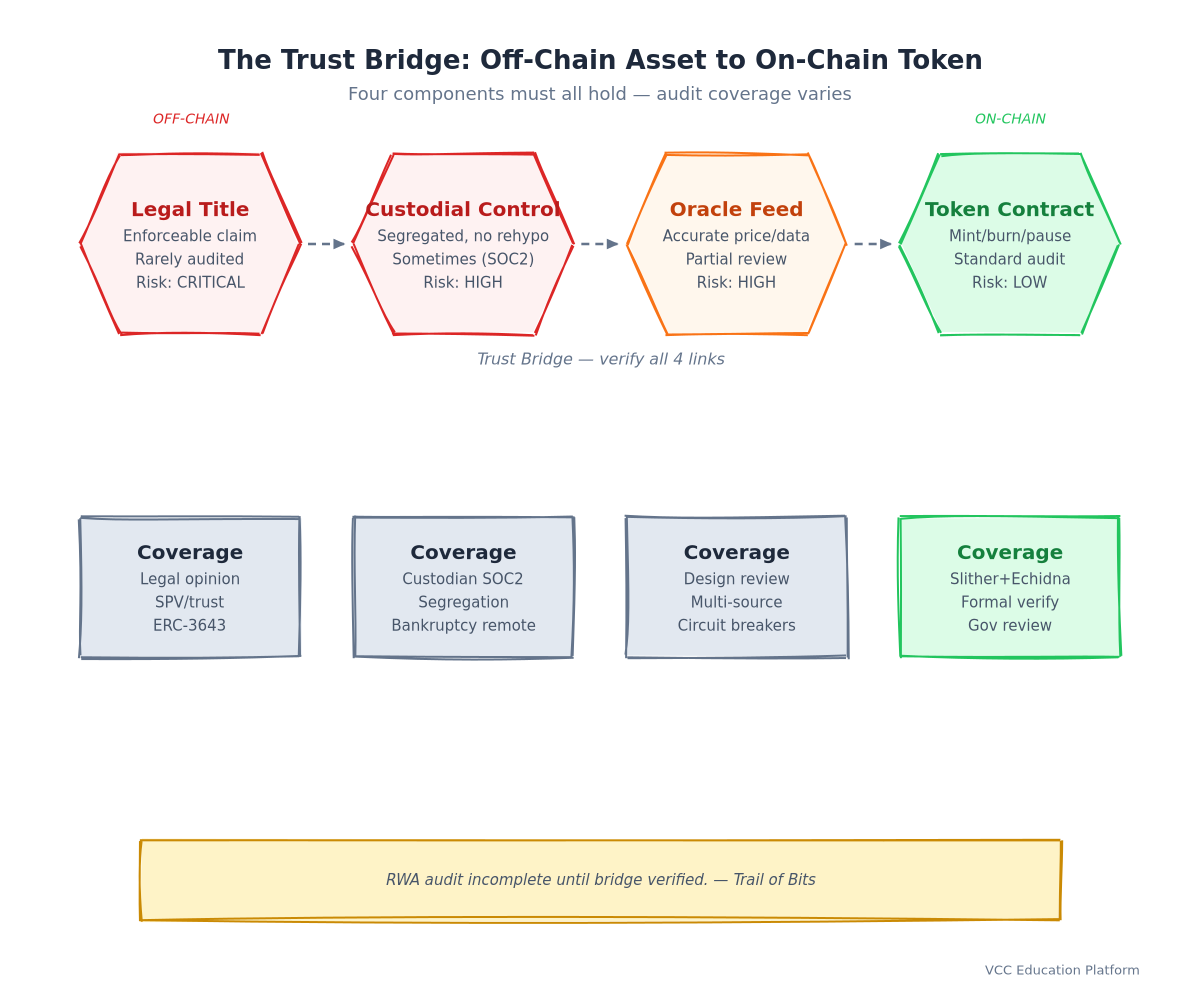
Every RWA protocol has a Trust Bridge with four components that must all hold:
| Component | What It Covers | Typical Audit Coverage |
|---|---|---|
| Legal Title | Token holder has enforceable claim on asset | Rarely covered |
| Custodial Control | Assets segregated, not rehypothecated, bankruptcy-remote | Sometimes (custodian SOC2) |
| Oracle Feed | Price/quantity data accurate, manipulation-resistant | Partial (oracle design review) |
| Token Contract | Mint/burn/pause/transfer logic correct | Standard audit covers this |
As Trail of Bits puts it: "An RWA audit is not complete until you've verified the bridge between on-chain token and off-chain asset." Their 2024 RWA methodology explicitly models this bridge as a state machine and verifies invariants across all four layers.
Vietnam context: Under the draft Decree 01/2025/ND-CP, tokenized assets require licensed custodians and quarterly independent verification. A standard smart contract audit satisfies none of these requirements. Local projects like VNDC or tokenized real estate pilots (DatXanh, Homedy) need the full Trust Bridge verified—not just the token contract.
Three Firms, Three Philosophies: Choosing Your Audit Partner
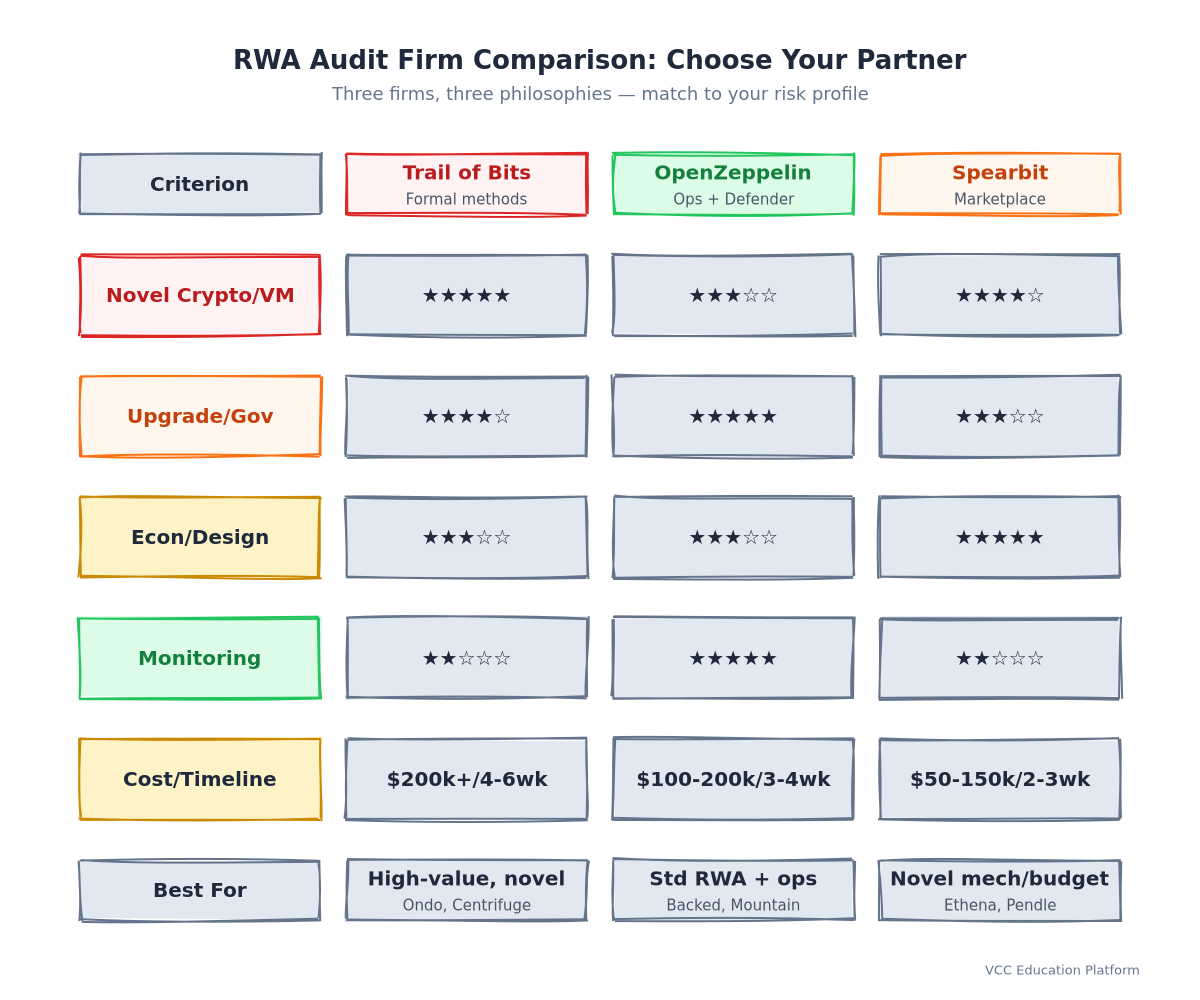
Not all audit firms are equal for RWA. Each brings a distinct methodology shaped by their tooling, talent, and business model.
Trail of Bits: The Formal Methods Powerhouse
Best for: Novel cryptography, VM-level bugs, high-value protocols where cost is secondary to depth.
Methodology: 4-6 week engagements combining:
- Threat modeling specific to RWA bridge components
- Property-based testing with Echidna (custom properties like "totalSupply <= verifiedReserves")
- Symbolic execution via Manticore for oracle manipulation bounds
- Formal verification of critical invariants using Certora or custom Coq proofs
RWA track record: Ondo Finance (OUSG), Centrifuge, Maple Finance, Goldfinch.
Dan Guido (CEO) on RWA: "We model the TradFi → DeFi bridge as a state machine. The invariant isn't 'code works'—it's 'every token minted has a corresponding reserve unit verified off-chain.'"
Trade-off: $150k-300k per audit, 4-6 week timelines. Smaller RWA projects often can't afford this depth.
OpenZeppelin: The Operational Security Partner
Best for: Standard RWA patterns (ERC-3643/T-REX, upgradeable proxies), teams needing ongoing monitoring, regulatory compliance integration.
Methodology: Audit + Defender deployment:
- Baseline audit (3-4 weeks): Slither + Foundry + manual review
- Defender onboarding: Autotasks for pause triggers, sentinel detectors for RWA patterns
- Ongoing ops: 24/7 monitoring, incident response playbooks, upgrade governance
RWA track record: Backed Finance, Mountain Protocol (USDM), Franklin Templeton BENJI.
Key differentiator: "Audit is day 0; Defender is day 1 to infinity." Their 3-layer defense model—contract security, operational security via Defender, incident response—treats audit as the starting line, not the finish line.
Trade-off: Checklist-based approach can miss novel attack vectors. Defender only detects known patterns.
Spearbit: The Competitive Marketplace
Best for: Novel economic mechanisms, budget-conscious teams, protocols wanting diverse researcher perspectives.
Methodology: Competitive audit sprint (2-3 weeks):
- 50+ independent researchers compete for bounty pool
- Multiple perspectives on same codebase
- Economic/design review + code review in one engagement
- Standardized severity taxonomy (but researcher quality varies)
RWA track record: Ethena (sUSDe), Pendle, Morpho, Euler v2.
Guy Young (Ethena founder): "We wanted diverse perspectives on a delta-neutral design nobody had audited before. The competitive format surfaced three critical issues a single firm missed."
Trade-off: Quality variance across researchers. No consistent methodology. Hard to compare reports across engagements.
Selection Framework for Your RWA Project
| If Your Priority Is... | Choose |
|---|---|
| Novel cryptography / VM safety | Trail of Bits |
| Upgradeable contracts + ongoing ops | OpenZeppelin |
| Novel tokenomics / economic design | Spearbit |
| Budget <$100k | Spearbit or regional firm + specialized review |
| Regulatory compliance (MiCA, VASP) | OpenZeppelin (Defender + audit trail) |
| Maximum depth, cost no object | Trail of Bits + OpenZeppelin Defender |
Vietnam recommendation: Local projects typically engage regional firms (Verichains, PeckShield APAC, VinCSS) for baseline audits at 30-50% cost. But these firms lack RWA-specific tooling. Hybrid approach: regional firm for baseline + specialized firm (ToB/OZ/Spearbit) for RWA-specific risks (oracle, custody, legal bridge).
Proof of Reserve: The Attestation Stack
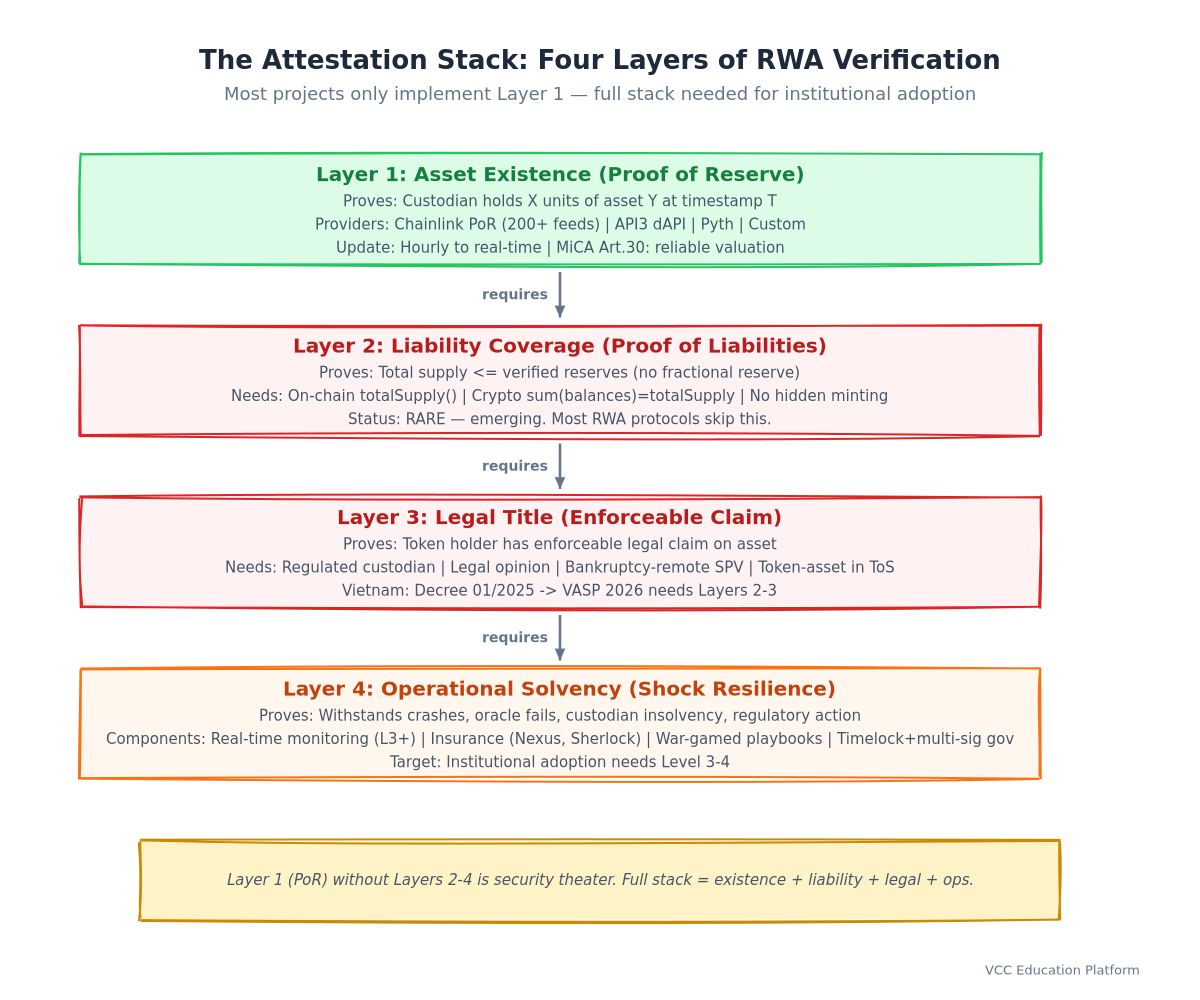
Proof of Reserve (PoR) became a buzzword after FTX. But for RWA, it's not optional—it's the minimum viable Layer 1 of a four-layer attestation stack.
Layer 1: Asset Existence (Proof of Reserve)
What it proves: The custodian holds X units of asset Y at timestamp T.
Major providers:
| Provider | Architecture | Update Frequency | Cost | Notable Users |
|---|---|---|---|---|
| Chainlink PoR | Decentralized node network → on-chain feed | Configurable (hourly to real-time streams) | High ($3k-10k/month) | 200+ feeds, $50B+ TVL |
| API3 dAPI | First-party oracles (data providers run Airnodes) | Real-time | Medium | Mountain Protocol, Ondo |
| Pyth Network | Publisher-signed prices, high-frequency | Sub-second | Free (publisher pays) | High-freq trading, some RWA |
| Custom | Custodian API → merkle tree → on-chain | Daily/weekly | Low (dev cost) | Tether-style attestations |
Chainlink PoR is the most mature: off-chain reserves → Chainlink nodes → on-chain feed → consumer contracts verify before mint/burn. Supports merkle tree proofs, API attestations, and TEE-based proofs.
API3's differentiation: First-party oracles eliminate middlemen. The data provider (e.g., a custodian) runs the Airnode directly. Used by Mountain Protocol for USDM reserves.
Layer 2: Liability Coverage (Proof of Liabilities)
What it proves: Total token supply ≤ verified reserves. Covers the "fractional reserve" risk.
Status: Rare. Emerging. Requires:
- On-chain totalSupply() readable by verifier
- Cryptographic proof that sum of user balances = totalSupply
- No hidden minting capabilities (verified via audit + monitoring)
Projects attempting this: Some stablecoins (USDC-style attestations), but most RWA protocols skip it.
Layer 3: Legal Title
What it proves: Token holder has enforceable legal claim on the underlying asset.
Requirements:
- Regulated custodian (QC, trust company, licensed VASP)
- Legal opinion in relevant jurisdictions
- Bankruptcy-remote structure (SPV, trust)
- Clear token-to-asset mapping in terms of service
Vietnam angle: Draft Decree 01/2025 requires "periodic independent verification of reserve assets" (Layer 1). But the coming VASP licensing framework (2026) will likely require Layers 2-3. Building the full stack now avoids costly retrofits.
Layer 4: Operational Solvency
What it proves: The protocol can withstand shocks—market crashes, oracle failures, custodian insolvency, regulatory action.
Components:
- Real-time monitoring (Level 3+ in maturity model)
- Insurance/cover (Nexus Mutual, Sherlock, custom)
- Incident response playbooks tested via war games
- Upgrade governance with timelocks and multi-sig
Real-Time Monitoring: From "Audit and Pray" to Continuous Security
Most RWA projects operate at Maturity Level 0-1: single audit, maybe daily PoR snapshots, manual review. Institutional adoption requires Level 3+.
The Maturity Model
| Level | PoR Frequency | Monitoring | Automation | Incident Response |
|---|---|---|---|---|
| 0 | None | None | None | None |
| 1 | Daily snapshots | Manual review | Alerts only | Ad-hoc |
| 2 | Hourly + alerts >1% deviation | Automated alerts | Autotasks for pause | Documented playbooks |
| 3 | Real-time streams | Autotask pause/execute | Custom sentinels | Tested war games |
| 4 | Real-time + continuous fuzzing | CI/CD formal verification | Property testing 24/7 | Insurance integration |
OpenZeppelin Defender: The Level 2-3 Enabler
Defender autotasks can:
- Monitor oracle deviations > threshold → pause minting
- Detect mint/burn without corresponding reserve change → alert + pause
- Track custodial balance changes → verify against on-chain supply
- Execute timelocked governance actions for emergency upgrades
Trail of Bits adds: Continuous fuzzing campaigns in CI/CD. Properties like "totalSupply <= verifiedReserves at all times" run 24/7 via Echidna. They caught 3 production bugs in Ondo/Centrifuge post-deployment this way.
The Contrarian Warning
samczun (Paradigm) warns: "Monitoring creates false confidence. Automated monitors only detect known failure modes. Novel attacks—like Euler's donate() manipulation—bypass all monitors. Human-in-the-loop is still essential."
Synthesis: Monitoring is necessary but not sufficient. It catches regressions and known patterns. Novel attacks require: (1) diverse audit perspectives (Spearbit model), (2) formal verification of core invariants (Trail of Bits model), (3) human incident response capability (OpenZeppelin model).
RWA-Specific Attack Vectors: What Standard Audits Miss
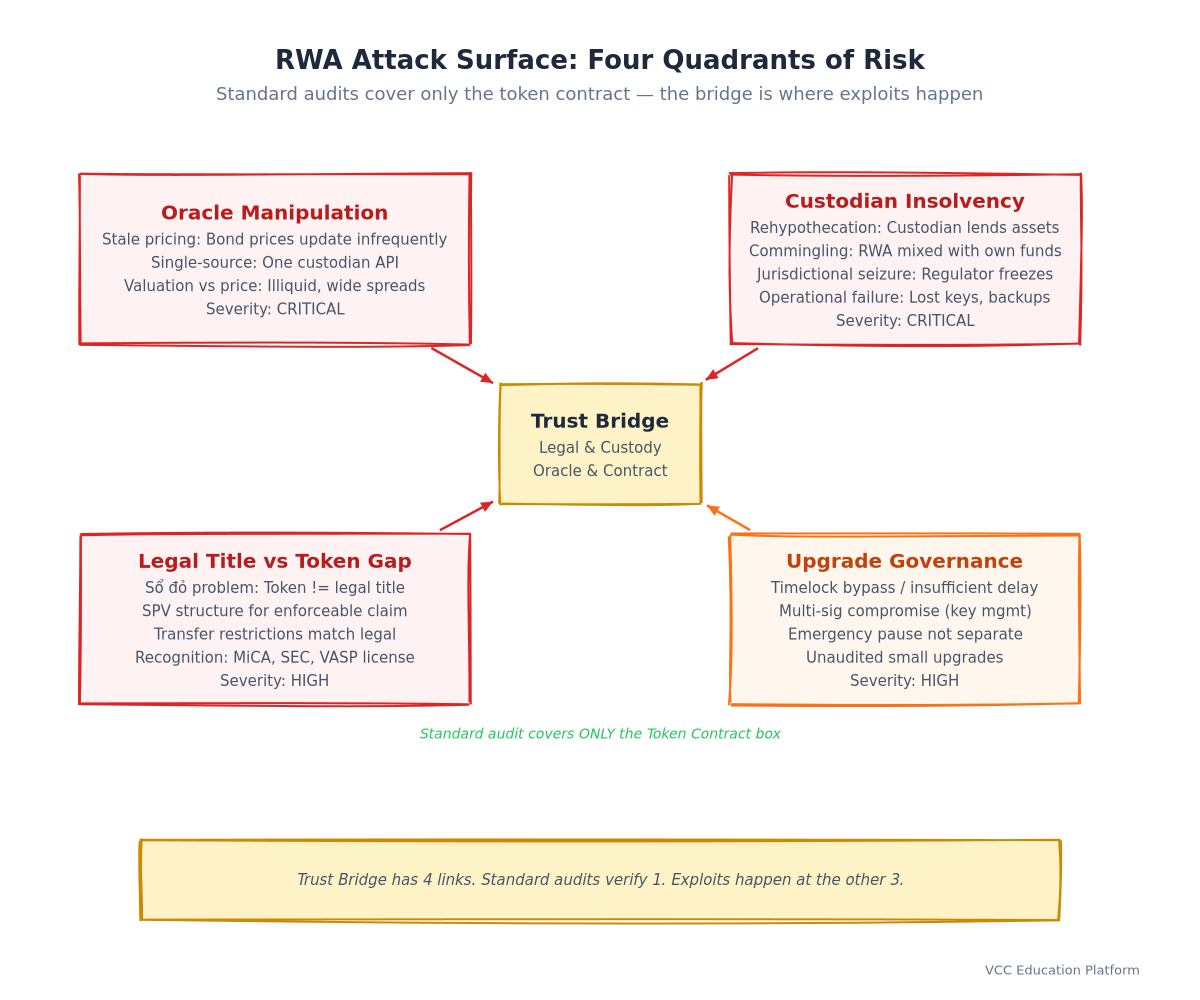
1. Oracle Manipulation on Off-Chain Assets
Standard DeFi oracle attacks (flash loan + DEX manipulation) are well-understood. RWA oracle attacks are different:
- Stale pricing: Bond prices update infrequently. A 4-hour TWAP on a Treasury bond is meaningless during rate volatility.
- Single-source dependence: Many RWA oracles rely on one custodian API. Compromise that API, compromise the protocol.
- Valuation vs. price: RWA needs valuation (fair value), not just price (last trade). Illiquid assets have wide bid-ask spreads.
Real incident: A tokenized real estate protocol used a quarterly appraisal oracle. Between appraisals, property value dropped 30%. Tokens traded at stale valuation. Redemptions drained reserves.
Mitigation: Multi-source oracles (Chainlink + API3 + Pyth), valuation models with confidence intervals, circuit breakers on deviation.
2. Custodian Insolvency / Fraud
The FTX lesson: Assets on a balance sheet ≠ assets in custody.
RWA-specific risks:
- Rehypothecation: Custodian lends your assets. You get IOU; they get yield.
- Commingling: RWA assets mixed with custodian's own funds.
- Jurisdictional seizure: Assets frozen by regulator in custodian's jurisdiction.
- Operational failure: Key person risk, lost keys, failed backups.
Verification needed: SOC2 Type II, proof of segregation, legal opinion on bankruptcy remoteness, insurance coverage.
3. Legal Title vs. Token Ownership Gap
The "Sổ đỏ" problem (Vietnam analogy): In Vietnam, land ownership is recorded in the "Sổ đỏ" (red book). A token saying "you own this land" is meaningless unless the Sổ đỏ reflects it.
Global equivalent: Token ≠ legal title unless:
- SPV structure with token holders as beneficiaries
- Recognized security token standard (ERC-3643, ERC-1400)
- Transfer restrictions enforced on-chain matching legal restrictions
- Regulatory recognition (MiCA, SEC no-action, VASP license)
4. Regulatory Seizure / Freeze Risks
Emerging threat: OFAC sanctions, SEC enforcement, SBV directives can freeze assets at custodian level. On-chain tokens become unbacked.
Mitigation: Multi-jurisdictional custody, legal wrapper entities, emergency redemption mechanisms, insurance for regulatory risk.
Building a Continuous Security Program: The RWA Security Lifecycle
Security doesn't end at audit. For RWA, it begins there.
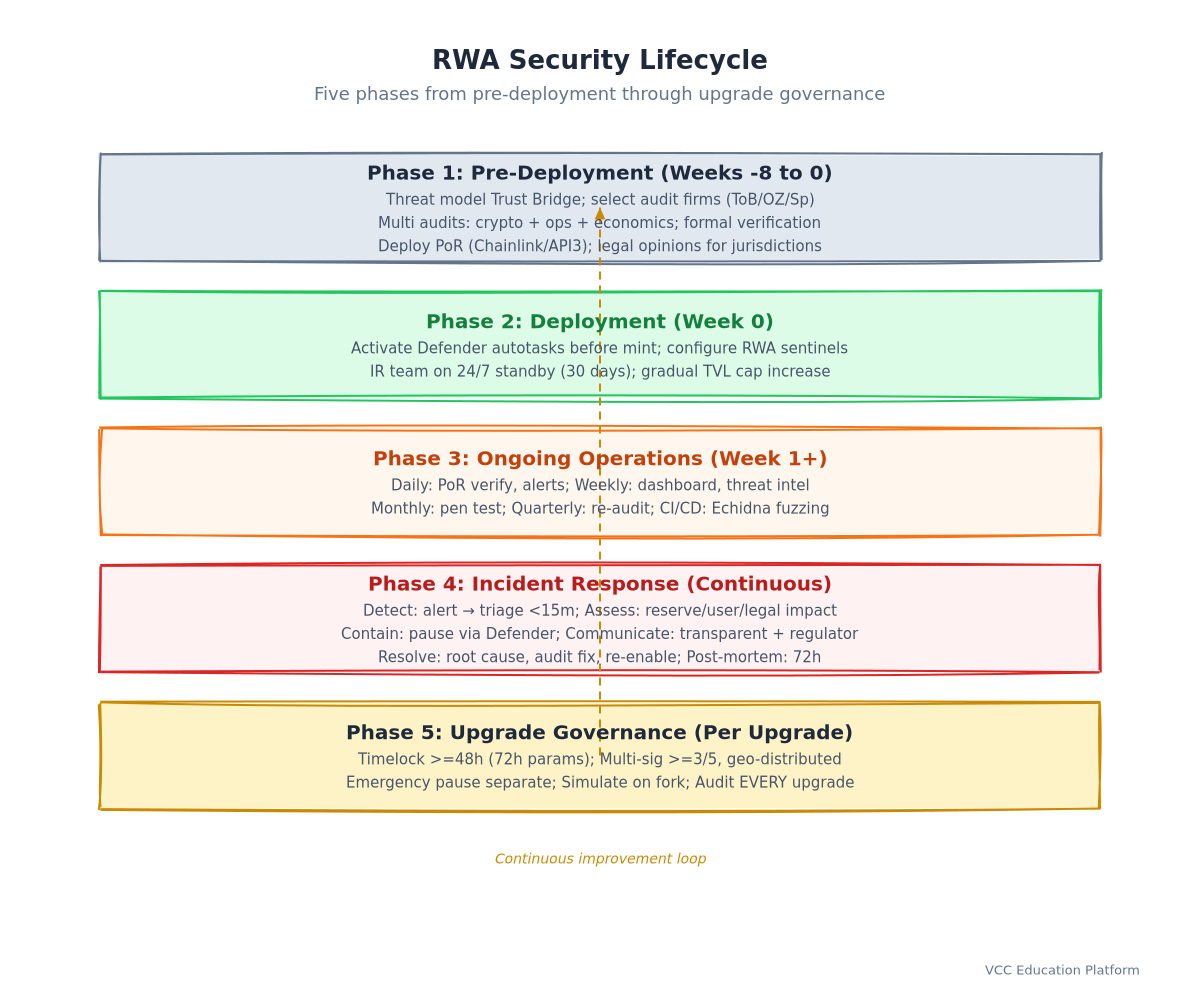
Phase 1: Pre-Deployment (Weeks -8 to 0)
- Threat modeling the Trust Bridge (all 4 components)
- Audit firm selection using framework above
- Multiple audits for high-value protocols:
- Formal verification of critical invariants (supply ≤ reserves, pause authority)
- PoR infrastructure deployed and tested (Chainlink/API3/Pyth)
- Legal opinions for all target jurisdictions
Phase 2: Deployment (Week 0)
- Defender autotasks activated before first mint
- Sentinel detectors configured for RWA patterns
- Incident response team on standby (24/7 for first 30 days)
- Gradual rollout: Cap TVL, increase weekly as monitoring validates
Phase 3: Ongoing Operations (Week 1+)
- Daily: PoR verification, alert review
- Weekly: Monitoring dashboard review, new threat intel
- Monthly: Penetration testing (external), dependency updates
- Quarterly: Full re-audit of changed components, legal opinion refresh
- Continuously: Echidna fuzzing in CI/CD on every PR
Phase 4: Incident Response
Playbook template:
- Detect: Automated alert → human triage (<15 min)
- Assess: Impact on reserves, users, legal obligations
- Contain: Pause minting/redeeming via Defender autotask or multi-sig
- Communicate: Transparent user notification, regulator notification if required
- Resolve: Root cause fix, audit of fix, gradual re-enable
- Post-mortem: Public report within 72 hours
Phase 5: Upgrade Governance
RWA protocols must be upgradeable (regulatory changes, oracle migrations, custodian changes). But upgrades are the #1 source of post-deployment hacks.
Required controls:
- Timelock ≥ 48 hours (72 for parameter changes)
- Multi-sig (≥ 3/5) with geographically distributed signers
- Emergency pause separate from upgrade path
- Upgrade simulation on fork before mainnet
- Audit of every upgrade (even "small" ones)
FAQ: RWA Audit & Security
Q: How much does a proper RWA audit cost?
A: $150k-500k+ for comprehensive coverage (multiple firms + ongoing monitoring). Budget-conscious projects: $50k-100k for baseline + specialized RWA review. Vietnam regional firms: $20k-50k baseline, but supplement with specialized review.Q: Is Proof of Reserve enough for compliance?
A: No. PoR = Layer 1 only. MiCA Article 30 and coming VASP regulations require liability coverage (Layer 2), legal title (Layer 3), and operational solvency (Layer 4).Q: Can we use one audit firm for everything?
A: Possible but not recommended. Trail of Bits excels at cryptography; OpenZeppelin at operations; Spearbit at economics. No single firm is best at all three. Hybrid approach reduces blind spots.Q: How often should we re-audit?
A: Quarterly for high-TVL (> $50M) or post-major-upgrade. Semi-annual for smaller. Continuous fuzzing (Level 4) reduces need for frequent full re-audits.Q: What's the Vietnam regulatory timeline?
A: Decree 01/2025/ND-CP (draft) → public consultation → final decree ~2025. VASP licensing framework ~2026. Build to final standards now.Q: Do we need insurance?
A: For institutional TVL (> $10M), yes. Nexus Mutual, Sherlock, or custom cover. Insurance also forces better security practices (underwriting requirements).Q: Can a regional audit firm handle RWA?
A: For baseline contract security: yes. For RWA-specific risks (oracle, custody, legal bridge, PoR): no. They lack tooling and experience. Use hybrid model.Conclusion: Security Is a Process, Not a Certificate
The audit report is a snapshot. The Trust Bridge is a living system.
Ondo Finance didn't stop at their Trail of Bits audit. They added OpenZeppelin Defender for monitoring, Chainlink PoR for reserve verification, and Spearbit for economic review. They run continuous fuzzing. They have incident response playbooks tested quarterly.
That's the standard for RWA audit excellence.
For Vietnamese projects entering this space: start with the Trust Bridge model. Map your four components. Identify which layers you've verified (probably just the token contract). Budget for the other three. Engage specialized firms for each gap. Build monitoring from day one.
The $200B+ RWA market will be built on trust. Trust requires verification—not just at launch, but every block thereafter.
This article provides a framework for evaluating RWA security. It does not constitute legal or financial advice. Consult qualified professionals for your specific jurisdiction and protocol design.