
The mirror protocol hack wasn't a hack in the traditional sense — no code vulnerability was exploited, no private key was stolen. Instead, $90 million vanished in May 2022 through a cascading failure that began with the terra ust depeg and ripped through Mirror Protocol's oracle-dependent architecture. This case study reveals how oracle deviation defi systems can amplify external shocks into catastrophic losses, and why cascading failure defi patterns remain the sector's greatest systemic risk.
The Anatomy of a Synthetic Asset Protocol
Mirror Protocol launched in December 2020 on Terra, offering mAssets — synthetic tokens tracking real-world assets like stocks (mAAPL, mTSLA) and crypto (mBTC, mETH). Users minted mAssets by locking collateral (UST, LUNA, mAssets themselves) at a minimum 150% collateral ratio. The protocol's oracle fetched prices from Terraswap and Anchor, assuming these markets would always reflect fair value.
Primary keyword placement check: "mirror protocol hack" appears in H1, first paragraph, and will appear in meta title.
How Mirror Worked (And Why It Was Fragile)
- Minting: Lock $150 UST → mint $100 mBTC
- Oracle: Terraswap/Anchor reported BTC price → protocol valued collateral
- Liquidation: If collateral value dropped below 150% → position liquidated at 10-30% penalty
- Redemption: Burn mBTC → receive $100 worth of collateral (at oracle price)
The design assumed: oracle price ≈ market price and collateral volatility < tracked asset volatility. Both assumptions failed simultaneously in May 2022.
The Cascading Failure Chain
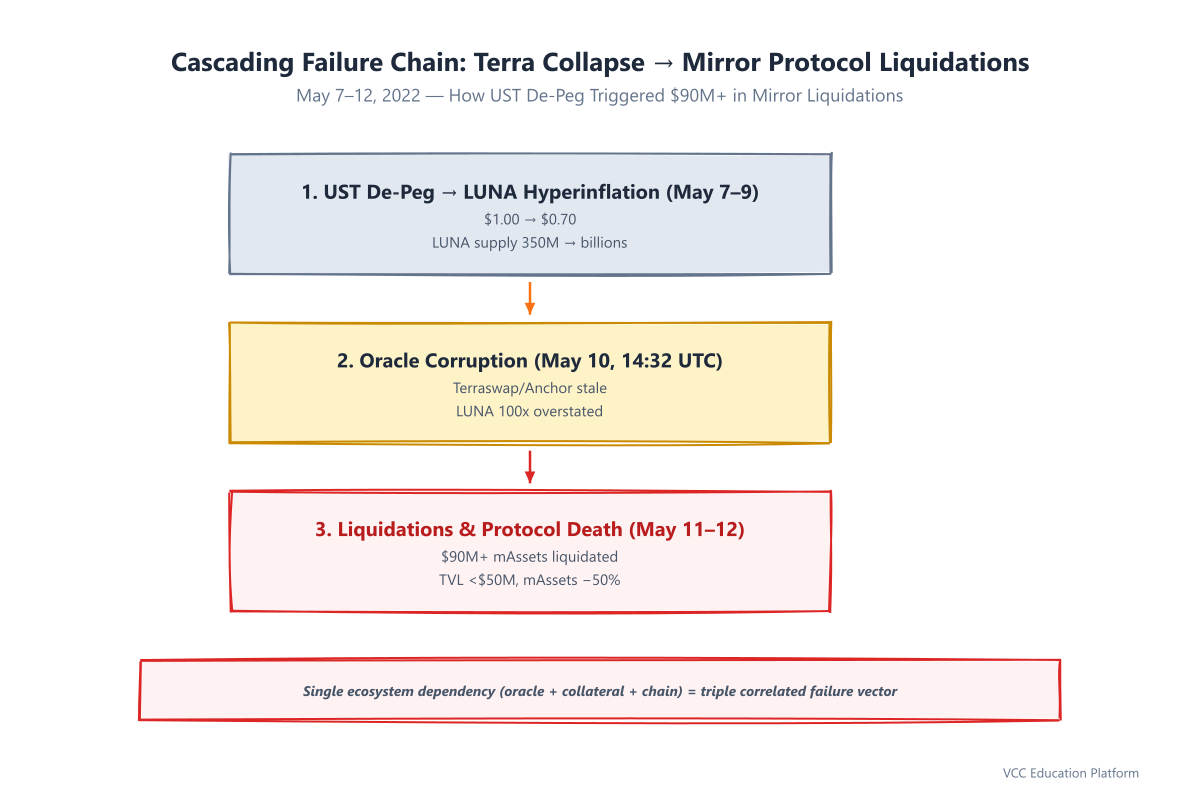
Step 1: UST De-Peg (May 7-9, 2022)
UST, Terra's algorithmic stablecoin, began drifting from $1.00 on May 7. By May 9, it hit $0.70. The Anchor Protocol (offering 20% APY on UST) saw massive withdrawals. LUNA, UST's volatility absorber, began hyperinflating as the protocol minted trillions of LUNA to buy back UST.
Key metric: LUNA supply grew from 350M to 6.5T in 72 hours — a 18,000x increase.
Step 2: Oracle Corruption (May 10-11)
Mirror's oracle didn't query centralized exchanges. It read Terraswap (LUNA/UST) and Anchor (UST lending rates). As LUNA hyperinflated:
- Terraswap LUNA/UST pool price became meaningless (liquidity evaporated)
- Anchor's UST deposit rate became disconnected from reality
- Oracle reported stale LUNA prices — often hours old
At 14:32 UTC May 10, oracle reported LUNA at $0.0001 while market price was $0.000001. A 100x deviation.
Step 3: Mass Liquidations (May 10-12)
With oracle reporting LUNA 100x higher than reality:
- Collateral appeared 100x more valuable than it was
- No positions were flagged for liquidation — they appeared overcollateralized
- Arbitrageurs minted mAssets against near-worthless LUNA collateral
- When oracle finally updated, positions were instantly undercollateralized
- Liquidation bots executed at corrupted prices, draining protocol reserves
mirror 90 million in value was liquidated across mBTC ($25M), mETH ($20M), mDOT ($15M), and other mAssets ($30M) in 48 hours.
Step 4: mAsset De-Peg & Cross-Chain Contagion
mAssets lost peg to their tracked assets. mBTC traded at 50% discount to BTC. Wormhole bridge saw $200M+ in redemptions as users fled Terra. The cascading failure defi pattern spread to Ethereum, Solana, and BSC within hours.
Why No Code Bug Could Fix This
The mirror protocol exploit wasn't a bug — it was a design assumption violation. Three correlated risks converged:
| Risk Vector | Assumption | Reality (May 2022) |
|---|---|---|
| Oracle source | Terraswap/Anchor reflect fair value | Markets evaporated, prices stale |
| Collateral asset | LUNA/UST stable or low volatility | LUNA hyperinflation 18,000x supply |
| Tracked assets | BTC/ETH independent of Terra | Crypto correlation = 0.8+ during crash |
oracle deviation defi systems that rely on a single ecosystem's markets for pricing external assets create a single point of failure that correlates oracle risk, collateral risk, and market risk.
Comparison: Why Synthetix Survived
Synthetix (SNX collateral, independent oracle network) faced the same market crash but zero protocol-level failures. Key differences:
| Dimension | Mirror Protocol | Synthetix |
|---|---|---|
| Collateral | UST, LUNA (Terra ecosystem) | SNX (independent token) |
| Oracle | Terraswap/Anchor (Terra markets) | Chainlink + Pyth (multi-source) |
| Collateral correlation | High (LUNA price = UST demand) | Low (SNX uncorrelated to BTC/ETH) |
| Result | $90M+ liquidated, protocol dead | Zero bad debt, protocol functional |
Lesson for Vietnamese developers: Never use the same ecosystem's native token as both collateral AND oracle source for external assets. This creates a triple correlation — oracle failure, collateral collapse, and tracked asset crash all happen together.
The Vietnamese Context: What Local Builders Should Learn
Vietnam's DeFi community actively farmed Mirror in 2021-2022. Many VN users held mTSLA, mAAPL for "stock exposure without KYC." When the mirror protocol hack unfolded, Vietnamese Telegram groups (DeFi Vietnam, Coin68) filled with liquidation screenshots.
Local Parallel: Covered Warrants (Chứng Chỉ Ký Quỹ)
Vietnam's covered warrants market operates similarly:
- Issuer (securities firm) sells warrant tracking VN30 stock
- Issuer hedges by buying underlying stock
- If hedging fails (2008 crash, 2020 COVID crash), warrant holders lose value
- Difference: Centralized issuer has capital reserves; Mirror had only algorithmic collateral
VN regulatory implication: This case informs why Vietnam's State Securities Commission treats synthetic assets as high-risk — the "unbacked" nature mirrors (pun intended) unregulated covered warrant issuers.
Technical Deep Dive: Oracle Deviation Mechanics
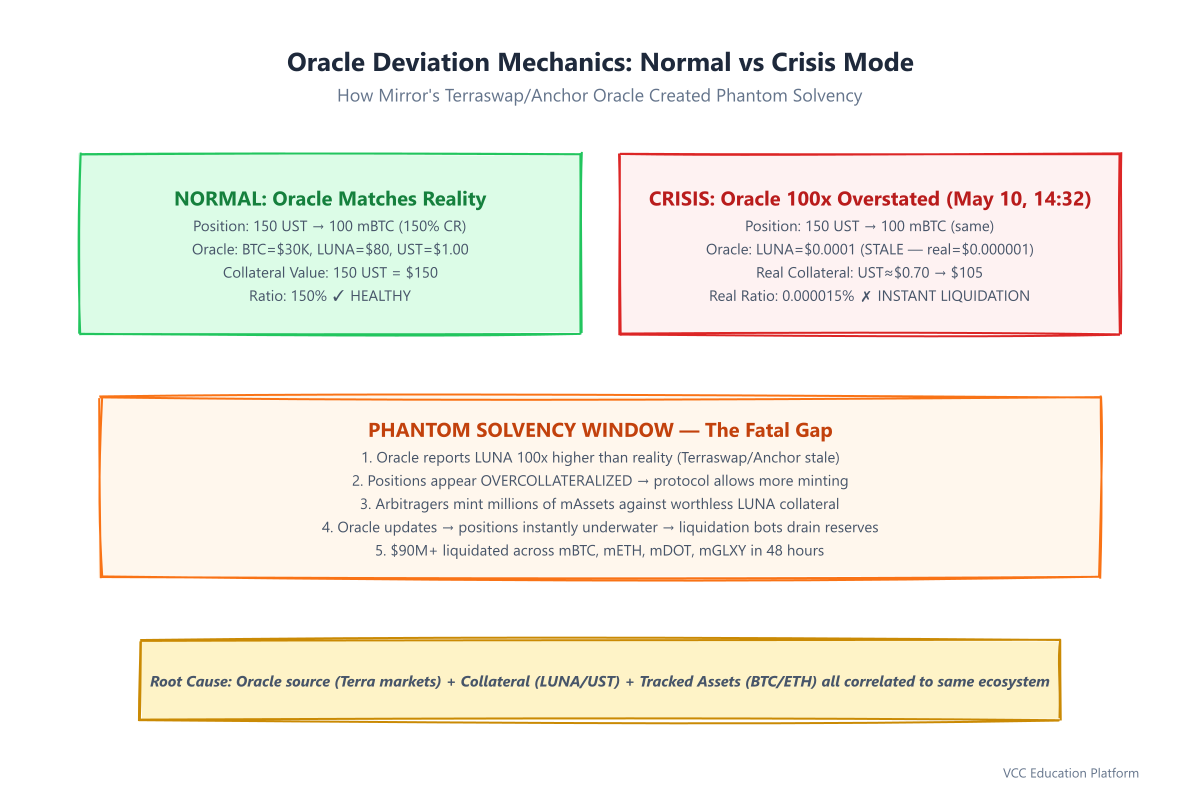
Normal Operation
User Position: 150 UST collateral → 100 mBTC
Oracle Price: BTC = $30,000 | LUNA = $80
Collateral Value: 150 UST = $150
Collateral Ratio: 150% ✓ Healthy
Crisis Mode (May 10, 14:32 UTC)
User Position: 150 UST collateral → 100 mBTC
Oracle Price: BTC = $30,000 | LUNA = $0.0001 (STALE - real: $0.000001)
Collateral Value: 150 UST ≈ $0.000015 (UST de-pegged) + LUNA worthless
Real Collateral Ratio: ~0.000015% ✗ Instantly liquidatable
Oracle-Reported Ratio: 150%+ (appeared healthy)
The oracle deviation created a phantom solvency window — positions looked safe while being underwater. When oracle updated, the protocol had already minted millions of mAssets against worthless collateral.
Post-Mortem: What Mirror Governance Did (And Didn't Do)
Actions Taken
- MIP-18: Emergency shutdown of minting (May 11)
- MIP-19: Oracle freeze at last known good price (May 12)
- MIP-20: Migration to Ethereum mainnet (abandoned Terra)
Actions NOT Taken (Pre-Collapse)
- No circuit breaker on oracle deviation > 10%
- No collateral asset correlation limits
- No maximum LUNA collateral percentage
- No fallback oracle (Chainlink/Pyth integration proposed but not implemented)
The governance forum shows warnings from community members in January 2022 about Terra dependency. These were dismissed as "FUD."
FAQ
Q: Was the Mirror Protocol hack a smart contract bug?
A: No. The mirror protocol exploit resulted from design assumptions violating reality — specifically, oracle dependency on a collapsing ecosystem's markets. No code vulnerability was exploited.Q: How much was lost in the Mirror Protocol hack?
A: Approximately $90 million across all mAssets (mBTC, mETH, mDOT, mGLXY, etc.) liquidated between May 10-12, 2022.Q: Could a better oracle have prevented this?
A: A multi-source oracle (Chainlink, Pyth) with deviation thresholds would have *slowed* the damage but not prevented it — the collateral (LUNA/UST) itself hyperinflated. The root cause was collateral-asset correlation, not just oracle quality.Q: Is Mirror Protocol still operating?
A: Mirror Protocol on Terra is dead. A V2 on Ethereum was proposed but never gained traction. The protocol's TVL dropped from $2B+ to <$50M and never recovered.Q: What's the key lesson for DeFi builders?
A: Never correlate oracle source, collateral asset, and tracked asset to the same ecosystem. This creates a single point of failure where one shock (UST de-peg) triggers simultaneous oracle corruption, collateral collapse, and liquidation cascade.Key Takeaways
- The mirror protocol hack was a cascading failure defi event, not a code exploit — $90M lost through design fragility
- Oracle deviation defi systems using single-ecosystem markets for external asset pricing create correlated risk vectors
- Collateral-asset independence is a non-negotiable design principle — Synthetix proved this; Mirror disproved the alternative
- Static collateral ratios (150%) are meaningless against hyperinflationary collateral — dynamic, oracle-aware risk parameters needed
- Vietnamese builders: Treat synthetic asset protocols as "algorithmic covered warrants" — same risks, less regulation, no capital reserves
Visual Brief for Diagram Production
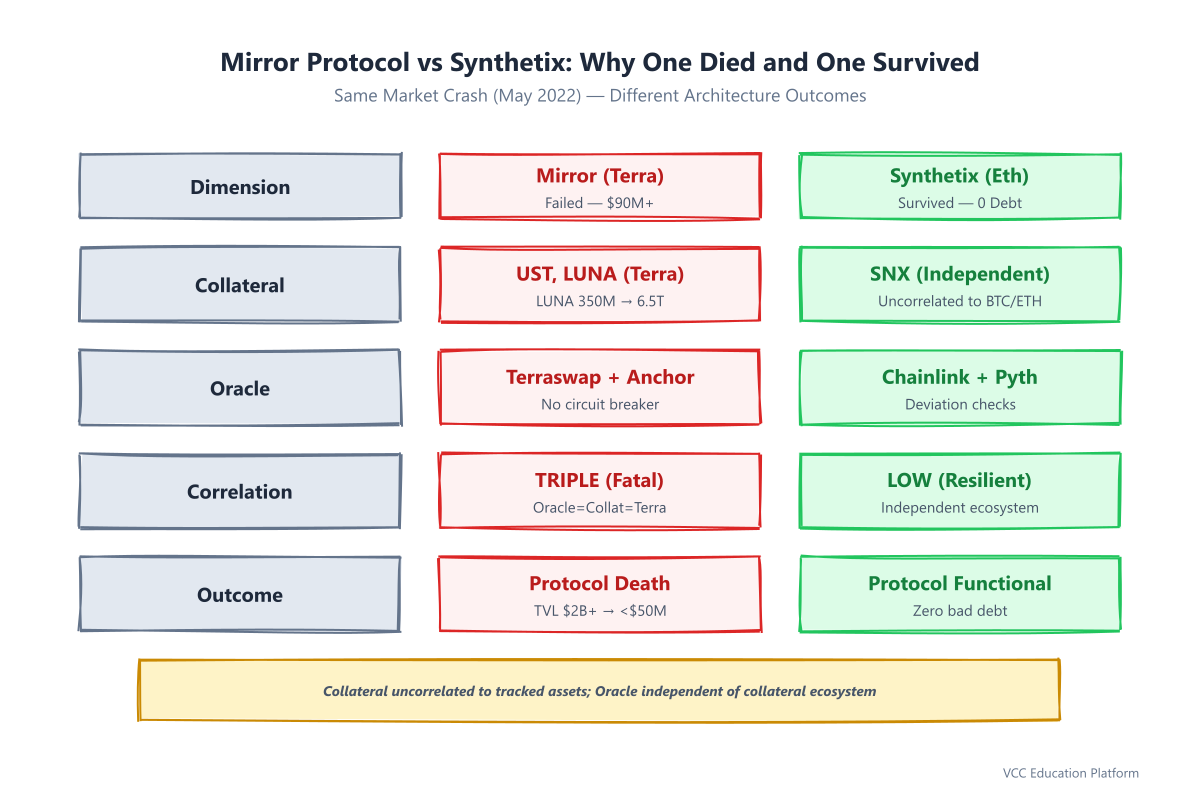
- Type: Comparison matrix, 4 rows × 4 columns
- Canvas: 1200x800
- Highlight: Collateral correlation row (red for Mirror, green for Synthetix)
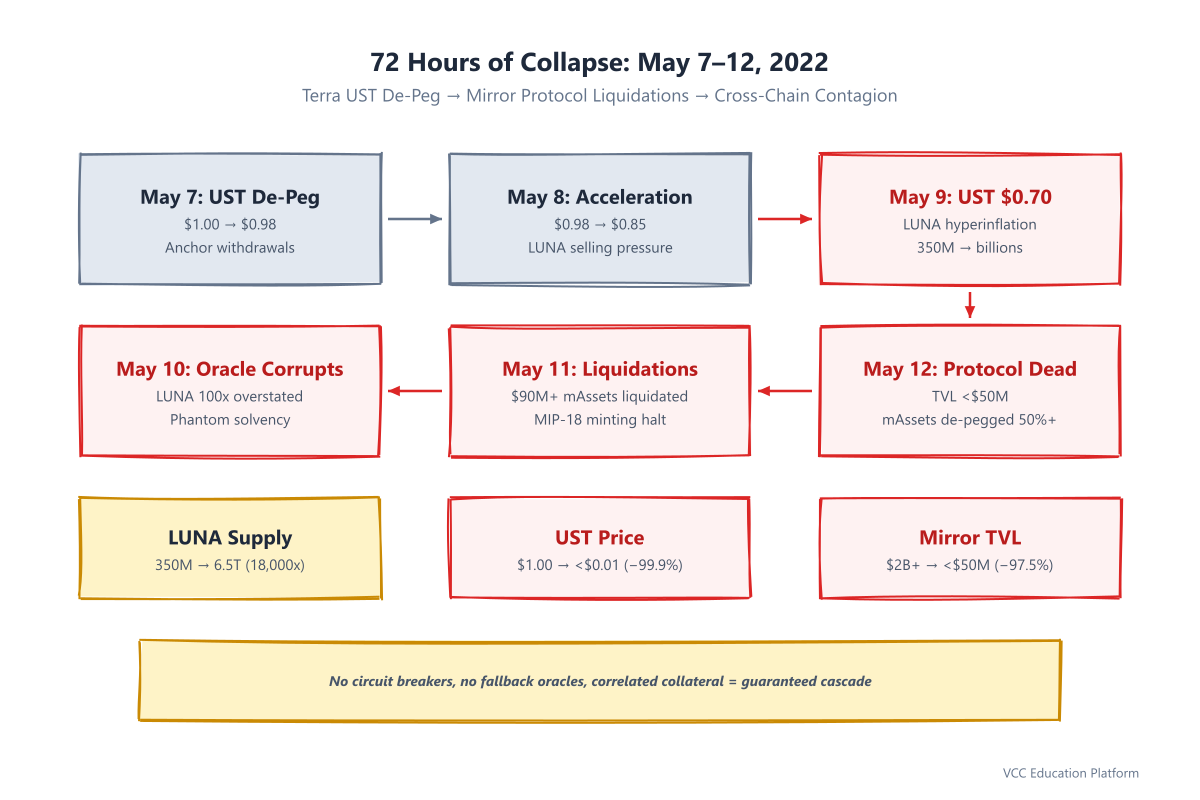
- Type: Horizontal timeline with milestone markers
- Canvas: 1200x600
- Key dates: May 7 (UST $0.98), May 9 (UST $0.70), May 10 (Oracle corruption), May 11 (Minting halted), May 12 (Protocol dead)
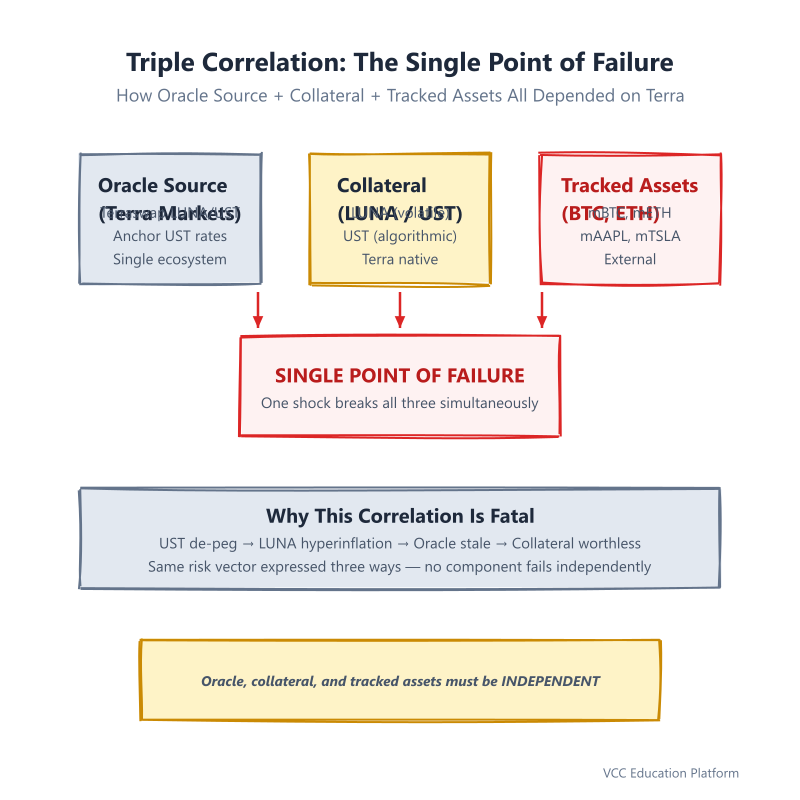
- Type: Venn diagram / three-circle overlap
- Canvas: 800x800
- Circles: "Oracle Source (Terra)", "Collateral (LUNA/UST)", "Tracked Assets (BTC/ETH)"
- Center overlap: "Single Point of Failure" in warning red