
The Mango Markets hack was not a typical exploit — it was a calculated financial engineering operation that weaponized oracle manipulation, perpetual funding rates, and governance loopholes. The attacker, Avi Eisenberg, openly claimed his actions were "legal" and even proposed returning funds in exchange for governance control. This case redefined what "code is law" means in DeFi.
The Attack That Wasn't a Hack
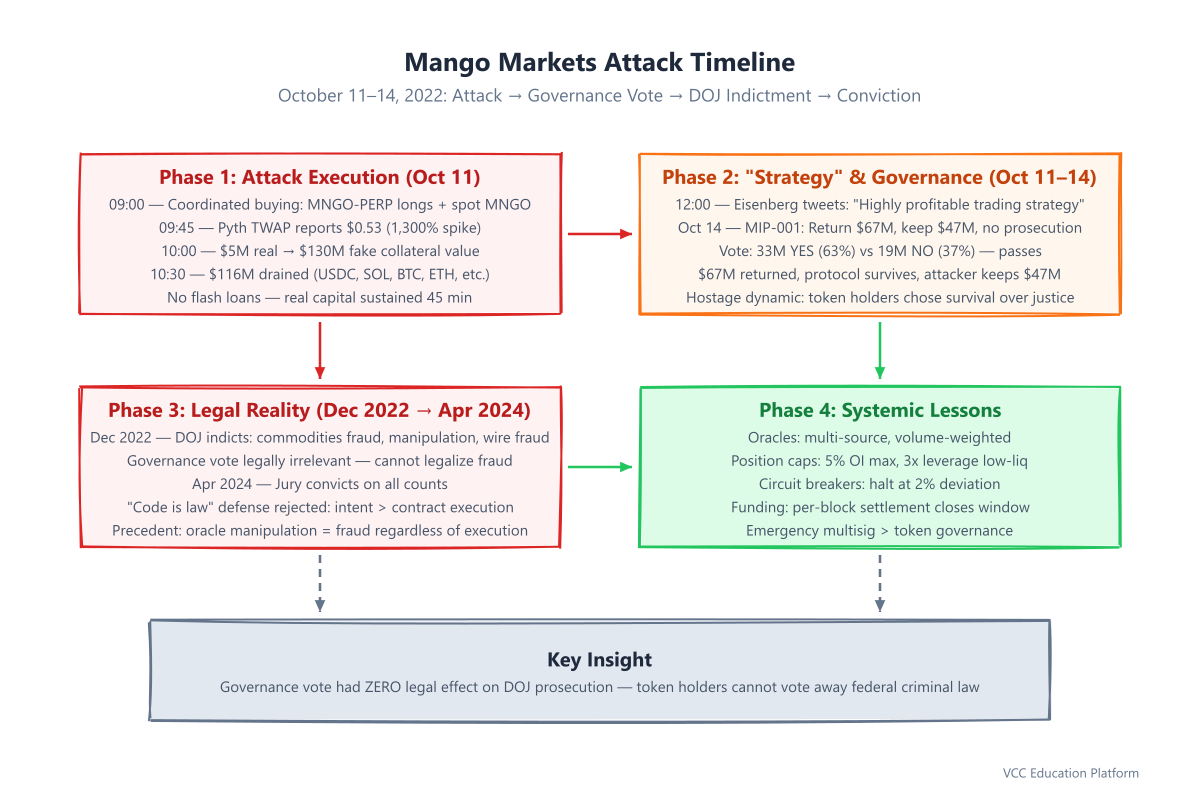
On October 11, 2022, Mango Markets — a decentralized perpetual futures exchange on Solana — lost approximately $116 million in a single coordinated operation. The attacker drained the protocol's treasury by manipulating the MNGO token price oracle, then used the inflated collateral to borrow against every available asset.
What made this event unprecedented was not the amount stolen, but the attacker's behavior afterward. Avi Eisenberg publicly identified himself, claimed his strategy was "a highly profitable trading strategy" rather than a hack, and offered to return a portion of funds if Mango token holders voted to let him keep the rest.
How the Oracle Manipulation Worked
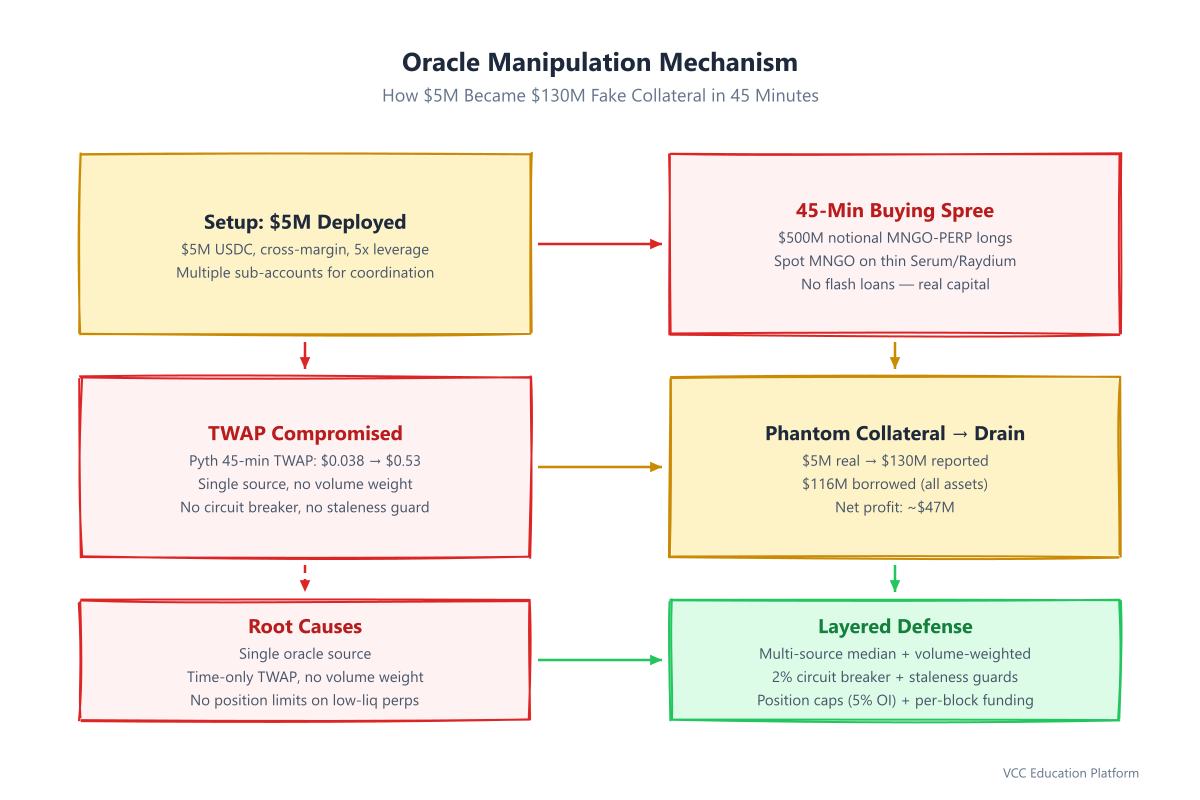
Mango Markets used a TWAP (Time-Weighted Average Price) oracle fed by Pyth Network. The oracle reported the MNGO/USD price based on recent trading activity across multiple venues. The vulnerability: thin order books on low-liquidity markets could be moved with relatively small capital.
The Setup
The attacker deposited $5 million USDC as initial collateral. Then, across multiple accounts, they executed a coordinated buying spree on MNGO-PERP perpetual futures:
- Aggressive long positions on MNGO-PERP using high leverage (up to 5x)
- Simultaneous spot purchases on thin order books (Serum DEX, Raydium)
- Cross-market arbitrage to amplify price impact per dollar deployed
The Math
| Metric | Value |
|---|---|
| Initial capital deployed | ~$5M USDC |
| MNGO price pre-attack | ~$0.038 |
| MNGO price at peak | ~$0.53 (1,300% increase) |
| Oracle TWAP window | 45 minutes |
| Fake collateral value | ~$130M |
| Assets borrowed | $116M (USDC, USDT, SOL, MSOL, BTC, ETH) |
| Net profit (after repayments) | ~$47M |
The TWAP oracle smoothed the price over time, but 45 minutes of sustained buying was enough to drag the average up. The protocol saw $130M in collateral value where only $5M existed. The attacker then borrowed against this phantom collateral until the insurance fund and user deposits were drained.
Perp Funding Rates: The Hidden Engine
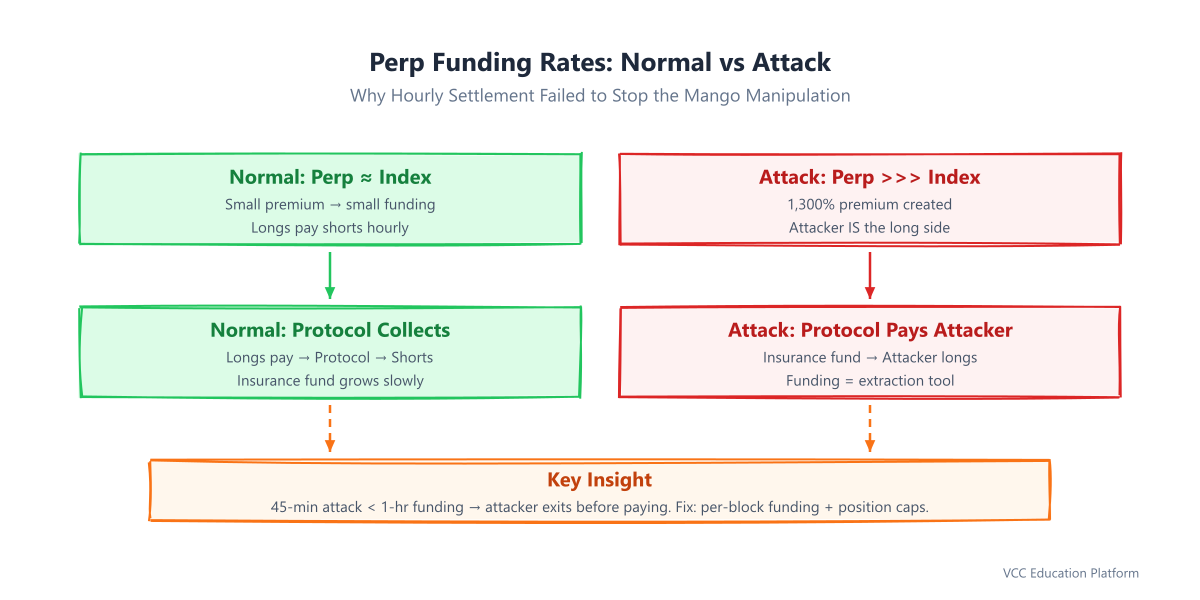
Perpetual futures funding rates played a critical but underappreciated role. Mango's perp markets charged funding every hour based on the premium/discount of the perp price versus the index.
Why Funding Rates Didn't Stop the Attack
- Hourly settlement: Funding accrues continuously but settles hourly. The attack completed in ~45 minutes.
- Attacker was long: Normally longs pay funding when perp trades above spot. But the attacker created the premium — they were paying themselves via the protocol's insurance fund.
- No position limits: Mango had no max position size per account. The attacker opened ~$500M notional with $5M margin.
The funding rate mechanism, designed to tether perp prices to spot, became a transfer mechanism from the protocol to the attacker during the manipulation window. Every hour the distorted price persisted, the protocol paid funding to the attacker's long positions.
The "Not Illegal" Defense
Eisenberg's post-attack behavior created a legal and ethical firestorm. His October 11 tweet:
"I was involved with a team that operated a highly profitable trading strategy last week... Mango Markets code allowed this. I believe all our actions were legal."
He followed with a governance proposal (MIP-001) offering:
- Return $67M to Mango treasury
- Keep $47M as "trading profits"
- No criminal prosecution
- Protocol continues operating
The Governance Vote
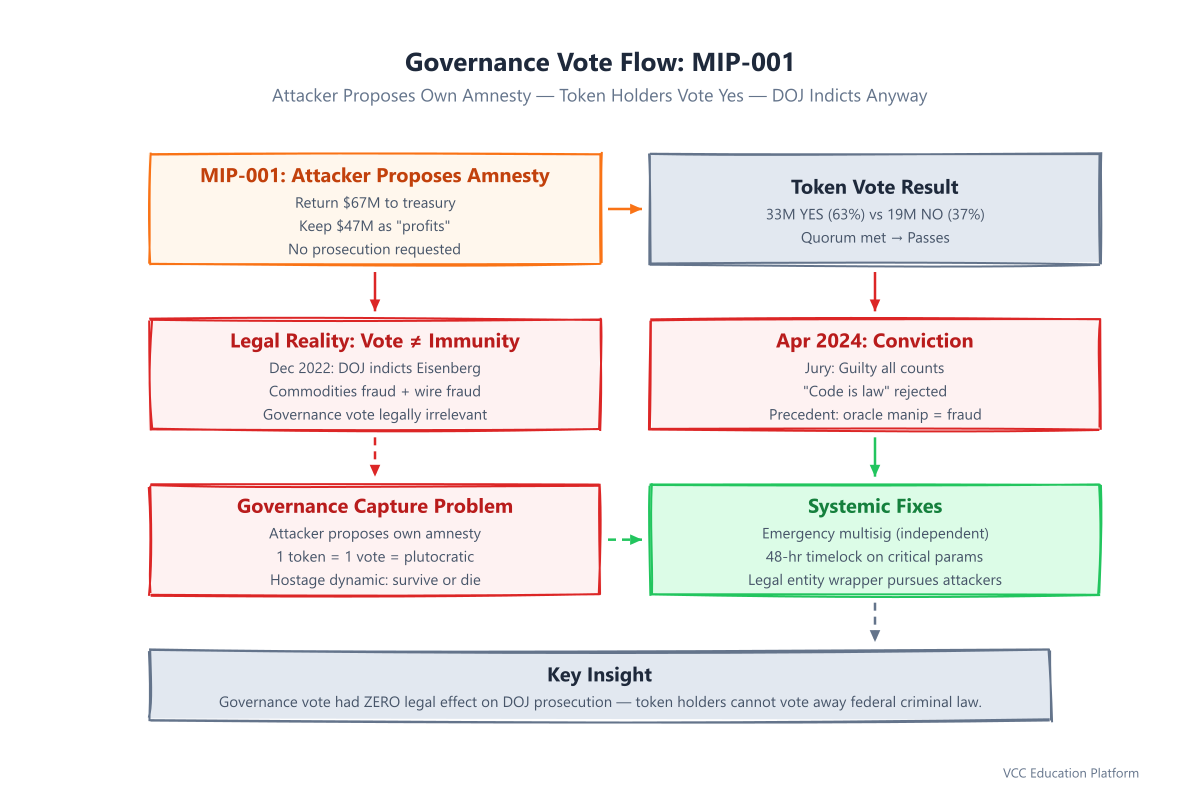
The vote passed with 63% in favor. Many voters were addresses that received MNGO airdrops or held tokens from the attacker's own wallets. The vote revealed a fundamental flaw: governance can be captured by the very exploiter draining the protocol.
Legal Outcome
Despite the "code is law" defense and governance approval:
- December 2022: DOJ charged Eisenberg with commodities fraud, manipulation, and wire fraud
- April 2024: Jury convicted on all counts
- Sentencing pending: Faces up to 20 years per count
The conviction established that manipulating oracles to create fake collateral value constitutes fraud, regardless of whether the smart contract "allowed" it. Code is not law when the code's execution is predicated on manipulated inputs.
Technical Lessons for DeFi Protocols
1. Oracle Design Must Assume Adversarial Inputs
Mango's TWAP oracle assumed honest market participation. Any oracle that can be moved by a single entity with <10% of TVL is a vulnerability.
Defenses:
- Median-of-medians: Aggregate multiple TWAPs from independent sources
- Volume-weighted oracles: Weight prices by actual traded volume, not just time
- Circuit breakers: Halt borrowing when price deviates >X% from secondary sources
- Staleness checks: Reject oracle updates if volume drops below threshold
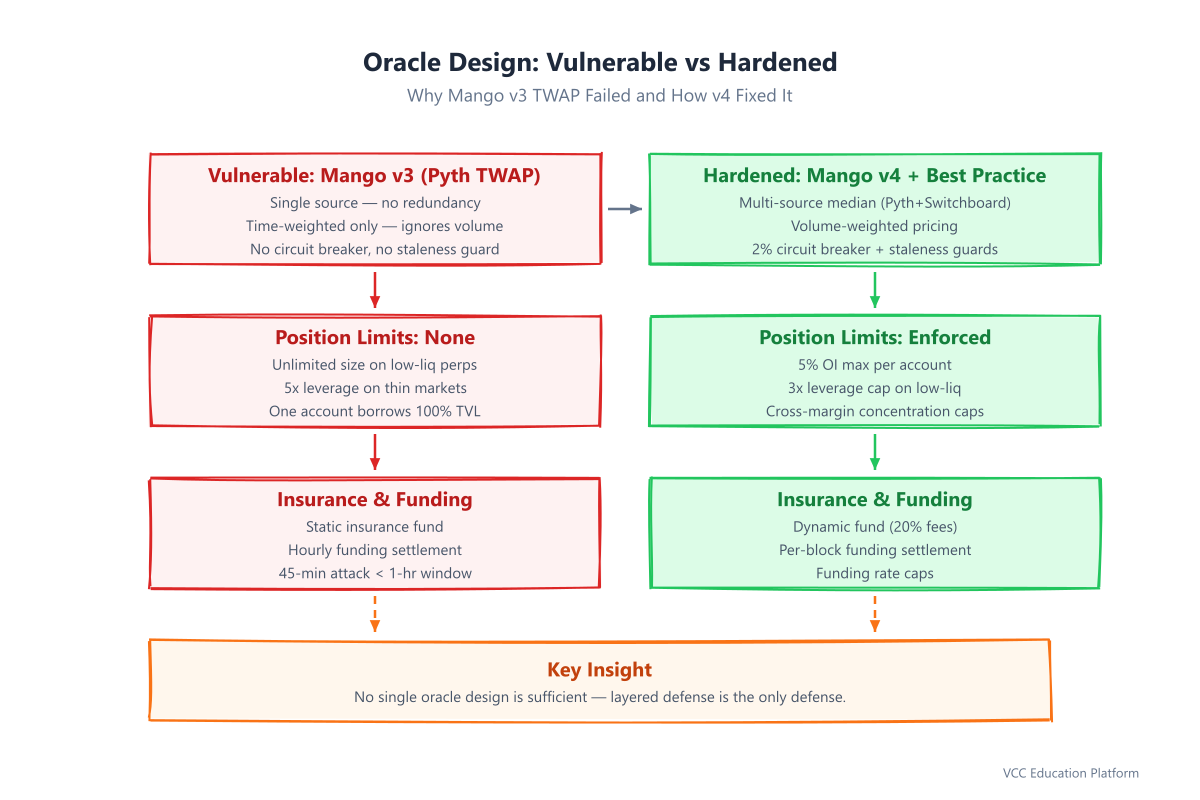
2. Position Limits Are Not Optional
Mango had no per-account position limits on perpetual futures. This allowed one entity to accumulate $500M notional with $5M margin.
Required limits:
- Max notional per account (e.g., 5% of open interest)
- Max leverage per asset class (lower for low-liquidity assets)
- Cross-margin concentration caps (no single collateral asset >30% of total)
3. Insurance Funds Need Dynamic Sizing
Mango's insurance fund was static and sized for normal volatility, not oracle attacks. The fund was exhausted in minutes.
Better approach:
- Insurance fund grows with protocol revenue (e.g., 20% of trading fees)
- Dynamic sizing based on open interest and asset volatility
- Separate insurance tranches per collateral asset
4. Governance Cannot Be the Remediation Layer
The MIP-001 vote proved that token-weighted governance is vulnerable to sybil and plutocratic capture during crises.
Governance safeguards:
- Timelock on parameter changes (48+ hours)
- Emergency multisig with independent signers (not token holders)
- Quadratic voting or conviction voting for critical decisions
- Legal entity wrapper that can pursue attackers regardless of governance votes
The Aftermath: Mango Markets Today
Mango Markets did not die. After the hack:
- V4 launched (2023) with hardened oracles, position limits, and dynamic insurance
- $67M returned via governance vote partially recapitalized the protocol
- New oracle: Pyth + Switchboard dual-feed with 2% circuit breaker
- Position caps: 5% of open interest per account, max 3x leverage on low-liquidity perps
- Active users: Recovered to ~60% of pre-hack levels
However, trust never fully returned. TVL peaked at $400M pre-hack; as of 2024 it hovers around $40M. The protocol survives, but the "Mango brand" in DeFi is permanently associated with the exploit.
Broader Implications for DeFi
The "Strategy vs. Exploit" Gray Zone
Eisenberg's defense relied on a distinction: if the contract executes it, it's a feature. This logic would make any oracle manipulation, flash loan attack, or reentrancy "legal" because the EVM/SVM executed it faithfully.
The conviction rejected this. Intent matters. Deploying capital specifically to distort an oracle input — knowing the protocol will trust that input — is fraud. The smart contract is the instrument, not the authority.
Regulatory Signal
The DOJ prosecution signaled that DeFi is not a law-free zone. Manipulating oracles to extract value from protocols will be prosecuted as commodities fraud under CEA Section 6(c)(1) and wire fraud statutes.
For builders: Assume your protocol will be attacked. Assume attackers will be identified. Assume law enforcement will pursue them. Design accordingly.
The Oracle Problem Remains Unsolved
Every major DeFi hack since 2020 has involved oracle manipulation:
- bZx (2020): Kyber oracle manipulated via flash loan
- Harvest Finance (2020): Curve oracle manipulated via flash loan
- Cream Finance (2021): AMP oracle manipulated via flash loan
- Mango Markets (2022): Pyth TWAP manipulated via sustained buying
- Euler Finance (2023): Uniswap TWAP manipulated via flash loan
There is no silver bullet. The solution is layered: better oracles + position limits + circuit breakers + insurance + governance safeguards + legal entity structure.
FAQ
Was the Mango Markets hack a flash loan attack?
No. The attacker used their own capital (~$5M) sustained over 45 minutes. No flash loans were involved. This made it harder to detect and reverse — the capital was "real" and the positions were held, not instantly unwound.Could the attack have been prevented by a better oracle?
Partially. A volume-weighted oracle with circuit breakers would have limited the price distortion. But the root cause was unlimited position sizing on a low-liquidity asset. Even a perfect oracle cannot fix a protocol that lets one user borrow 100% of TVL against a single collateral asset.Why did Mango token holders vote to let the attacker keep $47M?
Game theory. Voters faced a choice: reject the proposal → attacker keeps all $116M, protocol dies, MNGO goes to zero. Accept → protocol lives, $67M returns, MNGO has value. Rational token holders chose survival. This is the hostage-taking problem in DeFi governance.Is Avi Eisenberg in prison?
As of 2024, no. He was convicted in April 2024 but sentencing has not occurred. He remains free on bail pending sentencing. The case is being closely watched as a precedent for DeFi enforcement.What happened to the $47M Eisenberg kept?
Partially frozen. After the DOJ indictment, ~$27M was frozen on centralized exchanges (Binance, OKX) and via USDC blacklisting. The remainder (~$20M) was moved through mixers and bridges. Recovery efforts continue.Can a protocol use governance to legally immunize an attacker?
No. The Mango governance vote had zero legal effect on the DOJ prosecution. Token holders cannot vote away federal criminal law. Governance votes only control protocol parameters — they do not grant legal immunity.Key Takeaways
- Oracle manipulation is the #1 DeFi attack vector — every major hack since 2020 exploited oracle trust assumptions
- Position limits are mandatory — no protocol should allow one entity to borrow >100% of TVL
- Funding rate mechanisms can amplify attacks — perps with hourly settlement create a window for manipulation
- Governance is not a court — token votes cannot legalize fraud or bind law enforcement
- "Code is law" failed its hardest test — the Mango case proved that manipulated inputs invalidate the "contract execution = legality" argument
- Layered defense is the only defense — oracles, limits, circuit breakers, insurance, governance safeguards, legal structure — all must work together
The Mango Markets hack was a masterclass in financial engineering — and a warning. The next attack will be different. The defense must be systematic.