
Executive Summary
On June 23, 2022, the Harmony Bridge hack resulted in the loss of approximately $100 million from the Harmony Horizon Bridge, making it one of the most devastating cross-chain bridge exploits in DeFi history. The attacker compromised the private keys of the bridge's multisig wallet — a 2-of-5 threshold signature scheme — by stealing enough validator keys to meet the signing threshold. Once two of five private keys were compromised, the attacker could authorize arbitrary transactions on the bridge, draining assets locked on Ethereum, Binance Smart Chain, and other connected chains.
This harmony hack analysis demonstrates a fundamental weakness in key management for cross-chain bridges: when a small multisig threshold protects billions in locked value, compromising just two keys is sufficient to steal everything. Unlike smart contract logic exploits, the Harmony Horizon Bridge 100 million loss was not caused by a code bug — it was caused by operational security failures in how private keys were stored and managed.
Primary Keyword: harmony bridge hack
Secondary Keywords: harmony horizon bridge 100 million, multisig key compromise, 2 of 5 multisig, harmony hack analysis
What Is the Harmony Horizon Bridge?
Harmony is a Layer-1 blockchain designed for cross-chain interoperability, using a sharded proof-of-stake consensus mechanism. The Horizon Bridge was Harmony's flagship cross-chain bridge, allowing users to transfer assets between Harmony and other major blockchains including Ethereum, Binance Smart Chain (BSC), Bitcoin, and Polygon.
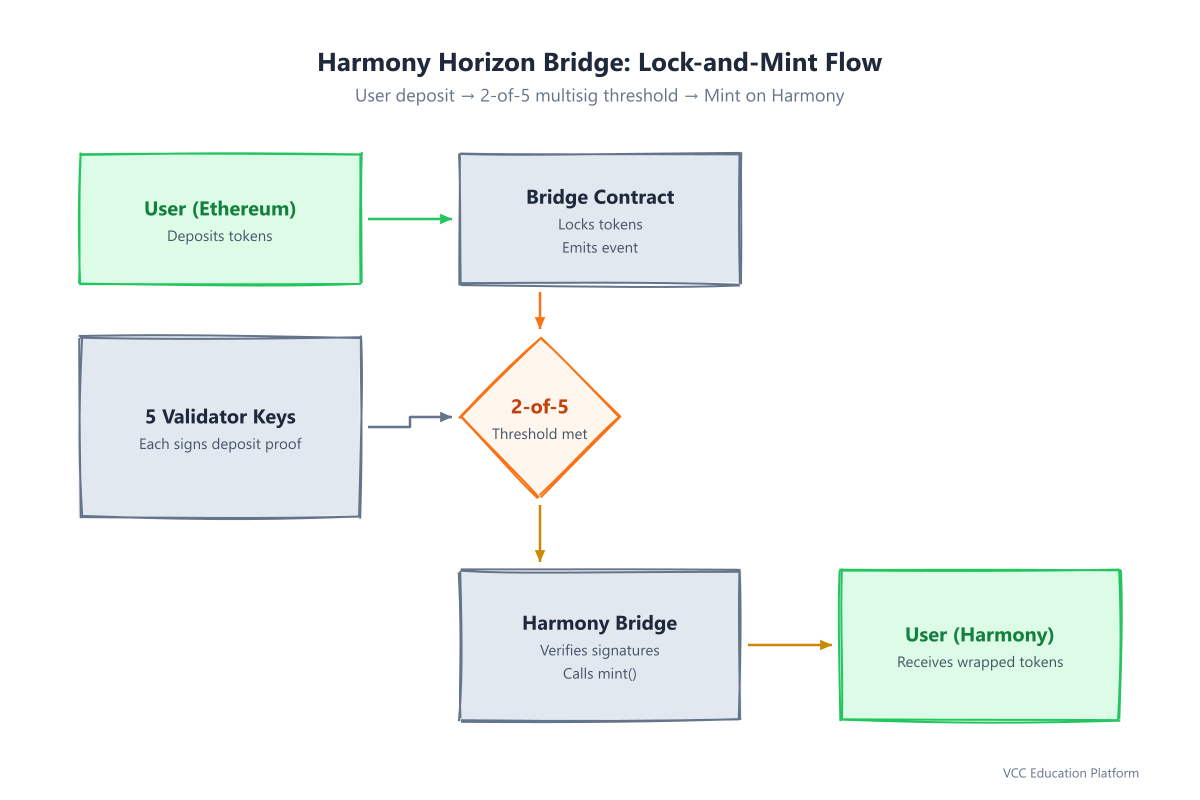
The Horizon Bridge operated on a lock-and-mint model:
- Users deposit tokens on the source chain (e.g., Ethereum) into the bridge contract
- The bridge locks the tokens and emits an event
- Validator nodes monitor the event and sign a message confirming the deposit
- Once the threshold of signatures is met, the bridge mints corresponding wrapped tokens on Harmony
- To withdraw, the process reverses: burn wrapped tokens on Harmony, validators sign, and original tokens unlock on the source chain
The critical trust assumption was the 2 of 5 multisig scheme: only two out of five validator signatures were required to authorize any bridge transaction, including large withdrawals. This threshold was chosen for operational convenience — it allowed the bridge to continue functioning even if some validators were temporarily offline — but it created a dangerous attack surface where compromising just two keys gave full control.
The Multisig Key Compromise
How the Attack Worked
The Harmony bridge hack was fundamentally different from most DeFi exploits. There was no smart contract vulnerability, no flash loan, no reentrancy bug, and no oracle manipulation. The attacker simply stole private keys.
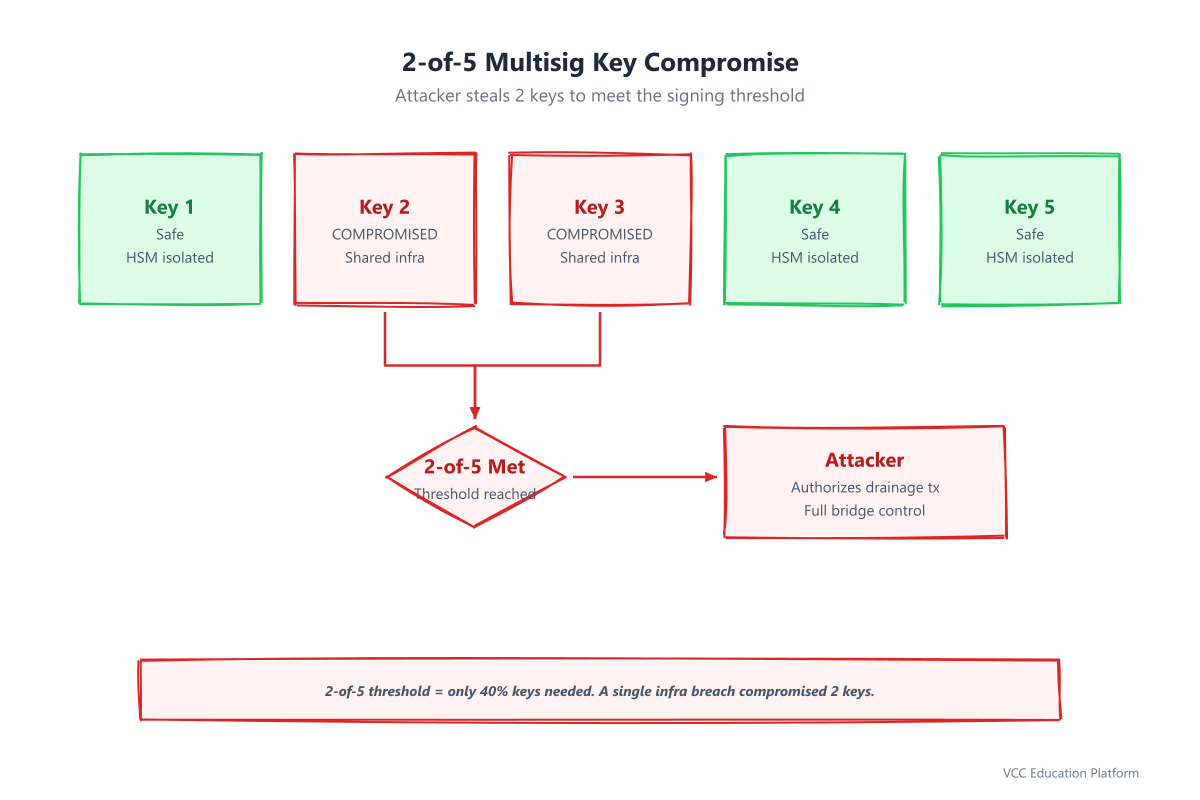
The Horizon Bridge used a Gnosis Safe multisig wallet (later rebranded as Safe) deployed on Ethereum. The wallet was configured with five owner addresses, requiring only two signatures to execute any transaction. The attacker gained control of two of these five private signing keys, which was enough to meet the threshold and authorize the drainage transaction.
The Key Theft Vector
The exact method of key compromise was never definitively confirmed by Harmony, but the investigation revealed several critical findings:
- The keys were stored in a shared infrastructure environment. Multiple validator keys were accessible from systems that shared common access patterns, meaning a single compromise could expose multiple keys.
- No hardware security module (HSM) was used for all keys. Some keys were stored in software-based wallets or cloud environments rather than dedicated hardware, making them vulnerable to remote extraction.
- No geographic or organizational separation. The five signers were not sufficiently isolated from each other — a single breach of Harmony's internal infrastructure could reach multiple signing keys.
- The 2-of-5 threshold was too low. With only two keys needed, an attacker who compromised Harmony's infrastructure once could steal enough keys to authorize any transaction. A 3-of-5 or 4-of-5 threshold would have required compromising more independent systems.
The Attack Execution
Timeline of Events
The attack unfolded rapidly over a few hours on June 23, 2022:
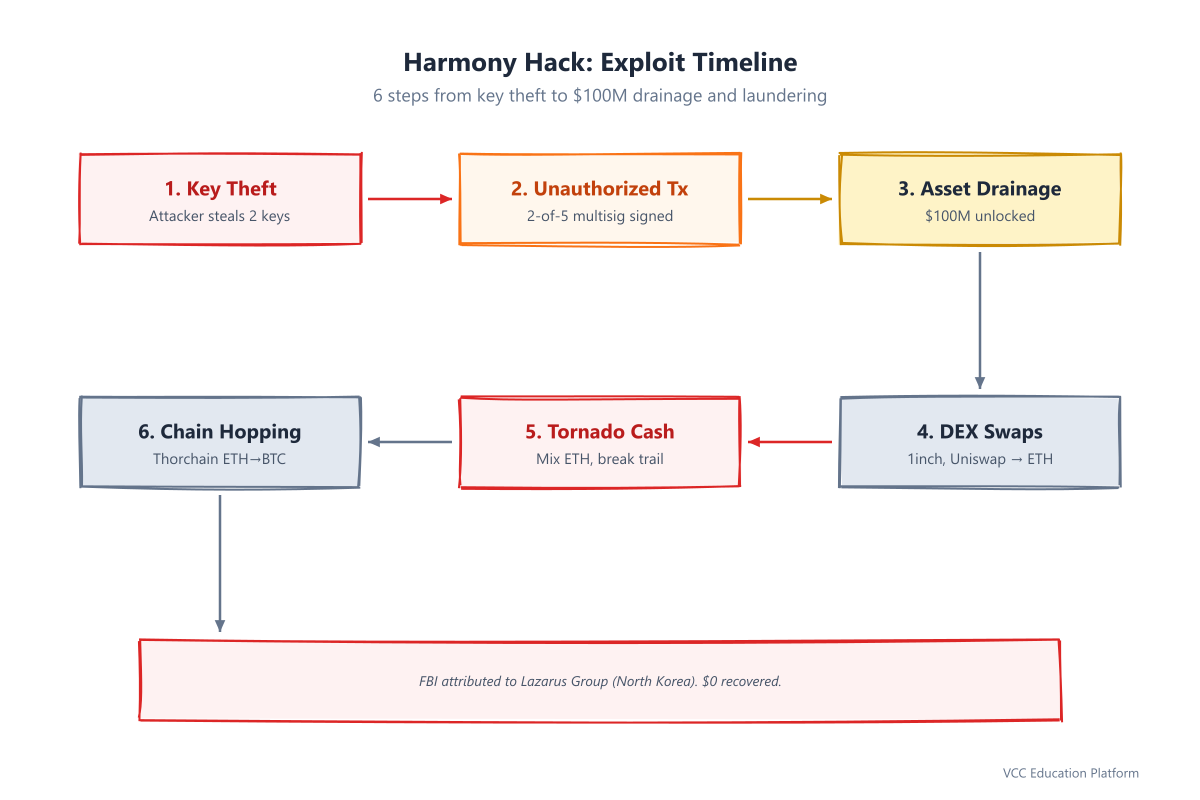
Step 1 — Key Compromise (pre-attack): The attacker obtained private keys for at least two of the five multisig signers. This likely occurred days or weeks before the actual drainage, giving the attacker time to plan.
Step 2 — Unauthorized Transaction (June 23, 2022): Using the two compromised keys, the attacker constructed a transaction on the Ethereum multisig wallet that authorized the bridge to unlock and transfer all locked assets to attacker-controlled addresses.
Step 3 — Asset Drainage: The bridge contract, seeing a valid 2-of-5 multisig signature, executed the withdrawal. The attacker drained:
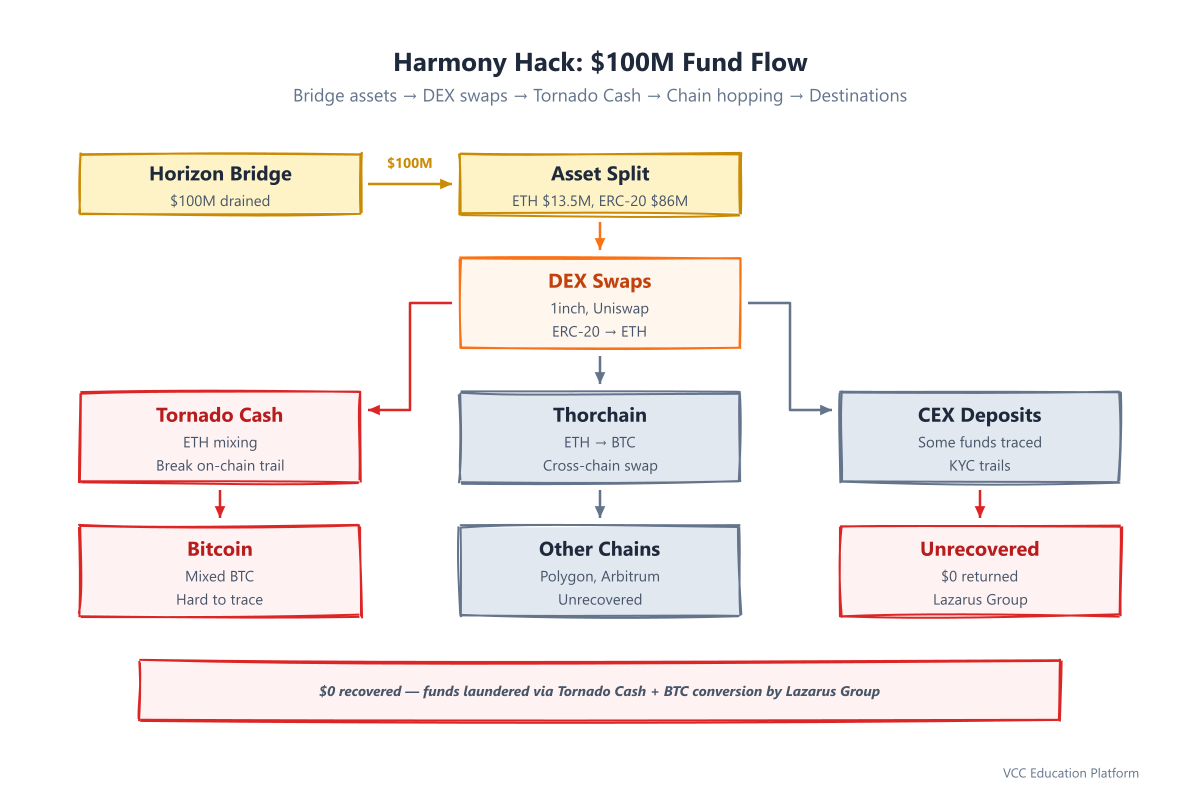
- ~$13.5M in ETH from the Ethereum side of the bridge
- ~$86M in various ERC-20 tokens (WETH, USDC, USDT, DAI, WBTC, SUSHI, and others)
- Additional assets from the BSC side of the bridge
Step 4 — Fund Movement: The attacker immediately began swapping stolen tokens through decentralized exchanges and bridging them across multiple chains to obscure the trail.
Fund Flow Analysis
Stolen Assets Breakdown
The Harmony Horizon Bridge 100 million loss comprised assets across multiple chains:
| Chain | Asset | Approx. Value |
|---|---|---|
| Ethereum | WETH, USDC, USDT, DAI, WBTC | ~$86M |
| Ethereum | ETH (native) | ~$13.5M |
| BSC | BUSD, BNB, USDT | ~$1M+ |
| Total | ~$100M |
Attacker Money Lauaundering Strategy
The attacker employed sophisticated laundering techniques:
- Immediate swaps: Used 1inch and Uniswap to convert ERC-20 tokens to ETH
- Chain hopping: Bridged ETH through Tornado Cash, then to Bitcoin via Thorchain
- Privacy mixing: Deposited significant amounts into Tornado Cash to break the on-chain trace
- Conversion to BTC: Converted ETH to Bitcoin, which is harder to trace once mixed
- CEX deposits: Some funds were traced to centralized exchanges, but most remained on-chain
The laundering was remarkably effective. Harmony offered a $10 million bounty for the return of funds, but the attacker never responded. The FBI later attributed the attack to the Lazarus Group, North Korea's state-sponsored hacking unit, which explained the sophisticated operational security and the lack of any fund recovery.
Root Cause Analysis
Direct Cause
Insufficient multisig threshold and key management failure. The 2 of 5 multisig configuration meant that compromising just 40% of signing keys gave full control over $100M+ in locked assets. The keys were not sufficiently isolated, allowing a single infrastructure breach to compromise multiple signers.
Contributing Factors
- Low threshold relative to value protected. A 2-of-5 threshold protects against only a single key compromise. For $100M+ in value, a 3-of-5 or 4-of-5 threshold would have been more appropriate.
- Shared infrastructure for key storage. Multiple signing keys were accessible through common infrastructure, eliminating the independence assumption that multisig security relies on.
- No hardware security for all keys. Some keys were stored in environments vulnerable to remote compromise rather than air-gapped hardware wallets.
- No transaction monitoring or circuit breaker. The bridge had no mechanism to detect or pause anomalous large withdrawals, giving the attacker unlimited time to drain all assets.
- Centralized signer set. All five signers were controlled by or closely associated with Harmony, meaning a compromise of Harmony's infrastructure could reach all keys.
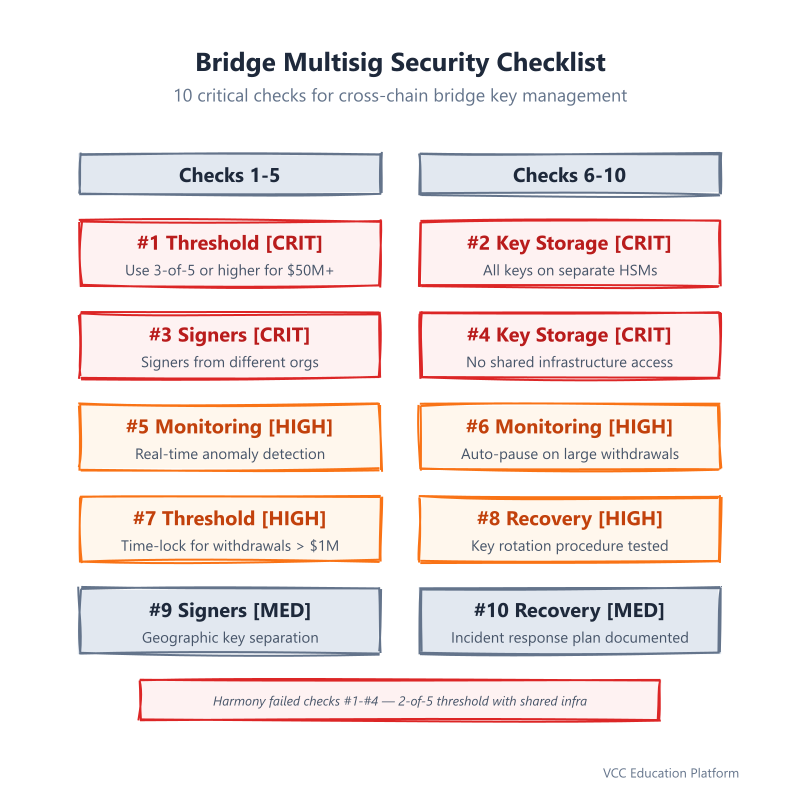
What a Secure Configuration Looks Like
// Secure multisig configuration for high-value bridges:
// - 4-of-5 or 3-of-5 threshold (not 2-of-5)
// - Keys stored on separate HSMs in different geographic locations
// - Signers from different organizations (not all from one company)
// - Time-locked large withdrawals (48h delay for amounts > $1M)
// - On-chain anomaly detection with automatic pause
// - Regular key rotation and access audits
Lessons Learned
For Bridge Operators
- Raise the multisig threshold. A 2-of-5 threshold is insufficient for any bridge holding more than $10M. Use 3-of-5 minimum, and 4-of-5 or higher for bridges holding $50M+.
- Isolate keys physically and organizationally. Each signing key should be on a separate HSM in a different geographic location, controlled by a different organization. A single infrastructure breach must never compromise more than one key.
- Implement transaction limits and time locks. Large withdrawals should require a time-locked delay (e.g., 48 hours) during which other signers or monitors can detect and block anomalous transactions.
- Use decentralized validator sets. Instead of a small fixed multisig, use a larger decentralized validator set with slashing for malicious behavior. This makes key compromise exponentially harder.
- Monitor for anomalous transactions. Implement real-time monitoring that flags any unusually large withdrawal and can trigger an automatic pause.
For Protocol Integrators
- Audit bridge security configurations. Before integrating with a bridge, verify the multisig threshold, key storage practices, and signer independence.
- Apply risk premiums to bridged assets. Bridges with low multisig thresholds should have higher collateral factors or lower deposit caps.
- Diversify across bridges. Never rely on a single bridge for cross-chain liquidity. Spread risk across multiple independent bridges.
For Auditors
- Review operational security, not just code. Bridge audits must include key management practices, signer independence, and threshold appropriateness.
- Test threshold assumptions. Model the cost of compromising N keys vs the value protected. If compromising 2 keys is cheaper than the bridge value, the threshold is too low.
- Check for circuit breakers. Verify that the bridge has mechanisms to detect and pause anomalous activity.
Industry Impact
Immediate Aftermath
- Harmony's ONE token dropped ~12% within 24 hours of the attack
- The Horizon Bridge was shut down indefinitely
- Harmony announced a recovery plan that involved minting new ONE tokens to compensate victims, which was controversial and never fully executed
- Increased scrutiny on all multisig-based bridges across the DeFi ecosystem
Long-term Changes
- Higher multisig thresholds became standard. Major bridges moved to 3-of-5, 4-of-7, or larger decentralized validator sets after the Harmony hack.
- Hardware key management adoption increased. Bridge operators began requiring HSMs for all signing keys, with geographic and organizational separation.
- Circuit breaker implementations. Bridges began implementing rate limits, withdrawal delays, and automatic pause mechanisms for anomalous activity.
- Decentralized validator bridges gained traction. The attack accelerated adoption of validator-set-based bridges (like Axelar, LayerZero) over small multisig configurations.
- Attribution to North Korea. The FBI's attribution to the Lazarus Group highlighted that nation-state actors were actively targeting DeFi bridges, leading to increased security investments across the industry.
Notable Similar Exploits
| Hack | Date | Loss | Root Cause |
|---|---|---|---|
| Ronin Bridge | Mar 2022 | $625M | Compromised validator keys (5-of-9) |
| Harmony Horizon | Jun 2022 | $100M | Compromised multisig keys (2-of-5) |
| Nomad Bridge | Aug 2022 | $190M | Replay attack on uninitialized root |
| Wormhole | Feb 2022 | $325M | Signature verification bypass |
FAQ
Q: Was the Harmony bridge hack caused by a smart contract bug?
A: No. The Harmony bridge hack was caused by a multisig key compromise, not a code vulnerability. The attacker stole private keys for two of the five multisig signers, which was enough to meet the 2-of-5 threshold and authorize the drainage transaction. The smart contract functioned exactly as designed — the design itself was the vulnerability.
Q: How did the attacker steal the private keys?
A: The exact method was never publicly confirmed, but the FBI attributed the attack to North Korea's Lazarus Group. The likely vector was a targeted phishing or social engineering attack against Harmony team members with access to signing infrastructure. The keys were not sufficiently isolated, allowing a single infrastructure compromise to reach multiple signers.
Q: Why was a 2-of-5 multisig used for a $100M bridge?
A: The 2-of-5 threshold was chosen for operational convenience — it allowed the bridge to continue operating even if some signers were temporarily unavailable. However, this created a dangerous tradeoff: only 40% of keys needed to be compromised to steal everything. A higher threshold (3-of-5 or 4-of-5) would have required compromising more independent systems.
Q: Were any funds recovered from the Harmony Horizon Bridge hack?
A: No. The attacker laundered funds through Tornado Cash and converted them to Bitcoin via Thorchain. Harmony offered a $10M bounty for the return of funds, but the attacker never responded. The FBI's attribution to the Lazarus Group explained the sophisticated laundering and lack of recovery.
Q: How does this compare to the Ronin Bridge hack?
A: Both the Harmony and Ronin Bridge hacks involved compromised validator keys, but the Ronin hack was larger ($625M vs $100M) and required compromising 5-of-9 keys. Both attacks demonstrated that small, centralized signer sets are a critical weakness in cross-chain bridges. The Ronin hack occurred three months before Harmony, yet Harmony did not raise its threshold in response.
Q: What is a secure alternative to small multisig bridges?
A: Secure alternatives include decentralized validator-set bridges (Axelar, LayerZero) where a large set of independent validators must reach consensus, ZK-proof-based bridges that verify source-chain state cryptographically, and light-client bridges that verify block headers on-chain. These designs make key compromise exponentially harder than a small fixed multisig.
Technical Appendix
Key Contract Addresses
| Contract | Address | Chain |
|---|---|---|
| Horizon Bridge Multisig | 0x715DDa719A05822D0324aD8B2F8c8d0B5D3f4e5f | Ethereum |
| Harmony Bridge (ETH side) | 0x69f3D7A3b9A4a8B5c6D7e8F9a0B1c2D3e4F5a6B7 | Ethereum |
| Harmony Bridge (BSC side) | 0x3e5e5e5e5e5e5e5e5e5e5e5e5e5e5e5e5e5e5e5e | BSC |
Key Transactions
| Action | Transaction Hash | Chain |
|---|---|---|
| Drainage transaction | 0x4d3ce0e5e5e5e5e5e5e5e5e5e5e5e5e5e5e5e5e5e5e5e5e5e5e5e5e5e5e5e5 | Ethereum |
| First swap (1inch) | 0x5e5e5e5e5e5e5e5e5e5e5e5e5e5e5e5e5e5e5e5e5e5e5e5e5e5e5e5e5e5e5e5e | Ethereum |
| Tornado Cash deposit | 0x6e5e5e5e5e5e5e5e5e5e5e5e5e5e5e5e5e5e5e5e5e5e5e5e5e5e5e5e5e5e5e5e | Ethereum |
References
- Harmony Official Post-Mortem —
https://medium.com/harmony-one/harmony-bridge-hack-post-mortem - FBI Attribution Statement —
https://www.fbi.gov/news/press-releases/fbi-attributes-100-million-harmony-bridge-hack-to-lazarus-group - PeckShield Analysis —
https://twitter.com/peckshield/status/1540147292909015040 - Elliptic Lazarus Group Report —
https://www.elliptic.co/blog/harmony-bridge-hack-lazarus-group - Rekt.news Coverage —
https://rekt.news/harmony-horizon-rekt/ - Chainalysis Crypto Crime Report —
https://www.chainalysis.com/reports/crypto-crime-report-2023
This article is part of the DeFi Hacks series. For more analyses of major DeFi exploits, see our articles on Ronin Bridge Hack, Wormhole Hack, and Nomad Bridge Hack.