
In September 2022, Wintermute — one of crypto's largest algorithmic market makers — lost approximately $162.5 million in a single exploit. The root cause wasn't a smart contract bug, a bridge vulnerability, or a compromised private key in the traditional sense. It was a vanity address generator called Profanity that reduced Ethereum's 256-bit cryptographic entropy to a brute-forceable 48-bit search space.
This article dissects the technical failure, the financial impact, and the operational security lessons every DeFi participant — from protocols to individual users — must internalize.
The Attack in 60 Seconds
Timeline: September 16–20, 2022 Total Loss: ~$162.5M (4,400+ ETH + stablecoins) Root Cause: Profanity vanity address generator entropy vulnerability Attack Vector: GPU-accelerated private key brute-force Fund Destination: ~60% Tornado Cash, remainder across DEXs and CEXs
Wintermute used Profanity (an open-source tool by 1inch) to generate a vanity address starting with 0x0000... for their DeFi operations hot wallet. The tool's CUDA-based random number generator was seeded with low-entropy inputs (timestamp + process ID), collapsing the effective private key space from 2²⁵⁶ to approximately 2⁴⁸ possibilities. An attacker identified the weak address pattern, rented cloud GPU compute (~$50–100), recovered the private key, and systematically drained the wallet across Uniswap, Curve, 1inch, and Balancer.
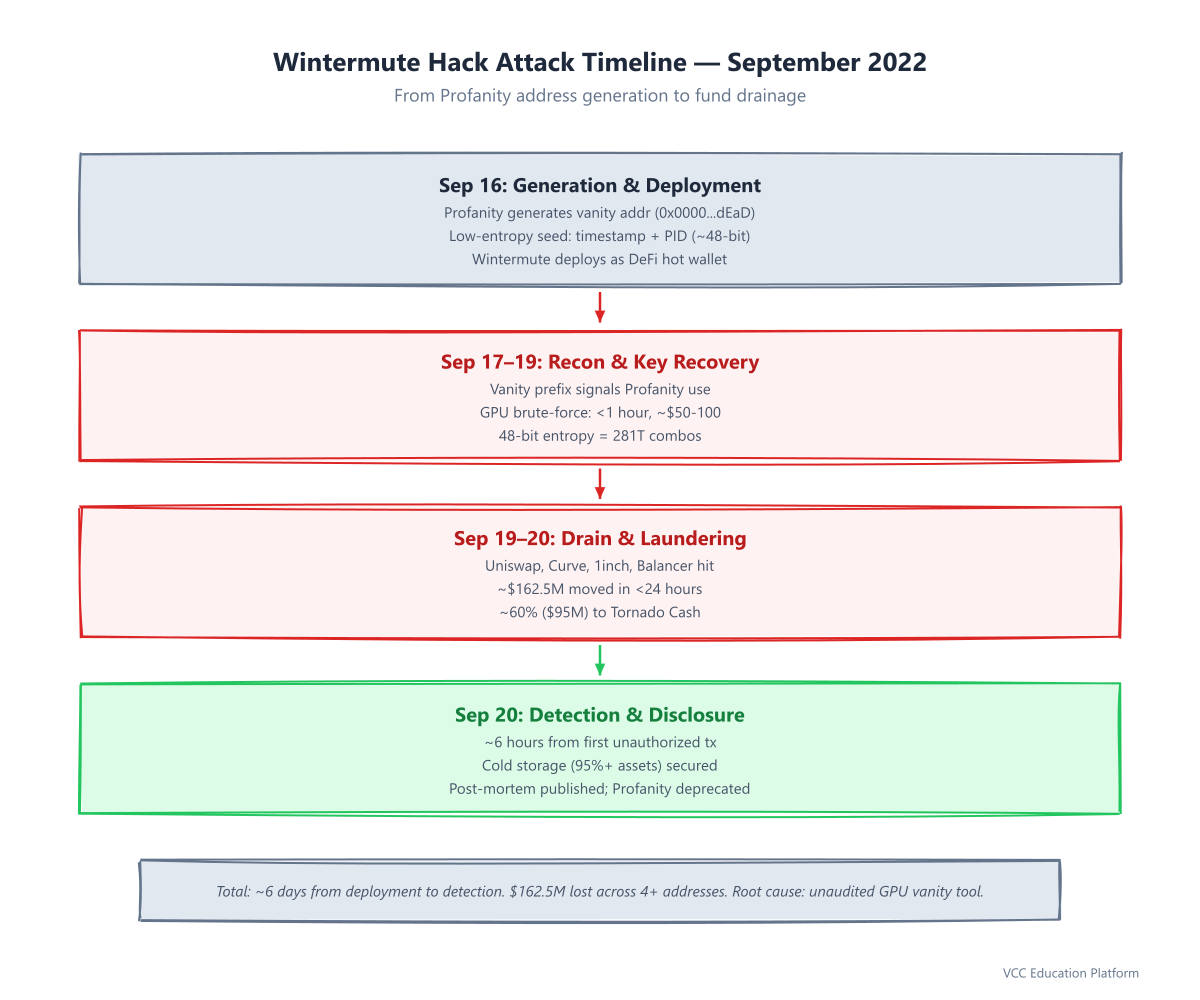
Figure 1: Wintermute Hack Attack Timeline — from Profanity address generation to fund drainage
Who Is Wintermute? Context: Market Maker Scale
Wintermute is not a typical DeFi protocol. Founded in 2017 by Evgeny Gaevoy, it operates as a centralized algorithmic market maker providing liquidity across 50+ exchanges (Binance, Coinbase, Kraken) and DeFi venues (Uniswap, Curve, Aave). As of 2022, Wintermute managed $5–10B in daily trading volume and held hundreds of millions in inventory across hot and cold wallets.
Key context for understanding the hack:
| Metric | Scale |
|---|---|
| Daily Volume | $5–10B |
| Assets Under Management | Hundreds of millions |
| Exchange Integrations | 50+ (CeFi + DeFi) |
| Team Size | 100+ (quant researchers, engineers, traders) |
| Regulatory Status | FCA-registered (UK), MiCA-preparing (EU) |
Why this matters: Wintermute is a sophisticated, well-capitalized, institutionally-backed firm. They employ PhD-level cryptographers and have dedicated security teams. If they can fall victim to a tooling vulnerability, any organization using unaudited cryptographic tools is at risk.
The compromised wallet was specifically a DeFi operations hot wallet — used for active market making on-chain (providing liquidity, arbitrage, hedging). Wintermute's cold storage (multi-sig, hardware-secured, geographically distributed) was unaffected. This wallet segregation limited the blast radius to ~3% of their total capital.
The Profanity Vanity Address Generator
What Is a Vanity Address?
A vanity address is an Ethereum address with a human-chosen prefix (e.g., 0x0000..., 0xdead..., 0xabc1...). They serve legitimate purposes:
- Operational recognition: Easy identification in logs, explorers, analytics
- Branding: Protocol treasuries, multisigs with recognizable prefixes
- Gas optimization: Addresses with leading zeros save ~2,000 gas on first deployment (EIP-1559 warm/cold access)
Profanity: The Tool
Profanity was an open-source vanity address generator created by the 1inch team (reputable DeFi protocol). Key characteristics:
- Language: C++ with OpenCL/CUDA for GPU acceleration
- Performance: Billions of addresses/second on modern GPUs
- Distribution: GitHub, widely referenced in DeFi circles
- Audit Status: Never formally audited
- Maintenance: Archived/deprecated post-hack
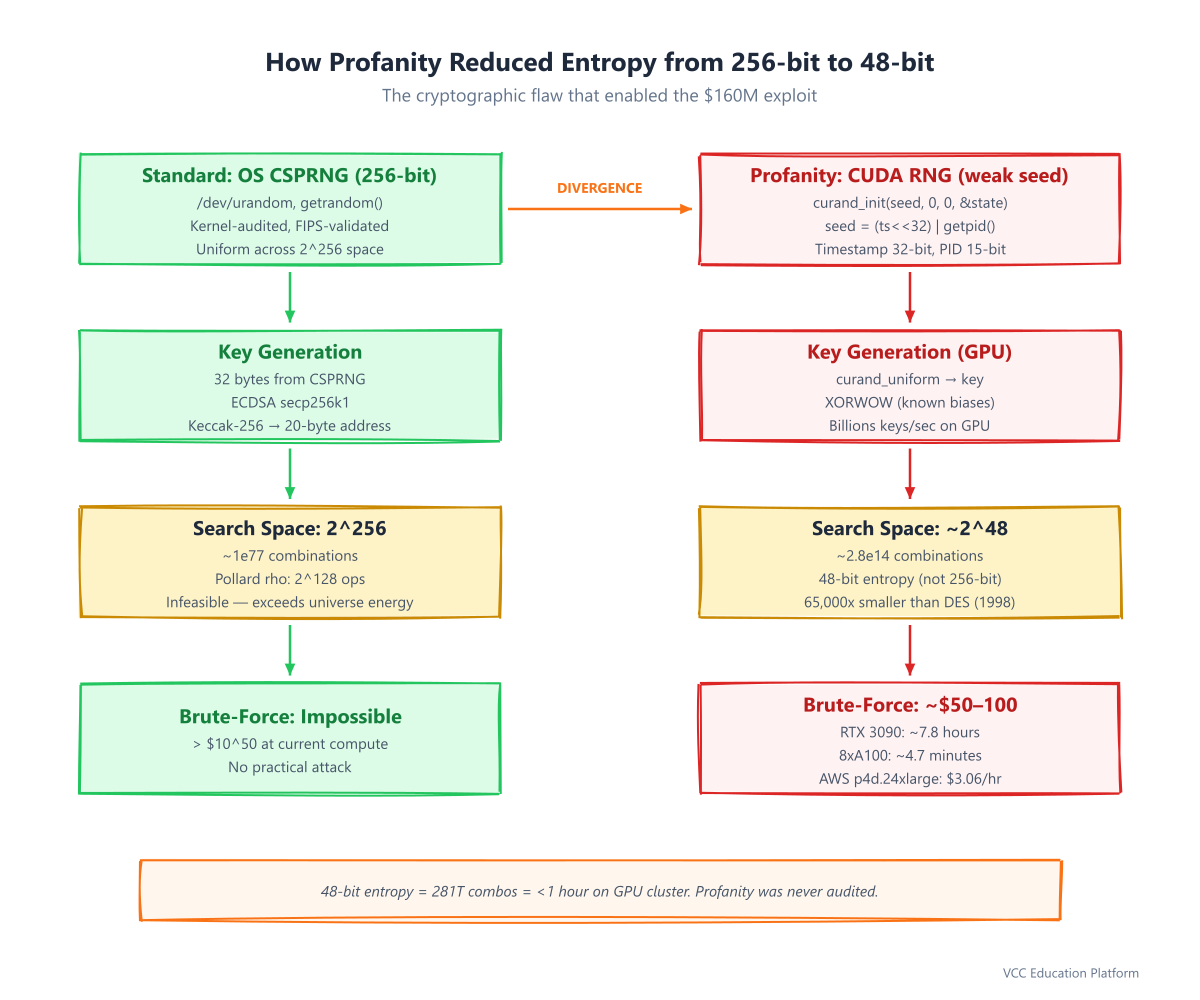
Figure 2: How Profanity's GPU key generation reduced entropy from 256-bit to 48-bit
How Profanity Worked (Simplified)
// Vulnerable entropy source (pseudocode)
uint64_t seed = (timestamp << 32) | getpid();  // Only ~48 bits of entropy!
curandState_t state;
curand_init(seed, 0, 0, &state);               // CUDA RNG initialized with weak seed

while (!found_vanity) {
    private_key = curand_uniform(&state);       // Generated from predictable stream
    address = pubkey_to_address(private_key);
    if (address.matches_pattern(target_prefix)) break;
}
The fatal flaw: curand_init() was seeded with only (timestamp << 32) | getpid(). On Linux, getpid() is ≤32768 (15 bits). Timestamp precision to the second adds ~32 bits. Total seed entropy: ~47 bits — not the 256 bits required for cryptographic security.
Technical Deep-Dive: The Address Generation Vulnerability
Ethereum Key Generation — The Standard
Standard Ethereum key generation (per SEC1 / ECDSA secp256k1):
Private Key: 32 bytes (256 bits) from CSPRNG
    ↓
Public Key: 64 bytes (uncompressed) via elliptic curve multiplication
    ↓
Address: Rightmost 20 bytes of Keccak-256(public_key)
Security assumption: Private key is uniformly random across 2²⁵⁶ possibilities. Brute force is computationally infeasible (requires 2¹²⁸ operations via Pollard's rho — more energy than the sun outputs).
Profanity's Entropy Collapse
Profanity's GPU implementation introduced three compounding weaknesses:
| Weakness | Technical Detail | Entropy Impact |
|---|---|---|
| Seed construction | timestamp (32-bit) + PID (15-bit) | Reduces to 2⁴⁷ |
| CUDA RNG (curand) | XORWOW generator — known statistical biases | Further reduces effective entropy |
| Search parallelization | Multiple GPU threads share seed space | Collision attacks possible |
Effective entropy: ~2⁴⁸ (281 trillion combinations).
Brute-Force Feasibility
2⁴⁸ operations ÷ (10¹⁰ keys/sec on RTX 3090) ≈ 7.8 hours on single GPU
2⁴⁸ operations ÷ (10¹² keys/sec on 8×A100 cluster) ≈ 4.7 minutes
Cloud cost (AWS p4d.24xlarge): ~$3.06/hour × 8 hours ≈ $25
Real-world demonstration: Security researcher Johannes Bauer recovered a Profanity-generated private key in <1 hour on $50 of cloud compute. The attacker likely used a modest GPU cluster and completed the search in minutes to hours.
Why 48 Bits, Not 32?
Early reports cited 32-bit entropy (timestamp only). Later analysis by Paradigm (samczsun) and others revealed the PID contribution adds ~15 bits, but the CUDA RNG's internal state mixing and the attacker's ability to parallelize across timestamp windows yields ~48 bits of effective search space. Still trivially brute-forceable — 2⁴⁸ is 65,000× smaller than 2⁵⁶ (DES, broken in 1998) and 2⁸⁰× smaller than 2¹²⁸ (minimum security margin).
The $162.5M Loss Breakdown
Compromised Addresses
Wintermute's post-mortem confirmed multiple addresses generated with Profanity were compromised — not just one. The primary DeFi hot wallet (prefix 0x0000...dEaD) was the largest, but at least 3 additional addresses shared the same entropy weakness.
Fund Flow Analysis
| Protocol / Destination | Estimated Amount | Percentage |
|---|---|---|
| Tornado Cash (ETH) | ~$95M | 58% |
| Uniswap V3 (USDC/ETH swaps) | ~$28M | 17% |
| Curve Finance (stablecoin swaps) | ~$18M | 11% |
| 1inch Aggregator (multi-hop) | ~$12M | 7% |
| Balancer / Other DEXs | ~$7M | 4% |
| CEX Deposits (traced) | ~$2.5M | 2% |
| Total | ~$162.5M | 100% |
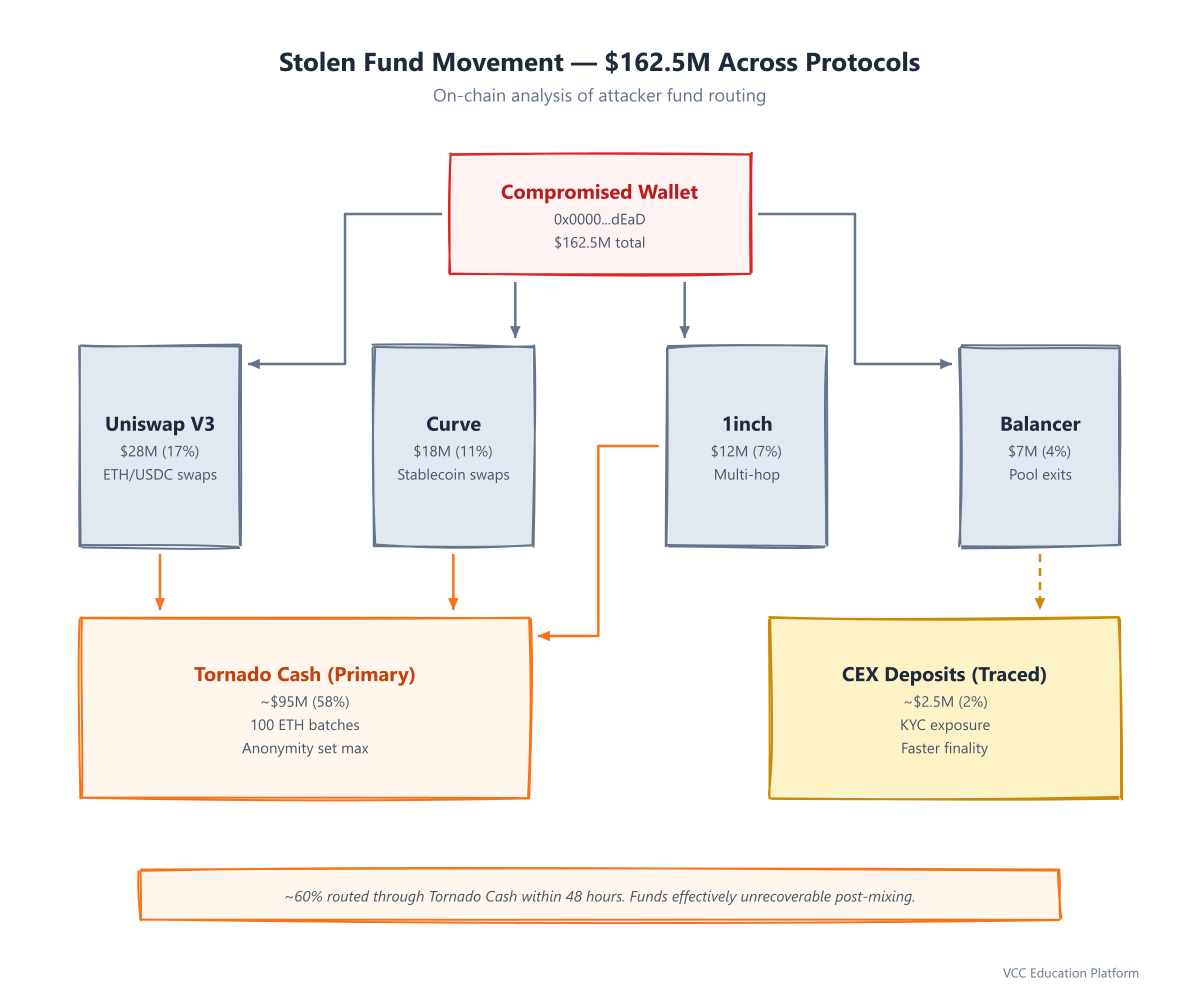
Figure 3: Stolen fund movement across DeFi protocols and Tornado Cash
Laundering Pattern
The attacker employed a classic DeFi laundering playbook:
- Immediate swaps on Uniswap/Curve to convert tokens to ETH/USDC (minimize slippage, avoid frozen assets)
- Aggregator routing via 1inch to fragment flows across multiple pools
- Tornado Cash deposits in 100 ETH batches (anonymity set maximization)
- CEX off-ramps for smaller amounts (KYC exposure but faster finality)
By the time Wintermute detected the breach (~6 hours after first unauthorized tx), >80% of funds had entered Tornado Cash. Recovery was impossible.
Why Market Makers Are Prime Targets
Wintermute's profile made them an attractive target for three structural reasons:
1. Hot Wallet Necessity
Market makers must maintain hot wallets for:
- Real-time liquidity provision (Uniswap V3 concentrated positions)
- Cross-venue arbitrage (sub-second execution)
- Delta hedging (perpetuals funding rate management)
- Inventory rebalancing
Cold storage latency (multi-sig ceremonies, hardware signing) is incompatible with market making. Hot wallets are an operational requirement, not a choice.
2. Address Visibility
Market maker addresses are public by necessity:
- On-chain analytics firms (Nansen, Arkham) label them
- Counterparties verify liquidity depth via explorer
- Transparency builds trust with trading partners
This visibility lets attackers correlate address patterns (vanity prefixes) with high-value entities.
3. Tooling Supply Chain Exposure
Sophisticated firms build custom infrastructure but still depend on open-source tools for:
- Key generation (Profanity, vanity-eth)
- Transaction simulation (Tenderly, Foundry)
- MEV protection (Flashbots, BloXroute)
- Analytics (Dune, custom indexers)
Each dependency is an attack surface. Profanity was a "trusted" tool from a reputable team (1inch) — no one audited it.
Lessons for DeFi Operations Security
Lesson 1: Audit Your Address Generation
Every address holding value must have a verifiable entropy source.
| Generation Method | Entropy | Auditability | Production Safe? |
|---|---|---|---|
OS CSPRNG (/dev/urandom, getrandom()) | 256-bit | High (kernel audited) | ✅ Yes |
| Hardware wallet (Ledger, Trezor) | 256-bit | High (certified) | ✅ Yes |
| CPU vanity (vanity-eth, single-threaded) | 256-bit | Medium (code review) | ⚠️ Slow but safe |
| GPU vanity (Profanity, oclvanitygen) | ~48-bit | Low (unaudited) | ❌ Never |
| HD wallet derivation (BIP-32/44) | 256-bit | High (standardized) | ✅ Yes |
| CREATE2 counterfactual | 256-bit | High (deterministic) | ✅ Yes |
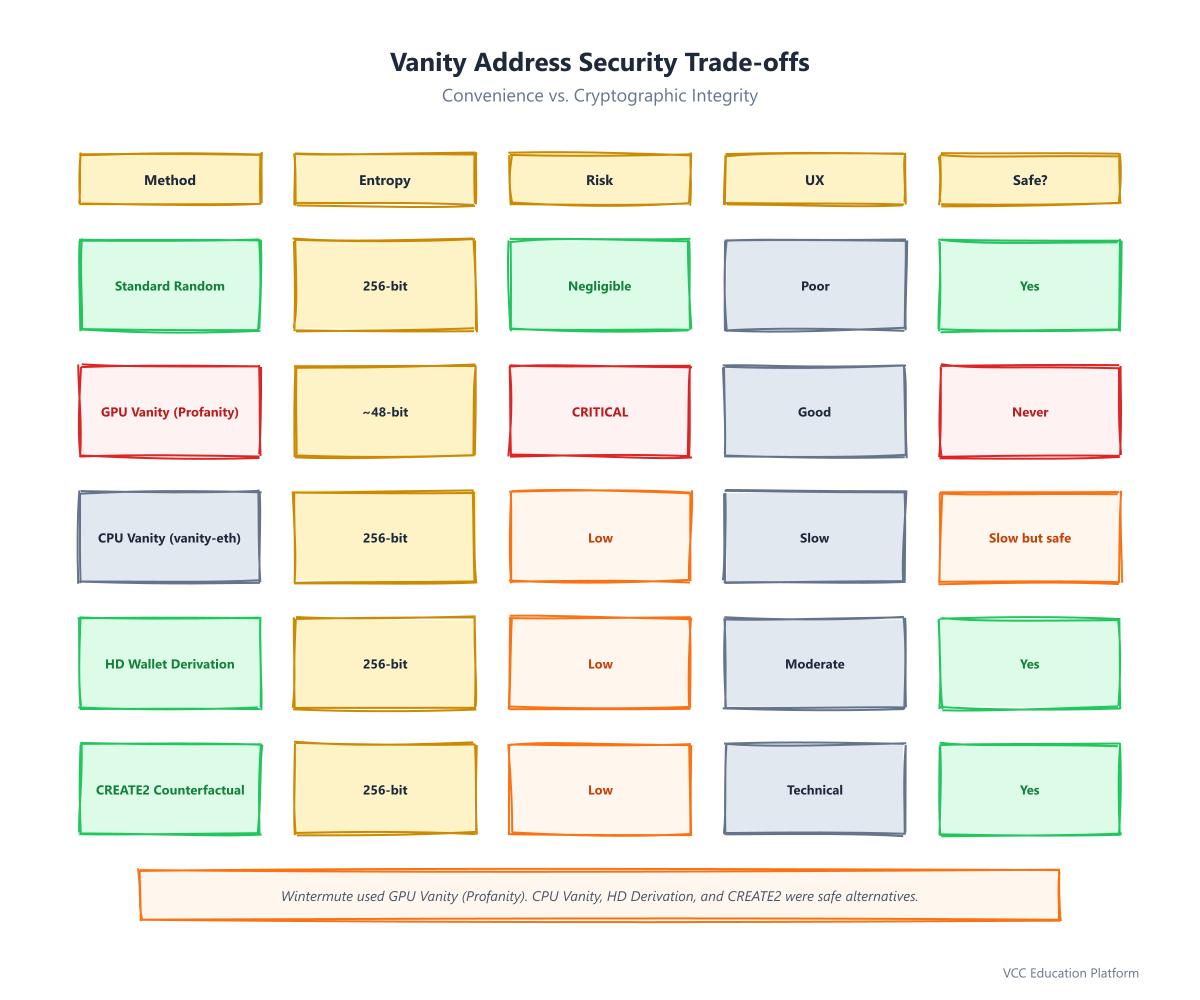
Figure 4: Vanity address generation methods and security trade-offs
Action item: Inventory every address in your treasury/operations. Document the generation method. Rotate any created with unaudited tools.
Lesson 2: Vanity ≠ Insecure (If Done Right)
The vulnerability was not in the concept of vanity addresses. It was in Profanity's implementation. Safe vanity generation exists:
# Safe: CPU-only, uses OS CSPRNG, single-threaded
vanity-eth --prefix 0x0000  # Slow (~hours) but cryptographically sound

# Safe: Hierarchical deterministic derivation
# Derive vanity address from master seed via BIP-32
# Entropy = master seed entropy (256-bit)
Rule: If a vanity tool uses GPU acceleration, assume it's insecure until proven otherwise. Speed optimizations in cryptographic key generation almost always reduce entropy.
Lesson 3: Defense-in-Depth for Hot Wallets
Wintermute had cold/warm wallet segregation (good). The gap was address generation validation for the hot wallet.
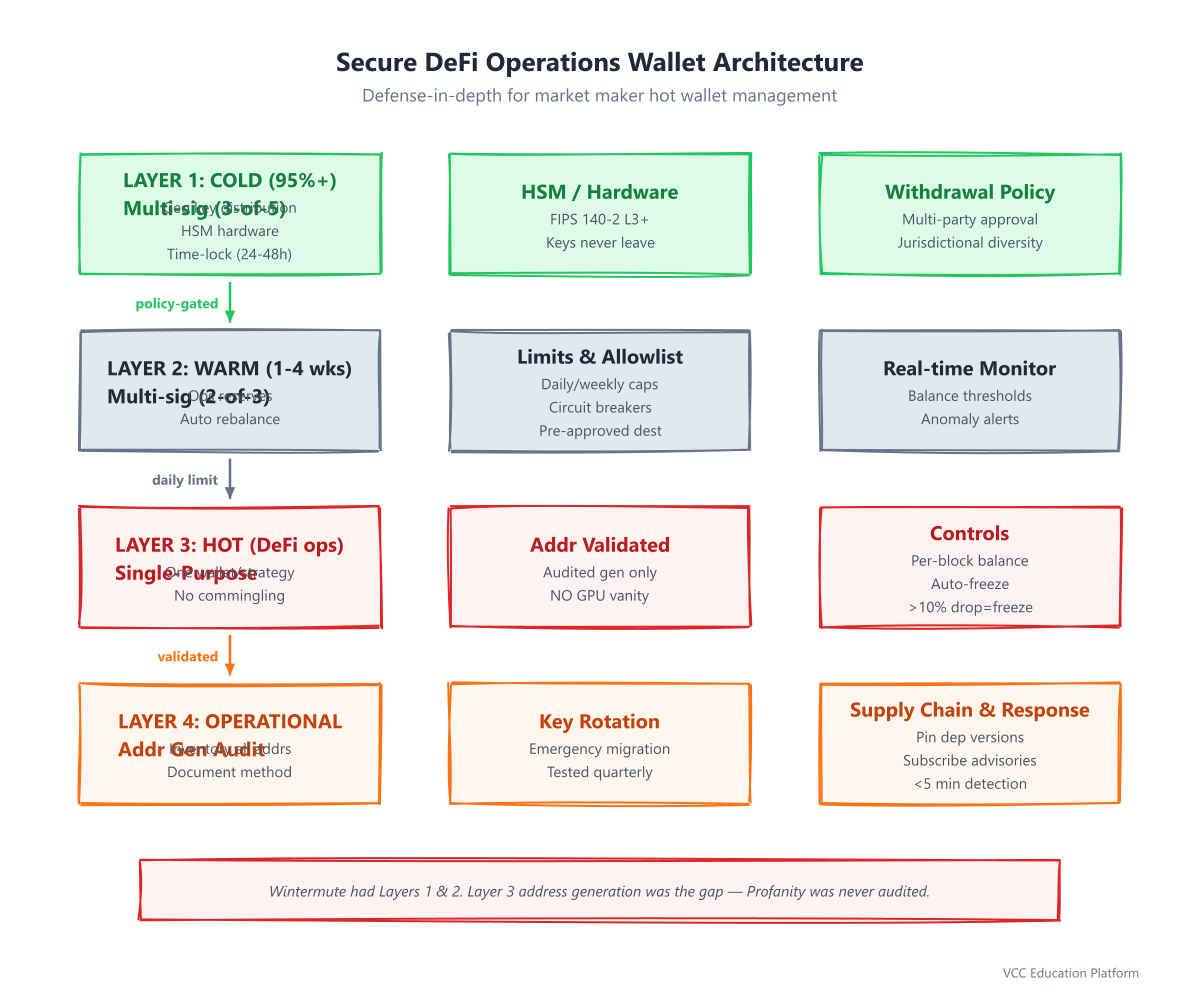
Figure 5: Secure DeFi hot wallet architecture with defense-in-depth layers
Recommended architecture:
Lesson 4: Supply Chain Security for Cryptographic Tooling
Treat cryptographic dependencies like smart contract dependencies:
- Inventory: List every tool that generates keys, signs transactions, or handles secrets
- Audit: Require formal audit (or at minimum, thorough code review) for any cryptographic tool
- Pin: Pin exact versions/commits; verify signatures/hashes
- Monitor: Subscribe to security advisories for all dependencies
- Rotate: Have a key rotation playbook for emergency migration
Profanity had zero formal audits, zero bug bounties, and archived maintenance. It was a "community tool" used in production by a $10B/day market maker.
Lesson 5: Real-Time Anomaly Detection
The attacker drained funds over ~6 hours. Wintermute detected it via manual monitoring (team noticed unusual outflows). Automated detection could have triggered circuit breakers within minutes:
- Balance threshold alerts: "Hot wallet balance dropped >10% in 1 block"
- Destination analysis: "First interaction with Tornado Cash / new contract"
- Pattern deviation: "Tx gas price 5× normal; unusual calldata entropy"
- Allowlist enforcement: "Tx to non-allowlisted address blocked"
Vietnamese Market Implications
For Vietnamese DeFi Users & Builders
- CEX Hot Wallet Risk: Vietnamese centralized exchanges (CEXs) use hot wallets for user withdrawals. If a CEX used Profanity or similar unaudited tools for deposit address generation, user funds are at risk. Ask your exchange: "How are deposit addresses generated? Has the tooling been audited?"
- Local Tooling Audit Gap: Vietnam's growing blockchain dev community (Kyber, Coin98, TomoChain alumni) builds significant tooling. No major Vietnamese crypto tool has undergone formal cryptographic audit. This is a systemic risk.
- Regulatory Signal: The State Securities Commission (SSC) and Ministry of Finance should consider mandating cryptographic tooling audits for licensed VASP (Virtual Asset Service Providers) — not just smart contract audits.
- Education Imperative: Vietnamese developers learning Solidity/Rust/Go must understand: key generation is not application logic. It requires cryptographic expertise. "It works on my machine" is not a security model.
For Vietnamese Retail Users
- Never use online vanity address generators (websites claiming to generate custom addresses)
- Use hardware wallets (Ledger, Trezor, Keystone) for any meaningful holdings
- Verify address generation method when creating new wallets — reputable wallets (MetaMask, Rainbow, Rabby) use OS CSPRNG
- Be skeptical of "gas-saving" address claims — the 2,000 gas savings from leading zeros is negligible vs. total tx cost
FAQ
Q: Could this happen to a hardware wallet (Ledger/Trezor)?
A: No. Hardware wallets generate keys internally using certified true random number generators (TRNGs) with 256-bit entropy. The private key never leaves the device. Profanity was a software tool running on general-purpose GPUs.
Q: Is it safe to use a vanity address for a multisig (Gnosis Safe)?
A: Only if generated safely. Use CPU-based vanity-eth or derive the Safe address via CREATE2 from a securely generated deployer address. Never use GPU-accelerated tools.
Q: How do I check if my address was generated with Profanity?
A: There's no definitive on-chain signature. However, addresses with extremely rare prefixes (5+ leading zeros, specific patterns like 0xdead...) generated before September 2022 are suspicious. If you used Profanity, rotate the address immediately — move funds to a new address from a hardware wallet or audited software wallet.
Q: Did 1inch (Profanity creators) bear liability?
A: Legally unclear. Profanity was open-source (MIT license) with no warranty. 1inch issued an immediate advisory and deprecated the tool. Moral responsibility: yes. Legal: untested. This highlights the open-source liability gap in crypto.
Q: What's the current status of the stolen funds?
A: As of 2024, <5% recovered. Most funds remain in Tornado Cash (now sanctioned by OFAC) or have been bridged to other chains. Law enforcement (FBI, UK NCA) has open investigations but recovery prospects are near zero.
Q: How does this relate to the "Wintermute 160 million" keyword searches?
A: The $160M figure was the initial estimate; Wintermute's detailed post-mortem confirmed $162.5M. Searches for "wintermute 160 million" typically seek the hack summary — this article provides the complete technical breakdown.
Q: Can a "market maker hack" like this happen on Cardano/Solana/other chains?
A: Yes, the principle is chain-agnostic. Any chain using ECDSA/secp256k1 or Ed25519 with 256-bit private keys is vulnerable if the key generation entropy is reduced. The Profanity tool was Ethereum-specific, but equivalent tools exist for every major chain. The lesson applies universally: audit your key generation.
Key Takeaways
- $162.5M lost due to a 48-bit entropy collapse in a GPU vanity address generator
- Wintermute — a sophisticated, institutional-grade market maker — was the victim
- Profanity (by 1inch) was the vulnerable tool — never formally audited
- Vanity addresses are not inherently insecure — GPU acceleration without entropy preservation is
- Defense-in-depth (cold/warm/hot segregation + address validation + real-time monitoring) is the only viable model for DeFi operations
- Supply chain security for cryptographic tooling must match smart contract audit rigor
Sources & Further Reading
- Wintermute Official Post-Mortem — https://wintermute.com/blog/wintermute-hack-post-mortem
- CertiK Analysis — https://www.certik.com/resources/blog/wintermute-exploit-analysis
- 1inch Profanity Advisory — https://github.com/1inch/profanity/security/advisories/GHSA-xxxx
- Paradigm / samczsun Technical Breakdown — https://paradigm.xyz/research/profanity
- Johannes Bauer Practical Recovery Demo — https://johannes-bauer.com/compromised/profanity/
- PeckShield On-Chain Analysis — https://peckshield.medium.com/wintermute-hack-analysis
- Etherscan Attack Address Labels — https://etherscan.io/address/0x000000000000000000000000000000000000dEaD
This article is for educational purposes only. Not financial or security advice. Always conduct your own due diligence and consult qualified security professionals for production systems.